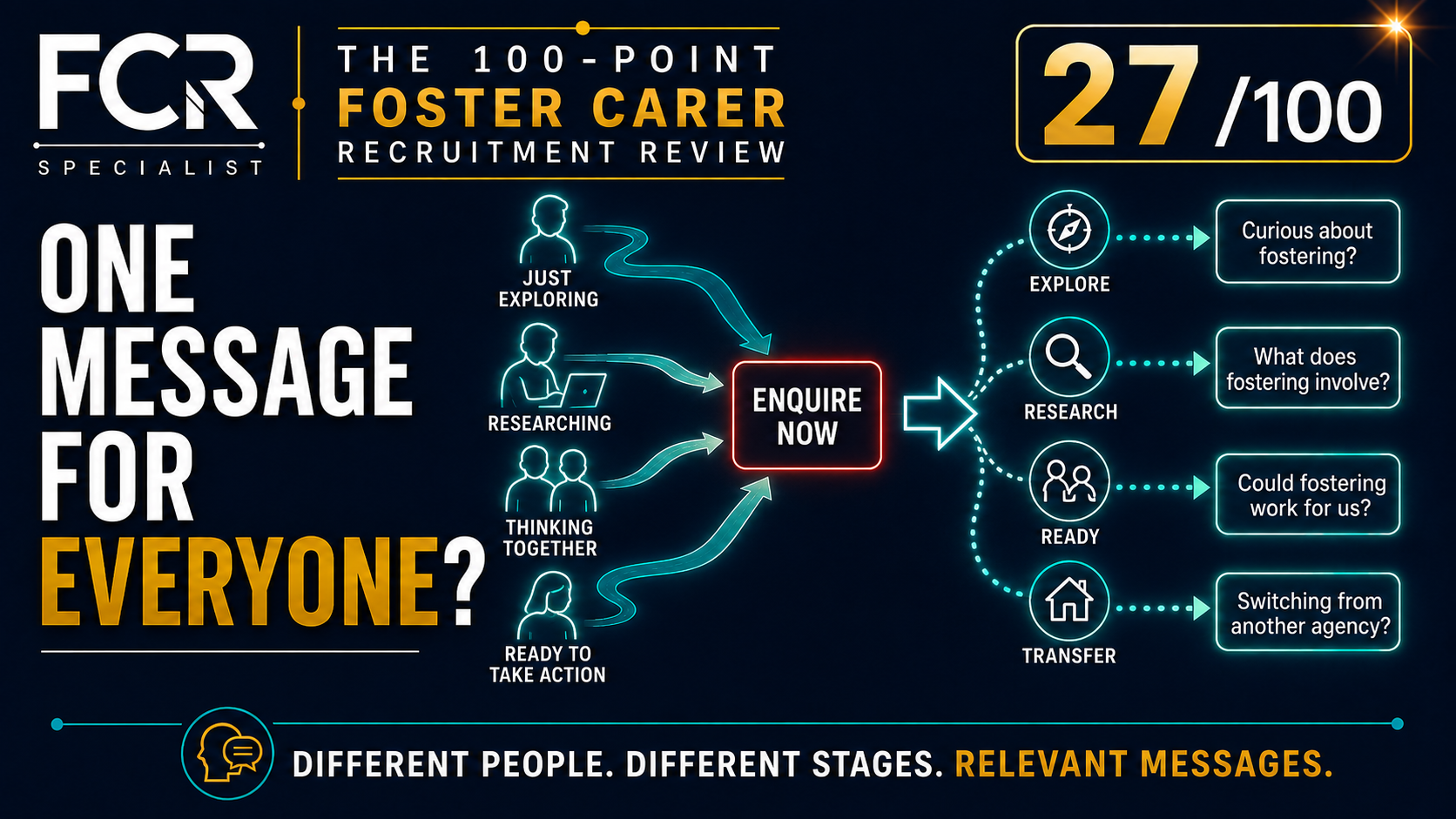
Are You Using One Message for Every Prospective Foster Carer?
Are You Using One Message for Every Prospective Foster Carer?
Point 27 of The 100-Point Foster Carer Recruitment Review
Imagine five people looking at your Foster Carer Recruitment advertising this evening.
The first has never seriously thought about fostering before.
Something in the advert catches their attention.
Their question is:
“Could I foster?”
The second has been considering fostering for several years.
Their children are getting older. Their circumstances are changing.
Their question is:
“Is now the right time?”
The third has already decided they probably want to foster.
They have looked at three Local Authorities and two Independent Fostering Agencies.
Their question is:
“Why should I foster with you?”
The fourth is already an experienced Foster Carer with another provider.
Their question might be:
“Would transferring actually improve anything?”
And the fifth fostered previously and is wondering whether to return.
Their question might be:
“Has fostering changed since I left?”
Five prospective Foster Carers.
Five completely different starting points.
And yet many Foster Carer Recruitment plans will send all five people to essentially the same place:
ENQUIRE NOW.
That is where Point 27 begins.
The right message can still be the wrong message at the wrong time
Point 26 looked at authenticity.
I argued that Foster Carer Recruitment should balance:
INSPIRATION + REALITY + SUPPORT.
But even excellent information can fail if it reaches somebody at the wrong stage.
Imagine approaching someone who has only just encountered fostering with:
“Start your fostering assessment today.”
They may not be ready.
They might simply want to know whether working automatically rules them out.
Or whether being single matters.
Or what fostering actually is.
Now consider someone who has researched fostering for two years.
Giving them another generic advert saying:
“Have you ever thought about fostering?”
may tell them nothing they do not already know.
Their questions are probably much further down the recruitment journey.
This is the distinction between having recruitment content and having a recruitment communication strategy.
The DfE evidence is unusually clear
The Department for Education's research into Foster Carer Recruitment and conversion rates makes an important observation:
a one-size-fits-all approach will not meet the needs and preferences of prospective Foster Carers.
The study discusses flexibility not only in the process itself but in how people make enquiries, how organisations communicate with them, when communication is available and the pace at which people progress.
Another DfE study — its behavioural-insights research into fostering and adoption — deliberately examined people at different points in the recruitment journey.
Those stages included people who were:
- interested but unsure
- considering
- researching
- applying
- withdrawing
- and ultimately fostering.
The research explored motivations, barriers, emotions and perceptions at different stages because those things do not necessarily remain constant throughout the journey.
That gives us a useful recruitment principle:
THE PERSON HASN'T CHANGED.
THEIR INFORMATION NEED HAS.
And Foster Carer Recruitment should be capable of recognising that.
This is what segmentation should mean
The word segmentation can make this sound like a marketing exercise.
Age 35–44.
Homeowner.
Married.
Children aged 12+.
Certain postcode.
Certain income.
Serve them advert A.
That is not the point I am making.
Demographic information can sometimes be useful.
Point 13 looked at geography and local population data.
Point 21 examined the household.
Point 24 established that the actual Foster Carer capacity required should influence recruitment activity.
But crude assumptions about people can become both inaccurate and counterproductive.
A 58-year-old and a 38-year-old could have exactly the same question.
Two married couples of the same age living in the same town can have completely different motivations, concerns and readiness to foster.
A single person may have a stronger support network than a couple.
Someone who works full time may have thought through fostering much more seriously than someone who has recently retired.
Good segmentation therefore asks more than:
Who are they demographically?
It asks:
WHERE ARE THEY IN THEIR DECISION?
That is behavioural or recruitment-stage segmentation.
And in Foster Carer Recruitment I believe it may often be more useful.
A simple segmentation model
Try dividing prospective Foster Carers into stages.
1. THE EXPLORER
They have encountered fostering.
Perhaps through:
an advert,
a Foster Carer they know,
a local event,
a news story,
social media,
their employer,
or somebody in their community.
Their question is not necessarily:
“How do I apply?”
It may simply be:
“Could I do this?”
They need:
accessible information,
reassurance that ordinary people foster,
basic eligibility information,
real Foster Carer stories,
simple answers,
and a low-pressure next step.
The call to action might therefore be:
Learn more.
Not necessarily:
Apply now.
2. THE CONSIDERER
They have moved beyond curiosity.
They are beginning to mentally insert fostering into their life.
Their questions become practical.
What about my job?
What about my children?
How much room do I need?
What is the financial position?
What kind of children need fostering?
How long does assessment take?
What support is provided?
This is where Points 21, 23, 25 and 26 start working together.
They need:
QUESTION → ANSWER → EVIDENCE → EXPERIENCE.
3. THE RESEARCHER
Now the person is comparing.
The DfE behavioural research found that people at the researching stage commonly went online first and could find the volume and fragmentation of fostering information difficult to navigate.
Their question has changed.
It may no longer be:
“Should I foster?”
It could be:
“WHO SHOULD I FOSTER WITH?”
This is where Point 23's proposition becomes critical.
Your generic message:
“Make a difference to a child's life”
may no longer differentiate you.
They want to understand:
support,
training,
culture,
finance,
respite,
matching,
therapeutic provision,
assessment,
timescale,
availability,
and what existing Foster Carers say about you.
This person may be much closer to an enquiry.
4. THE ACTIVE ENQUIRER
They have crossed an important psychological threshold.
They have given you their details.
Now advertising should begin giving way to recruitment.
Speed matters.
Human contact matters.
Consistency matters.
The DfE recruitment research places particular emphasis on relationship-building from initial enquiry onwards and notes the benefit of maintaining positive relationships even with people who are not yet ready to progress.
Their next question might be:
“What happens now?”
Your job is no longer simply attraction.
It is progression.
5. THE “NOT NOW”
This group is particularly important.
Somebody may be suitable for fostering.
Just not today.
Their children may be too young.
They may be moving house.
Their work circumstances may be changing.
They may be caring for a relative.
They might need another bedroom.
Their partner may not yet be ready.
The DfE recruitment research recognises that circumstances change and specifically discusses the importance of keeping communication channels open when people are not ready to proceed.
So why do so many recruitment systems treat:
NOT NOW
as:
NO?
This is exactly why I have argued throughout my work for structured nurture of prospective Foster Carers.
Today's “not yet” could become next year's applicant.
But only if you retain the relationship.
6. THE EXPERIENCED FOSTER CARER
Now consider somebody transferring from another provider.
Do they need an advert saying:
“Could you make a difference to a vulnerable child?”
They already foster.
They already know they can make a difference.
Their questions are different.
Why would I move?
Will the support actually be better?
What happens to my current placement?
How does transfer work?
Will you value my experience?
What is your allowance structure?
What is respite like?
How stable is your supervising social work team?
How do you handle allegations?
They require an entirely different proposition.
Treating a transferring Foster Carer as though they are a first-time enquirer wastes one of the strongest advantages they bring:
experience.
7. THE RETURNING FOSTER CARER
Someone who fostered ten years ago may be neither a new applicant nor a current Foster Carer.
Their barriers can be different again.
Why did they stop?
Have their circumstances changed?
Has the organisation changed?
What would need to be different this time?
What previous experience remains relevant?
Again:
different stage,
different questions,
different conversation.
This does not mean creating 47 different campaigns
Segmentation can become ridiculous if taken too far.
The solution is not to create a completely different website for every conceivable prospective Foster Carer.
It is to make the recruitment journey responsive enough that people can find the information relevant to them.
Perhaps your website asks:
Where are you in your fostering journey?
- I'm just exploring
- I want to know whether I could foster
- I've been thinking about fostering for a while
- I'm ready to talk
- I already foster and I'm considering transferring
- I've fostered before
- I enquired previously but wasn't ready
That one design decision changes the conversation.
Instead of forcing everyone through the same funnel, you begin meeting them where they are.
HERE IS THE TEST
Take your current advertising.
Your website.
Your information pack.
Your email follow-ups.
Your events.
Your enquiry scripts.
Then ask:
WHO EXACTLY IS THIS FOR?
If the answer is:
“Anyone who might foster,”
you may not yet have a sufficiently defined recruitment message.
Now ask:
What does this person already know?
What are they likely to be trying to understand?
What is stopping them moving forward?
What information would genuinely help them?
What is the appropriate next action?
A useful framework is:
PERSON → STAGE → QUESTION → MESSAGE → NEXT ACTION
Not:
AUDIENCE → ADVERT → ENQUIRE NOW.
The call to action should change too
This is often overlooked.
We segment the advert.
Then send everybody to the same button.
ENQUIRE NOW.
But people need different levels of commitment.
An early explorer might want:
Read a Foster Carer's story.
A considerer might want:
See whether you could foster.
A researcher might want:
Compare our support.
Someone almost ready might want:
Book an informal call.
A transfer Foster Carer might want:
Have a confidential conversation.
These are all recruitment actions.
Not every useful action has to be a formal enquiry.
That matters because the DfE behavioural research describes how, for some people, moving from online research straight into organisational contact can feel like a significant leap.
Good recruitment creates smaller bridges.
There is another strategic reason for doing this
In February 2026, the Government's Renewing fostering programme set out England-wide recruitment action alongside enhanced regional collaboration and an ambition to expand foster care substantially.
Government communication around the reforms has also emphasised reaching a broader range of people who might consider fostering.
That makes segmentation more important, not less.
A larger national or regional campaign can increase awareness.
But the broader the audience, the greater the danger of assuming everyone who responds is at the same point.
National awareness does not remove the need for local recruitment intelligence.
It increases it.
Segmentation should ultimately connect to sufficiency
And this brings us back to Point 24.
We are not recruiting abstract applicants.
We need particular Foster Carer capacity.
If an organisation needs more Foster Carers able to support sibling groups, teenagers or children within a specific locality, then its recruitment strategy should ultimately create communication relevant to people who could realistically provide that capacity.
But again, relevance is different from stereotyping.
The question isn't:
“What demographic do we think fosters teenagers?”
It is:
“What experience, circumstances, motivation, support and information might enable someone to consider fostering teenagers?”
That is a much more sophisticated recruitment question.
Foster Carer Recruitment is a conversation
Perhaps this is the simplest way to understand Point 27.
Good conversation changes depending on what the other person says.
If somebody says:
“I've never really considered fostering before…”
we respond one way.
If they say:
“I've been researching for two years…”
we respond differently.
If they say:
“I've fostered for twelve years but I'm unhappy with my current agency…”
the conversation changes completely.
Nobody would conduct those three telephone conversations using exactly the same script.
So why would we conduct the marketing conversation that way?
THE TEST FOR POINT 27
Take each major piece of Foster Carer Recruitment content and ask:
Who is this for?
Then:
Where are they in their journey?
Then:
What question does it answer?
Then:
What should they logically do next?
If we cannot answer those four questions, the communication may be filling a marketing calendar rather than moving a recruitment strategy forward.
The principle is simple:
DIFFERENT PEOPLE.
DIFFERENT STAGES.
DIFFERENT QUESTIONS.
RELEVANT MESSAGES.
And once we know who we want to talk to and what we want to say, the next question becomes obvious:
WHERE SHOULD WE SAY IT?
That takes us directly to: