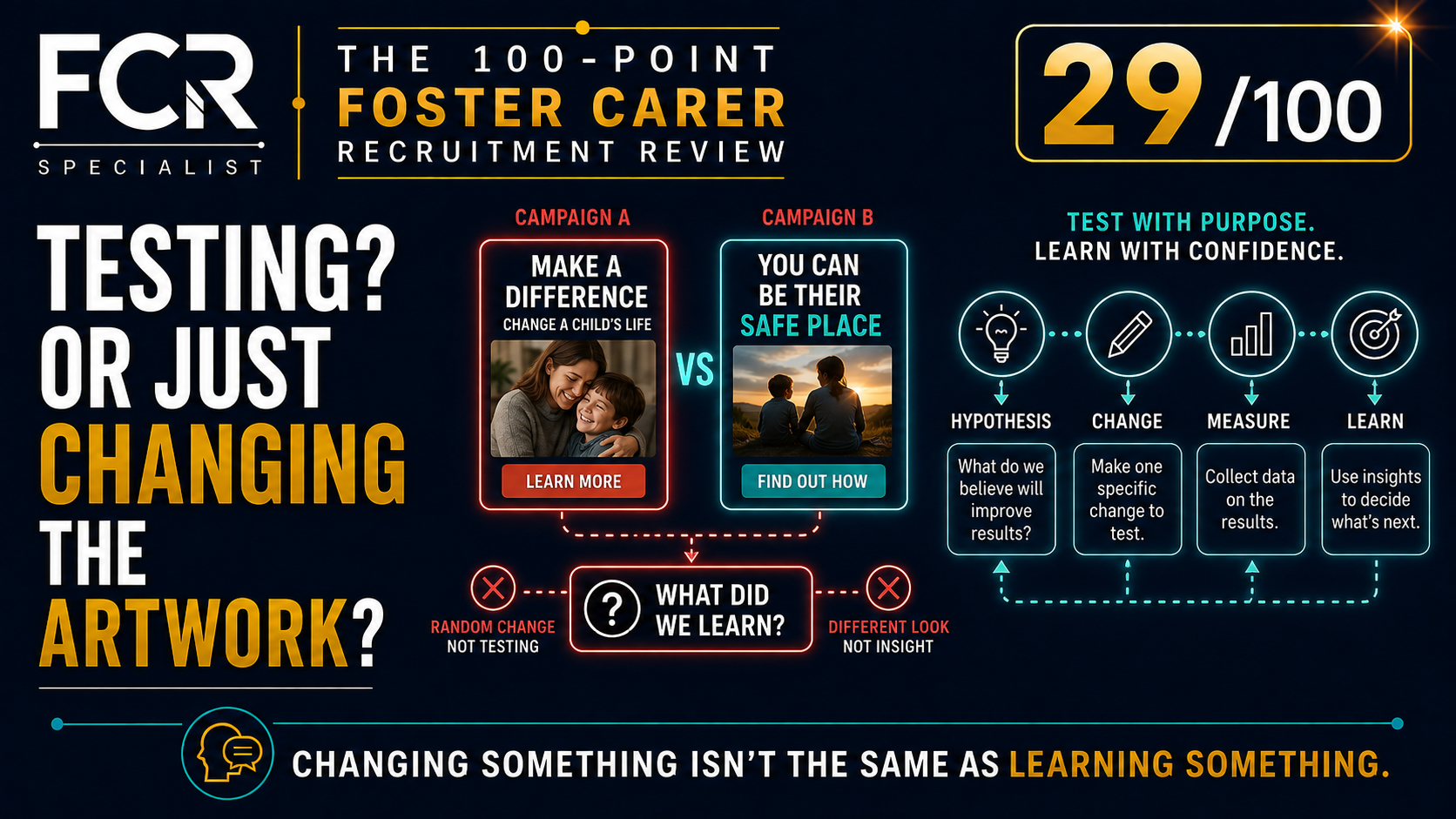
Are You Testing Your Recruitment Marketing — or Just Changing the Artwork?
Are You Testing Your Recruitment Marketing — or Just Changing the Artwork?
Point 29 of The 100-Point Foster Carer Recruitment Review
Imagine this conversation.
Foster Carer Recruitment enquiries are down.
Someone asks:
“What should we do?”
And the response is:
“We need some new creative.”
A designer is briefed.
The photograph changes.
The headline changes.
The colour changes.
Perhaps the wording changes.
A new Facebook campaign starts.
Three weeks later somebody asks:
“Is it working?”
And that is where things become interesting.
Because what exactly did we test?
The photograph?
The headline?
The audience?
The proposition?
The budget?
The targeting?
The geography?
The time of year?
The landing page?
The call to action?
The channel?
Or all of them simultaneously?
If everything changed, even a successful result can leave us knowing surprisingly little.
CHANGING THE CAMPAIGN IS NOT THE SAME AS TESTING THE CAMPAIGN.
That distinction is Point 29.
From Point 28: every channel needs a job
Point 28 asked:
Why is this channel in the plan?
We established:
PAID SOCIAL IS A TOOL.
IT IS NOT A RECRUITMENT STRATEGY.
And:
EVERY CHANNEL NEEDS A JOB.
But once we've selected a channel deliberately, we need to start learning how to use it better.
That means testing.
Not random change.
Not creative churn.
Not:
“This one feels fresher.”
Testing.
Start with a question, not another picture
Good experimentation begins with a problem.
For example:
Our adverts are receiving attention but very few people visit the website.
Or:
People reach our fostering page but very few make an enquiry.
Or:
We generate many enquiries but few are appropriate for our actual sufficiency requirement.
Or:
We are receiving general fostering enquiries but almost none from the particular geography we need.
Or:
People enquire but disappear before the first substantive conversation.
Each is a different problem.
And therefore each requires a different test.
Government A/B testing guidance makes this principle explicit: identify the problem, construct a hypothesis, create a control and a variation and then compare the outcomes. HMRC's experimentation work similarly starts with evidence about the problem and defines in advance what success should look like.
That gives us a practical Foster Carer Recruitment version:
HYPOTHESIS → CONTROLLED CHANGE → MEASUREMENT → LEARNING → DECISION
HYPOTHESIS
What do we think is happening?
Not:
“The advert isn't very good.”
That's an opinion.
Something more useful might be:
“We believe our current headline is attracting people interested generally in helping children but is not explaining clearly enough that we are recruiting Foster Carers for teenagers.”
Now we have something we can test.
CONTROLLED CHANGE
Change something deliberately.
Perhaps:
Version A:
Could You Foster?
Version B:
Could You Foster a Teenager Who Needs Stability, Patience and Someone in Their Corner?
Same geography.
Same audience.
Similar budget.
Same landing page.
Same period where reasonably possible.
Now the headline is the principal variable.
It will never be perfectly controlled in the real world.
But it is considerably more informative than changing everything.
MEASUREMENT
Decide what success means before looking at the result.
Clicks?
Maybe.
Enquiries?
Better.
Qualified enquiries?
Better again.
Applications?
Potentially much more meaningful.
Applications capable of meeting the particular sufficiency requirement?
Now we're getting somewhere.
This is crucial because a recruitment test can apparently succeed at the top of the funnel and fail further down.
HMRC's published experimentation approach makes the same general point: it uses primary and secondary measures so that an apparent improvement in one part of a service is not accepted without considering possible negative effects elsewhere in the user journey.
For Foster Carer Recruitment that principle matters enormously.
More clicks do not automatically mean better recruitment.
LEARNING
What did the test actually tell us?
Perhaps Version B received:
fewer clicks,
but more appropriate enquiries.
Is that failure?
Not necessarily.
Perhaps the audience narrowed.
The message filtered.
The people who responded understood more clearly what was being asked.
That's learning.
Alternatively, perhaps the highly specific headline reduced response dramatically and produced no improvement in quality.
That's learning too.
One of the most valuable principles in Government's A/B testing guidance is that a variant performing worse than the original is not necessarily a failed experiment: the organisation has learned something that can inform the next iteration.
That mindset matters.
Because organisations that regard every unsuccessful test as failure tend to stop experimenting.
They return to what feels familiar.
DECISION
Finally:
What are we going to do differently because of what we learned?
Keep the original?
Adopt the new version?
Test another proposition?
Change audience?
Change channel?
Investigate something further?
Stop spending?
Increase spending?
If the test produces a PowerPoint slide but no decision, the learning has not yet reached the recruitment strategy.
What can Foster Carer Recruitment actually test?
Quite a lot.
HEADLINE
Compare:
Make a Difference — Foster With Us
with something much more specific.
Does specificity affect:
attention,
enquiry volume,
or enquiry quality?
PROPOSITION
Point 23 established:
CLAIM → PROOF → EXPERIENCE
Perhaps the existing campaign says:
“Excellent support.”
Test a more tangible proposition:
“Speak to a Foster Carer before you decide whether fostering is right for you.”
Does proof outperform generic claim?
QUESTION-LED CONTENT
Point 25 established:
QUESTION → ANSWER → EVIDENCE → EXPERIENCE
Compare a generic myth-busting advertisement with:
Can I Foster if I Work Full Time?
Does answering the actual question produce different behaviour?
REALITY VERSUS GENERIC REWARD
Point 26 asked whether marketing shows only the reward.
Test an inspirational generic Foster Carer story against a more balanced lived-experience story.
Not to prove one is universally “better”.
To learn which works for:
which audience,
at which stage,
for which objective.
SEGMENTATION
Point 27 gave us:
PERSON → STAGE → QUESTION → MESSAGE → NEXT ACTION
Does an advert specifically designed for people already researching fostering outperform generic awareness messaging when shown to a high-intent audience?
CHANNEL
Point 28 gave us:
AUDIENCE → PURPOSE → CHANNEL → ACTION → OUTCOME
Perhaps two channels appear to produce similar enquiry volumes.
What happens later?
The DfE's Foster Carer Recruitment and Conversion Rates research specifically suggested breaking conversion data down by recruitment channel and said understanding which methods produce enquiries that lead to applications could inform future strategy.
That's testing at a strategic level.
CALL TO ACTION
Compare:
ENQUIRE NOW
with:
BOOK AN INFORMAL CHAT
or:
FIND OUT IF YOU COULD FOSTER
or:
HEAR FROM A LOCAL FOSTER CARER
Different calls to action imply different levels of commitment.
Point 27 already established why that matters.
LANDING PAGE
An advert can work beautifully and still fail if the person lands on the wrong page.
Is the advertisement about:
fostering teenagers,
but the click goes to a generic home page?
Is it aimed at transfer Foster Carers but takes them to:
“What is fostering?”
Changing the advert again will not repair the landing-page mismatch.
FORMAT
Image?
Video?
Foster Carer talking directly to camera?
Animation?
Long copy?
Short copy?
Don't decide based purely on internal preference.
Test where feasible.
GEOGRAPHY
Perhaps one message works well in one locality and poorly in another.
That might reflect:
population,
local awareness,
competition,
housing,
existing Foster Carer networks,
community structure,
or simply chance.
Do not jump immediately to a conclusion.
Investigate.
The biggest danger: changing five things simultaneously
This happens constantly in marketing.
Campaign One:
blue design,
generic headline,
broad audience,
Facebook,
home-page landing,
£50 daily spend.
Campaign Two:
photograph,
new headline,
different audience,
Facebook and Instagram,
new landing page,
£100 daily spend.
Campaign Two performs better.
The conclusion:
“The photograph worked.”
Did it?
There is no way to know.
Maybe the audience was better.
Maybe doubling the spend made the difference.
Maybe the landing page mattered.
Maybe the headline mattered.
Maybe it was school holidays.
Maybe competitor activity stopped.
Maybe a national fostering story appeared in the news.
This is why HMRC's published guidance highlights the problem of external factors such as deadlines or time of year when trying to understand whether a design change actually caused an apparent improvement.
Real-world Foster Carer Recruitment contains even more noise.
So we need humility.
Foster Carer Recruitment has a testing problem: volume
There is an important qualification.
True A/B testing relies on adequate numbers.
Government guidance explicitly notes that experimental tests can require substantial user volumes to produce statistically reliable conclusions.
Many fostering services simply don't have those numbers.
An individual Local Authority might generate only a modest number of genuine recruitment interactions during a test period.
Divide those between:
two adverts,
three audiences,
four geographical areas,
and multiple channels,
and the resulting numbers can become far too small to justify confident statistical claims.
So I am not proposing that every fostering service suddenly behaves like a major ecommerce business running hundreds of simultaneous randomised experiments.
That would create false precision.
The principle should instead be:
BE AS CONTROLLED AS PRACTICALLY POSSIBLE.
And:
BE HONEST ABOUT WHAT THE DATA CAN AND CANNOT TELL YOU.
Testing without pretending certainty
Where volume is low, combine evidence.
For example:
Quantitative evidence might tell you:
Version B produced more enquiries.
Recruitment evidence might tell you:
those enquiries were noticeably better aligned with your requirements.
Qualitative evidence might tell you:
people understood the message more clearly.
Website evidence might show:
people spent longer exploring relevant information.
Recruiter feedback might show:
people asked more informed questions.
Prospective Foster Carer feedback might reveal:
“That particular story was what made me think I could do it.”
None individually proves causation.
Together, they can produce useful recruitment intelligence.
This is exactly why the DfE's recruitment research warned against relying on conversion rates in isolation and stressed the importance of contextual and qualitative information alongside numerical measures.
That is a far more appropriate testing philosophy for many fostering services.
The Foster with North East evaluation shows why this matters
The interim evaluation of Foster with North East provides a useful real-world illustration.
The evaluation tracked not simply enquiry totals but differences in readiness to apply and recruitment source.
Up to December 2024, 59.3% of Hub enquirers said they were ready to apply, while 40.7% required more information. Among those who eventually gained approval, 83.9% had initially described themselves as ready to apply.
The same monitoring data showed markedly different progression patterns according to how people heard about the Hub. Word-of-mouth enquiries were substantially less likely to become closed contacts than social-media enquiries in that particular dataset.
That does not prove:
word of mouth good, social media bad.
It is one regional programme, at one stage of implementation, using a particular dataset.
But it demonstrates something extremely important for Point 29:
DON'T JUST COUNT THE RESPONSE.
FOLLOW THE RESPONSE.
If a campaign generated 1,000 leads but almost all disappeared, that tells us something.
If another generated 100 and a significant proportion progressed, that tells us something different.
And then we investigate why.
Testing needs recruitment involved — not just marketing
This is another organisational issue.
Suppose the marketing department runs the advertising.
They see:
impressions,
clicks,
cost per click,
lead forms.
They optimise accordingly.
The recruitment team sees:
who answered the telephone,
who could be contacted,
what questions they asked,
whether they were within geography,
whether fostering was realistic,
whether they progressed.
The social workers later see:
applications,
assessment,
withdrawals,
suitability,
approval.
If those three parts of the system do not share information, marketing cannot properly learn.
A campaign could look excellent in Meta's dashboard and poor in the recruitment system.
Or the reverse.
This is why Foster Carer Recruitment has to operate end-to-end.
Test the process too
And this Point should not stop with advertising.
Sometimes we keep changing the marketing because that is the easiest thing to change.
But perhaps the marketing isn't the problem.
Test:
speed of first response;
evening contact;
telephone versus email follow-up;
information-event timing;
booking methods;
initial-visit availability;
follow-up after “Not Now”;
Foster Carer involvement;
the information provided after enquiry.
The DfE's research found that services collect much more information later in recruitment than at enquiry stage, and that data is not always fully utilised because of resource or engagement constraints. It recommended improving how recruitment data is collected, analysed and used.
So before commissioning another advert, ask:
ARE WE SURE THE ADVERT IS THE PROBLEM?
That question sits at the heart of my whole approach to the 100-Point Review.
Regional hubs should increase our ability to learn
There is a potentially significant opportunity here.
Regionalisation increases scale.
Scale creates larger datasets.
Larger datasets can make comparison and testing more meaningful.
The DfE's 2026 end-to-end fostering hub specification now requires transparent monitoring from enquiry through applications and approvals to placement outcomes and retention, describing the intention as a data-driven approach supporting continuous improvement. Participating hubs are also expected to provide regular data to DfE so progress can be monitored.
That should create an opportunity to move beyond:
“We ran a campaign and got 487 leads.”
towards:
“We tested this approach against that approach, here is what happened across the recruitment journey, and here is what we are changing as a result.”
That is a far more mature recruitment system.
But there is also a risk.
Regional scale can magnify bad assumptions just as easily as good ones.
Spending £10,000 on an untested assumption is one thing.
Pooling regional budgets and spending £100,000 on it is another.
Scale should increase the requirement for disciplined learning.
Not reduce it.
Create a testing register
Here's a very practical idea.
Create a simple Foster Carer Recruitment testing register.
For every meaningful test record:
THE PROBLEM
What are we trying to improve?
THE HYPOTHESIS
What do we believe?
THE CHANGE
What exactly are we changing?
THE MEASURE
What will we look at?
THE RESULT
What happened?
THE LIMITATIONS
What else might have influenced the result?
THE LEARNING
What do we think we learned?
THE DECISION
What will we now do?
Suddenly organisational knowledge stops disappearing when:
a marketing officer leaves,
an agency contract ends,
a recruiter changes role,
or the next annual campaign begins.
Instead of restarting every year, the recruitment strategy accumulates knowledge.
HERE IS THE TEST
Ask your Foster Carer Recruitment team:
WHAT WERE THE LAST FIVE THINGS WE TESTED?
Not:
“What campaigns did we run?”
What did we test?
What hypothesis did we begin with?
What changed?
What stayed the same?
What happened?
What did we learn?
What did we do differently afterwards?
If nobody can answer those questions, the organisation may be producing activity rather than building recruitment intelligence.
Because the real value of testing isn't simply finding a winning advert.
It is becoming:
BETTER AT RECRUITING FOSTER CARERS EVERY TIME WE DO IT.
That is organisational learning.
And that leads directly to the final Point in Stage Three.
Because there is one enormous problem with testing.
You can only optimise what you choose to measure.
If your definition of success is:
clicks,
leads,
or enquiries,
you may become extremely good at generating something that isn't your real objective.
Which takes us to: