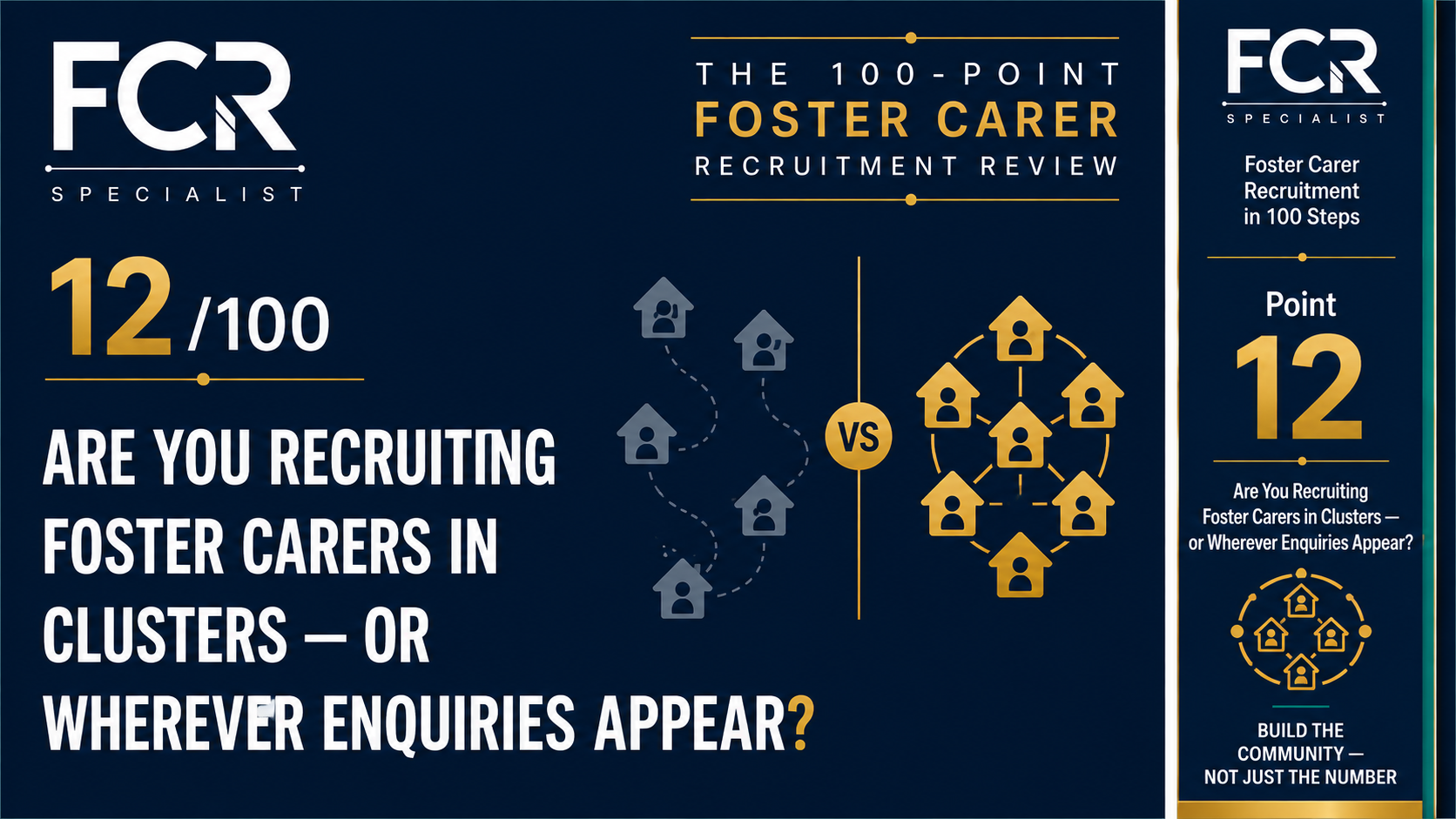
Point 12/100 Are You Recruiting Foster Carers in Clusters — or Wherever Enquiries Appear?
Point 12/100 — The 100-Point Foster Carer Recruitment Review
Here is the question I want fostering providers to consider:
If you could choose exactly where your next 20 Foster Carers lived, would you deliberately put them in 20 completely unrelated locations?
One here.
Another 17 miles away.
Another on the opposite side of the county.
Three around one town.
One 25 miles north.
Another 30 miles south.
Probably not.
If you genuinely had the ability to choose, you would surely at least consider whether some of those new fostering households would be more useful — both operationally and socially — if they were relatively close to one another.
And yet that is often not how Foster Carer Recruitment works.
We advertise.
Enquiries arrive.
We qualify them.
Assessments begin.
People are approved.
And eventually, when we look at the map, wherever they happened to live has become our Foster Carer geography.
That is the issue behind Point 12.
POINT 11 ASKED WHAT. POINT 12 ASKS WHERE.
In Point 11 we established that:
"We need more Foster Carers"
is not yet a sufficiently detailed recruitment requirement.
We need to understand which sufficiency gaps we are trying to fill.
Point 12 advances the question.
Once we know what kind of capacity we want to build:
Where would we ideally like that capacity to exist?
This matters because sufficiency itself has a geographic dimension.
The Department for Education and Ofsted's July 2026 work on children's social care sufficiency emphasises that sufficiency is not simply about how many places theoretically exist. Location matters, and children can be placed further from home where appropriate provision is unavailable locally.
The Government's 2026 end-to-end fostering hub programme goes further still. It states that regional Foster Carer Recruitment should use improved data and planning so homes are created where children need them, enabling more children to remain in their schools where that is right for them.
So geography is already part of the national policy discussion.
I think it should also become a much more deliberate part of recruitment planning.
FROM RECRUITMENT AREA TO RECRUITMENT CLUSTER
Most fostering providers already have a recruitment area.
It might be:
- a whole county;
- several neighbouring Local Authorities;
- a 30-mile radius around an office;
- a collection of postcodes;
- an operational region;
- or, for larger IFAs, multiple regions across England.
But a recruitment area and a recruitment strategy are not the same thing.
"Kent" is an area.
"West Yorkshire" is an area.
"Within 50 miles of our office" is an area.
None of those tells me where you particularly want your next Foster Carers to live.
I want to introduce a smaller unit of recruitment planning:
THE FOSTER CARER CLUSTER
My working concept is to consider deliberately developing local clusters of perhaps 10–20 Foster Carer households where practical.
Let me be very clear about that number.
10–20 is not a Government target.
It is not a regulatory requirement.
It is not a Mockingbird specification.
It is an FCR Specialist recruitment-planning concept.
Nor am I suggesting that every fostering household in Britain should somehow be placed into neat groups of twenty.
Geography, rurality, specialist need and existing provision will all affect what is practical.
The principle is simpler:
Stop allowing Foster Carer geography to be entirely accidental.
WHAT MIGHT A CLUSTER CHANGE?
Imagine you already have eight Foster Carer households within and around a particular town.
Now suppose the area also fits your sufficiency requirements.
Instead of running advertising evenly across an entire county, why not ask:
Could this become a deliberate growth area?
Could eight become twelve?
Could twelve become fifteen?
Could fifteen eventually become twenty?
That potentially changes much more than the recruitment number.
1. Foster Carers can know other Foster Carers locally
Fostering can be demanding and, at times, isolating.
Someone living five minutes away who understands fostering can offer something quite different from someone available only through a formal service structure.
A coffee.
A conversation.
Practical understanding.
Shared experience.
The Government's current fostering reform agenda explicitly includes stronger local networks among the measures intended to improve support for foster families.
That does not prove my recruitment-cluster model.
But it supports the underlying proposition that local relationships matter.
2. CHILDREN CAN BECOME PART OF A WIDER FOSTERING COMMUNITY
This is where there is an interesting parallel with Mockingbird.
Mockingbird is a specific support model and should not be confused with what I am proposing here.
The Department for Education-funded evaluation describes Mockingbird as a constellation of six to ten satellite fostering families, supported by an experienced hub-home Foster Carer providing peer support, training, advice and planned or emergency sleepovers.
The evaluation found strong evidence of improved Foster Carer retention and promising findings around support, relationships and children's friendships, while appropriately noting that more research was needed on longer-term impact and value for money.
My argument is not:
"Recruitment clusters are Mockingbird."
They are not.
My argument is:
If we already recognise the value of fostering families having relationships with other fostering families, why should recruitment planning completely ignore the geography required to make those relationships easier?
That is a legitimate question.
3. RESPITE AND INFORMAL SUPPORT MAY BECOME EASIER TO DEVELOP
A local concentration does not automatically create respite.
There are matching, approval, safeguarding and individual-child considerations involved.
But building a community of fostering households creates more potential relationships from which properly organised support arrangements might develop.
Again, Mockingbird provides useful adjacent evidence. Its evaluation identified peer support, sleepovers and relationships between families as important aspects of the model.
Rather than treating respite solely as a distant organisational service, fostering providers can at least consider how local networks might contribute to stronger support infrastructure.
4. TRAINING CAN BECOME MORE LOCAL
Suppose you have:
three Foster Carers in Town A.
Holding anything specifically local may make little sense.
Suppose you have:
eighteen households in and around Town A.
That starts to look different.
Could some training be delivered there?
Could support groups meet there?
Could information sessions happen there?
Could prospective Foster Carers attend a local event and meet existing carers?
Could specialist sessions be built around the needs of a local group?
The answer will vary by provider.
But the economics and practicality of local activity change when you deliberately create density.
5. SOCIAL WORK SUPPORT MAY BECOME EASIER TO ORGANISE
This needs to be treated sensibly.
I am not suggesting Foster Carers should be recruited simply to reduce mileage.
Nor am I claiming every supervising social work function can be geographically reorganised.
But consider the operational difference between supporting:
15 Foster Carers scattered across an enormous geography
and
15 Foster Carers concentrated within a more manageable locality.
Travel time matters.
Staff capacity matters.
The amount of someone's working day spent driving matters.
There is at least an operational question worth asking.
Government's new hub programme itself recognises that, although strategic recruitment may operate regionally, some post-approval Foster Carer support may be more appropriately delivered closer to communities, especially across large geographic areas.
Regional recruitment therefore does not need to mean losing local delivery.
In fact, I think successful regionalisation may make local intelligence even more important.
6. EXISTING FOSTER CARERS CAN BECOME PART OF RECRUITMENT
This is perhaps where the concept becomes particularly interesting.
Imagine twenty Foster Carer households living around the same town.
Those Foster Carers have:
neighbours,
work colleagues,
friends,
family members,
clubs,
sports connections,
schools,
community organisations,
local Facebook groups,
business relationships,
professional networks.
Collectively, those twenty households may have thousands of community connections.
Now recruitment does not begin with an advertisement dropped into a digital audience from outside.
It begins with:
a visible local fostering community.
Existing carers can attend events.
They can share genuine experiences.
They can introduce people.
They can host conversations.
They can explain why they foster.
They can reassure people who are still deciding.
And, importantly, prospective carers may start seeing fostering as something people around here actually do.
This will become even more important when we reach Point 19:
Are You Letting Prospective Carers Speak to Foster Carers Early Enough?
7. COMMUNITY RECRUITMENT BECOMES EASIER
If your recruitment area is:
"the whole county"
community engagement becomes an enormous and rather vague undertaking.
Which community?
Where?
With whom?
A cluster gives it focus.
Suppose we decide that:
Town A is a priority growth cluster.
Now I can start asking:
Which businesses operate there?
Which major employers?
Which community groups?
Which cafés?
Which sports clubs?
Which schools?
Which faith communities?
Which local publications?
Which Facebook groups?
Which events?
Where do people meet?
Who are the well-connected local people?
Suddenly community engagement becomes deployable.
This is where recruitment begins moving from broad advertising into territory development.
We will get to that properly in Point 14.
THE EXISTING FOSTER CARER MAP MAY BE ONE OF YOUR MOST VALUABLE RECRUITMENT TOOLS
I would be surprised if most fostering services could not tell me where their current Foster Carers live.
But that is different from actively using that information for recruitment planning.
Put every existing Foster Carer household on a map.
Then ask:
Where do we already have density?
Where are the gaps?
Where are Foster Carers isolated?
Where do we already have enthusiastic Foster Carers who might become ambassadors?
Where do we have operational infrastructure?
Where are children coming from?
Where are our sufficiency gaps?
Where might another ten carers materially strengthen what already exists?
That map begins to look very different from a standard advertising catchment area.
But there is another layer required before we can properly make those decisions.
We need to understand the population surrounding those areas.
And that is Point 13.
CLUSTERING MUST NOT BECOME PROFILING
There is an important caution here.
A cluster strategy must not become:
"We only want people from these postcodes."
Nor should it become a way of inventing a narrow stereotype of the "ideal Foster Carer".
Good Foster Carers come from enormously varied backgrounds.
The purpose is not exclusion.
It is deployment.
There will always be excellent prospective Foster Carers who enquire from outside a priority cluster.
Speak to them.
There will always be specialist people worth progressing despite geography.
Progress them.
There will be rural areas where twenty households cannot realistically be concentrated.
Adapt.
And there will be some children whose needs mean geography is secondary to finding a particularly suitable carer.
This is recruitment planning, not postcode discrimination.
THERE MAY ALSO BE A LIMIT TO CLUSTERING
A strong strategy should acknowledge its own boundaries.
I would not automatically keep recruiting into one location indefinitely.
At some point you may have enough capacity there.
Another area may have greater need.
You may discover that a locality is producing carers with similar availability while another type of capacity remains missing.
Existing Foster Carer demographics may also be concentrated in ways that make greater diversity desirable.
So the question is not:
"How do we put everybody into clusters?"
It is:
"Where would deliberate concentration improve our recruitment and operating model?"
Sometimes the answer could be dramatically.
Sometimes it may not.
That is why this is a diagnostic question rather than a prescription.
HERE IS THE TEST
Imagine I gave your organisation funding tomorrow for 20 additional Foster Carer approvals.
But there is one condition.
Before recruiting any of them, you have to tell me:
approximately where you would prefer them to live.
Could you?
Could commissioning answer?
Could placements?
Could the fostering service?
Could the recruitment team?
Would everybody nominate roughly the same places?
And more importantly:
What evidence would you use to choose them?
If the answer is:
"Anywhere within our existing recruitment area"
then I think there is more work to do.
Because "anywhere" is not geographical planning.
It is simply geographical permission.
FROM RANDOM ENQUIRIES TO DELIBERATE CAPACITY
This is the shift I am proposing.
Instead of:
Advertise broadly → receive enquiries → discover where carers live
consider:
Understand need → identify priority geography → develop local capacity → recruit deliberately → strengthen the cluster
That does not mean abandoning broad recruitment.
It means adding strategy to it.
And it aligns neatly with current Government direction towards a more data-driven and regionally coordinated fostering system that still recognises the importance of homes and support being available locally.
FOSTER — FIND CONTINUES
Point 11 began FOSTER — Find by asking us to:
Find the need.
Point 12 adds:
Find where that need should be met.
But we are still not ready to start advertising.
Because we now need to know something about the people already living in those areas.
Who lives there?
What does the population look like?
What kinds of households exist?
Where do communities gather?
Where are the digital communities?
Where might there be people worth starting a fostering conversation with?
That is Point 13:
DOES YOUR DATA SHOW WHERE YOUR FUTURE FOSTER CARERS MIGHT BE?
100 points.
10 stages.
One end-to-end examination of Foster Carer Recruitment.