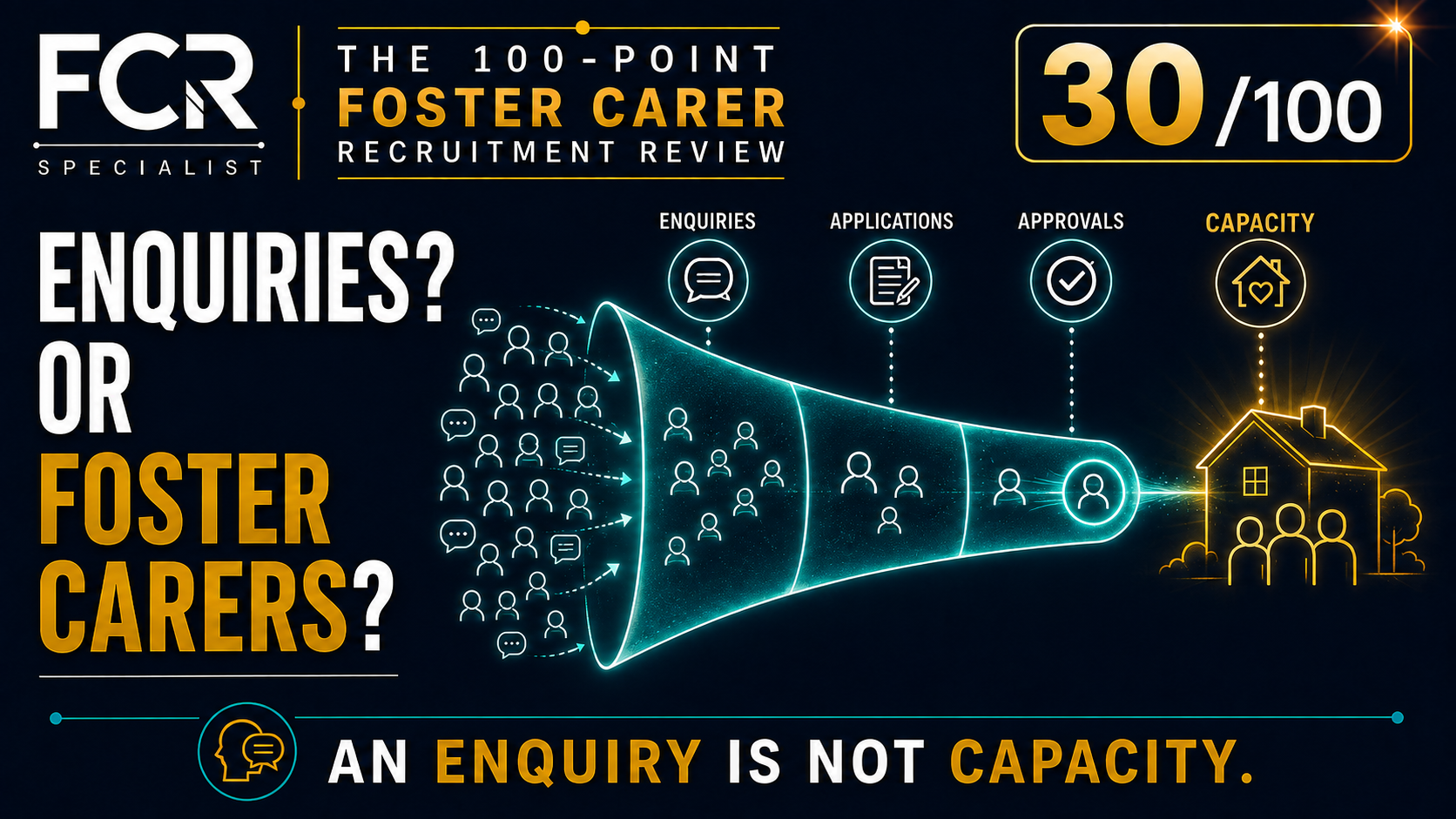
Are You Measuring Marketing by Enquiries — or by Foster Carers?
Are You Measuring Marketing by Enquiries — or by Foster Carers?
Point 30 of The 100-Point Foster Carer Recruitment Review
Imagine the marketing presentation.
The campaign has finished.
The slides look good.
1.2 million impressions.
340,000 people reached.
18,000 clicks.
CTR up 14%.
Cost per click down 23%.
637 leads generated.
Cost per lead £42.
There are graphs.
There are arrows pointing upwards.
There may even be several green boxes.
And then somebody says:
“Great campaign.”
Maybe it was.
But I have one more question.
HOW MANY FOSTER CARERS DID IT PRODUCE?
And then I have another.
WERE THEY THE FOSTER CARERS YOU ACTUALLY NEEDED?
That is Point 30.
It is also the question that closes Stage Three of The 100-Point Foster Carer Recruitment Review.
Because over the last ten Points we have examined:
proposition,
message,
households,
marketing expertise,
authenticity,
segmentation,
channels,
and testing.
But none of that ultimately matters if we are measuring the wrong outcome.
Marketing metrics are not wrong
Let's be clear about this from the start.
There is nothing wrong with measuring:
- impressions
- reach
- engagement
- clicks
- click-through rate
- cost per click
- video views
- landing-page visits
- lead forms
- cost per lead
- cost per enquiry.
Marketing professionals need those measures.
They help answer questions such as:
Did people see the campaign?
Did the creative attract attention?
Did one advert outperform another?
Did people click?
What did it cost to generate a response?
Is the platform delivering efficiently?
Those are entirely legitimate questions.
The problem starts when those answers become confused with:
DID OUR FOSTER CARER RECRUITMENT WORK?
They are not the same question.
There are really three levels of measurement
I think it is useful to separate them.
LEVEL 1 — MARKETING PERFORMANCE
Did the communication get noticed and generate a response?
Measures might include:
reach,
clicks,
engagement,
website traffic,
leads,
cost per lead.
LEVEL 2 — RECRUITMENT PERFORMANCE
What happened to the people who responded?
Measures might include:
contactability,
qualified enquiries,
initial visits,
applications,
assessment starts,
withdrawals,
approval,
timescale,
conversion.
LEVEL 3 — SUFFICIENCY OUTCOME
What did the recruitment activity actually create?
Did we recruit Foster Carers who could provide:
the type of care needed,
in the geography needed,
with the required household capacity,
at the time it was needed?
That third level is frequently the most important.
And it is also the furthest away from the advertising dashboard.
The enquiry number can be seductive
Enquiry volume is attractive because it is immediate.
Run campaign.
Receive leads.
Count them.
Compare with last month.
Report upwards.
But Ofsted's own national analysis demonstrates why enquiry volume needs caution.
In the year ending 31 March 2023, Ofsted recorded 125,195 initial enquiries from potential mainstream fostering households.
Only 6% resulted in an application.
There is an additional complication.
Ofsted explicitly cautioned that enquiry counts have limitations because providers have differed in what they define as an initial enquiry, and one individual can potentially make more than one enquiry.
I am deliberately describing that as historic national evidence, rather than presenting it as a current 2026 enquiry benchmark. Ofsted's collection arrangements have subsequently changed, including specific arrangements for fostering hubs and larger IFA groups submitting initial-enquiry data.
But the underlying lesson remains extremely relevant:
AN ENQUIRY COUNT IS NOT A HEADCOUNT OF FUTURE FOSTER CARERS.
Current Ofsted data reinforces the need to follow progression
For 2024–25, Ofsted reports 8,290 fostering applications received.
Of those applications, 5,370 had been completed by 31 March 2025: 2,050 resulted in approval, 3,290 were withdrawn and 30 were rejected. A further 2,925 remained in progress.
Separately, Ofsted recorded 4,115 newly approved households at the end of March 2025; some of those households had begun their application before the start of the reporting year.
That distinction matters.
Recruitment is a journey across time.
You cannot always take:
this year's enquiries,
this year's applications,
and this year's approvals
and divide one by another as though they all represent exactly the same cohort.
Some applicants began last year.
Some current applications will conclude next year.
Some will withdraw.
Some will transfer.
Good performance management understands the cohort.
Poor performance management simply divides the numbers available on the spreadsheet.
Follow the person
One of the strongest principles we can introduce at this stage of the Review is:
FOLLOW THE PERSON — NOT JUST THE METRIC.
Suppose somebody first encounters a Facebook advert.
They click.
They leave.
Three weeks later they Google you.
They read the website.
They watch a Foster Carer video.
They attend an information evening.
They enquire.
They have an initial conversation.
They apply.
They are assessed.
They are approved.
Which metric matters?
All of them tell us something.
But they tell us different things.
The ultimate recruitment chain looks more like this:
CAMPAIGN
↓
ENQUIRY
↓
QUALIFIED ENQUIRY
↓
INITIAL VISIT
↓
APPLICATION
↓
ASSESSMENT
↓
APPROVAL
↓
AVAILABLE CAPACITY
↓
USEFUL FOSTER CARER CAPACITY
That final distinction deserves attention.
Approval isn't quite the end either
It would be easy to say:
“Fine. Stop measuring enquiries and measure approvals.”
That's better.
But it still isn't enough.
Imagine an organisation urgently needs Foster Carers who can support:
teenagers,
sibling groups,
or children within a particular part of its geography.
Its campaign produces:
250 enquiries,
30 applications,
10 approvals.
That might appear highly successful.
But suppose all ten newly approved households can offer only a form of capacity the service already has reasonably well covered.
Meanwhile, the sufficiency gap remains unchanged.
The recruitment team has recruited Foster Carers.
But has the recruitment strategy delivered its intended outcome?
This reconnects directly to Point 24:
“WE NEED MORE FOSTER CARERS” IS NOT YET A RECRUITMENT BRIEF.
And:
AN ENQUIRY IS NOT CAPACITY.
The real question is:
WHAT CAPACITY DID THE RECRUITMENT ACTIVITY CREATE?
Capacity needs definition
A newly approved household could potentially represent:
one place,
two places,
three places,
short-break capacity,
long-term capacity,
capacity for particular age groups,
capacity within a particular location,
specialist experience,
or other combinations.
The latest Ofsted statistics illustrate this variation. Newly approved mainstream households in 2024–25 differed substantially in the number of children for whom they were approved, and many fostering households were approved for multiple care types.
So simply reporting:
“We approved ten households”
still leaves important questions unanswered.
Ten households providing what?
Where?
For whom?
And how does that compare with the sufficiency requirement?
Marketing success can therefore coexist with recruitment failure
Consider this example.
CAMPAIGN A
1,000 enquiries.
Cheap cost per lead.
High social-media engagement.
Marketing dashboard looks excellent.
But:
many people cannot be contacted;
many live outside the useful geography;
few progress;
very few reach application;
none eventually provide the priority capacity.
CAMPAIGN B
150 enquiries.
Higher cost per enquiry.
Lower engagement.
But:
high contactability;
stronger progression;
more applications;
more approvals;
several Foster Carers providing exactly the capacity the service needed.
Which campaign performed better?
From a lead-generation perspective, perhaps Campaign A.
From a Foster Carer Recruitment perspective:
almost certainly Campaign B.
That is why we need to distinguish:
MARKETING EFFICIENCY
from
RECRUITMENT EFFECTIVENESS.
Cost per enquiry can actively mislead
Imagine:
Campaign A costs £20,000 and generates 1,000 enquiries.
Cost per enquiry = £20.
Campaign B costs £20,000 and generates 250 enquiries.
Cost per enquiry = £80.
Easy conclusion:
Campaign A is four times more efficient.
Now follow them.
Campaign A eventually creates two approved Foster Carer households.
Campaign B creates ten.
The calculation changes dramatically.
Campaign A:
£10,000 marketing spend per approval.
Campaign B:
£2,000 marketing spend per approval.
And even that still isn't the final answer.
What capacity did the approved households provide?
This is why a marketing dashboard can be technically accurate while still giving senior management an incomplete picture of recruitment performance.
That wider issue — helping CEOs and owners see through the fog of marketing statistics and ask the questions that genuinely matter — deserves a later Point of its own.
For Point 30, we just need to establish the principle.
Don't punish marketing for downstream failure either
There is another side to this.
Suppose the advertising produces:
excellent prospective Foster Carers.
But the recruitment team takes three days to call them.
Or the first conversation is poor.
Or initial visits are difficult to arrange.
Or the application process introduces unnecessary delay.
Or communication breaks down during assessment.
Then it would be equally misleading to say:
“The marketing campaign didn't produce enough Foster Carers.”
Perhaps the marketing did its job perfectly.
The leakage happened somewhere else.
This is why this entire 100-Point Review examines Foster Carer Recruitment end to end.
The purpose of following the whole chain is not to blame marketing for everything.
It is to identify:
WHERE PERFORMANCE WAS ACTUALLY LOST.
This is where Point 29 becomes important
Point 29 introduced:
HYPOTHESIS → CONTROLLED CHANGE → MEASUREMENT → LEARNING → DECISION.
But measurement determines what you learn.
If you test advertising and measure only:
click-through rate,
you learn how to improve click-through rate.
If you measure:
lead forms,
you learn how to generate lead forms.
If you follow:
qualified enquiries,
you learn more.
If you follow:
applications,
you learn more again.
If you follow:
approvals and capacity,
you begin to learn what actually contributes to the recruitment objective.
So the principle becomes:
OPTIMISE AS CLOSE TO THE REAL OUTCOME AS YOUR DATA ALLOWS.
Government policy is moving in exactly this direction
The 2026 Renewing Fostering programme identifies inconsistent and incomplete recruitment data as a significant problem because it limits services' ability to understand applicant progress, identify delays and determine what drives successful recruitment.
The Government says improved data capability should help services track applicants, target recruitment and understand what improves conversion from enquiry to approval.
The new end-to-end hub specification similarly requires regional performance data tracking volume, conversion and timeliness from enquiry through to approval, with the wider approach intended to support continuous improvement and accountability.
That is an important change in emphasis.
Not simply:
How many enquiries did the hub produce?
But:
What happened throughout the pipeline?
But I would go one step further
Enquiry to approval is vital.
But Foster Carer Recruitment ultimately exists because children require appropriate foster homes.
So I would add another layer beyond the recruitment pipeline.
MARKETING
Did people respond?
↓
RECRUITMENT
Did the right prospective Foster Carers progress?
↓
APPROVAL
Did suitable households become approved?
↓
CAPACITY
What could those households offer?
↓
SUFFICIENCY
Did that capacity address an identified need?
That is the complete line of sight.
HERE IS THE TEST
Imagine I walk into the senior management meeting.
I ask:
How did Foster Carer Recruitment perform last year?
The response is:
“We had 900,000 impressions.”
I ask:
And?
“Twenty-three thousand clicks.”
And?
“Cost per lead came down 18%.”
And?
“We generated 740 enquiries.”
And?
Eventually, somebody has to answer:
HOW MANY FOSTER CARERS?
Then:
WHAT COULD THEY OFFER?
Then:
WAS THAT WHAT WE NEEDED?
Those are the questions that connect marketing activity to organisational purpose.
Build the dashboard backwards from the outcome
Rather than start with what Meta, Google or the CRM happens to measure, start with the result.
What do we need?
For example:
Foster Carer capacity for sibling groups in a particular geography.
Now work backwards.
How many approvals might realistically be needed?
How many assessments?
How many applications?
How many qualified enquiries?
How many initial responses?
Which channels?
What marketing spend?
Now the dashboard represents a recruitment strategy rather than a collection of available numbers.
One dashboard — several different conversations
The marketing team still needs:
CPC,
CTR,
reach,
frequency,
engagement,
conversion rates.
The recruiter needs:
contact rates,
qualified enquiries,
initial visits,
progression,
reasons for non-progression.
The fostering manager needs:
applications,
assessment,
timescale,
withdrawals,
approvals.
Senior leadership needs to see:
investment,
pipeline,
approvals,
capacity,
sufficiency impact.
Different measures.
One system.
The mistake is assuming the first dashboard can answer every question.
Point 30 closes Stage Three
Stage Three began with a deceptively simple question:
WHAT ARE WE OFFERING?
Over ten Points, we have moved through:
the household,
marketing capability,
proposition,
sufficiency-led messaging,
questions,
realism,
segmentation,
channel strategy,
testing,
and finally measurement.
Several practical tools have emerged.
CLAIM → PROOF → EXPERIENCE
QUESTION → ANSWER → EVIDENCE → EXPERIENCE
PERSON → STAGE → QUESTION → MESSAGE → NEXT ACTION
AUDIENCE → PURPOSE → CHANNEL → ACTION → OUTCOME
HYPOTHESIS → CONTROLLED CHANGE → MEASUREMENT → LEARNING → DECISION
And Point 30 adds the final line:
ACTIVITY → PROGRESSION → APPROVAL → CAPACITY → SUFFICIENCY.
Together they say something important.
Foster Carer Recruitment marketing should not simply become more creative.
It should become more intentional.
The final Point 30 question
So when the next marketing report lands on the desk:
Look at the impressions.
Look at the clicks.
Look at the enquiries.
They matter.
But keep going.
Ask:
What happened next?
And then keep asking it until you reach the outcome that actually matters:
DID WE CREATE MORE OF THE RIGHT FOSTER CARER CAPACITY, IN THE RIGHT PLACES, FOR THE CHILDREN WHO NEED IT?
If the organisation cannot make that connection today, that is not necessarily evidence of failure.
It is a diagnostic finding.
And it tells us what needs to improve.
MEASURE MARKETING PERFORMANCE.
MANAGE RECRUITMENT OUTCOMES.
That closes Stage Three — Proposition, Message & Attraction.
30 Points complete. 70 still to examine.