POINT 63/100 — WHY ARE WE ASKING THEM THE SAME QUESTIONS AGAIN?
POINT 63/100 — WHY ARE WE ASKING THEM THE SAME QUESTIONS AGAIN?
There is a relatively simple way of testing whether your Foster Carer Recruitment journey is genuinely joined-up.
Ask a prospective Foster Carer:
“How many times have we asked you the same question?”
The answer may be uncomfortable.
A person makes an enquiry.
They explain why they are interested in fostering.
They provide details about their household.
They discuss employment.
Children.
Relationships.
Accommodation.
Previous experience.
They then have an Initial Visit.
Much of this is explored again, usually in considerably more detail.
They decide to proceed.
Perhaps an application form follows.
Some of the same information is requested again.
Then the Assessing Social Worker arrives.
And the applicant hears:
“Let's start with why you want to Foster.”
From the professional's perspective, those conversations may all have different purposes.
From the applicant's perspective:
I'VE ALREADY TOLD YOU THIS.
That difference matters.
GOVERNMENT RESEARCH HAS ALREADY IDENTIFIED THE PROBLEM
This is not simply anecdotal.
The Department for Education's 2023 qualitative study Foster Carer Recruitment and Conversion Rates specifically identified repeated information gathering.
Participants described the same information being requested through an enquiry form, home visit, application form and later during assessment.
The researchers reported that sharing information obtained at one stage with colleagues later in the process could help prospective Foster Carers feel listened to rather than feeling that their time was being wasted.
The same research described a streamlined and informative process as an enabler to Foster Carer Recruitment and recommended explaining the journey clearly so applicants understand what happens and who they will speak to.
As I have stressed throughout this Review, this was a small qualitative study involving ten fostering services. It cannot tell us how widespread duplication is across every service in England.
But it identifies something every service can test for itself.
You don't need another national research project.
You need your paperwork.
PUT THE DOCUMENTS NEXT TO EACH OTHER
Take:
- your enquiry form;
- initial-call record;
- Initial Visit template;
- application process;
- pre-assessment paperwork;
- ASW handover information;
- and whatever information the applicant is asked to produce during early assessment.
Put them side by side.
Now highlight every question that appears more than once.
You might find:
Why do you want to Foster?
Three times.
Who lives in your home?
Three times.
Employment details?
Two or three times.
Previous fostering/adoption approaches?
Again.
Children and family details?
Again.
Accommodation?
Again.
Previous experience with children?
Again.
There may be perfectly good reasons for some of that.
But the organisation should know what those reasons are.
REVISITING IS NOT THE SAME AS REPEATING
This is the most important professional distinction in Point 63.
An Assessing Social Worker is not simply collecting a database of facts.
Assessment requires professional exploration.
Suppose the applicant told recruitment:
“I want to Foster because I had a difficult childhood and I'd like to give a child the opportunities I didn't have.”
That may be entirely sufficient information for recruitment at that stage.
It is obviously not necessarily sufficient for a professional Foster Carer assessment.
The ASW may appropriately need to explore:
what happened;
how the applicant understands those experiences;
the effect upon them;
their relationships;
their resilience;
and any implications for fostering.
That is not duplication.
That is assessment.
Similarly, the ASW may need to verify factual information, resolve discrepancies or return to something because new information has emerged.
None of this Review should prevent that.
The distinction is:
REVISIT WITH PURPOSE.
DON'T REPEAT THROUGH HABIT.
The applicant should understand that difference too.
Instead of:
“Tell me why you want to Foster.”
the ASW might explain:
“I've seen what you discussed with recruitment about your motivation. I now need to explore that with you in considerably more depth as part of the assessment.”
The subject has been revisited.
But the applicant knows the organisation has listened.
That is a very different experience.
ORGANISATIONAL AMNESIA
The problem occurs when repetition has no professional purpose.
The applicant tells recruitment something.
Recruitment records it.
The Initial Visit records it again.
The application asks again.
The ASW cannot see the recruitment notes.
Administration then requests the same information in another format.
This isn't thoroughness.
It's organisational fragmentation.
And it can communicate something damaging:
We don't remember you.
Our teams don't talk to each other.
You need to fit around our system.
For somebody voluntarily entering a deeply personal assessment process, that is not an insignificant message.
ONE HOUSEHOLD. ONE JOURNEY RECORD. MANY TOUCHPOINTS.
This principle has appeared earlier in The 100-Point Foster Carer Recruitment Review, but it becomes especially important here.
ONE HOUSEHOLD.
The person doesn't become a new household because assessment begins.
ONE JOURNEY RECORD.
Relevant information should move through the journey, subject of course to appropriate permissions, information governance and professional access controls.
MANY TOUCHPOINTS.
Different professionals can engage with the information for different purposes.
That does not require the applicant to continually recreate the information from scratch.
CAPTURE ONCE DOES NOT MEAN NEVER CHECK AGAIN
This needs another important qualification.
“Capture once” can easily become an oversimplified technology slogan.
Information changes.
People misunderstand questions.
Errors occur.
The applicant may want to correct something.
A professional may require direct confirmation.
A statutory process may require particular evidence.
The ASW may need to hear something directly rather than rely upon another worker's account.
So the model should not be:
Enter once and nobody ever asks again.
It should be:
CAPTURE → CARRY FORWARD → VERIFY → EXPLORE WHERE NECESSARY.
That is much more realistic.
COULD THE APPLICANT HELP BUILD THEIR OWN RECORD?
There is another practical opportunity.
Some fostering services now have case-management technology capable of giving prospective Foster Carers secure access to enter information directly.
Rather than:
applicant completes document;
administrator receives document;
administrator rekeys information;
another worker accesses another record;
applicant corrects mistakes;
assessment recreates information;
the applicant can potentially enter or verify information directly within the system that will support the subsequent journey.
A documented example is CHARMS, whose supplier describes prospective Foster Carers completing sensitive application information securely online and the wider platform managing recruitment from enquiry through training, assessment and approval. That is a supplier description rather than independent evidence of improved conversion, but it demonstrates that this type of functionality already exists.
The important point is not the particular software.
Different local authorities and IFAs use different systems.
Some have sophisticated applicant portals.
Others do not.
Some systems may require configuration or integration.
The principle is:
DON'T MAKE THE APPLICANT RE-ENTER INFORMATION JUST BECAUSE YOUR ORGANISATION CHANGED SCREENS.
AND DON'T JUST DIGITISE THE OLD PROBLEM
Technology can also make this worse.
An organisation replaces its paper application form with an online application form.
That sounds like digital transformation.
But if the applicant has already supplied the information elsewhere, all the organisation may have done is create:
digital duplication.
The form looks better.
The underlying process remains the same.
Government policy is now explicitly pointing towards greater digital transformation in fostering and a more streamlined end-to-end approach. Renewing Fostering states that Government intends to use national levers where digital tools are needed and proposes expanding regional hubs across assessment and approval to create a more joined-up end-to-end system.
The opportunity therefore isn't merely to turn paper into screens.
It is to redesign the information journey.
DON'T DIGITISE DUPLICATION.
DESIGN IT OUT.
WHAT MIGHT A BETTER INFORMATION JOURNEY LOOK LIKE?
Imagine the prospective Foster Carer has already had:
Initial call
Relevant basic information is recorded.
↓
Initial Visit
The existing record is used and expanded.
Nobody starts with a blank page.
↓
Decision to proceed
The applicant reviews or confirms relevant information already held.
Missing information is collected.
Required declarations and consents are completed.
Checks can be initiated where appropriate.
↓
Secure applicant access
Where the service's technology supports it, the applicant can add documents, complete outstanding factual information or confirm details directly rather than creating another parallel document.
↓
Handover to ASW
The ASW receives the relevant recruitment context and knows what has already been discussed.
↓
Assessment
The ASW revisits what needs professional exploration.
Not because the information has disappeared.
Because assessment requires greater depth.
That's one journey.
DUPLICATION CAN ALSO CREATE INCONSISTENCY
There is another less obvious risk.
Every time you ask somebody to recreate information, you create another version.
An employment date changes slightly.
A previous address is entered differently.
A family member's details are abbreviated.
The applicant phrases their motivation differently.
Suddenly there are apparent inconsistencies.
Some may genuinely require professional exploration.
Others may simply be the result of repeatedly collecting the same information in different places.
A single developing record can reduce that risk.
Again, that does not remove professional verification.
It makes the source of information clearer.
THIS IS PARTICULARLY IMPORTANT AS THE QUESTIONS GET MORE PERSONAL
Early Foster Carer Recruitment can be relatively straightforward.
Name.
Telephone number.
Location.
Bedroom.
Broad household circumstances.
But assessment becomes increasingly personal.
Applicants may be asked about:
relationships;
childhood experiences;
health;
bereavement;
family difficulties;
previous partners;
their own parenting;
significant life events;
and other deeply private matters.
There are legitimate professional reasons for that depth.
But precisely because the assessment becomes more intrusive, the organisation should eliminate unnecessary repetition around it.
The Department for Education research noted that applicants can find the process invasive and that lengthy assessment is among factors associated with dropout.
The solution is not to avoid the difficult questions.
It is to ensure the applicant is not carrying unnecessary administrative burden alongside them.
AND REMEMBER THE ATTRITION
We cannot examine any of these processes in isolation from what happens nationally after application.
Ofsted recorded 5,370 applications as completed during 2024–25.
Of those:
2,050 — 38% — were approved.
3,290 — 61% — were withdrawn.
30 — 1% — were rejected.
Of the withdrawals, 2,175 were recorded as applicant withdrawals and 1,115 as service withdrawals.
These are reporting-year flows rather than a single cohort followed from application through to outcome, so they must not be interpreted as a simple application-to-approval conversion rate.
And, again, withdrawal is not automatically evidence of service failure.
But Ofsted also reports that among applications started during the year and withdrawn by applicants by year-end, 20% cited the fostering process not being as they expected.
That does not prove duplication causes withdrawal.
But it makes this question worth asking:
WHEN AN APPLICANT TELLS US “I'VE ALREADY ANSWERED THAT”, ARE WE LISTENING?
THE ASW SHOULD NOT HAVE TO RECREATE THE RECRUITMENT RECORD EITHER
There is another side to this.
Duplication wastes professional time.
If an ASW spends their first visit rediscovering straightforward information already held elsewhere, that isn't just frustrating for the applicant.
It consumes assessment capacity.
And where ASW capacity is constrained, unnecessary administrative repetition can contribute to a slower process.
The 2023 DfE research also reported that assessment delays can occur where staff carrying assessments have competing responsibilities.
So information continuity potentially helps both sides.
The applicant is not repeatedly reconstructing their story.
And the ASW can spend professional time assessing, rather than rebuilding the organisation's memory.
DON'T CONFUSE MORE PAPERWORK WITH MORE RIGOUR
This is another management trap.
A long process can look thorough.
Multiple forms can look safe.
Several people asking the same question can look like checking.
But repetition itself does not create quality.
The Fostering Services Regulations require the service to obtain extensive specified information and properly assess the applicant.
The management question is not whether those requirements should be reduced.
It is:
How efficiently can the organisation meet them while preserving professional rigour?
That is a very different question.
HERE IS THE TEST…
For Point 63, I would recommend something extremely practical.
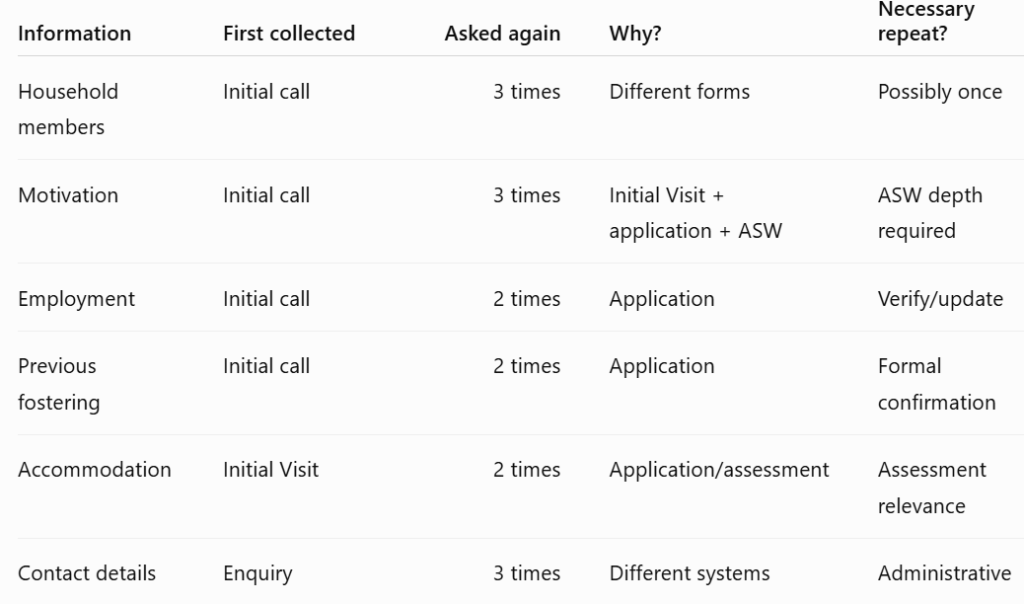
THE DUPLICATION AUDIT
Take one recently completed applicant journey.
Preferably use the actual records rather than blank templates.
Track the information from first enquiry through early assessment.
Then create a simple table:
Then ask ten management questions:
- How many pieces of information are genuinely being collected more than once?
- For each repeat, can we explain why?
- Is it being revisited for professional assessment or simply recollected administratively?
- Can the ASW see the relevant Initial Visit and recruitment information before first contact?
- Can applicants verify existing information rather than type it again?
- Are staff rekeying information from one system into another?
- If we use multiple databases, does the information read across effectively? The DfE research specifically identified multiple databases and poor accessibility as an area services should examine.
- What information genuinely has to be recorded differently because of professional or regulatory requirements?
- Have applicants ever been asked directly which parts of the process felt repetitive?
- If we redesigned the journey today with no historic paperwork, would we build it this way?
That final question is often the most revealing.
A VERY SIMPLE RULE
Before asking an applicant something, the organisation should increasingly be able to ask itself:
DO WE ALREADY KNOW THIS?
If yes:
Can we use what we have?
If it needs confirming:
Can we ask them to verify it?
If it needs updating:
What has changed?
If the ASW needs greater depth:
Explain why it is being revisited.
If none of those applies:
Why are we asking again?
THE INFORMATION SHOULD MOVE — NOT THE APPLICANT
Too many organisational processes work the other way round.
The information sits still in departmental systems.
The applicant travels around collecting and reproducing it.
Recruitment knows one part.
Administration holds another.
Assessment creates another.
Training creates another.
The applicant becomes the integration between systems.
That should not be their job.
MAKE THE INFORMATION TRAVEL THROUGH THE ORGANISATION.
DON'T MAKE THE APPLICANT CARRY IT.
The principle for Point 63 is therefore:
REVISIT WITH PURPOSE. DON'T REPEAT THROUGH HABIT.
And:
ONE HOUSEHOLD. ONE JOURNEY RECORD. MANY TOUCHPOINTS.
Point 64 takes us to the next question.
Once assessment begins, can the applicant actually see the journey ahead — or are they simply waiting to be told what happens next?