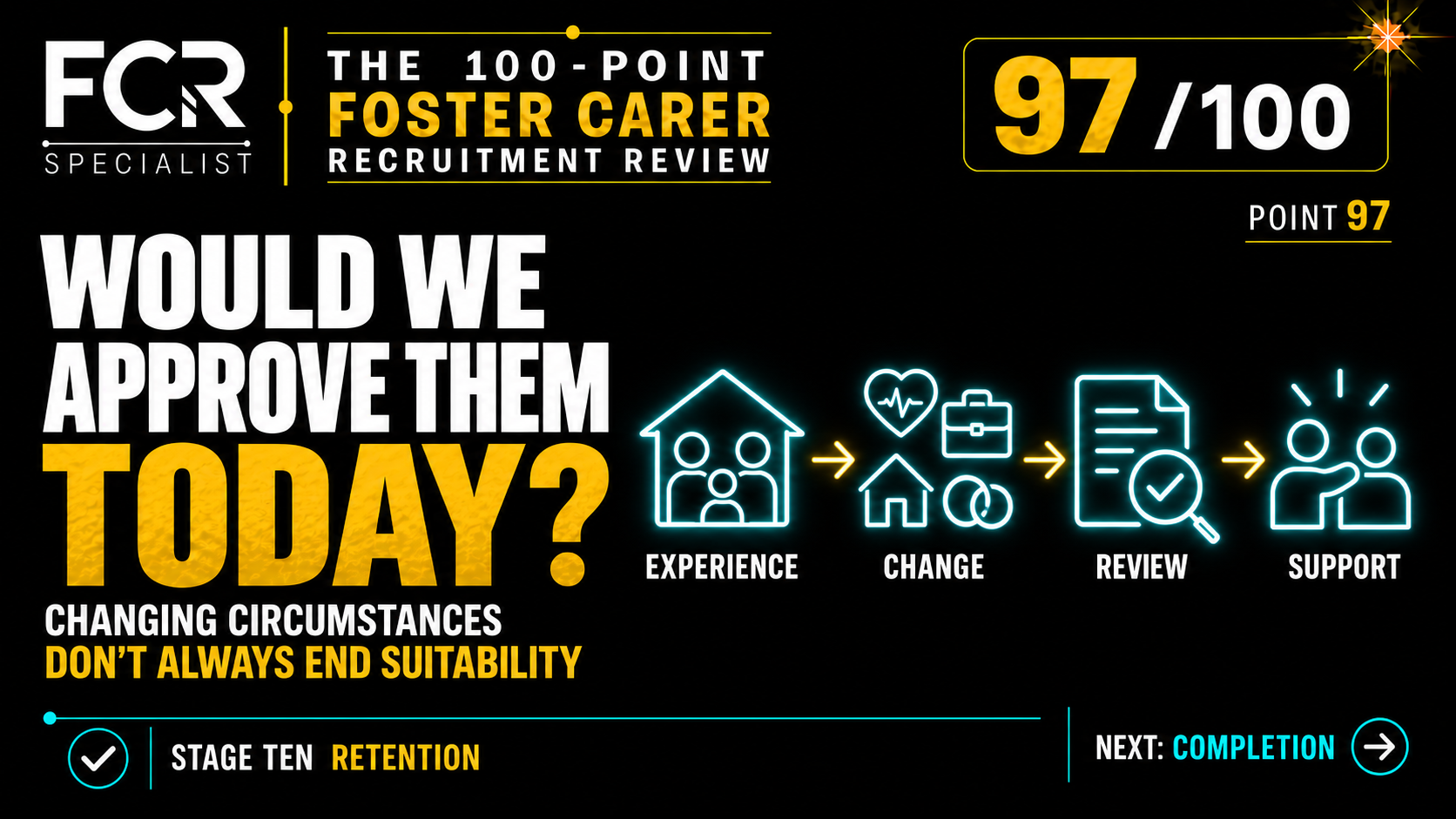
POINT 97/100 — WOULD WE APPROVE THEM TODAY? FOSTERING THROUGH CHANGING CIRCUMSTANCES
POINT 97/100 — WOULD WE APPROVE THEM TODAY? FOSTERING THROUGH CHANGING CIRCUMSTANCES
Here is a question that sounds slightly provocative:
WOULD WE APPROVE SOME OF OUR EXISTING FOSTER CARERS IF THEY PRESENTED TO US TODAY?
I don't mean because they have somehow become unsuitable.
Quite the opposite.
Imagine an experienced Foster Carer who has successfully fostered for:
five years;
ten years;
perhaps fifteen years.
During that time, life has happened.
They may have experienced:
bereavement;
a health problem;
a relationship change;
employment change;
financial pressure;
stress;
an adult child returning home;
family difficulties;
moving house;
or another significant change within the household.
And yet, following appropriate review and consideration, they may quite properly have continued fostering.
Now think about recruitment.
What would happen if an applicant arrived with exactly the same life circumstance?
Would we say:
“Let's understand this.”
Or:
“Come back in twelve months.”
That is the territory of Point 97.
Not because we should lower assessment standards.
Not because every applicant should proceed.
And certainly not because changing circumstances should ever override child safety.
The question is more subtle:
DO WE SOMETIMES CONFUSE UNCERTAINTY WITH PERMANENT UNSUITABILITY?
Real life does not stop at approval
One of the strange things about any approval process is that it inevitably looks at somebody at a particular moment in their life.
Assessment gathers a great deal of information.
But approval does not then freeze:
health;
relationships;
employment;
finances;
family;
housing;
or emotional wellbeing
for the next ten years.
Foster Carers remain ordinary people living ordinary lives while performing an extraordinary role.
People:
age;
become ill;
recover;
lose relatives;
change jobs;
separate;
form new relationships;
move home;
experience financial pressures;
have adult children return;
become grandparents;
care for elderly parents;
and go through difficult periods.
The regulatory framework recognises this reality.
Suitability is reviewed — it is not granted forever
Under the Fostering Services (England) Regulations 2011, Foster Carer approval must be reviewed not more than one year after approval and thereafter whenever the fostering service considers it necessary, but at intervals of no more than a year.
When undertaking that review, the service must consider whether:
the Foster Carer continues to be suitable;
the household continues to be suitable;
and:
the terms of approval remain appropriate.
The first review must be referred to the fostering panel; subsequent reviews may be referred to panel.
This gives us an important principle.
APPROVAL IS NOT THE END OF SUITABILITY THINKING.
Suitability remains under consideration throughout the fostering journey.
Significant change can legitimately trigger review
The Fostering Network's current guidance on Foster Carer reviews notes that a fostering service can review approval whenever necessary.
It identifies circumstances such as:
a serious health issue;
separation or divorce;
an allegation;
a complaint;
or a major household change
as examples that might trigger a review rather than waiting for the next routine annual review.
Again, this makes sense.
Something has changed.
The service needs to understand what that means.
But notice the language:
UNDERSTAND WHAT IT MEANS.
Not automatically:
END THE FOSTERING CAREER.
There will certainly be circumstances where change means fostering cannot safely continue.
There may also be circumstances where:
support;
time;
different matching;
revised terms of approval;
or another appropriate adjustment
allows an experienced and capable Foster Carer to continue.
That distinction is critical.
Now compare that with recruitment
This is where the question becomes interesting.
During assessment, the service has limited evidence of the applicant's actual fostering practice.
It has:
interviews;
references;
checks;
training;
family history;
observations;
and professional assessment.
All of those matter enormously.
But the Assessing Social Worker does not have eight years of evidence demonstrating how this person responds when:
a child is distressed;
a placement becomes difficult;
professionals disagree;
family life is disrupted;
plans change;
or the household is under pressure.
That evidence does not yet exist.
So the professional lens is necessarily prospective.
The question may be:
“Does this current uncertainty mean approval should wait?”
Years later, a Supervising Social Worker and fostering service may have substantial evidence about the same person's actual fostering capability.
Now the question can be different:
“What does this change mean for somebody whose practice we already know?”
Neither question is inherently wrong.
THE EVIDENCE BASE IS DIFFERENT.
We must not turn this into criticism of Assessing Social Workers
This distinction matters.
Point 97 is not telling Assessing Social Workers:
“Take more risks.”
That would be inappropriate.
Assessment exists for a reason.
Children deserve Foster Carers who are suitable and households capable of meeting their needs.
There will be applicants whose circumstances mean:
assessment should pause;
more information is required;
or fostering should not proceed.
The management challenge is to make sure those decisions are based on the actual implications of the circumstance, rather than a simplistic assumption that the circumstance itself automatically determines suitability.
For example:
Bereavement does not tell you, by itself, exactly how somebody is functioning.
A health condition does not, by itself, tell you what somebody can safely do.
Employment does not, by itself, tell you whether fostering can work.
Financial pressure does not, by itself, tell you whether the household is suitable.
Relationship change certainly matters — but its meaning depends upon the circumstances.
The assessment remains professional.
The management question is whether organisational rules have become blunter than the professional judgement they were designed to support.
Temporary difficulty versus permanent barrier
This is perhaps the distinction I am most interested in.
Some circumstances are:
temporary.
Some are:
manageable.
Some require:
additional information.
Some require:
support.
Some represent:
significant ongoing risk.
And some mean fostering genuinely isn't appropriate.
Those categories should not be collapsed into one.
Consider a prospective Foster Carer experiencing bereavement.
There may be very good reasons to allow time.
But:
How much time?
Why?
What would demonstrate readiness?
Is there a clear route back?
Or do we simply say:
“Come back next year”?
Then twelve months later discover the person has:
lost interest;
chosen another provider;
returned to full-time employment;
or concluded fostering isn't for them.
That is a recruitment and sufficiency issue.
“Not now” must have an evidence-based meaning
Earlier Points in this Review dealt extensively with the danger of using:
“Not now”
as a polite form of rejection.
Point 97 adds another layer.
Sometimes not now is exactly the right answer.
The problem is not delay itself.
The problem is delay without:
reason;
proportion;
criteria;
or a route back.
If an applicant is asked to wait because circumstances need to stabilise, they should ideally understand:
What specifically needs to change?
Why does it matter?
What would demonstrate sufficient stability?
When should we revisit it?
This is not instructing an ASW how to assess.
It is good recruitment management around the assessment experience.
A MANAGEABLE DELAY SHOULD HAVE A MANAGEABLE ROUTE BACK.
Existing Foster Carers give us useful perspective
The continuing suitability framework creates an interesting thought experiment.
Imagine an applicant says:
“My adult daughter has moved back into our home temporarily.”
The service quite rightly explores the implications.
Now imagine an established Foster Carer says exactly the same thing after eight successful years.
The fostering service will also need to understand:
who is now in the household;
what the implications are;
what checks or assessment may be required;
and whether existing arrangements remain suitable.
But it also has something it didn't have during recruitment:
EVIDENCE OF THE FOSTER CARER'S ACTUAL PRACTICE.
That evidence shouldn't trump safeguarding.
But it is relevant.
And this is why suitability should not be thought of as a simplistic checklist where one life circumstance always produces one answer.
Reviews are designed for precisely this reason
Current sector guidance describes Foster Carer reviews as an opportunity to consider:
whether approval should continue;
whether terms of approval should change;
what has happened during the preceding year;
challenges;
changes in household circumstances;
learning and development;
and any additional support needed.
The National Minimum Standards also expect reviews to be sufficiently thorough to allow the fostering service to satisfy itself about ongoing suitability. Ofsted continues to inspect whether review arrangements provide robust oversight of ongoing suitability.
So the system already recognises:
SUITABILITY IS SOMETHING THAT CONTINUES TO BE TESTED AGAINST REAL LIFE.
A change in circumstance is not automatically a change in suitability
This is probably the central message of Point 97.
A CHANGE IN CIRCUMSTANCES IS NOT AUTOMATICALLY A CHANGE IN SUITABILITY.
Sometimes it will change suitability.
Sometimes it will change:
availability;
matching;
terms of approval;
support needs;
or the type of fostering that is sustainable.
Sometimes it may change very little.
The correct outcome depends upon:
the individual;
the household;
the child;
the evidence;
and professional judgement.
This is not an argument for predetermined answers.
It is an argument against them.
Supporting change can preserve sufficiency
Now bring this back to Stage Ten.
Suppose an experienced Foster Carer has provided:
eight years of stable care;
teenage placements;
sibling placements;
peer support;
and substantial organisational knowledge.
Then their health changes.
The question should rightly be:
Can they still foster safely and appropriately?
But there may be another question immediately behind it:
IF THEY CAN CONTINUE SAFELY WITH DIFFERENT SUPPORT OR DIFFERENT TERMS, WHY WOULD WE THROW AWAY EIGHT YEARS OF CAPABILITY?
Perhaps their approval range needs reconsidering.
Perhaps a particular type of placement is no longer suitable.
Perhaps they need time.
Perhaps the household requires additional support.
Or perhaps fostering genuinely needs to end.
The answer must be individual.
But:
SUPPORTING AN EXPERIENCED FOSTER CARER THROUGH MANAGEABLE CHANGE CAN BE A SUFFICIENCY INTERVENTION.
We should also learn backwards into recruitment
This is where Point 97 reconnects retention with recruitment.
If our experienced Foster Carers regularly continue successfully despite manageable life changes, what can recruitment learn from that?
Not:
“Ignore risk.”
But:
“Understand risk more intelligently.”
Could an applicant's situation be:
temporary rather than permanent?
manageable rather than prohibitive?
supportable rather than disqualifying?
capable of review rather than requiring complete disengagement?
This does not alter statutory assessment responsibility.
It challenges recruitment systems to avoid becoming unnecessarily binary around ordinary human life.
THE CHANGING CIRCUMSTANCES CHECK
For existing Foster Carers, I suggest a simple management lens.
This is not a replacement for statutory review, professional assessment or safeguarding processes.
It is a management prompt.
WHAT HAS ACTUALLY CHANGED?
Avoid broad labels.
Identify the specific circumstance.
WHAT IS THE ACTUAL IMPACT?
What has changed in practical terms for fostering?
WHAT DOES THEIR PRACTICE HISTORY TELL US?
What evidence exists about how the Foster Carer has actually performed?
IS THIS TEMPORARY, MANAGEABLE OR ENDURING?
Do not assume.
Understand.
WHAT SUPPORT OR ADJUSTMENT IS POSSIBLE?
Where appropriate, could support or changed arrangements maintain safe fostering?
DO TERMS OF APPROVAL NEED REVIEW?
The current framework specifically requires services to consider whether terms remain appropriate.
WHAT DOES THE CHILD NEED?
This remains central.
WHAT CAPABILITY COULD WE LOSE?
Not to override safety.
To ensure sufficiency consequences are understood.
This is not retention at any cost
That needs stating clearly.
If circumstances mean a Foster Carer is no longer suitable, then retention is not the objective.
If a child's safety or welfare would be compromised, sufficiency does not override that.
If fostering has naturally reached its conclusion for that household, that should be respected.
RETENTION MUST ALWAYS BE SUSTAINABLE AND SAFE.
But the opposite mistake is also possible.
We should not lose experienced Foster Carers simply because organisational thinking treats any life change as evidence that:
“Things aren't what they were at approval.”
Of course they aren't.
Nobody's life is.
Suitability is not a photograph
Perhaps there is a useful analogy here.
Assessment gives us a detailed photograph of somebody's circumstances and potential at a particular point.
Fostering then gives us a film.
Years of:
practice;
relationships;
challenge;
learning;
success;
mistakes;
adaptation;
and evidence.
The photograph matters.
But once we have years of film, we shouldn't pretend the photograph is the only thing we know.
SUITABILITY IS NOT A SNAPSHOT FROZEN ON APPROVAL DAY.
It is something the fostering service must continue to understand.
Current policy context
At 9 September 2026, the Fostering Services (England) Regulations 2011, the existing National Minimum Standards and current statutory guidance remain relevant to the ongoing review and approval framework.
The Department for Education is currently consulting on proposed revised fostering standards and guidance. That consultation opened on 8 July and closes on 16 September 2026, so the proposed revisions should not yet be treated as the current framework.
The management question for Point 97
Think about one of your experienced Foster Carers who has been through a major life change.
Ask:
Did we support them through it?
Did we reassess what actually mattered?
Did their terms or support need to change?
Did their years of evidence help us understand their continuing capability?
Then look back at recruitment.
Ask:
IF THIS PERSON ARRIVED AS AN APPLICANT WITH THE SAME CIRCUMSTANCE TODAY, WHAT WOULD WE DO?
Would we explore?
Would we delay?
Would we reject?
Would we have a route back?
And:
Would our response be proportionate to the actual issue?
That is not about lowering the bar.
It is about making sure the bar measures the thing we actually need to know:
CAN THIS PERSON AND THEIR HOUSEHOLD FOSTER SAFELY, SUSTAINABLY AND WELL?
Because:
SUPPORTING CHANGE IS NOT LOWERING STANDARDS.
Sometimes it is exactly what allows good Foster Carers to continue meeting them.