POINT 96/100 — WHEN COMMITMENT BECOMES EXHAUSTION
POINT 96/100 — WHEN COMMITMENT BECOMES EXHAUSTION
There is a phrase I think fostering services should become suspicious of:
“It happened very suddenly.”
An experienced Foster Carer resigns.
Perhaps they have fostered successfully for:
five years;
ten years;
fifteen years;
perhaps considerably longer.
Then something happens.
A difficult placement ends.
A professional relationship deteriorates.
A complaint occurs.
A promised break doesn't materialise.
Another Social Worker changes.
The household experiences another financial pressure.
Or the Foster Carer simply says:
“I've had enough.”
From the organisation's perspective, the decision may appear sudden.
From the Foster Carer's perspective, it may be the end of a process that has been developing quietly for years.
That gives us the central principle for Point 96:
THE FINAL STRAW IS NOT NECESSARILY THE FIRST CAUSE.
Commitment can hide exhaustion
One of the difficulties with Foster Carer retention is that some of the most committed people may continue functioning for a very long time while becoming progressively less sustainable.
They keep going because:
they care about the child;
they do not want to let anybody down;
they have made a commitment;
they know how difficult finding another placement could be;
they have successfully managed difficult situations before;
or fostering has become central to their identity and family life.
From outside, this may look like resilience.
And sometimes it is.
But commitment can also conceal accumulated strain.
The Foster Carer who appears to be:
coping
may actually be:
coping because they cannot see an acceptable alternative.
That is a very different proposition.
What does the current evidence tell us?
The Fostering Network's State of the Nations' Foster Care 2024 surveyed more than 3,000 current and former Foster Carers and 114 fostering services across the UK.
Almost three in five Foster Carers reported experiencing burnout or poor wellbeing because of their fostering role.
We should use the word burnout carefully.
This is Foster Carer self-report within survey research; it is not a clinical diagnosis for every respondent.
Nevertheless, the scale is important.
There is another finding I think managers should pay particularly close attention to.
Less than half of Foster Carers said they felt able to ask for support for their wellbeing when they needed it without fear of negative consequences for themselves or the children they fostered.
Across the UK the figure was 48%.
In England it was 49%.
That creates a serious retention question.
If a Foster Carer is becoming exhausted but does not feel completely safe admitting it:
HOW WILL THE SERVICE KNOW?
Perhaps only when something changes visibly.
They reject a referral.
Ask for a placement to end.
Withdraw from support groups.
Become more frustrated in meetings.
Stop offering certain types of care.
Begin talking to another provider.
Or eventually resign.
That is why:
RESIGNATION IS A LAGGING INDICATOR.
The accumulation matters
There may be no single cause.
An experienced Foster Carer may have accumulated years of:
complex placements;
emotional loss when children move;
difficult endings;
allegations or complaints;
professional disagreements;
poor communication;
changes of Social Worker;
changes of manager;
meetings;
records;
mandatory training;
administrative demands;
financial uncertainty;
household disruption;
sleep deprivation;
cancelled plans;
and the ordinary emotional responsibility of caring for children who may have experienced considerable trauma.
Then add ordinary life.
Ageing.
Health.
Partners.
Birth children.
Adult children.
Grandchildren.
Parents becoming elderly.
Bereavement.
Mortgage or housing pressures.
Changes in employment.
Relationships.
Foster Carers do not stop living ordinary lives because they foster.
So the retention question should not be:
“What one thing made them leave?”
It may need to become:
“WHAT HAD ACCUMULATED BEFORE THE FINAL THING HAPPENED?”
Beware the final-straw explanation
Imagine an experienced Foster Carer resigns shortly after a disagreement with a Social Worker.
The organisation records:
Reason for leaving: disagreement with Social Worker.
That may be technically correct.
But what if the fuller story was:
two difficult placement endings;
three SSW changes;
no meaningful break for eighteen months;
financial pressure;
a complaint twelve months earlier;
a partner becoming less enthusiastic about continuing;
and then:
one professional disagreement.
Which one caused the resignation?
Perhaps none of them individually.
Perhaps all of them cumulatively.
This is why exit data can be dangerously simplistic.
And it is why Point 96 needs to move upstream.
Breaks are not a luxury
Current National Minimum Standard 21 in England requires fostering services to provide Foster Carers with the support and supervision they need.
It includes:
effective out-of-hours advice and support;
encouragement of peer support and Foster Carer groups;
adequate professional support;
consideration of support needed by the sons and daughters of Foster Carers;
and importantly:
Foster Carers should be provided with breaks from caring as appropriate, planned around the needs of children placed.
That is important.
A break should not automatically be regarded as evidence that a Foster Carer:
cannot cope;
is insufficiently committed;
or lacks resilience.
Sometimes a planned break is precisely what makes long-term commitment sustainable.
This also connects with the Fostering Network's findings around Mockingbird.
Mockingbird Foster Carers in its 2024 survey were less likely to report burnout or poor wellbeing and more likely to feel able to ask for support than other respondents.
That does not prove Mockingbird causes better wellbeing.
The relationship is an association, and other factors may contribute.
But it reinforces the importance of:
practical networks;
trusted support;
and being able to ask for help.
“Be more resilient” is not a retention strategy
Resilience matters in fostering.
There will always be difficult experiences.
Foster Carers need emotional resources, learning, realistic expectations and support.
But there is a danger when resilience becomes the organisational answer to problems that are partly created by the organisation itself.
If a Foster Carer is exhausted because:
calls repeatedly go unanswered;
breaks cannot be arranged;
support is inconsistent;
professional relationships repeatedly break down;
training is inaccessible;
or promised help does not materialise,
then simply offering another course on:
resilience
risks locating the problem inside the Foster Carer.
That is why I want to make this principle explicit:
FOSTER CARER RESILIENCE SHOULD NOT BE USED TO EXCUSE ORGANISATIONAL WEAKNESS.
Sometimes the Foster Carer does need additional coping strategies.
Sometimes the service needs to redesign what the Foster Carer is being asked to cope with.
Those are not the same thing.
Ageing needs sensitive management
Ofsted's latest England statistics tell us around one third of approved mainstream Foster Carers are aged 60 or over.
The largest age group is Foster Carers in their 50s.
We need to be very careful with those figures.
Age does not determine capability.
Many Foster Carers in their 60s and beyond are highly capable, healthy, experienced and extremely valuable.
But a sector with a substantial experienced older Foster Carer population should think strategically about:
health;
energy;
changing household circumstances;
appropriate matching;
breaks;
succession;
mentoring;
and whether experienced Foster Carers can adapt their contribution rather than facing a binary choice between:
continuing exactly as before
and:
stopping completely.
Perhaps an experienced Foster Carer no longer wants repeated emergency placements.
Could they foster long-term?
Offer short breaks?
Mentor?
Support newer Foster Carers?
Take a different approval range?
There will be regulatory and matching considerations in individual cases, of course.
But the strategic principle is important:
RETENTION DOES NOT ALWAYS MEAN ASKING SOMEBODY TO KEEP DOING EXACTLY WHAT THEY HAVE ALWAYS DONE.
Sometimes sustainable retention requires adaptation.
Experience is expensive to lose
Ofsted reported that in 2024–25, mainstream fostering households deregistering from local authorities had been approved for an average of just over 7.5 years.
IFA households deregistering had been approved for just over 5.5 years.
Those averages have remained relatively consistent in recent years.
Think about the accumulated capability represented by those years.
An experienced Foster Carer may have developed confidence around:
siblings;
teenagers;
trauma;
family time;
education;
health systems;
professional meetings;
transitions;
challenging behaviour;
advocating for children;
and working through uncertainty.
You can recruit another Foster Carer.
They may eventually become exceptional.
But they cannot arrive at approval carrying eight years of fostering experience.
This brings us back to Stage Ten's central distinction:
HEADCOUNT SUFFICIENCY IS NOT THE SAME AS CAPABILITY SUFFICIENCY.
Don't wait for the exit interview
Many organisations conduct exit interviews.
They are useful.
We will return to exit intelligence later.
But an exit interview has an obvious limitation:
THE PERSON HAS ALREADY DECIDED TO LEAVE.
So perhaps retention needs another conversation.
Not an annual review disguised as something else.
Not supervision.
Not a performance discussion.
A genuine:
STAY CONVERSATION.
The purpose is not:
“How do we persuade you never to leave?”
It is:
“What is your experience telling us before leaving becomes the answer?”
THE STAY CONVERSATION
For experienced Foster Carers, consider periodically asking:
WHAT IS BECOMING HARDER?
Has something changed in the Foster Carer's capacity, household or experience?
WHAT IS STILL WORKING WELL?
Retention shouldn't focus only on problems.
What does the Foster Carer value?
WHAT KEEPS YOU HERE?
Purpose?
Relationships?
Children?
Support?
Community?
Finances?
Professional recognition?
WHAT WOULD MAKE YOU STOP?
This may be the most useful question in the entire conversation.
WHAT HAS CHANGED OVER THE LAST TWO YEARS?
Sometimes deterioration is easier to see through comparison.
WHAT SUPPORT DO YOU FIND DIFFICULT TO ASK FOR?
A particularly important question given the current survey evidence.
WHAT WOULD MAKE FOSTERING SUSTAINABLE FOR LONGER?
The answer might be:
a break;
different matching;
better financial viability;
less complex care;
more support;
greater recognition;
better training;
a changed role;
or simply something the organisation had not considered.
This is not a statutory framework.
It is a management conversation.
Don't turn the stay conversation into a retention sales pitch
This is important.
If the Foster Carer says:
“I am exhausted.”
the response should not immediately become:
“But we really need you.”
Sufficiency pressure can unintentionally make people feel guilty.
That may keep somebody fostering temporarily.
It does not necessarily create sustainable retention.
The purpose of a stay conversation is curiosity.
Not persuasion.
Managers need to understand:
What is sustainable?
What is changing?
What is avoidable?
What is not?
Some departures will remain inevitable.
Health changes.
People retire.
Families change.
That is normal.
The objective isn't zero turnover.
It is preventing avoidable loss and managing foreseeable change better.
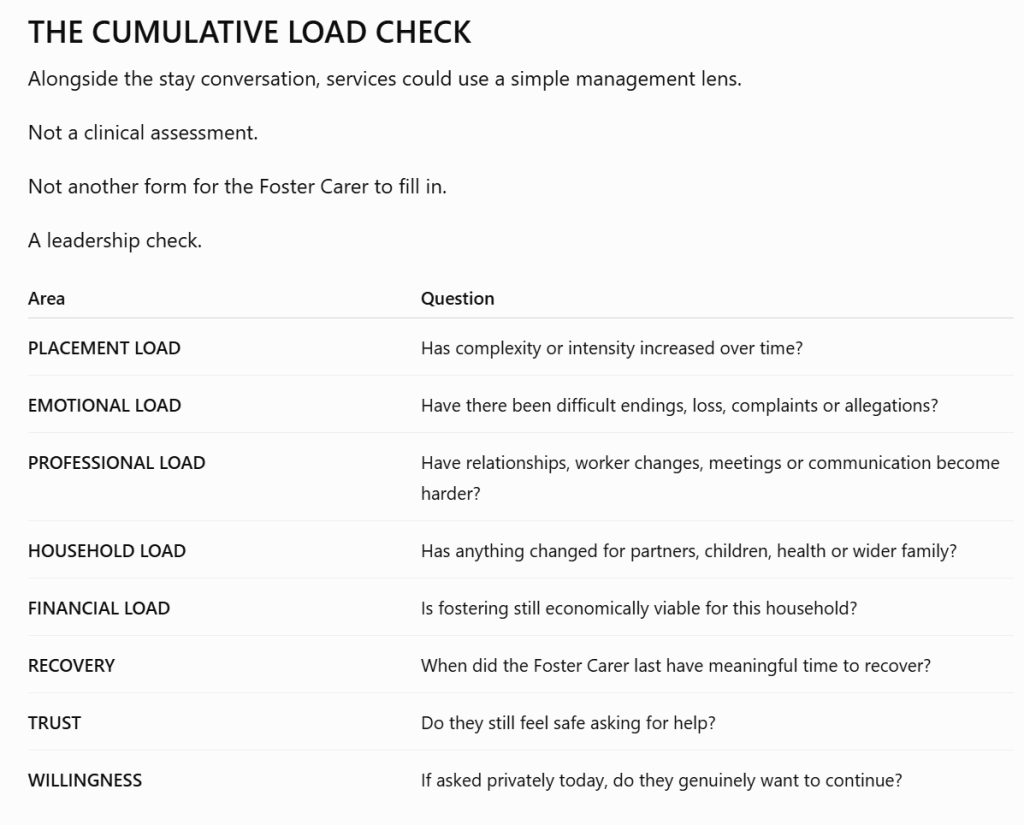
The purpose is not to create another bureaucratic dashboard.
It is to see accumulation.
Because organisations tend to record events separately.
The Foster Carer experiences them together.
Watch the behavioural signals
There may also be early signals worth becoming curious about.
An experienced Foster Carer who previously accepted referrals begins saying no more often.
A household narrows its approval preferences.
Training attendance falls.
Support-group participation drops.
Emails become more frustrated.
A Foster Carer begins repeatedly mentioning:
“How much longer can we do this?”
A partner becomes less involved.
They ask more questions about transferring.
Or they simply become quieter.
None of those automatically means somebody is leaving.
There may be perfectly ordinary explanations.
The management response is not:
“They're a retention risk.”
It is:
“SHOULD WE ASK HOW THINGS ARE GOING?”
Curiosity again.
The sufficiency question is bigger than resignation
Suppose an experienced Foster Carer does not leave.
But because they are exhausted they move from being willing to foster:
teenagers;
siblings;
or children with more complex needs
to only considering significantly narrower referrals.
That may be entirely appropriate.
But from a sufficiency perspective, the organisation has still experienced a change in usable capability.
This reinforces why senior managers should understand retention beyond simple deregistration.
A Foster Carer can remain on the register while:
confidence falls;
availability falls;
range narrows;
and willingness declines.
RETAINING THE REGISTRATION IS NOT ALWAYS THE SAME AS RETAINING THE CAPABILITY.
The current policy context
At the date of writing, 9 September 2026, England's existing 2011 National Minimum Standards remain part of the current regulatory framework.
The Department for Education's consultation on revised fostering standards and guidance remains open and is due to close on 16 September 2026.
So any proposed new standards should still be distinguished from the current framework.
But whatever the eventual wording, the management question behind Point 96 will remain:
CAN YOUR EXPERIENCED FOSTER CARERS TELL YOU THEY ARE BECOMING EXHAUSTED BEFORE EXHAUSTION BECOMES RESIGNATION?
The management test for Point 96
Look at your experienced Foster Carer population.
Not just those currently complaining.
Particularly those who:
rarely complain;
have fostered for years;
take difficult placements;
are repeatedly relied upon;
mentor others;
and are described as:
“rock solid.”
Then ask:
When did somebody last ask them how sustainable fostering still feels?
When did they last have a meaningful break?
What has their household absorbed during the last five years?
Has their placement complexity increased?
Has their trust increased or decreased?
Could they safely tell you they were struggling?
And:
WHAT WOULD MAKE THEM STOP?
Because if the answer only becomes visible in the resignation letter, management has learned it too late.
THE FINAL STRAW IS NOT NECESSARILY THE FIRST CAUSE.
And: