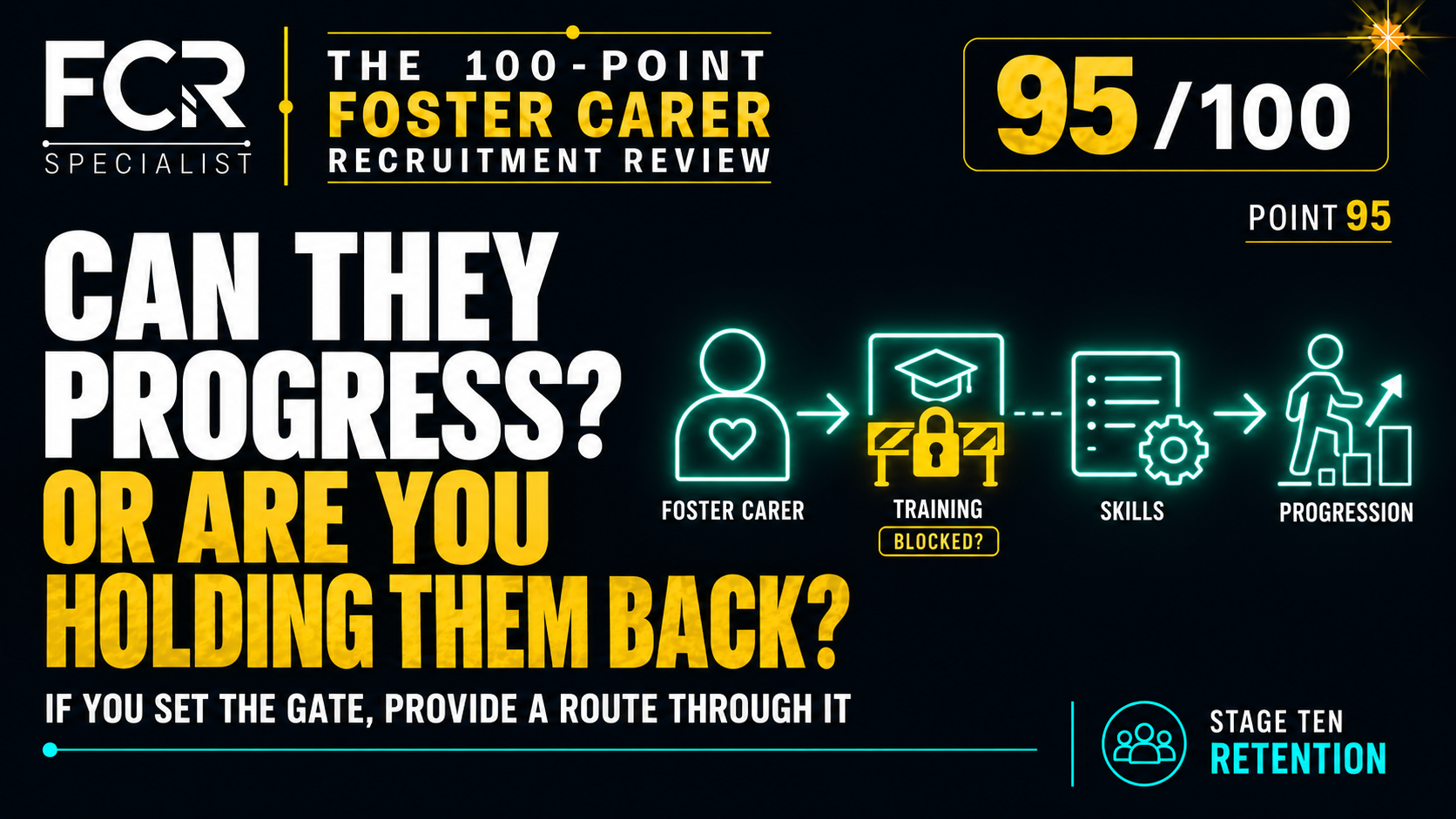
POINT 95/100 — CAN THEY PROGRESS — OR ARE YOU HOLDING THEM BACK?
POINT 95/100 — CAN THEY PROGRESS — OR ARE YOU HOLDING THEM BACK?
There is a particular kind of frustration that can develop slowly in fostering.
It often starts positively.
A Foster Carer wants to develop.
They want to become more skilled.
Perhaps they want to foster children with more complex needs.
Perhaps they want to complete therapeutic training.
Perhaps they have fostered successfully for several years and expect their increasing experience to be recognised.
Perhaps their provider operates a skills or competency payment structure and the Foster Carer wants to move to the next level.
The organisation says:
“Absolutely. To progress you need to complete A, B and C.”
So far, so good.
Then reality intervenes.
Course A runs once a year.
Course B is full.
Course C is cancelled because not enough people booked.
Another course is only available during working hours.
A Foster Carer caring for a child cannot attend because appropriate cover isn't available.
Another needs advanced rather than introductory training but the provider keeps offering the same basic course.
Months pass.
Eventually the Foster Carer is told:
“You haven't completed the requirements.”
Technically, that may be true.
Experientially, the Foster Carer may hear:
“YOU WON'T LET ME COMPLETE THEM.”
That is where development becomes a retention issue.
Training is not simply a course catalogue
Current National Minimum Standard 20 in England is quite clear about the underlying principle.
The outcome is that Foster Carers receive the training and development they need to carry out their role effectively.
The Standard expects:
induction;
ongoing training and development;
a development portfolio;
personal development plans;
review of development needs;
and training appropriate to the Foster Carer's experience.
Importantly, it also states that support and training should be available to help Foster Carers meet children's specific needs and that training should be organised in ways that encourage and facilitate attendance.
That final phrase matters.
Because:
“WE OFFER THE TRAINING”
is not necessarily the same as:
“THE FOSTER CARER CAN REALISTICALLY ACCESS THE TRAINING.”
That distinction becomes especially important where progression or payment depends on completion.
The evidence suggests an access problem
The Fostering Network's State of the Nations' Foster Care 2024 gives us some useful contemporary evidence.
Across the UK, only 53% of Foster Carers said they had an agreed learning and development plan for the following 12 months.
The England figure was substantially better at 72%, but that still leaves more than a quarter of respondents without one.
The survey also found that 63% of recently approved Foster Carers rated post-approval training as excellent or good, down from the overall learning-and-development rating reported in 2021.
But one of the most interesting findings concerns training Foster Carers wanted but could not access.
The most common issue was not the subject matter.
It was:
timing;
format;
or:
level.
Together these accounted for 45% of comments about inaccessible training.
Foster Carers wanted more flexibility, a mixture of face-to-face and online learning, more advanced training and opportunities to gain qualifications.
That is important.
A provider could therefore have an extensive training programme on paper and still have Foster Carers saying:
“I cannot get the development I need.”
Offered is not the same as received
The same survey found some striking differences between what services said they had offered and what Foster Carers reported receiving.
For example, almost half of Foster Carers said they had received training on allegations while around 90% of services said they had offered it.
Almost half reported receiving children's mental-health training compared with around three quarters of services saying they offered it.
There were similar gaps elsewhere.
That doesn't necessarily mean services are reporting incorrectly.
It may reflect:
courses being offered but not attended;
availability problems;
timing;
carer choice;
cancellations;
limited places;
different reporting periods;
or simply the difficulty of making provision reach everybody.
But it gives us an important management distinction:
TRAINING AVAILABLE TO THE ORGANISATION IS NOT NECESSARILY TRAINING ACCESSIBLE TO THE FOSTER CARER.
That is the gap leaders need to examine.
Now add progression
This is where the issue becomes more sensitive.
Different fostering providers operate very different payment structures.
We must not write as though there is one national progression model.
There isn't.
Some Foster Carers receive:
an allowance only;
an allowance plus a fee;
a fee based on the child;
a fee based partly on skill or approval level;
a flat fee;
or another provider-specific arrangement.
The distinction between an allowance and a fee is important.
The fostering allowance is intended to meet the costs associated with caring for a child.
A fee, where paid, recognises the Foster Carer's time, skills and experience.
There is currently no single national fee structure applying across fostering providers. The Fostering Network's 2024 research reports substantial variation and notes that fees are determined by individual providers.
That variation means progression arrangements also vary.
But skills-based progression is common enough to matter
The Fostering Network's FOI research found that 60% of local authorities increased Foster Carer fee rates as carers were deemed to gain skills, including through:
training;
qualifications;
or length of fostering experience.
The 2024 State of the Nations survey also found that, among Foster Carers in England who received a fee, just over half said it was calculated according to their skill or approval level.
So the issue is not theoretical.
For many Foster Carers, development may have a direct relationship with financial progression.
And that creates a governance responsibility.
IF THE ORGANISATION CONTROLS THE GATE, IT MUST ALSO PROVIDE A ROUTE THROUGH IT
Imagine a provider says:
Level 1 → £X
Level 2 → £Y
Level 3 → £Z
To move from Level 1 to Level 2, the Foster Carer must:
complete four courses;
demonstrate competencies;
have a particular amount of experience;
and receive management approval.
There is nothing inherently wrong with that.
In fact, a transparent skills framework can reward experience and encourage development.
But now ask:
Are all four courses actually available?
How often?
Can carers attend online?
Evenings?
Weekends?
Can caring responsibilities be accommodated?
Can equivalent prior learning be recognised?
Is advanced training available for experienced carers?
Who monitors somebody who has been waiting nine months for a course?
Is progression automatically reviewed once requirements are completed?
Or does the Foster Carer then enter another discretionary process?
Those questions determine whether the progression framework is:
A PATHWAY
or:
A BOTTLENECK.
The financial issue cannot be ignored
The State of the Nations survey found that only around a quarter of Foster Carers who received fees felt those fees were sufficient to cover their own essential living costs.
In England, 58% of Foster Carer respondents said they received a fee, while the survey also found that payment models varied substantially.
Finances were also the most frequently identified issue when Foster Carers were asked for the main change they wanted to make Foster Care better.
This doesn't mean Foster Carers foster principally for money.
The same evidence consistently tells us that making a difference to children's lives remains central.
But purpose and financial viability are not opposites.
A Foster Carer can be deeply committed to children and still need to pay:
the mortgage;
energy bills;
food;
transport;
and ordinary household costs.
PURPOSE DOES NOT PAY THE ELECTRICITY BILL.
Financial viability is therefore a retention condition.
Be very careful about the provider incentive question
This Point needs to address an uncomfortable governance question.
Suppose higher skill levels attract higher fees.
Suppose the provider determines:
the progression criteria;
the training programme;
the availability of that training;
and the final decision about progression.
The provider may therefore pay less while the Foster Carer remains at the lower level.
It would be irresponsible to jump from that fact to:
“Providers deliberately stop Foster Carers progressing because it saves money.”
I have found no evidence that would justify such a sector-wide accusation.
That is not the argument.
The governance question is much more defensible:
WHO BENEFITS FINANCIALLY WHEN PROGRESSION CANNOT HAPPEN?
And then:
WHAT SAFEGUARDS MAKE SURE THAT FINANCIAL INCENTIVE CANNOT DISTORT THE DEVELOPMENT PROCESS?
Good governance anticipates conflicts of interest even where nobody is acting improperly.
That is what governance is for.
What would a fair progression system look like?
A credible development-and-progression system should be able to answer some basic questions.
CLEAR CRITERIA
Does the Foster Carer know exactly what is required?
Not:
“Show more experience.”
But specific, understandable criteria.
ACCESSIBLE TRAINING
Can the required courses realistically be completed within a reasonable period?
MULTIPLE ROUTES
Can existing experience, previous qualifications or recognised equivalent learning count where appropriate?
DEVELOPMENT AT THE RIGHT LEVEL
Are experienced Foster Carers offered advanced learning rather than repeatedly being sent to introductory courses?
ACTIVE MONITORING
Does somebody notice when a Foster Carer has been unable to progress because provision has not been available?
TIMELY DECISION-MAKING
Once requirements are met, is progression considered promptly?
APPEAL OR REVIEW
Can the Foster Carer challenge a progression decision or ask for the criteria to be explained?
TRANSPARENT FINANCIAL CONSEQUENCE
Do they know exactly what progression changes financially?
Without those things, a skills framework may look clear in policy while feeling arbitrary in practice.
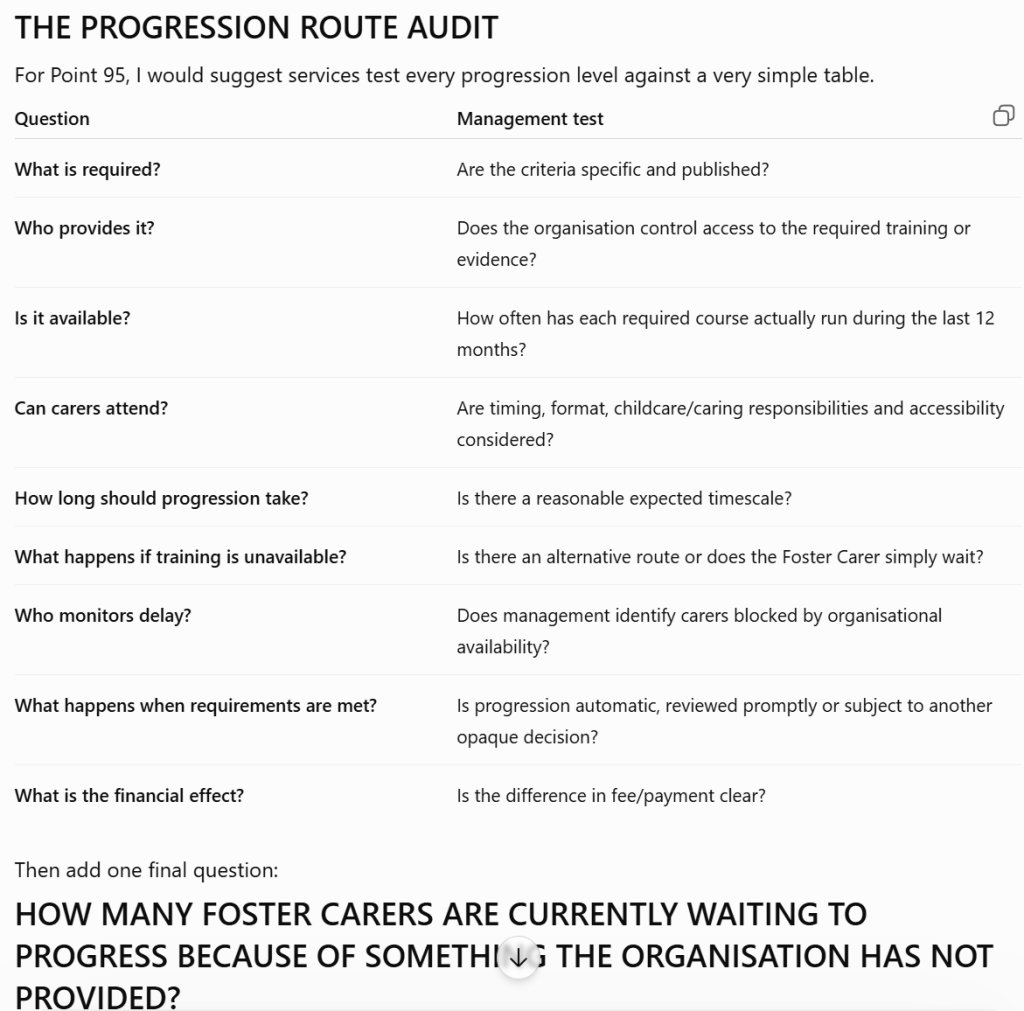
That is a very different metric from:
“How many Foster Carers haven't completed the progression requirements?”
Development should also follow capability
There is a sufficiency issue here that goes beyond money.
Suppose you have an experienced Foster Carer who wants to develop confidence around:
teenagers;
sibling groups;
neurodiversity;
therapeutic care;
disability;
or children with more complex needs.
Those are precisely the capabilities many sufficiency strategies need.
If the service makes that development easy, it potentially increases:
placement choice;
matching flexibility;
carer confidence;
and retention.
If the development route is blocked, the service may simultaneously:
frustrate the Foster Carer
and:
fail to build the capability it says it needs.
That is an extraordinary own goal.
DEVELOPMENT IS ALSO SUFFICIENCY BUILDING.
We should not think of training only as maintaining compliance.
It can expand the usable capability of the existing Foster Carer population.
Recognise experience — don't make people start again
There is another interesting requirement in Standard 20.
Where a Foster Carer moves to another fostering service, details of training and development should be made available on request and the Foster Carer should be able to take their development portfolio with them.
There is a useful principle inside that.
Experience belongs partly to the Foster Carer.
It does not disappear because the organisational logo changes.
So even before a transfer occurs, services should ask:
Are we recognising accumulated learning?
Prior qualifications?
Specialist experience?
Years of successful practice?
Or does everybody repeatedly have to begin at the bottom of the organisational training ladder?
For an experienced Foster Carer, constant repetition can feel less like development and more like failure to recognise professional growth.
What happens if another provider offers a better route?
This is where progression becomes retention.
Imagine a Foster Carer thinks:
“I have been here eight years.”
“I have asked repeatedly for advanced training.”
“I cannot move to the next fee band.”
“Another provider will recognise my experience and pay me at a higher level.”
At that point, transferring may look entirely rational.
That does not make the Foster Carer disloyal.
It should make the original provider curious.
What did the other organisation offer?
Was it:
better training?
recognition of prior experience?
a clearer skills framework?
better financial progression?
more appropriate placements?
greater professional status?
If the Foster Carer remains in fostering but transfers organisation, national system capacity may remain.
But the original provider has still lost local capability.
HOW MUCH EXPERIENCE DO YOU LOSE WHEN SOMEBODY HAS TO LEAVE TO PROGRESS?
The management question for Point 95
Look at your skills and fee structure.
Then don't ask only:
“Have Foster Carers completed the requirements?”
Ask:
“HAVE WE MADE IT REALISTICALLY POSSIBLE FOR THEM TO COMPLETE THE REQUIREMENTS?”
How many required courses were cancelled?
How long are waiting lists?
How many are available evenings or online?
How many experienced Foster Carers are still waiting for advanced development?
How many progression applications are delayed?
How many people have sat at the same level for years?
How many left for another provider offering better recognition?
Because if progression depends upon development, the organisation cannot treat access to development as somebody else's problem.
IF YOU SET THE GATE, YOU HAVE A RESPONSIBILITY TO PROVIDE A REALISTIC ROUTE THROUGH IT.
And if an experienced Foster Carer eventually concludes:
“The only way I can progress is to leave,”
then the retention consequence is obvious.