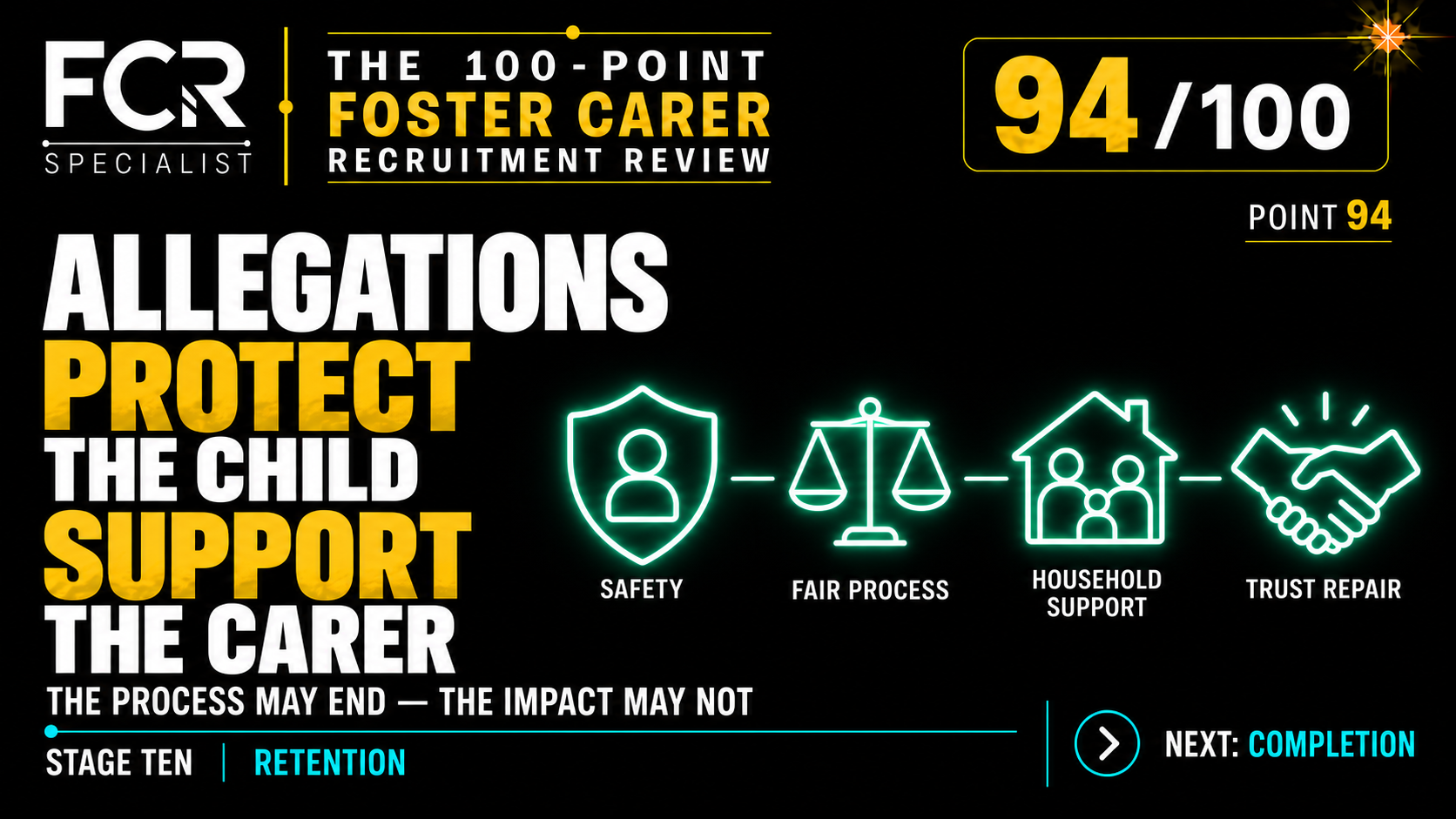
POINT 94/100 — ALLEGATIONS: CAN YOU PROTECT THE CHILD WITHOUT BREAKING THE CARER?
POINT 94/100 — ALLEGATIONS: CAN YOU PROTECT THE CHILD WITHOUT BREAKING THE CARER?
There are some subjects in fostering that change the emotional temperature of the room the moment they are raised.
Allegations are one of them.
In my experience, if you ask Foster Carers what most damages trust and most powerfully makes them question whether they can continue fostering, allegations will be mentioned very quickly.
That does not mean every allegation is wrong.
It does not mean Foster Carers should somehow be protected from investigation.
And it certainly does not mean that child safety should ever be diluted to preserve recruitment or retention.
Let us start in the right place.
CHILD SAFETY IS PARAMOUNT.
Allegations and suspicions of harm must always be taken seriously.
Children must be protected.
Concerns must be investigated properly.
Where risk exists, it must be addressed.
This Point is not an argument against scrutiny.
It is an argument for understanding something the sector can sometimes avoid saying clearly enough:
AN ALLEGATION IS NOT ONLY A SAFEGUARDING EVENT.
IT IS ALSO A RETENTION EVENT.
Because even where an allegation is not substantiated, the Foster Carer's experience of the process may be enough to alter permanently how safe, valued and willing to continue they feel.
One of the biggest retention issues — but we need to speak carefully
I have often heard people in the sector describe allegations as one of the biggest reasons Foster Carers leave.
Many Foster Carers would say the same.
I think that is an important professional insight.
But we should still be careful.
I have not seen a robust national dataset that tells us precisely how many Foster Carers leave fostering because of allegations, how long after the allegation they leave, or how many transfer rather than resign altogether.
That evidence gap matters.
It means we should not make claims we cannot prove.
But the absence of good data is not the same as absence of a problem.
In fact, it may tell us something important:
WE TRACK THE PROCESS.
WE DO NOT ALWAYS TRACK THE AFTERMATH.
And the aftermath is where retention either survives or begins to collapse.
Why allegations feel different
Many difficult experiences in fostering are painful.
A placement ending can be painful.
Professional disagreement can be painful.
A complaint can be painful.
But allegations often feel different because they can strike directly at identity.
A Foster Carer may experience the allegation process as saying, implicitly or explicitly:
“Can you be trusted?”
That can be devastating.
Especially for people who may have fostered for years, built a reputation, and opened their home repeatedly to children with complex needs.
The experience may involve:
sudden shock;
fear about what is being said;
uncertainty about what happens next;
worry about whether a child will remain in placement;
worry about whether the service still believes in them;
concern about money;
concern about confidentiality;
stress within the household;
stress for partners and children;
and the sense that even if the issue is resolved, something fundamental has changed.
That is why allegations cannot simply be understood as a compliance procedure.
They are also a human experience.
And sometimes a deeply destabilising one.
This is not about choosing between the child and the carer
That is a false choice.
A good fostering service should be capable of holding both principles at once:
PROTECT THE CHILD.
and:
TREAT THE FOSTER CARER FAIRLY AND SUPPORTIVELY THROUGH THE PROCESS.
In fact, current National Minimum Standards in England already say exactly that.
Standard 22 expects allegations and suspicions of harm to be handled fairly, quickly and consistently in a way that provides effective protection for the child and, at the same time, supports the person who is the subject of the allegation.
The same Standard also says there should be written guidance making clear how Foster Carers will be supported during an investigation, including payment of allowance and any fee while investigations are ongoing, and that independent support should be made available.
That matters enormously.
Because it means support for the Foster Carer during an allegation is not an optional kindness.
It is part of good fostering governance.
On paper, the framework is stronger than people sometimes realise
The current framework is actually quite instructive.
It says fostering services should:
handle allegations fairly, quickly and consistently;
make a clear distinction between allegations of harm and standards-of-care issues;
make written guidance available about support during the process;
set out what happens regarding payment and allowance;
provide independent support to the person subject to the allegation and, where appropriate, their household;
and review the Foster Carer's approval as soon as possible after the investigation concludes.
That is important because many of the issues Foster Carers describe as most damaging are not always the fact of investigation itself.
They are often the experience surrounding it.
For example:
not understanding the process;
poor communication;
long periods of uncertainty;
feeling abandoned by the service;
not knowing whether income is protected;
believing colleagues now see them differently;
or feeling that when the allegation ends, nobody knows how to restore normality.
A service can therefore comply procedurally and still lose the carer relationally.
PROCESS COMPLIANCE DOES NOT GUARANTEE RETENTION.
The distinction between allegations and standards of care
One of the most important parts of the current National Minimum Standards is the requirement to keep allegations of harm clearly distinct from discussions about standards of care.
That may sound technical.
It is not.
It goes directly to trust.
If an allegation is investigated and no evidence of harm is found, the Standards say that should not simply roll over into a standards-of-care process as a way of continuing the issue by another route.
That does not mean standards-of-care concerns can never exist.
They may.
But they must be treated separately and fairly.
This principle matters because many Foster Carers fear not only the allegation itself, but the sense that once concern has been raised, the service will never quite see them the same way again.
Whether that fear is justified in any individual case will vary.
But leadership should be interested in the fact that the fear exists.
Because fear changes behaviour.
A Foster Carer who no longer trusts the organisation may:
stop taking challenging placements;
become more risk-averse;
reduce availability;
withdraw from the fostering community;
begin thinking about transferring;
or leave altogether.
Which takes us straight back to Point 91.
RETENTION IS SUFFICIENCY.
The household experiences the allegation too
One of the things that can be missed is that allegations do not affect only the individual Foster Carer.
They can affect:
partners;
birth children;
other children in placement;
the wider household;
and the emotional climate of the home.
That is one reason the Standards refer not only to support for the Foster Carer, but potentially support for the household too.
Think about what may be happening inside that home.
People may be frightened.
They may be confused.
They may feel judged.
They may be trying to manage ordinary family life while also dealing with professionals, uncertainty and emotion.
If the service's only response is procedural, a great deal may go unsupported.
And yet this is precisely the moment when support most powerfully communicates organisational values.
HOW YOU RESPOND DURING AN ALLEGATION TELLS THE FOSTER CARER WHAT YOUR PARTNERSHIP REALLY MEANS.
What usually shapes the memory of the experience?
Not every Foster Carer will remember an allegation experience in the same way.
But if services want to understand why some allegations become lasting retention damage, these are the sorts of questions worth asking.
Did the Foster Carer understand what was happening?
Were they treated respectfully?
Was there clarity about the process?
Was communication regular, even when there was little progress to report?
Was independent support actually offered and accessible?
Was financial position clear?
Did the service distinguish properly between safeguarding enquiry and other concerns?
Did anybody think about the effect on the household?
Was the matter progressed as quickly as possible?
And when the process ended:
DID ANYBODY HELP THEM FIND THEIR WAY BACK INTO FOSTERING?
Because many services focus heavily on the investigation and too little on re-entry.
A closed process is not the same as a repaired relationship
An allegation may be concluded.
The paperwork may be finished.
A review may have taken place.
A decision may have been made.
But a retention question remains.
Does the Foster Carer still feel:
safe;
trusted;
wanted;
respected;
and willing to continue?
This is where some services can underestimate the damage.
They assume that because the process is over, the problem is over.
But from the Foster Carer's perspective, they may still be asking:
“Will they ever really trust me again?”
“Do they see me differently now?”
“Could this happen again?”
“Would I risk going through this twice?”
“Is this still emotionally and financially viable for my household?”
Those are retention questions.
And if nobody asks them, the first time management hears the answer may be when the Foster Carer resigns or transfers.
RESIGNATION MAY COME MONTHS AFTER THE ALLEGATION.
THE DAMAGE MAY HAVE STARTED DURING IT.
We also need better intelligence
If allegations really are one of the biggest drivers of Foster Carer exit, services should know much more than many currently do.
For example:
How many Foster Carers have experienced an allegation in the last three years?
How many remained active and confident afterwards?
How many reduced their availability?
How many stopped taking more complex placements?
How many transferred?
How many resigned within 6–12 months?
How many said the process itself, or how they were treated during it, influenced that decision?
Without this kind of intelligence, leaders may underestimate the sufficiency impact.
They may assume:
“The allegation was resolved and the carer stayed.”
But did they stay wholeheartedly?
Did they continue offering the same type of care?
Did trust recover?
Or did the service retain the registration but lose the confidence?
That distinction matters.
The policy context is moving too
This issue is not static.
In February 2026, the Government consulted specifically on handling allegations of abuse against Foster Carers as part of wider fostering reform.
By June 2026, the consultation outcome and Government response had been published.
And, at the time of writing, England is also consulting on wider updated fostering standards and guidance, with that consultation due to close on 16 September 2026.
So allegations are not just a local operational concern.
They are part of current national reform territory.
But for Point 94, we need to keep one distinction very clear:
PROPOSED REFORM IS NOT THE SAME AS THE CURRENT FRAMEWORK.
At present, the current National Minimum Standards still matter.
And those Standards already require more than many people sometimes realise.
THE ALLEGATION EXPERIENCE CHECK
For Point 94, I want to propose a simple management tool.
Not a legal framework.
Not a replacement for safeguarding procedures.
A management check.
1. SAFETY
Was the child protected immediately and appropriately?
2. FAIRNESS
Was the Foster Carer told clearly what was happening and treated fairly through the process?
3. SUPPORT
Was support offered — including independent support — to the Foster Carer and, where relevant, their household?
4. VIABILITY
Was there clarity about allowance, fee and practical household implications during the investigation?
5. DISTINCTION
Was a clear line maintained between the allegation process and any separate standards-of-care issues?
6. REPAIR
When the matter concluded, was there a conscious attempt to review trust, restore working relationships and understand the impact on retention?
That last one is often the missing piece.
Because a service can be excellent at opening an allegation process and far less strong at closing the emotional gap it leaves behind.
You can protect the child and still lose the carer
This is the central management warning of Point 94.
A service may do exactly the right thing in relation to child protection.
It may follow process properly.
It may reach a justified outcome.
And it may still lose an experienced Foster Carer afterwards because the Foster Carer no longer feels safe to continue.
That does not necessarily mean the service acted wrongly.
But it does mean the service should learn from what happened.
Could communication have been better?
Could support have been stronger?
Could the distinction between process and person have been clearer?
Could recovery have been handled differently?
Because if the answer is yes, then allegations should not be treated only as safeguarding casework.
They should also be treated as retention intelligence.
The management question for Point 94
So I would ask every fostering service to reflect on the last allegation involving one of its Foster Carers.
Not only:
Was the procedure followed?
Ask also:
WHAT DID IT FEEL LIKE TO THE FOSTER CARER?
Did they understand the process?
Did they feel supported?
Did the household feel supported?
Was income clear?
Was the issue concluded quickly enough?
Was trust reviewed afterwards?
Did the service retain the person — or only the registration?
Because:
AN ALLEGATION MAY END ON PAPER.
BUT THE RETENTION CONSEQUENCES MAY LAST MUCH LONGER.
And if that Foster Carer eventually leaves, or never quite fosters in the same way again: