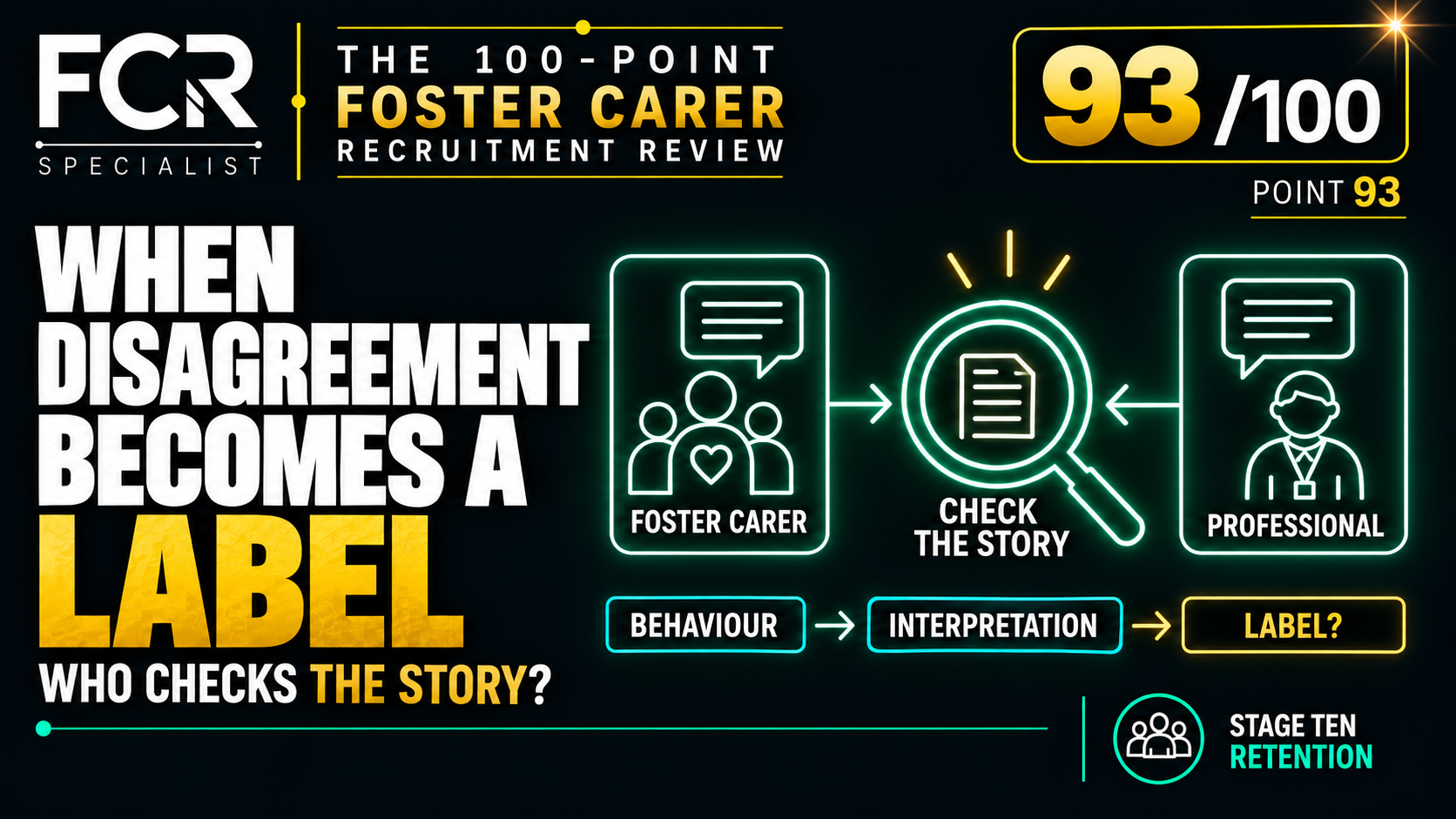
POINT 93/100 — WHEN DISAGREEMENT BECOMES A LABEL: WHO CHECKS THE STORY?
POINT 93/100 — WHEN DISAGREEMENT BECOMES A LABEL: WHO CHECKS THE STORY?
Point 92 asked a deliberately uncomfortable question:
Are Foster Carers equal partners — until they disagree?
Point 93 goes one stage further.
What happens after the disagreement?
A Foster Carer raises a concern.
Perhaps they challenge a decision.
Perhaps they complain.
Perhaps they feel something has happened unfairly.
The Social Worker disagrees.
The relationship becomes strained.
Other colleagues become involved.
Meetings happen.
Emails are exchanged.
People understandably discuss the situation with their managers.
And gradually the organisational description of the Foster Carer may begin to change.
They were:
experienced.
committed.
passionate.
Now the words become:
difficult.
challenging.
unrealistic.
demanding.
always complaining.
This Point is not an allegation that Social Workers routinely label Foster Carers.
I have found no evidence that would justify making that claim.
Nor should we pretend that every Foster Carer who challenges a service is behaving reasonably.
Sometimes Foster Carer behaviour is difficult.
Sometimes professional challenge is necessary.
Sometimes managers should support their Social Workers.
But the important governance question is:
WHO CHECKS WHETHER A DESCRIPTION OF BEHAVIOUR HAS QUIETLY BECOME A DESCRIPTION OF CHARACTER?
This isn't about deciding that the Foster Carer must be right
That would simply reverse the problem.
A Foster Carer may:
misunderstand information;
react angrily;
behave inappropriately;
refuse reasonable professional advice;
communicate poorly;
or form conclusions that the evidence does not support.
Equally, a Social Worker can misunderstand something.
A manager can receive an incomplete account.
A professional team can become defensive.
Relationships can deteriorate on both sides.
This is exactly why organisations need to resist the temptation to resolve difficult relationship problems through simplified narratives.
The question should not immediately become:
“Who is the problem?”
It should remain:
“WHAT HAS ACTUALLY HAPPENED?”
The evidence tells us professional respect matters
The Fostering Network's State of the Nations' Foster Care 2024 found that three in five Foster Carers surveyed across the UK had considered, or were considering, resignation.
Among the most commonly selected reasons were:
lack of support from the fostering service;
lack of respect from other professionals;
and burnout or poor wellbeing associated with fostering.
The same research found that Foster Carers wanted greater recognition of their professional status, voice and contribution within the team around the child.
That does not prove that professional conflict causes Foster Carers to leave.
It certainly does not prove that Foster Carers who complain are subsequently labelled.
But it tells us something important.
THE WAY FOSTER CARERS EXPERIENCE PROFESSIONAL RELATIONSHIPS MATTERS TO RETENTION.
So organisations should be very interested in what happens when those relationships begin to fail.
Complaining is not outside the fostering system
There can sometimes be a subtle psychological shift when a Foster Carer moves from being somebody who is receiving support to somebody who is making a complaint.
Yet complaining is not evidence that somebody is unsuitable to foster.
Nor should the existence of a complaint automatically prove that the service has failed.
It is a mechanism for raising concerns.
Current National Minimum Standard 21.11 in England states that current and prospective Foster Carers must be able to make a complaint about any aspect of the service that affects them directly.
It also requires services to keep records of representations and complaints, how they were dealt with, the outcome and action taken, and to review those records so practice can improve where necessary.
For local authority children's services, the Government's statutory complaints guidance also explicitly states that it applies to Foster Carers and other adults making complaints.
That gives us an important starting point.
A COMPLAINT SHOULD CREATE INFORMATION FOR ORGANISATIONAL LEARNING.
It should not automatically create a negative identity for the person making it.
But organisations are made of people
This is where things become more complicated.
When somebody feels criticised, challenged or complained about, they may naturally feel defensive.
That doesn't make them a bad professional.
It makes them human.
A Foster Carer may also become defensive when their practice is challenged.
Again, human.
The organisational risk arises when those understandable reactions begin influencing interpretation.
Consider this sequence:
A Foster Carer has a disagreement with their SSW.
The SSW discusses it with their manager.
That is entirely reasonable.
The manager speaks to colleagues.
Also reasonable.
The Foster Carer raises another issue.
Now the second issue is heard through the context of the first.
Then perhaps a third issue appears.
Somebody says:
“This is becoming a pattern.”
Maybe it is.
But maybe three legitimate issues have occurred.
The only way to know is to examine them.
Confirmation bias: use the concept carefully
There is a useful concept from decision-making research here:
CONFIRMATION BIAS.
Broadly, once people form an initial hypothesis, they may become more likely to seek, interpret or give weight to information that confirms it.
Research across professional decision-making has identified cognitive biases including confirmation bias, although the evidence base is much stronger in areas such as psychology, medicine and law than it is specifically in Social Work. One scoping review found substantially fewer studies in Social Work than in psychology and cautioned that more profession-specific research was needed.
A broader review of professional decision-making similarly describes confirmation bias as a potential influence on interpretation once an initial view has formed.
We need to be precise.
That research does not demonstrate:
“Fostering managers suffer confirmation bias when Foster Carers complain.”
We do not have evidence for that statement.
What it gives us is a legitimate management warning:
ONCE AN ORGANISATIONAL NARRATIVE FORMS, BUILD IN A WAY TO TEST IT.
That applies to the narrative about the Foster Carer.
And equally to the Foster Carer's narrative about the Social Worker.
Behaviour versus character
This may be one of the simplest improvements organisations can make.
Compare these descriptions:
“The Foster Carer raised their voice during Tuesday's meeting and interrupted the Social Worker repeatedly.”
with:
“The Foster Carer is aggressive.”
Or:
“The Foster Carer has emailed four times this week asking for an update on the outstanding support request.”
with:
“They are demanding.”
Or:
“The Foster Carer has disagreed with three decisions concerning this placement.”
with:
“They are always difficult.”
The first description in each case identifies behaviour.
It can be examined.
It can be evidenced.
It can be discussed.
The second assigns character.
Once character language enters records and professional discussion, it may be much harder to remove.
That leads to a useful management principle:
DESCRIBE WHAT SOMEBODY DID BEFORE DECIDING WHAT SOMEBODY IS.
The Foster Carer may not be in the room
There are legitimate reasons for professionals to meet without a Foster Carer.
Safeguarding.
Confidential information.
Employment or management matters.
Case planning where particular information cannot appropriately be shared.
Point 93 is not arguing:
“Foster Carers must attend every professional meeting.”
That would be unrealistic.
The risk is different.
Suppose a meeting discussing a deteriorating relationship occurs without the Foster Carer present.
Different professionals share their experiences.
A coherent organisational story develops.
That story may be completely accurate.
But the Foster Carer has not been part of testing it.
That is where management needs to ask:
HAVE WE HEARD THE OTHER ACCOUNT BEFORE TURNING THIS VERSION INTO ORGANISATIONAL FACT?
This does not mean giving everybody equal credibility automatically.
It means gathering enough information to reach a considered view.
Professional hierarchy matters too
Foster Carers occupy an unusual position.
They are central to children's day-to-day care.
They can be highly experienced.
Yet they do not hold the same statutory authority as Social Workers and may feel they have less power within organisational structures.
The Rees Centre's review of the Supervising Social Worker role identified a longstanding tension around whether Foster Carers are understood as clients, colleagues or something between the two.
The review found that feeling trusted, valued and treated as part of the team was important to Foster Carers, while Social Workers themselves could experience tension because the relationship is simultaneously supportive and supervisory.
That complexity matters during conflict.
If both sides disagree, they do not necessarily enter the organisational process with the same status.
The Social Worker may:
have organisational colleagues;
understand internal processes;
know management structures;
write professional records;
and participate routinely in professional meetings.
The Foster Carer may have none of those advantages.
That does not mean the Social Work account is wrong.
It means:
MANAGEMENT SHOULD NOTICE THE POWER DIFFERENCE WHEN TESTING THE STORY.
Independent listening does not always mean a formal investigation
When I suggest that somebody outside the immediate relationship should hear the Foster Carer, I am not proposing another cumbersome procedure every time somebody disagrees.
Most relationship difficulties should be resolved locally and quickly.
Perhaps through:
an SSW manager;
another experienced manager;
a Foster Carer liaison role;
mediation;
a facilitated conversation;
or whatever suitable arrangement the service already has.
The principle is simply:
IF THE RELATIONSHIP ITSELF HAS BECOME THE PROBLEM, DON'T RELY ENTIRELY ON THAT RELATIONSHIP TO EXPLAIN THE PROBLEM.
That is particularly important where the Foster Carer says:
“The person I have a problem with is also the person explaining me to everybody else.”
A manager needs enough independence to become curious.
Procedural fairness can help us understand why this matters
There is a large body of organisational research around procedural justice.
One recurring finding is that people tend to judge processes as fairer when they have a genuine opportunity to express their view, when information is considered accurately, when decision-makers are impartial and when there is some route to challenge or correct decisions.
Research also suggests that voice can affect perceptions of fairness even when the eventual outcome is not the person's preferred one.
Again, this is general organisational research rather than fostering-specific evidence.
But the application is useful.
A Foster Carer may still disagree with management's final conclusion.
Yet they may experience the process very differently if they can say:
“They heard me.”
“They checked what happened.”
“They explained why they reached that conclusion.”
That is very different from:
“Everybody had already decided what I was like before anyone asked me.”
CURIOSITY BEFORE CONCLUSION
This takes us back to the principle established for Stage Ten.
CURIOSITY BEFORE CONCLUSION.
That doesn't mean indecision.
Managers have to make decisions.
It doesn't mean every account is equally plausible.
They may not be.
It means making sure the route to conclusion is sufficiently curious.
Before somebody becomes described throughout the organisation as:
difficult;
unrealistic;
challenging;
or:
a problem;
ask:
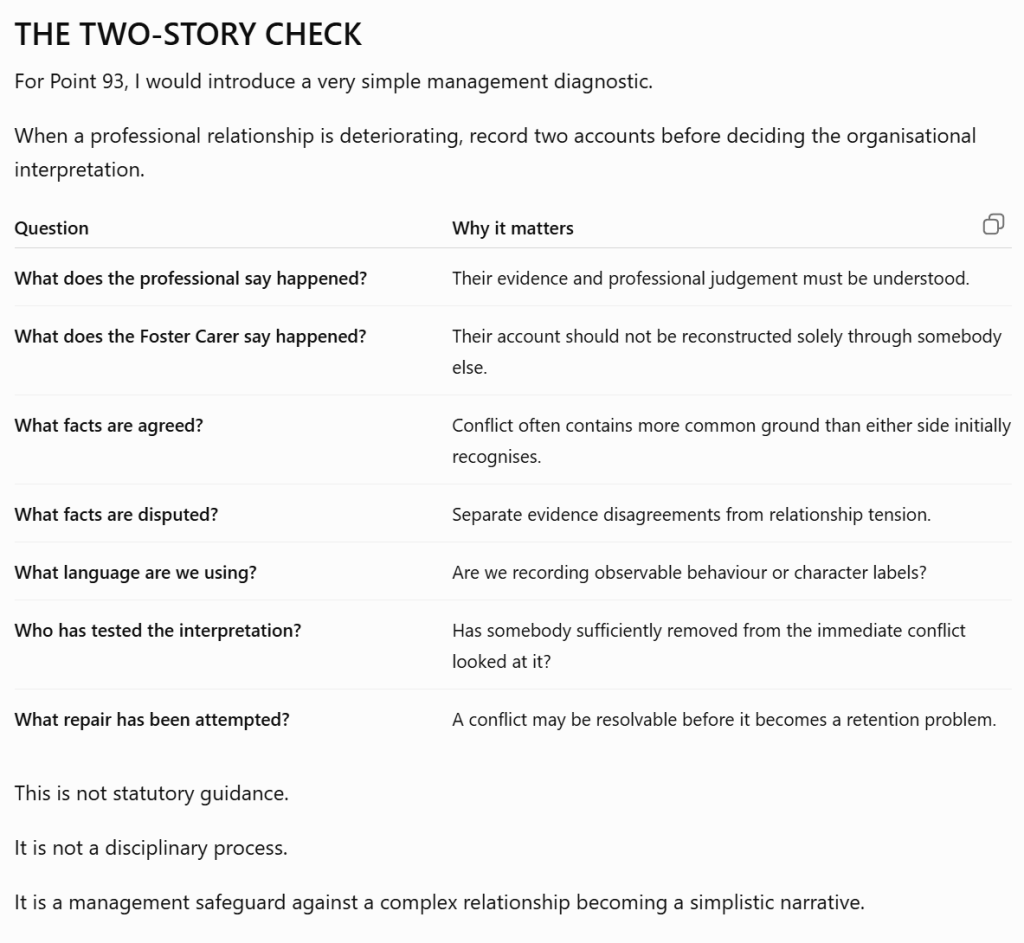
What specifically happened?
What evidence supports each interpretation?
What does the Foster Carer say happened?
Has somebody outside the immediate relationship heard them?
Are we describing behaviour — or assigning character?
What has been done to repair the relationship?
And:
WOULD WE USE THE SAME LANGUAGE IF THE FOSTER CARER WERE SITTING IN THE ROOM?
That final question is deliberately uncomfortable.
It should be.
Sometimes management will conclude the Foster Carer's behaviour really is the problem
That needs saying clearly.
After listening to both sides, a manager may conclude:
the Social Worker acted appropriately;
the Foster Carer behaved unacceptably;
professional boundaries were crossed;
practice concerns are legitimate;
or the complaint isn't supported by the evidence.
That is entirely possible.
FAIRNESS DOES NOT MEAN THE FOSTER CARER MUST WIN.
It means the conclusion is reached after proper consideration.
Equally, management may discover:
communication was poor;
a commitment was not honoured;
the Social Worker was under impossible pressure;
the Foster Carer was not listened to;
the situation escalated unnecessarily;
or both sides contributed to the breakdown.
That creates an opportunity to repair something.
Do not make this an SSW problem
The temptation would be to reduce Point 93 to:
“SSWs need to listen better.”
That would miss the issue completely.
Many SSW relationships are extremely strong.
The 2024 State of the Nations survey found three quarters of Foster Carers rated their SSW support as good or excellent.
The organisational question is broader.
Does the service give SSWs and managers:
time to repair relationships;
access to supervision;
support when conflict occurs;
clear escalation routes;
management curiosity;
and an organisational culture in which admitting that a relationship has deteriorated is safe?
A Social Worker who feels unsupported may become defensive too.
RELATIONSHIP REPAIR IS AN ORGANISATIONAL RESPONSIBILITY — NOT SIMPLY AN INDIVIDUAL SKILL.
And now bring it back to sufficiency
Suppose the Foster Carer eventually says:
“I've had enough.”
They transfer to another provider.
Or they resign altogether.
The original service may record:
One household deregistered.
But perhaps that household had:
eight years' experience;
space for siblings;
confidence fostering teenagers;
excellent placement stability;
a strong local reputation;
and the ability to mentor newer Foster Carers.
Point 91 told us:
HEADCOUNT SUFFICIENCY IS NOT THE SAME AS CAPABILITY SUFFICIENCY.
Point 93 adds:
RELATIONSHIP FAILURE CAN BECOME CAPABILITY LOSS.
That is why apparently small professional conflicts deserve attention before they harden into organisational stories.
The management test for Point 93
Think about the last Foster Carer your organisation described as:
difficult.
Don't immediately change the conclusion.
Just test it.
Ask:
WHAT WERE THEY DIFFICULT ABOUT?
Did they challenge something important?
Were they wrong?
Were they right?
Were they partly right?
Were they badly behaved?
Were they badly treated?
Did the conflict begin with one unresolved issue?
Did anybody attempt to repair it?
Did somebody independent of the immediate relationship hear their account?
Would the organisation use the same language if they were in the room?
Because:
DON'T ALLOW ONE VERSION OF A RELATIONSHIP BREAKDOWN TO BECOME ORGANISATIONAL FACT WITHOUT TESTING IT.
This is not about believing Foster Carers over professionals.
It is about good management.
And when the stakes include the potential loss of an experienced fostering household:
it is also about sufficiency.