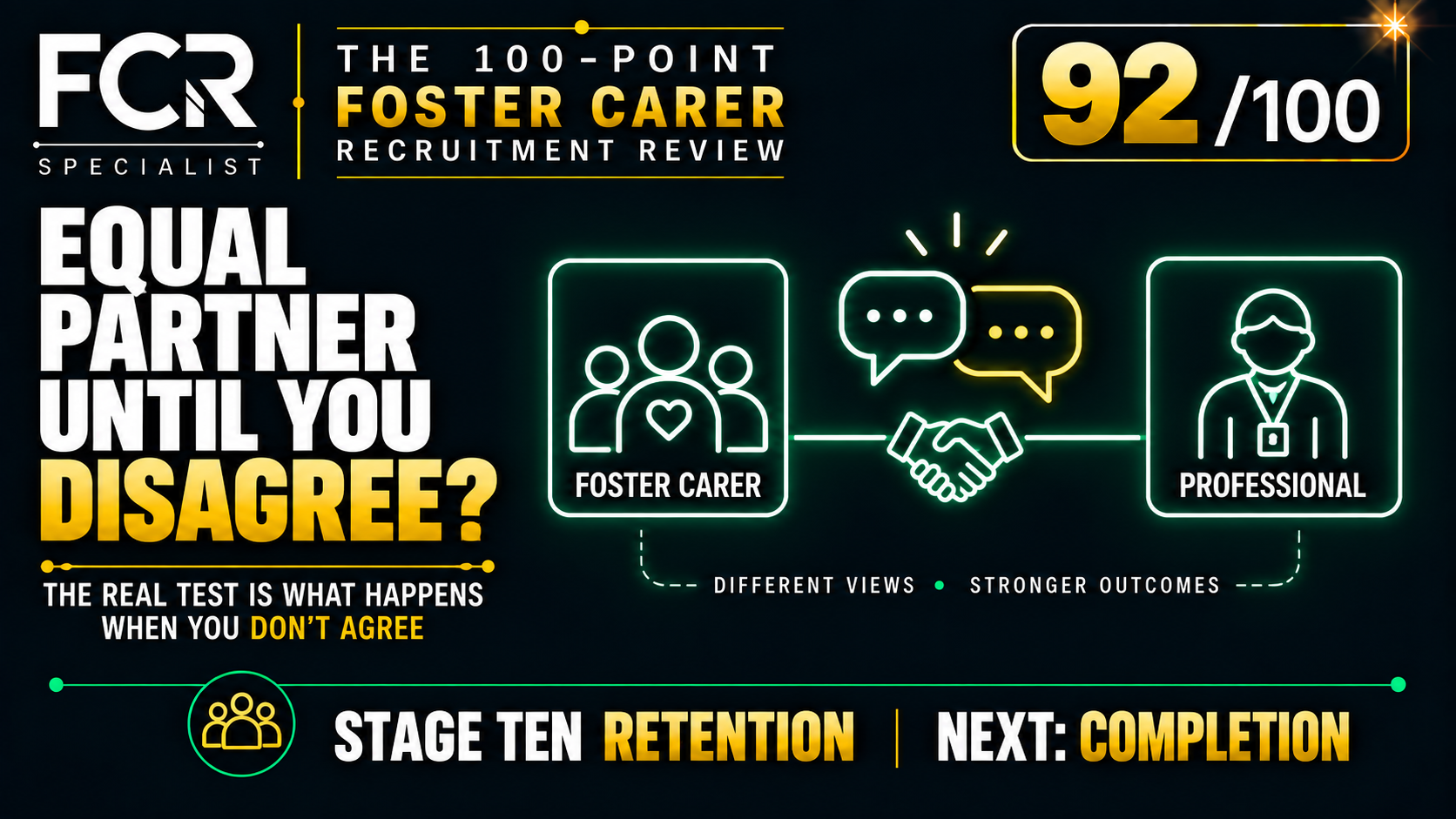
POINT 92/100 — ARE YOU AN EQUAL PARTNER — UNTIL YOU DISAGREE?
POINT 92/100 — ARE YOU AN EQUAL PARTNER — UNTIL YOU DISAGREE?
Foster Carers hear this phrase repeatedly:
“You are part of the team around the child.”
It appears in fostering conversations, training, charters, supervision and professional practice.
And rightly so.
A child in Foster Care may have a complex network around them:
their Foster Carer;
their child's Social Worker;
their Supervising Social Worker;
Independent Reviewing Officer;
school;
health professionals;
therapists;
birth family;
and potentially numerous other people.
Nobody sees the whole picture alone.
Good Foster Care therefore depends heavily upon people working together.
But I think there is an important question hiding underneath that familiar phrase:
DOES THE FOSTER CARER'S STATUS AS A PARTNER SURVIVE DISAGREEMENT?
Because partnership is relatively easy when everybody agrees.
The difficult test comes when the Foster Carer says:
“I don't think this is working.”
“I am worried about what I'm seeing.”
“I don't agree with this plan.”
“I think this child needs something different.”
“I don't think we have enough information.”
Or simply:
“No.”
That is when an organisation discovers whether partnership is a genuine working principle or just something written in its Foster Carer Charter.
The evidence tells us that status still matters
The Fostering Network's State of the Nations' Foster Care 2024 asked Foster Carers whether they generally felt treated as an equal and valued member of the team around the child.
Across the UK, Foster Carers were most positive about health professionals and Supervising Social Workers and least positive about children's Social Workers.
Only 53% said they always or usually felt treated as an equal and valued team member by children's Social Workers.
For Supervising Social Workers the figure was 76%.
The children's Social Worker figure had fallen from 57% in 2021, while the SSW figure had fallen from 80%.
This is UK-wide evidence rather than England-only data.
But it gives us an important management question.
If around half of Foster Carers do not consistently experience themselves as equal and valued members of the team in their relationship with children's Social Workers, what does that mean for day-to-day collaboration?
And what happens when there is disagreement?
Equal does not mean identical
We need to be careful with the phrase equal partner.
It can easily be misunderstood.
A Foster Carer is not the child's Social Worker.
A Foster Carer does not have identical statutory responsibilities.
They do not automatically have authority to make every decision.
They do not have a veto over the care plan.
Nor should professional disagreement automatically be resolved in their favour simply because they live with the child.
Likewise, the child's Social Worker may hold information, duties and wider family context that the Foster Carer does not.
So the argument is not:
“The Foster Carer knows best.”
The argument is:
DIFFERENT PEOPLE HOLD DIFFERENT PARTS OF THE CHILD'S STORY.
A Foster Carer may have particularly detailed knowledge of the child's everyday lived experience.
They may see:
how the child sleeps;
what happens before school;
what happens after family time;
what makes them anxious;
which friendships matter;
how they respond after professional meetings;
what routines settle them;
what food they will eat;
what happens when they are frightened;
what they say quietly at home;
and gradual changes that are difficult to capture through periodic professional visits.
That knowledge does not replace statutory professional judgement.
But neither should it be treated as secondary simply because it comes from a Foster Carer.
Being listened to does not mean getting your own way
This distinction is fundamental.
A Foster Carer can be properly listened to and still not get the outcome they requested.
A Social Worker can disagree with a Foster Carer without disrespecting them.
A manager can uphold a decision the Foster Carer dislikes while still maintaining a strong professional relationship.
The test is often what happens in between.
Was the Foster Carer:
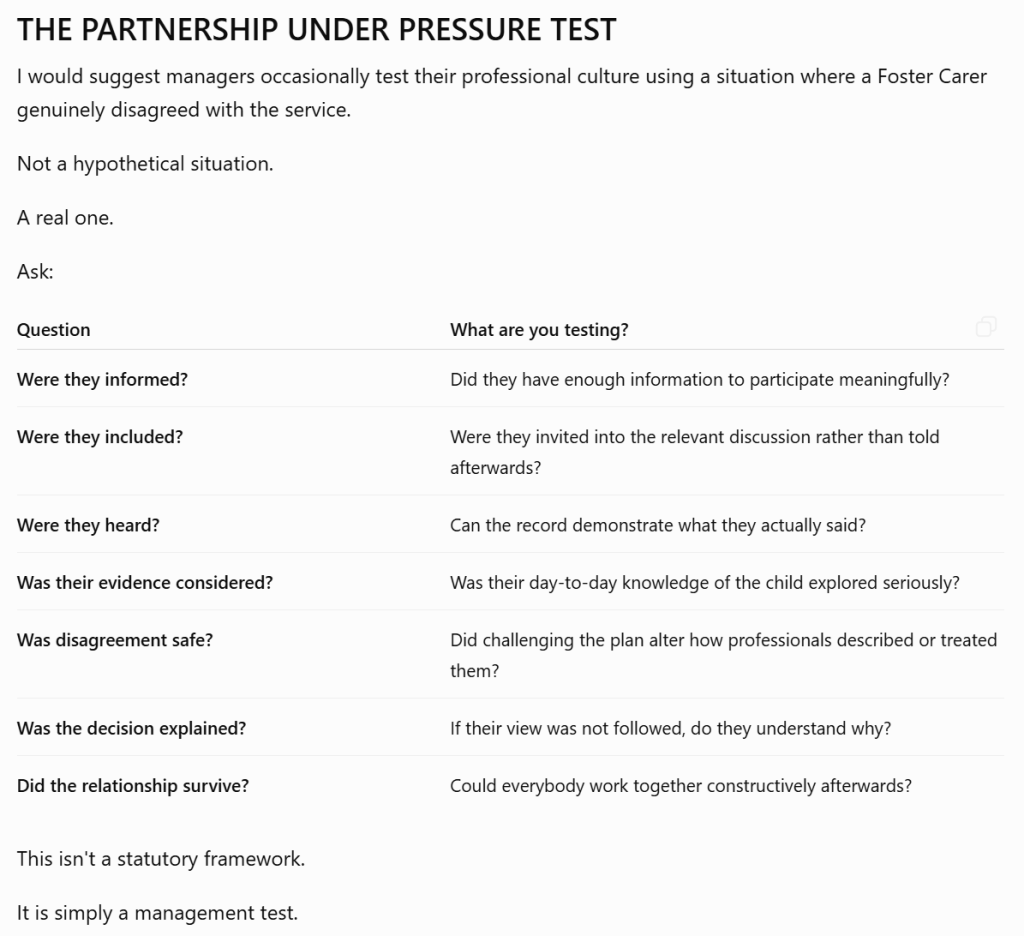
informed?
invited?
heard?
asked why they held that view?
given an explanation?
treated respectfully?
and able to disagree without fearing that disagreement itself would alter how the organisation saw them?
That is very different from requiring everybody to agree.
PROFESSIONAL RESPECT IS NOT THE ABSENCE OF DISAGREEMENT.
It is partly about how disagreement is handled.
Foster Carers are expected to contribute
Current National Minimum Standards in England already recognise a meaningful role for Foster Carers in planning and review.
Standard 31 says fostering services should support Foster Carers to play an active role in agreeing the contents of the child's placement plan and to contribute effectively to reviews of the child's care plan.
The standards also require the Foster Carer to receive the placement plan and support them to assist the child in expressing their wishes and feelings during review processes.
Elsewhere, the standards require Foster Carers to have full information about the child and access to adequate professional support, information and advice.
So involvement isn't simply an optional courtesy.
There is already an expectation that Foster Carers contribute meaningfully to planning around children.
At the date of writing, 8 September 2026, these 2011 standards remain the current framework.
The Department for Education is consulting on revised standards and guidance, with that consultation closing on 16 September 2026.
Being invited matters too
Participation starts before anybody speaks.
You first have to be in the room.
The 2024 State of the Nations survey found that:
86% of Foster Carers said they were always or usually invited to children's care planning and review meetings;
80% said this about meetings with education professionals;
and:
82% about health meetings.
The report notes that the wording changed from asking about attendance in 2021 to asking about invitation in 2024, so direct comparison needs care, although The Fostering Network itself interpreted the findings as suggesting worsening inclusion.
That leaves another useful management question:
WHO IS MISSING FROM THE ROOM — AND WHY?
But being present is not the same as being influential.
A Foster Carer can sit through an entire meeting and still leave thinking:
“Nobody actually heard what I said.”
The knowledge imbalance can work both ways
Sometimes Foster Carers feel professionals do not understand the child they are living with.
Sometimes professionals may feel the Foster Carer does not appreciate the wider complexities of the case.
Both can be true.
For example, a Foster Carer may say:
“Family time is affecting this child badly.”
They may be observing distress before and after contact.
The child's Social Worker may simultaneously hold important information about:
the child's identity;
birth-family relationships;
court decisions;
the care plan;
siblings;
long-term planning;
and the child's own wishes.
Those perspectives are not automatically competing truths.
They may be different pieces of the same problem.
Good partnership should help bring those pieces together.
Research highlighted by the Rees Centre similarly emphasises that relationships within fostering are interconnected and dynamic, and that trusting, collaborative relationships between Foster Carers and Social Workers can support more effective help for children.
Then comes disagreement
This is where the issue becomes more difficult.
A Foster Carer might challenge:
a matching decision;
family-time arrangements;
school decisions;
the level of support a child needs;
a proposed move;
a placement ending;
information they believe is inaccurate;
whether the household can sustainably continue;
or the speed of a professional decision.
Sometimes the Foster Carer will be right.
Sometimes the professional will be right.
Often reality will be more complicated than either initial position.
The management question isn't:
“Who wins?”
It is:
CAN THIS ORGANISATION DISAGREE WITHOUT DAMAGING THE RELATIONSHIP?
Because once disagreement becomes personal, something changes.
The discussion can move from:
“We have different professional views.”
to:
“This Foster Carer is becoming difficult.”
That is the territory we will examine much more deeply in Point 93.
For Point 92, we need to establish the foundation.
CHALLENGE SHOULD NOT AUTOMATICALLY CANCEL PARTNERSHIP.
Respect is directly relevant to retention
This is not merely about good manners.
The 2024 State of the Nations findings connect professional respect directly with the contemporary retention discussion.
Sixty per cent of Foster Carers surveyed had either considered or were still considering resignation.
Among the most commonly selected reasons were:
lack of support from the fostering service — 54%;
lack of respect from other professionals — 54%;
and:
burnout or poor wellbeing — 53%.
Again, these figures should not be interpreted causally.
They do not mean that 54% of Foster Carers will resign because somebody disrespected them.
But they do show that professional respect sits among the most prominent factors reported by Foster Carers already thinking about leaving.
And the comparison with former Foster Carers is interesting.
Among former Foster Carers in the survey:
only 30% said they had always or usually felt treated as equal and valued by children's Social Workers, compared with 53% of current Foster Carers.
For SSWs, the comparison was 51% of former Foster Carers versus 76% of current Foster Carers.
That is an association.
It does not prove that feeling undervalued caused people to stop fostering.
But it is certainly enough to justify management curiosity.
A Charter is useful — but only if it survives reality
Many fostering services have Foster Carer Charters.
That can be positive.
A charter should set out the expectations between Foster Carers, services and placing authorities and demonstrate a commitment to partnership.
The State of the Nations data produce an interesting association here.
Foster Carers whose service had a charter were significantly more likely to say they felt equal and valued by their SSW:
84%
compared with:
35%
among those saying their service did not have a charter.
Those with a charter were also less likely to say they were currently considering resignation:
11% compared with 39%.
The Fostering Network itself cautions that this does not establish that the charter caused the difference. Better-performing services may simply be more likely to have a visible and meaningful charter in the first place.
That caveat is crucial.
A beautifully designed charter pinned to the wall changes nothing by itself.
The question is:
WHAT HAPPENS WHEN SOMEBODY USES IT?
If your charter says:
“We will listen to Foster Carers.”
what happens when the Foster Carer says something uncomfortable?
If it says:
“We treat Foster Carers as professional partners.”
what happens when they challenge the organisation?
If it says:
“We value their expertise.”
what happens when their expertise leads them to a different conclusion?
That is where the charter becomes real.
Because if partnership only functions when the Foster Carer agrees with the organisation, it isn't really partnership.
It is compliance.
Equal partnership requires boundaries too
There is another side to this discussion.
Services should not become frightened of appropriately challenging Foster Carers.
Professional respect works both ways.
Foster Carers are accountable.
They operate within approval terms, policies, safer-care expectations, regulation and children's care plans.
Sometimes a Foster Carer's view needs to be challenged.
Sometimes a boundary needs to be maintained.
Sometimes a decision may need to be made that they strongly oppose.
And sometimes professional concerns about a Foster Carer's practice will be legitimate.
PARTNERSHIP DOES NOT REMOVE ACCOUNTABILITY.
Nor should it.
The stronger organisational culture is one capable of holding two things simultaneously:
“We take your expertise seriously.”
and:
“We do not agree with you on this occasion.”
That is mature professional partnership.
Where does management come in?
Managers may only become aware of disagreement once it has escalated.
By then, each side may already have developed a story.
The Foster Carer may say:
“Nobody listens.”
The professional may say:
“They won't accept professional advice.”
Both may genuinely believe their interpretation.
A strong manager should become curious before becoming certain.
What was the actual disagreement?
What evidence was available?
Was everybody working with the same information?
Was the Foster Carer able to explain their view?
Was the professional able to explain theirs?
Was the language used about the Foster Carer proportionate?
Could the relationship have been repaired earlier?
This takes us directly towards Point 93.
The sufficiency consequence
Point 91 established that:
RETENTION IS SUFFICIENCY.
Point 92 adds another layer.
An experienced Foster Carer who leaves after repeated professional conflict does not merely represent:
“one relationship that didn't work.”
The service may lose:
experience;
placement capacity;
local knowledge;
sibling capability;
teenage capability;
peer support;
and future Foster Carer referrals.
That is why professional relationships cannot be dismissed as a soft issue.
They have operational consequences.
WHEN A PROFESSIONAL RELATIONSHIP BREAKS DOWN, SUFFICIENCY MAY EVENTUALLY PAY THE PRICE.
The management question for Point 92
So I would ask fostering services to look again at the familiar phrase:
“Foster Carers are equal partners in the team around the child.”
Then remove the easy cases.
Do not look at the Foster Carer who always agrees.
Find the one who challenged you.
The one who complained.
The one who said no.
The one who argued that the plan wasn't working.
Then ask:
DID WE STILL TREAT THEM AS A LEGITIMATE PARTNER?
Because: