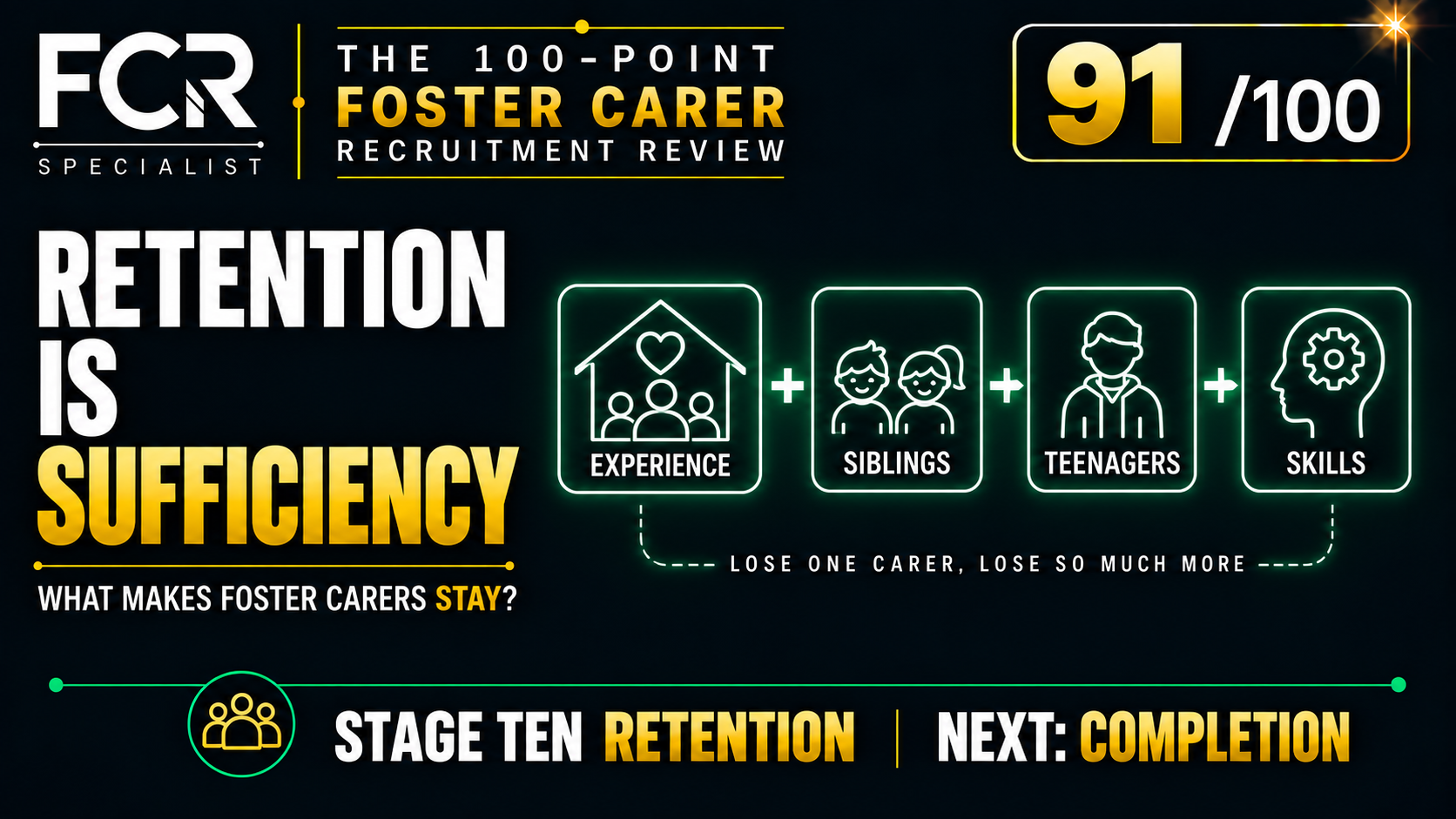
POINT 91 — RETENTION IS SUFFICIENCY: WHAT MAKES FOSTER CARERS WANT TO STAY?
POINT 91 — RETENTION IS SUFFICIENCY: WHAT MAKES FOSTER CARERS WANT TO STAY?
For the first 90 Points of this Review, much of the focus has inevitably been on getting people into fostering.
Strategy.
Marketing.
Enquiries.
Initial conversations.
Initial Visits.
Assessment.
Approval.
Early experience.
Now I want to ask a different question.
Not:
Why do Foster Carers leave?
At least, not yet.
Let's start somewhere more positive and potentially more useful:
WHAT MAKES FOSTER CARERS WANT TO STAY?
That question takes us into the final Stage of the 100-Point Foster Carer Recruitment Review.
And it starts with a principle that I think every senior fostering leader should have somewhere within their sufficiency thinking:
RETENTION IS SUFFICIENCY.
We cannot look only at the front door
There is something fundamentally wrong with a recruitment strategy that celebrates ten new approvals without becoming equally curious about ten experienced Foster Carers who have left.
Yet recruitment and retention can still be managed as though they are separate activities.
Recruitment sits at the front.
Retention sits somewhere further down the organisation.
Deregistrations are reported.
Recruitment targets are reported.
But are they routinely considered together?
The latest Ofsted statistics demonstrate why they should be.
At 31 March 2025, England had 56,345 approved mainstream Foster Carers.
That was 1% fewer than the previous year and 12% fewer than in 2021.
During 2024–25:
4,430 mainstream households joined the sector;
while:
4,690 mainstream households deregistered.
Ofsted correctly cautions that some deregistering households may subsequently re-register elsewhere.
We therefore shouldn't treat every deregistration as somebody leaving fostering altogether.
That distinction will become particularly important later in this Stage.
But look at another figure.
The average local authority household deregistering during 2024–25 had been registered for:
JUST OVER 7.5 YEARS.
For IFAs it was:
JUST OVER 5.5 YEARS.
Think about what those numbers mean operationally.
One out. One in. Problem solved?
Imagine you lose a Foster Carer who has fostered for eight years.
They may have:
fostered several children successfully;
developed confidence around trauma and attachment;
supported teenagers;
fostered siblings;
built relationships with schools and health professionals;
learned how the care system works;
supported other Foster Carers;
become comfortable advocating for children;
developed specialist skills;
and become one of the households your service trusts with particularly difficult matching decisions.
Now imagine that during the same reporting period you approve one brand-new Foster Carer.
Your dashboard might say:
One left.
One joined.
Net change: zero.
But operationally those households aren't necessarily interchangeable.
That new Foster Carer may eventually become exceptional.
But they cannot arrive on approval day carrying eight years of fostering experience.
This is why:
HEADCOUNT SUFFICIENCY IS NOT THE SAME AS CAPABILITY SUFFICIENCY.
The question isn't simply:
How many Foster Carers have we got?
It is also:
WHAT CAN OUR FOSTER CARER POPULATION ACTUALLY PROVIDE?
That means understanding capacity for:
siblings;
teenagers;
children with disabilities;
complex trauma;
emergency care;
long-term fostering;
short breaks;
particular geographical areas;
cultural or identity needs;
and other requirements within your local child population.
Lose certain Foster Carers and the numerical reduction might be one.
The operational reduction could be considerably greater.
YOU CAN REPLACE A VACANCY.
YOU CANNOT INSTANTLY REPLACE EXPERIENCE.
So what actually makes Foster Carers stay?
There isn't one answer.
And this is important.
I don't believe there is a single clever retention initiative that fixes everything.
You cannot compensate for poor relationships with an annual thank-you event.
You cannot compensate for financial insecurity by sending a newsletter saying how valued Foster Carers are.
You cannot solve burnout merely by offering another resilience course.
And you cannot necessarily solve poor support simply by paying more.
Retention is much more likely to be the cumulative result of the:
ENVIRONMENT FOSTER CARERS EXPERIENCE.
The Fostering Network's State of the Nations' Foster Care 2024 survey heard from more than 3,000 current and former Foster Carers and 114 fostering services across the UK.
Three in five Foster Carers responding said they had considered, or were considering, resigning.
Among the most commonly cited reasons were:
lack of support from their fostering service;
lack of respect from other professionals;
and burnout or poor wellbeing associated with fostering.
Almost three in five also reported experiencing burnout or poor wellbeing because of their fostering role.
Those figures should command senior management attention.
But the evidence also tells us what works
Three quarters of Foster Carers rated support from their Supervising Social Worker as good or excellent.
When Foster Carers were asked what currently worked well, leading themes included:
positive relationships with Social Workers;
the fostering community;
and the impact fostering has on children and young people.
That matters.
It means we shouldn't approach retention as though Foster Carers are simply dissatisfied consumers looking for a better package.
For many Foster Carers, purpose still matters enormously.
The principal motivation to foster identified in the same survey remained:
MAKING A DIFFERENCE TO CHILDREN'S LIVES.
But purpose does not make someone infinitely absorbent.
Strong personal commitment can coexist with poor organisational experience.
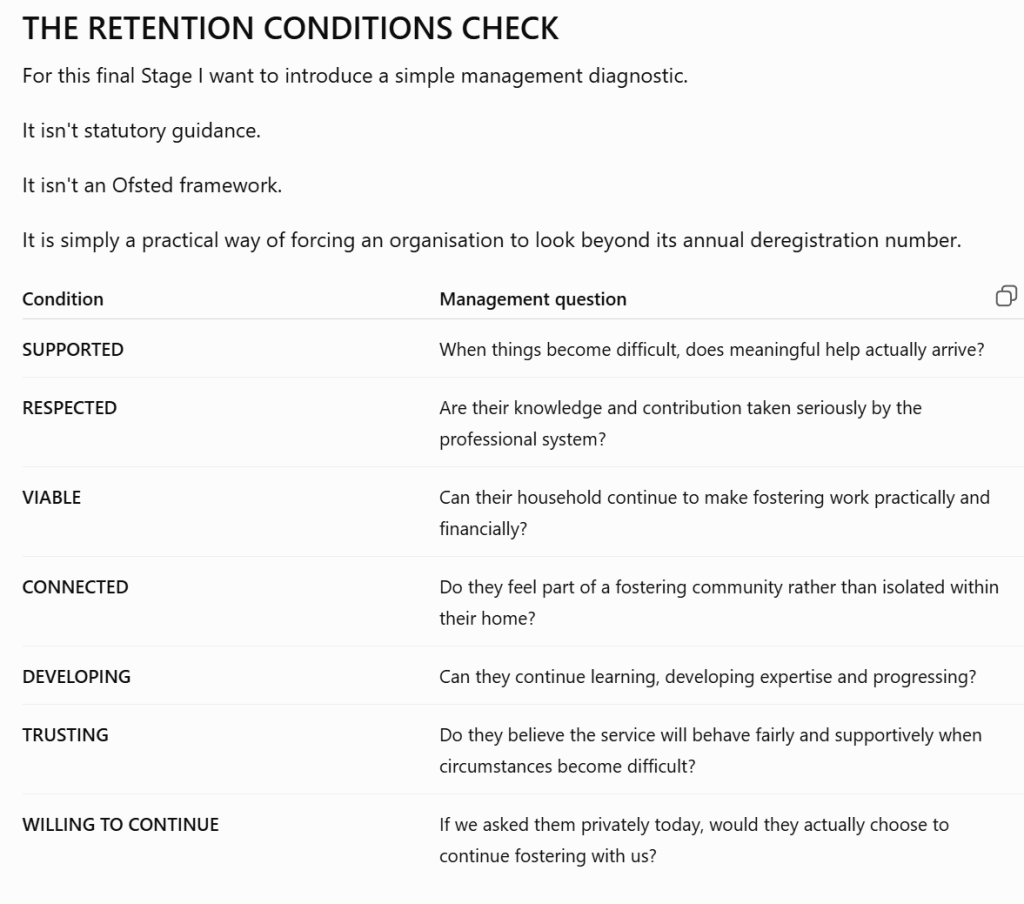
That last question matters enormously.
Do not assume approval equals commitment indefinitely.
Do not assume an available fostering household is a content fostering household.
And do not assume that because somebody has not resigned they are nowhere near doing so.
RESIGNATION IS A LAGGING INDICATOR.
By the time someone formally gives notice, the real story may have been developing for months.
Sometimes years.
Support is more than having an SSW
The evidence around Supervising Social Workers is actually relatively positive.
Three quarters of Foster Carers in the Fostering Network survey rated their SSW support good or excellent.
That should be recognised.
This final Stage must not descend into:
“Foster Carers good — Social Workers bad.”
It would be wrong.
And it would prevent us learning anything useful.
The better management question is:
WHAT CONDITIONS ALLOW GOOD PROFESSIONAL RELATIONSHIPS TO FLOURISH?
And:
WHAT HAPPENS WHEN THOSE CONDITIONS DETERIORATE?
Support can involve:
professional availability;
out-of-hours help;
peer networks;
good supervision;
training;
planned breaks;
specialist advice;
consistency;
clear communication;
help during difficult placements;
and confidence that somebody will act when help is requested.
Current National Minimum Standards in England explicitly address learning and development and the supervision and support of Foster Carers.
So support isn't simply a retention perk.
It sits within the expected infrastructure of a functioning fostering service.
Retention is also about viability
Foster Carers live in households.
They have:
partners;
children;
mortgages or rent;
jobs;
health issues;
family responsibilities;
financial pressures;
and limits on their own emotional and physical energy.
Their capacity to continue fostering partly depends upon whether fostering remains sustainable within that wider household.
The Fostering Network's 2024 research identified finances as the most frequently mentioned area Foster Carers wanted changed to make fostering better.
That was followed by:
their status and respect within the team around the child;
and support for Foster Carers and children.
These factors interact.
A Foster Carer who feels financially stretched but exceptionally supported may experience fostering very differently from somebody who feels financially stretched, professionally ignored and unable to obtain a break.
RETENTION IS CUMULATIVE.
And so is dissatisfaction.
Connected Foster Carers may be better protected
One particularly interesting finding concerns Mockingbird.
Foster Carers participating in Mockingbird reported:
better support;
greater access to approved networks capable of providing overnight care;
and lower levels of burnout or poor wellbeing than respondents who were not participating.
That does not prove that one particular model is the solution to every retention problem.
But it strengthens the case for taking:
connection;
practical support;
and:
peer relationships
seriously.
Fostering can be an unusually isolating role.
Much of the difficult work happens inside somebody's home.
Often outside normal office hours.
Connection therefore shouldn't be regarded simply as a pleasant extra.
Avoidable and unavoidable loss
We also need to be sensible.
No fostering service will retain everybody.
Nor should that be the objective.
Foster Carers retire.
People become ill.
Relationships change.
People move.
Family circumstances alter.
Sometimes fostering simply reaches its natural conclusion.
And sometimes a service will appropriately end a Foster Carer's approval.
A crude:
“zero deregistrations”
target would therefore be meaningless and potentially unhealthy.
The useful management distinction is between:
UNAVOIDABLE OR APPROPRIATE LOSS
Circumstances in which leaving is natural, necessary or appropriate.
And:
POTENTIALLY AVOIDABLE LOSS
Circumstances where organisational experience may have materially contributed to the decision.
That second category is where much of the learning sits.
It is also why simply coding a departure as:
“Foster Carer resigned”
tells management very little.
Later in this Stage we will look much more closely at:
transfers;
professional relationships;
progression;
burnout;
allegations;
stay conversations;
and exit intelligence.
For now, I want managers to begin with one question:
WHAT CONDITIONS ARE WE CREATING THAT MAKE GOOD FOSTER CARERS WANT TO REMAIN WITH US?
This is now national policy territory too
The Government's February 2026 Renewing fostering: homes for 10,000 more children action plan explicitly identifies stronger support around foster families and a simpler rulebook built around trusted relationships as areas for reform.
At the date of writing, 8 September 2026, the Department for Education is also consulting on revised fostering standards and guidance.
That consultation closes on:
16 September 2026.
Those revised standards therefore remain proposals at this point rather than the current framework.
But the direction matters.
England is simultaneously trying to increase fostering capacity and reconsider elements of the system that shape Foster Carers' experience.
Recruitment cannot sensibly be separated from that.
THE MANAGEMENT TEST FOR POINT 91
Before moving to Point 92, I would ask every fostering service to answer these questions honestly.
How many Foster Carers have we lost during the last three years?
How many were unavoidable departures?
How many transferred elsewhere?
How many might have stayed if something within our control had been different?
How many years of fostering experience left with them?
What types of placements could those households provide?
Which skills, locations and approval ranges did we lose?
And perhaps most importantly:
DO WE KNOW WHAT MAKES OUR OWN FOSTER CARERS WANT TO STAY?
Not nationally.
Not what we think.
Not simply what an annual satisfaction score tells us.
What do:
OUR FOSTER CARERS THEMSELVES SAY?
Because every avoidable loss isn't simply a retention statistic.
EVERY AVOIDABLE RETENTION LOSS IS ALSO A SUFFICIENCY EVENT.
And that is where the final ten Points of this Review begin.