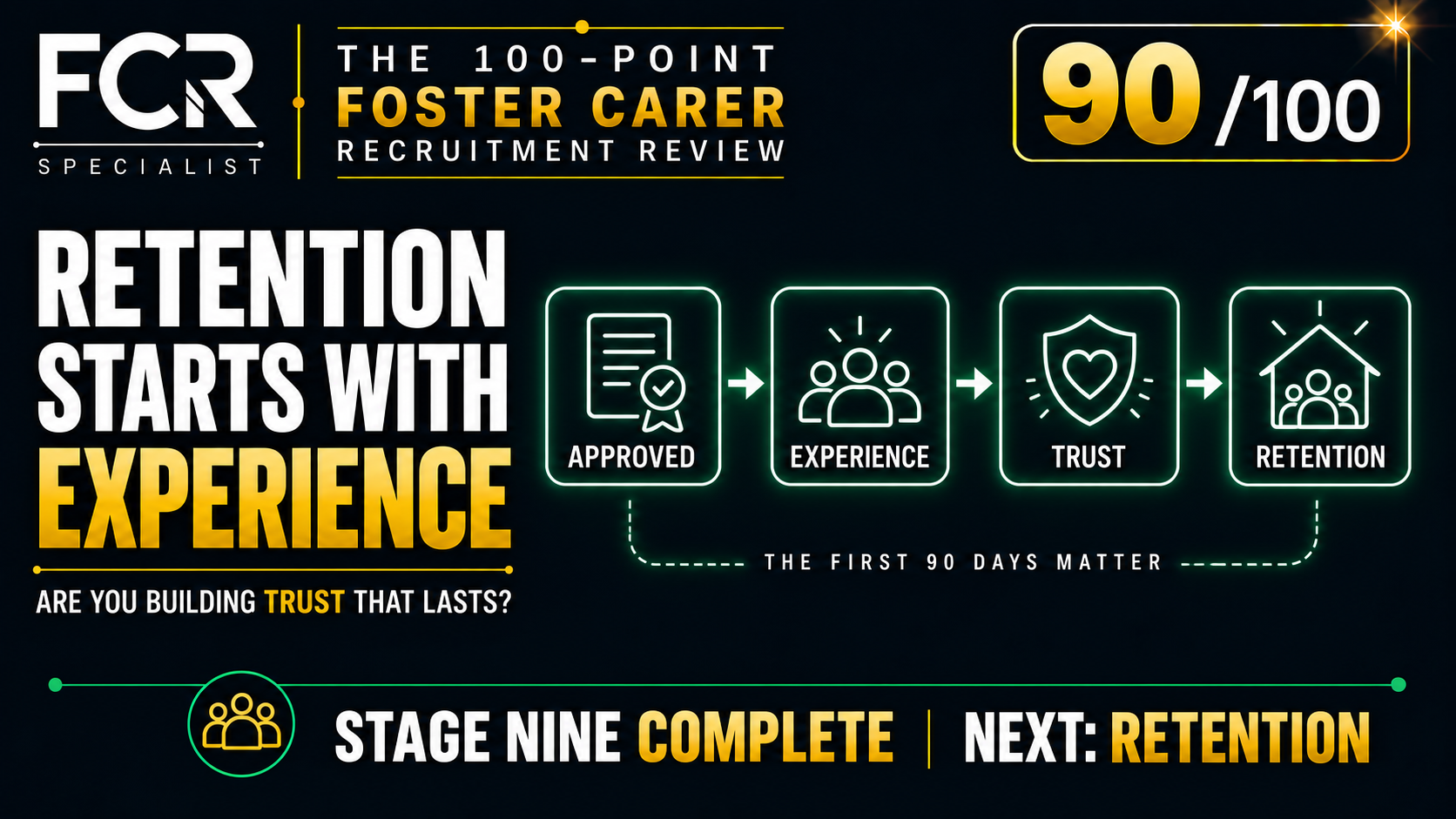
POINT 90/100 — FROM APPROVAL TO CONFIDENCE: ARE YOU BUILDING TRUST THAT LASTS?
POINT 90/100 — FROM APPROVAL TO CONFIDENCE: ARE YOU BUILDING TRUST THAT LASTS?
Stage Nine began at a major moment.
Approval.
The prospective Foster Carer had completed recruitment and assessment and finally become an approved Foster Carer.
At that point it would have been very easy for this Review simply to declare:
Recruitment complete.
But that would miss something important.
The weeks and months immediately following approval begin testing almost everything the organisation said during recruitment.
We promised support.
We promised relationships.
We promised training.
We explained matching.
We described what fostering with our organisation would feel like.
Then the Foster Carer actually joins us.
THIS IS WHERE THE RECRUITMENT PROMISE MEETS THE FOSTERING EXPERIENCE.
And underneath almost every issue explored during Points 81–89 sits one word:
TRUST.
Stage Nine started with congratulations
Point 81 asked whether approval triggers a welcome — or an information blizzard.
We argued:
ACCESS IMMEDIATELY. ABSORB SEQUENTIALLY.
Do not make a newly approved Foster Carer project-manage the organisation.
Give people time to understand their new role.
That begins building trust.
Then we looked at continuity
Point 82 asked whether the Foster Carer reaches approval and has to introduce themselves all over again.
The principle was:
HAND OVER THE RELATIONSHIP — NOT JUST THE FILE.
Months of organisational knowledge should not disappear simply because professional responsibility changes hands.
That is trust too.
Then came confidence
Point 83 explored the period before first placement.
Approval confirms suitability.
It does not manufacture confidence.
Point 84 looked at training not simply as courses and certificates but as a route into the fostering community.
Knowledge.
Conversation.
Connection.
Network.
Those things begin helping somebody feel:
“I belong here.”
Again — trust.
Then the telephone rang
Points 85 and 86 looked at the first referral.
Excitement.
Fear.
Pressure.
The possibility that a newly approved Foster Carer thinks:
“I've just been approved. Surely I can't say no.”
We argued that:
A PLACEMENT CONVERSATION SHOULD INFORM — NOT SELL.
And:
“I'M NOT SURE” SHOULD OPEN A CONVERSATION — NOT CLOSE ONE.
Why?
Because the Foster Carer is learning whether honesty is safe.
That learning may become enormously important later.
Then fostering became real
Point 87 asked whether, in the right child-centred circumstances, a supported short-break experience could sometimes help a nervous Foster Carer move from imagined fostering towards informed confidence.
Point 88 widened the lens.
THE FIRST PLACEMENT ARRIVES IN A FAMILY — NOT A VACANCY.
The household begins to experience fostering.
Routines.
Relationships.
Children.
Partners.
Employment.
Privacy.
Sleep.
Family life.
Then Point 89 asked perhaps the most important question so far:
DOES YOUR SUPPORT ACTUALLY FEEL SUPPORTIVE?
And that takes us directly to Point 90.
What has the Foster Carer learned about your organisation?
During those first weeks and months, the Foster Carer is learning constantly.
Not only about children.
Not only about Foster Care.
They are learning about you.
They are learning:
whether people call back;
whether different teams communicate;
whether what was promised during recruitment happens;
whether uncertainty is tolerated;
whether their family remains visible;
whether their opinions matter;
whether professional disagreement is safe;
whether somebody notices when they are struggling;
and whether asking for support actually produces support.
None of these things necessarily causes somebody to remain or resign by itself.
But collectively they create experience.
Experience creates interpretation.
And interpretation begins creating organisational trust.
EXPECTATION → EXPERIENCE → TRUST.
The Supervising Social Worker sits in a particularly important position
The SSW relationship deserves special consideration.
Current National Minimum Standard 21 requires Foster Carers to have appropriate professional support and a named, appropriately qualified Social Worker providing supervision and support. It also requires the role of the Supervising Social Worker to be clear to both worker and Foster Carer.
The role itself contains an inherent complexity.
The SSW is both:
supportive
and:
supervisory.
The Rees Centre's international literature review identified exactly this dual role and found that Foster Carers particularly valued emotional support delivered through visits and telephone contact. It also found evidence linking SSW support with Foster Carer retention, while cautioning that evidence concerning placement outcomes was limited.
That means the quality of this relationship deserves considerable management attention.
But “support” may mean different things to the professional and the Foster Carer
This is something I think services need to examine more closely.
An SSW might quite reasonably believe:
“I supported the Foster Carer.”
They visited.
They explained the process.
They provided advice.
They signposted a service.
They completed the required action.
The Foster Carer may experience the same interaction differently:
“Nobody really listened.”
“I was told what the procedure was.”
“I still had the same problem afterwards.”
“I felt as though I was being assessed rather than supported.”
Neither person necessarily has bad intentions.
They may simply have very different understandings of what support looked like in that moment.
That is why Point 89 distinguished:
SUPPORT OFFERED
from:
SUPPORT EXPERIENCED.
Continuity makes this even more important
The Fostering Network's 2024 survey produced an interesting combination of findings.
Three quarters of Foster Carers rated support from their SSW as excellent or good.
That is a substantial positive.
But only 44% said they had had one consistent SSW during the previous 24 months.
We need to interpret that carefully.
A change of SSW does not automatically mean poor support.
Sometimes people leave.
People are promoted.
Teams restructure.
Long-term absence occurs.
Temporary and agency Social Workers may be required.
And some temporary workers bring substantial experience and provide excellent support.
EMPLOYMENT STATUS IS NOT A MEASURE OF SUPPORT QUALITY.
The management risk lies somewhere else.
What does the new worker know?
Imagine being the Foster Carer.
You have already built a relationship with one SSW.
They know:
your family;
the children you foster;
your anxieties;
your strengths;
previous difficulties;
what happened during that challenging placement;
what support worked;
and what support didn't.
Then they leave.
A new person arrives.
Perhaps permanently.
Perhaps temporarily.
And the Foster Carer begins hearing:
“You'll have to explain that to me.”
“I wasn't aware of that.”
“I'm not sure what was agreed before.”
“That's not normally how I work.”
Each sentence may be perfectly understandable individually.
Collectively, however, the Foster Carer can experience:
“I'm starting again.”
That takes us straight back to Point 82.
THE FOSTER CARER SHOULD NOT HAVE TO CARRY THE ORGANISATIONAL MEMORY.
Temporary workers: position this carefully
I think this warrants an explicit distinction.
It would be both unfair and unsupported to argue:
Temporary SSW = poorer support.
That isn't the claim.
An experienced agency Social Worker may understand Foster Care exceptionally well.
Likewise, a permanent employee does not automatically provide excellent relational support.
The risk arises when a temporary — or indeed any incoming — worker is expected to take over without sufficient:
induction;
handover;
organisational knowledge;
knowledge of local support arrangements;
understanding of previous commitments;
or opportunity to develop the relationship.
That is an organisational responsibility.
Not an individual worker failing.
A CHANGE OF WORKER SHOULD NOT MEAN A CHANGE OF SERVICE PROMISE.
If continuity of personnel cannot always be guaranteed, continuity of experience still needs managing.
The service needs to support the SSW as well
There is another side to this.
We cannot tell SSWs to build trusted Foster Carer relationships while constantly putting them into conditions that make this difficult.
The Fostering Network asked fostering services what they considered the most effective things they did to retain Foster Carers.
Among 106 comments, 78% mentioned support.
Services also identified:
consistent staff;
small agency size;
lower caseloads;
relationship-based practice;
valuing Foster Carers;
listening to them;
and involving them.
These are service perceptions rather than experimental proof of causation, but they are highly relevant to management thinking.
The message is not simply:
“SSWs need to support Foster Carers better.”
Managers need to ask:
“Have we created conditions in which good relational support is actually possible?”
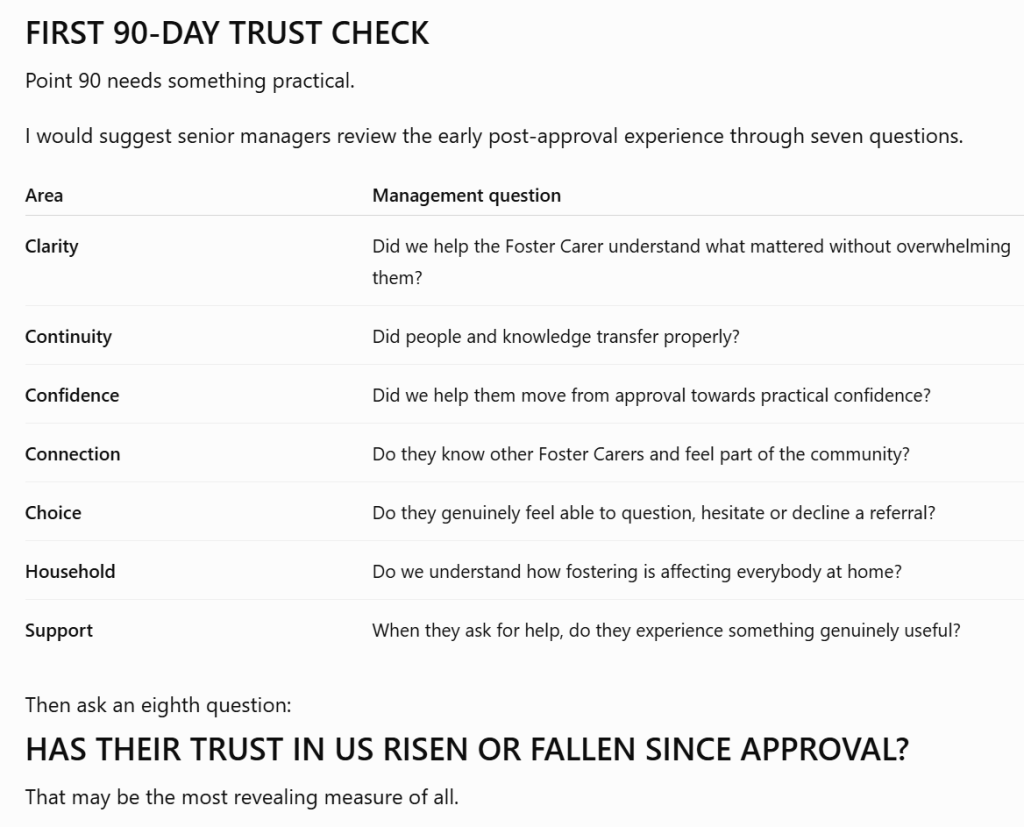
Then ask an eighth question:
HAS THEIR TRUST IN US RISEN OR FALLEN SINCE APPROVAL?
That may be the most revealing measure of all.
Do not wait for the annual survey
Services may already run Foster Carer surveys.
Useful.
But the first indication that trust is weakening should not arrive six months later in a survey report.
Look for:
repeated unresolved requests;
hesitation about contacting professionals;
comments such as “there's no point asking”;
disengagement from groups;
increasing frustration;
repeated worker changes;
mismatched expectations;
late disclosure of difficulties;
or a previously enthusiastic Foster Carer gradually becoming quiet.
None automatically means they are considering resignation.
But each deserves curiosity.
Retention doesn't begin at resignation
This is the transition we now need to make.
There can be a tendency to think about Foster Carer retention when somebody says:
“I'm thinking about leaving.”
By then, the retention story may already be months or years old.
Perhaps:
support repeatedly failed;
their family stopped feeling considered;
professional relationships changed;
they felt undervalued;
financial pressures grew;
difficult placements accumulated;
or trust was gradually eroded.
The resignation letter may simply be the final observable event.
RETENTION DOESN'T BEGIN WHEN SOMEBODY THINKS ABOUT LEAVING.
RETENTION STARTS WITH EXPERIENCE.
And the current evidence makes the final ten Points necessary
The Fostering Network's 2024 survey found three in five Foster Carers had considered or were considering resignation, with lack of support from the fostering service, lack of respect from other professionals and burnout or poor wellbeing among the most commonly reported reasons.
The same research found less than half would recommend fostering.
Those figures do not tell us that every Foster Carer will leave.
But they tell us that recruitment cannot sensibly be separated from retention.
We cannot continually pour people into the top of the system while failing to understand why experienced Foster Carers consider walking out of the other end.
The final ten Points
So the emphasis now changes.
Points 1–90 have followed the prospective Foster Carer from strategy and recruitment through enquiry, assessment, approval and the first realities of fostering.
For Points 91–100, the central question becomes:
WHAT MAKES A FOSTER CARER WANT TO STAY?
And equally:
WHAT HAPPENS BEFORE THEY DECIDE THEY HAVE HAD ENOUGH?
We will look beyond simple retention statistics.
We need to understand:
trust;
relationships;
support;
experience;
recognition;
pressure;
and the signals services may be missing long before a resignation lands on somebody's desk.
That is where this Review now needs to go.
Because recruiting another Foster Carer is important.
But protecting the commitment of the Foster Carers already providing homes to children may be just as important.