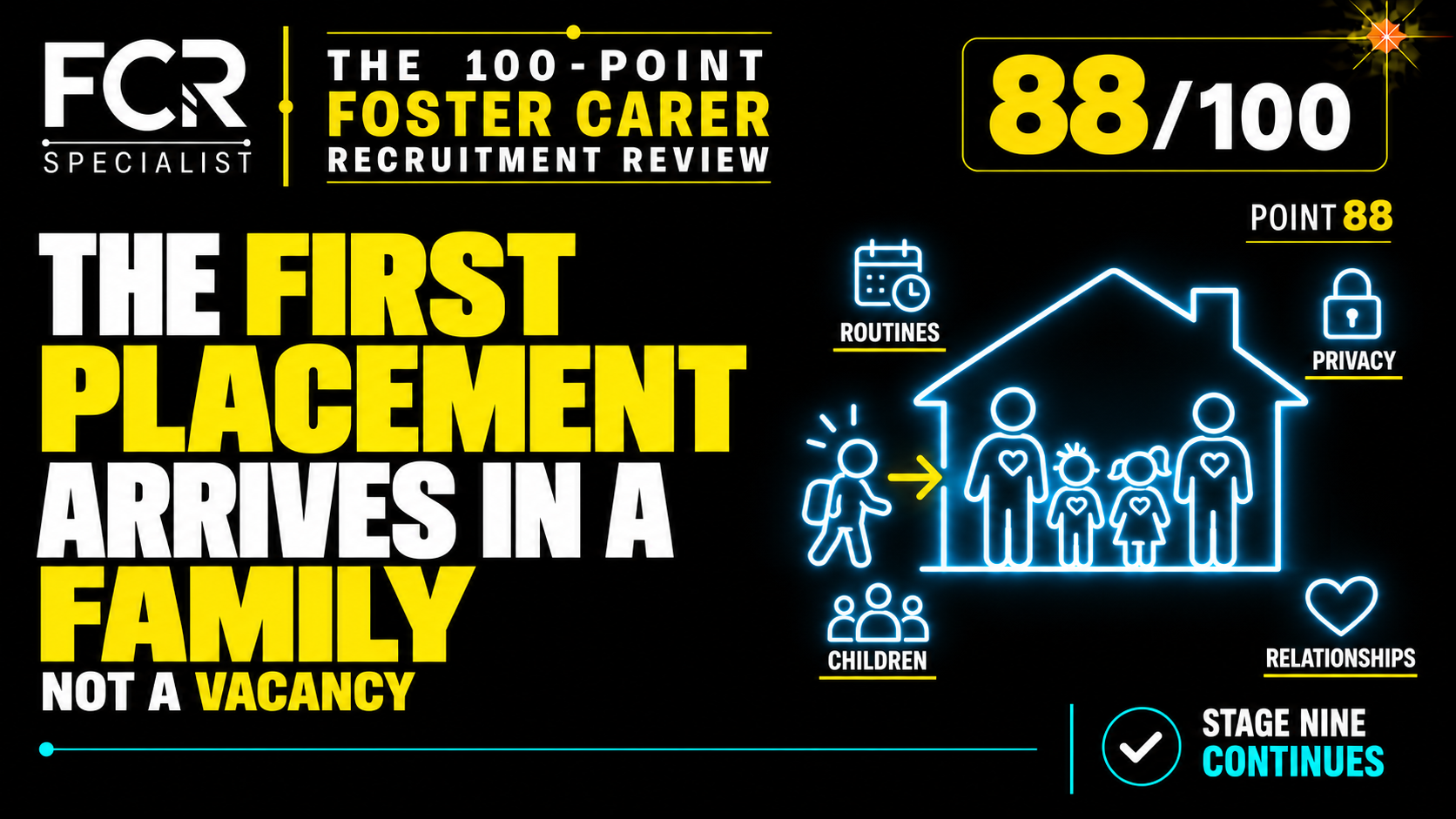
POINT 88/100 — THE FIRST PLACEMENT ARRIVES IN A HOUSEHOLD
POINT 88/100 — THE FIRST PLACEMENT ARRIVES IN A HOUSEHOLD
One of the most familiar questions in Foster Carer Recruitment is:
“Do you have a spare bedroom?”
Obviously, accommodation matters.
But once the first child arrives, something becomes very clear.
The child does not simply occupy the spare bedroom.
They enter:
the kitchen;
the bathroom;
the car;
the school run;
weekends;
meal times;
bedtimes;
holidays;
relationships;
family conversations;
work arrangements;
privacy;
and the emotional life of the household.
THE FIRST PLACEMENT ARRIVES IN A FAMILY — NOT A VACANCY.
That may sound obvious.
Yet it is remarkably easy for organisations to focus so strongly on the approved Foster Carer and the child that the wider household gradually disappears from view.
Assessment can prepare a household. It cannot reproduce fostering.
The impact of fostering on the household should not first be considered after a child arrives.
Current National Minimum Standard 15 says that when a service proposes a Foster Carer as a potential match, the impact of the proposed placement on existing household members should be considered.
The Fostering Network similarly emphasises that becoming a Foster Carer affects the whole family and that children already living within the home need opportunities to understand what fostering may mean for them and to have their views heard.
That preparation is important.
But preparation and experience are different things.
A child can understand theoretically:
“Mum and Dad will need to spend time with another child.”
It feels different when Mum misses their football match because something has happened within the placement.
A partner can understand:
“Fostering may affect our routines.”
It feels different after the third interrupted night's sleep.
The Foster Carer can understand:
“Our family life will change.”
It feels different when they realise they have not had an uninterrupted conversation with their partner for two weeks.
Nothing here necessarily means the placement is wrong.
It means the household is adapting.
THE SPARE BEDROOM ISN'T THE ONLY SPACE FOSTERING OCCUPIES
This could be one of the most useful ways of thinking about early placement experience.
Fostering occupies space in several different ways.
Physical space
Bedrooms.
Bathrooms.
Living rooms.
Storage.
Toys.
Clothes.
Possessions.
Visitors.
Pets.
Time
Appointments.
School.
Family time.
Professional meetings.
Training.
Recording.
Travel.
Contact arrangements.
Emotional space
Worry.
Responsibility.
Uncertainty.
Attachment.
Frustration.
Concern about getting things right.
Relationship space
Partners.
Children already living at home.
Adult children.
Extended family.
Friends.
Neighbours.
Support networks.
Practical space
Employment.
Transport.
Shopping.
Meals.
Sleep.
Weekends.
Holidays.
None of these is necessarily negative.
Many Foster Carers and their families describe fostering as enormously enriching.
But pretending that the household remains unchanged doesn't help anybody.
Children of Foster Carers are not incidental to the placement
This deserves particular attention.
Children already living in the fostering household may make an enormous contribution.
They may:
welcome a child;
share toys and space;
explain household routines;
help a child feel less conspicuous;
provide companionship;
and introduce something that professionals cannot manufacture — ordinary family life.
The Fostering Network describes children of Foster Carers as playing a vital role in fostering relationships and notes that fostering can require them to share parents, home, possessions and friends.
Current National Minimum Standard 21.6 also specifically says consideration should be given to help or support needed by Foster Carers' sons and daughters.
That is important.
Because they should not become the invisible workforce of fostering.
They are children and young people experiencing substantial change within their own family.
Their contribution can be recognised without assuming unlimited resilience.
“They knew what fostering involved”
This is one response we should be particularly careful about.
Yes, the household has been assessed.
Yes, fostering will have been discussed.
Yes, preparation should have happened.
But knowing that fostering will affect family life is not the same as knowing exactly how this placement will affect this household.
The same applies to Foster Carers themselves.
A new Foster Carer saying:
“This is much harder than I expected”
should not simply be met with:
“We covered this during assessment.”
That confuses preparation with lived experience.
The better question is:
“What has turned out differently from what you expected?”
That creates learning.
Household adjustment may happen slowly
One of the dangers is waiting for obvious problems.
Household strain may not arrive dramatically.
It can accumulate.
Perhaps:
the Foster Carer is sleeping less;
their partner is taking on more practical responsibilities;
their own child is spending more time in their bedroom;
friends visit less often;
one parent is constantly attending professional meetings;
weekends become dominated by fostering;
family plans are repeatedly rearranged;
or everybody starts behaving as though the Foster Carer is the only person whose feelings matter because they are the approved carer.
Each issue may appear small.
Together, they may become significant.
OVERWHELM DOESN'T ALWAYS ARRIVE AS A CRISIS.
Sometimes it arrives as twenty small compromises nobody discusses.
The first few weeks need a Household Reality Check
I would suggest a very simple management approach.
Not another assessment.
Not another form for the Foster Carer to complete.
A conversation.
1. WHAT HAS CHANGED?
What is genuinely different since the child arrived?
Not what everyone expected to change.
What actually has.
2. WHAT IS WORKING?
It is important not to make every review deficit-focused.
What has gone better than expected?
What has the household adapted to well?
What new relationships are developing?
3. WHAT IS HARDER THAN EXPECTED?
Sleep?
Privacy?
Time?
Behaviour?
Transport?
Work?
Professional demands?
Impact upon children?
Relationships?
4. WHO ELSE IN THE HOUSEHOLD NEEDS TO BE HEARD?
Is everybody's experience visible?
That does not mean discussing confidential information with people who should not receive it.
It means recognising the effect fostering is having upon them.
5. WHAT NEEDS TO CHANGE OR BE SUPPORTED?
Sometimes the answer will be substantial professional support.
Sometimes something remarkably practical could help.
A different meeting time.
Help with transport.
A support-group connection.
Protecting some family time.
Clarification about expectations.
A conversation with a child of the Foster Carer.
Small changes can matter.
Ask about the household, not only the placement
There is an important difference between:
“How is the placement going?”
and:
“How is everybody at home finding things?”
The first naturally focuses discussion on the fostered child.
The second widens the lens.
Both are necessary.
A placement could appear relatively settled from the child's perspective while the wider household is beginning to struggle.
If nobody asks, the Foster Carer may not volunteer it.
Why?
Because they may feel guilty.
They may worry that saying their own child is struggling sounds selfish.
They may believe they are expected to cope.
They may fear that admitting difficulty will make professionals question whether they should have been approved.
That connects directly with Point 86.
We need Foster Carers to learn that honesty is safe.
Birth children may protect their parents too
There is another subtle dynamic.
Children of Foster Carers may not always tell their parents that they are finding fostering difficult.
Why?
Perhaps they know how much fostering matters to Mum or Dad.
Perhaps they do not want a fostered child to have to leave.
Perhaps they feel guilty.
Perhaps they believe complaining would be selfish.
So silence cannot automatically be interpreted as:
“They're fine.”
The Fostering Network's guidance encourages services to provide children of Foster Carers with support, training and opportunities to connect with others in fostering households.
The principle is important:
DON'T ONLY SUPPORT THE PERSON WITH THE APPROVAL CERTIFICATE.
Support the fostering household.
Partners matter too
One member of a couple may be the primary Foster Carer.
That does not mean the other partner remains unaffected.
Their working life may change.
Their relationship may change.
Their home certainly changes.
Their evenings may change.
Their social life may change.
Their responsibilities may change.
Sometimes both partners foster jointly.
Sometimes they do not.
Either way, assuming that the partner will simply absorb the consequences can gradually create tension.
An early question such as:
“How are the two of you finding this?”
can reveal very different perspectives.
That difference is not necessarily a problem.
Not discussing it may become one.
Work does not disappear at placement
Many Foster Carers continue working.
Point 81 already reminded us that approval does not clear somebody's diary.
Placement does not either.
Appointments, meetings, training, school arrangements and unexpected events now have to coexist with employment.
That can create pressure surprisingly quickly.
The organisation may see one appointment.
The Foster Carer experiences:
an appointment;
a rearranged shift;
a cancelled meeting;
school collection;
travel;
recording;
and trying to explain another change to their employer.
Again, none of this means they cannot foster.
It means practical reality needs to remain visible.
Pets, visitors and ordinary family life
Some changes look almost too mundane to mention.
That is exactly why they may be missed.
Can friends still visit?
Where does everyone sit?
Who uses which bathroom?
Can the dog safely be around the child?
What happens to family movie night?
Can someone's boyfriend or girlfriend visit?
How do bedrooms remain private?
Where do valuables go?
How does everybody get enough sleep?
Fostering is lived through ordinary details.
And those details accumulate into:
“What does our family life feel like now?”
That is the real household question.
Do not make the fostered child responsible for household pressure
There is an essential boundary.
If a household is struggling, the child should not be framed as:
“the problem.”
The child has entered a system that has changed.
Adults and organisations need to understand that system.
The question is:
What conditions does this household need in order to provide good care?
not:
“Why is this child causing difficulties?”
That distinction protects the child and produces better organisational learning.
Recognise what is going well too
Whole-household thinking must not become an endless risk assessment.
Fostering can bring:
new relationships;
greater empathy;
shared achievement;
humour;
connection;
new perspectives;
and enormous pride.
Small-scale research by Shelton involving children of Foster Carers found themes including emotional and resource costs, but also strong family identity and empathy, with many participants seeing considerable value in having grown up within fostering families.
That study involved only 17 participants, so it should not be generalised to every fostering household.
But it is a useful reminder:
household impact is complex — not automatically negative.
We need to understand both.
Why this increasingly becomes a retention issue
This Stage is moving steadily towards Foster Carer retention.
And household experience belongs in that conversation.
A Foster Carer may love fostering.
But if:
their partner becomes unhappy;
their children feel consistently overlooked;
employment becomes impossible;
family relationships deteriorate;
privacy disappears;
or the household remains permanently exhausted,
eventually the question may become:
“Can our family continue doing this?”
That is different from:
“Do I still believe in fostering?”
The Fostering Network currently argues that supporting children of Foster Carers can help services retain fostering families because Foster Carers are more likely to feel that the whole family is recognised and supported.
That is not evidence that household support guarantees retention.
But it makes the relationship entirely plausible and worthy of management attention.
Don't wait for resignation to discover what changed at home
This is perhaps the most important point.
If a Foster Carer resigns after two years and says:
“It became too much for our family,”
the relevant story may have started twenty months earlier.
A child stopped inviting friends home.
A partner became increasingly frustrated.
Sleep reduced.
The Foster Carer felt guilty asking for help.
The service continued asking:
“How's the placement?”
and everybody continued answering:
“Fine.”
DON'T WAIT FOR A HOUSEHOLD CRISIS TO ASK HOW THE HOUSEHOLD IS COPING.
The first placement is therefore a critical period for establishing this habit.
Ask early.
Ask everybody appropriately.
Normalise adjustment.
Respond when small pressures are still small.
Because:
THE FIRST PLACEMENT ARRIVES IN A FAMILY — NOT A VACANCY.
And if we want Foster Carers to remain, we cannot afford to forget the family that makes the fostering possible.