
POINT 87/100 — COULD RESPITE BE THE BRIDGE INTO FOSTERING?
POINT 87/100 — COULD RESPITE BE THE BRIDGE INTO FOSTERING?
A newly approved Foster Carer has completed months of recruitment, preparation and assessment.
They have been found suitable.
They want to foster.
Then the possibility of an actual child entering their home becomes real.
And suddenly they are frightened.
Not necessarily because a particular referral is unsuitable.
Sometimes the fear is much more fundamental:
“I've never actually done this before.”
What will it feel like when an unfamiliar child walks through the front door?
What happens at bedtime?
What if the child won't eat?
How will my own children respond?
Will I know what to say?
Will I sleep?
Will the house feel completely different?
What happens if I get something wrong?
We should not automatically interpret those questions as evidence that somebody is unsuitable.
As Point 86 established:
DON'T CONFUSE FEAR OF THE UNKNOWN WITH UNSUITABILITY TO FOSTER.
So it raises an interesting question.
For some newly approved Foster Carers, could an appropriately planned short-break or respite experience provide a supported bridge between understanding fostering theoretically and living it for the first time?
First, a very important boundary
This idea could be badly misunderstood if we aren't explicit.
A CHILD IS NOT A PRACTICE PLACEMENT.
A child should never be moved into somebody's home simply so that a new Foster Carer can “have a go”.
That would reverse the entire purpose of Foster Care.
Any respite or short-break arrangement must exist because it is appropriate for the child, properly planned and matched, and consistent with their needs and circumstances.
Ofsted's current Social Care Common Inspection Framework for independent fostering agencies states that respite care should be provided only where it is in the child's best interests, including where it contributes to placement stability, and that any respite must take full account of the child's needs.
That principle has to come first.
What I am proposing is much narrower.
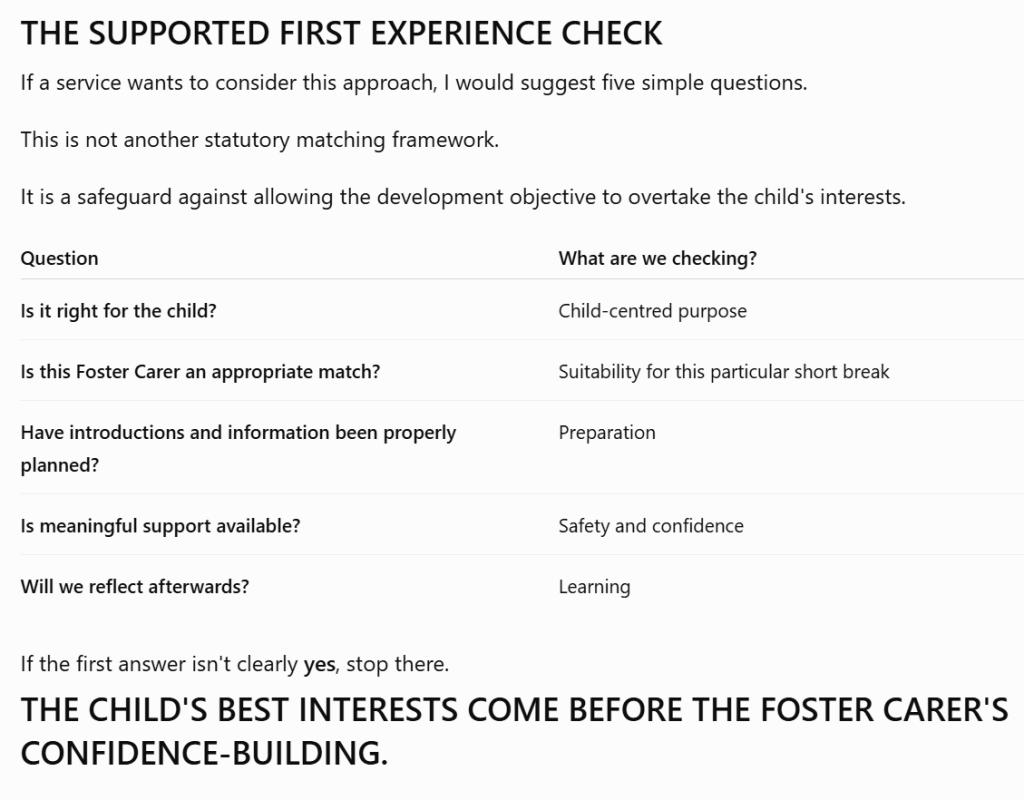
Where an appropriate child-centred short-break arrangement already exists, and a newly approved Foster Carer is suitable for it, could that sometimes provide a supported first fostering experience as well?
That is a management question.
It is not a new statutory requirement.
Respite and short-break fostering already exist
GOV.UK identifies respite and short breaks as recognised forms of fostering, where Foster Carers look after children while parents or their usual Foster Carers have a break.
There are also specific Training, Support and Development materials for short-break Foster Carers, reflecting the fact that this is an established form of fostering provision.
So the concept itself is not unusual.
What is different here is asking whether, in carefully selected circumstances, an existing type of fostering experience could also help build the confidence of a newly approved Foster Carer who is anxious about their first full placement.
Why might this help?
Before somebody has fostered, many fears are abstract.
They are imagining fostering.
And imagination tends to fill gaps.
Perhaps catastrophically.
A short, planned experience can replace some of that imagined uncertainty with actual experience.
The Foster Carer discovers:
what it feels like preparing for a child's arrival;
how introductions work;
how quickly household routines change;
what questions arise that training never quite anticipated;
how their partner responds;
how their own children respond;
what mealtimes feel like;
what bedtime feels like;
what having responsibility for another child feels like;
and what their own emotional reactions are.
The objective isn't to prove:
“See — fostering is easy.”
It isn't.
The value is:
“Now I have something real to understand.”
Experience can make future learning more meaningful
There is also a potential connection with Points 83 and 84.
Before experience, training can sometimes remain conceptual.
After experience, previously discussed subjects suddenly make sense differently.
A Foster Carer may return to training and think:
“Now I understand why we discussed that.”
Questions become more specific.
Reflection becomes more grounded.
Conversations with experienced Foster Carers become more meaningful.
That creates a useful learning cycle:
PREPARATION → EXPERIENCE → REFLECTION → GREATER UNDERSTANDING
Again, this is my proposed management approach, not an established fostering standard.
But it reflects something familiar from many forms of professional learning: experience creates context for subsequent learning.
The usual Foster Carer may be particularly valuable
Where the child normally lives with another Foster Carer, there may also be an opportunity for lived-experience support.
The usual Foster Carer knows things that may never be fully captured in a document.
For example:
“They like the hallway light left on.”
“They will tell you they're not hungry, but usually eat later.”
“Don't worry if they don't talk much when they first arrive.”
“This is what helps at bedtime.”
“If they're anxious, this is normally how it shows.”
That information still needs to sit within appropriate professional planning and information-sharing arrangements.
The usual Foster Carer is not replacing the Social Worker or placement planning process.
But lived experience can add valuable context.
For the new Foster Carer, it also provides something emotionally important:
someone who knows this child and whom they can learn from.
A supported experience needs to be genuinely supported
The word supported is doing a lot of work here.
We should not simply place a child overnight with a nervous newly approved Foster Carer and call that confidence-building.
If this approach is used, the support around it matters.
The new Foster Carer should understand:
who the child is;
why the short break is happening;
the child's needs;
routines;
relevant risks;
what the child has been told;
what support is available;
who to contact;
and what happens if they become concerned.
Where appropriate, the child's usual Foster Carer may remain an experienced point of reference.
Professional support must remain clear.
GOV.UK's current guidance states that Foster Carers and their families should have practical, financial and emotional support, access to out-of-hours advice, support groups and opportunities for breaks where needed.
The principle should be:
SUPPORTED EXPERIENCE — NOT SINK OR SWIM.
The child's experience must remain central
There is another danger.
We can become so interested in developing the new Foster Carer's confidence that we forget what this feels like to the child.
Some children may know and value short-break arrangements.
Others may find another move difficult.
Some may benefit from introductions and predictability.
Some may already know the respite Foster Carer.
Some may find unfamiliar environments unsettling.
Research involving care-experienced children and young people has specifically recommended that short-break Foster Care should, where possible, be provided by people known to the child so trusting relationships can be sustained.
That provides an important challenge to this idea.
Foster Carer confidence can never be built at the expense of a child's security.
So the child's needs, wishes, relationships and existing plan must remain primary.
Don't call it a “trial”
Language matters enormously here.
I would avoid:
trial placement;
practice placement;
test run;
or:
seeing how you get on with a child.
Those descriptions make the child sound like an instrument within the Foster Carer's development.
Instead, where the arrangement is genuinely appropriate, describe what it actually is:
a planned short break;
a respite placement;
or:
a supported first fostering experience within an appropriate short-break arrangement.
The child is not there to test the Foster Carer.
The Foster Carer may nevertheless learn from the experience.
Those two propositions can coexist.
Reflection afterwards matters
If the short break occurs, don't simply record:
Placement completed successfully.
Have a conversation.
Ask:
WHAT SURPRISED YOU?
Perhaps reality was different from expectation.
WHAT FELT NATURAL?
This can reveal emerging strengths.
WHAT FELT DIFFICULT?
This creates development opportunities.
HOW DID THE HOUSEHOLD RESPOND?
Partners and children may have noticed things the Foster Carer didn't.
WHAT DO YOU NOW WANT TO KNOW MORE ABOUT?
This connects experience back into training.
HAS YOUR CONFIDENCE CHANGED?
Not necessarily increased.
It may have become more realistic.
And that can be just as valuable.
Confidence does not mean removing anxiety
A successful supported experience should not necessarily produce:
“I'm no longer nervous.”
Someone about to accept their first longer placement may still be nervous.
Perhaps they should be.
The better outcome could be:
“I now know what some of the nerves are about.”
or:
“I know which questions I need to ask.”
or:
“I know we can cope with more than I thought.”
or even:
“I've realised there are areas where we need more preparation.”
All of those represent learning.
Short breaks already matter to retention
There is a wider retention context here.
The Fostering Network says regular short breaks can help maintain particularly demanding placements and emphasises that these arrangements should be properly planned around the child's needs.
Its current recruitment and retention work also identifies inadequate access to approved networks for sleepovers and short breaks as one of the challenges described by Foster Carers.
In earlier national research, 35% of surveyed Foster Carers selected better short breaks/respite/sleepovers among suggestions for improving retention.
Those findings concern respite as support for existing Foster Carers.
They do not provide evidence that respite should routinely be used as an induction bridge for newly approved carers.
That distinction is important.
The bridge idea remains a practitioner-management proposal.
But it sits within a wider evidence base showing that well-planned short breaks form a meaningful part of Foster Carer support.
Not everyone needs this
This should never become:
“Every new Foster Carer must do respite first.”
That would be completely contrary to the argument.
Some newly approved Foster Carers will be confident and appropriately matched to their first placement.
Some may already have extensive relevant caring experience.
Some children's circumstances will make short-break arrangements inappropriate.
Some Foster Carers may not be approved or suited to the particular short-break opportunity available.
So:
RESPITE IS A POSSIBLE BRIDGE — NOT AN EXTRA HURDLE.
The purpose is to expand options for supporting confidence, not create another compulsory stage between approval and fostering.
If fear is the barrier, understand the fear
This is where Points 85, 86 and 87 join together.
Point 85:
What does that first referral feel like?
Point 86:
Can they say no — or “I'm not sure”?
Point 87:
If the barrier is genuinely fear of the unknown, is there a safe way to build experience?
Sometimes the answer will be no.
Sometimes more conversation or training will be sufficient.
But occasionally, for the right Foster Carer and the right child-centred arrangement, a supported short break might help.
And instead of imagining fostering, the newly approved Foster Carer starts understanding it.
IF FEAR IS THE BARRIER, COULD A SUPPORTED FIRST EXPERIENCE BUILD CONFIDENCE?
That is the question.
Not:
“Can we use respite to test new Foster Carers?”
Never that.
But:
“Can an appropriate fostering experience sometimes help an approved Foster Carer turn fear into informed confidence?”
That seems worth asking.