POINT 86/100 — CAN THEY SAY NO — OR “I’M NOT SURE”?
POINT 86/100 — CAN THEY SAY NO — OR “I’M NOT SURE”?
Point 85 looked at the psychology surrounding the first referral.
Excitement.
Fear.
The desire to prove yourself.
The worry that perhaps you cannot cope.
Now we need to ask an even more fundamental question:
DOES THE NEW FOSTER CARER GENUINELY BELIEVE THEY ARE ALLOWED TO SAY NO?
On paper, the answer appears straightforward.
The Fostering Network's current information for Foster Carers states that they do not have to agree to a child coming to live with them if they believe they cannot meet that child's needs or their family circumstances mean the proposed placement would not be a good fit.
But organisational culture is rarely measured by what somebody is technically entitled to do.
It is measured by what they feel safe doing.
And for somebody approved only a few weeks earlier, saying no to their fostering service can feel much more difficult than we might imagine.
“What will they think of me?”
Imagine the position.
For months, the applicant has demonstrated their commitment to fostering.
They have explained why they want to do it.
They have rearranged their life.
They have completed checks, training and assessment.
They have welcomed professionals into their home.
They have eventually been told:
“We believe you are suitable to foster.”
Then their first referral arrives.
And they think:
“I'm not comfortable with this.”
That thought can quickly be followed by others.
“Will they think I've changed my mind about fostering?”
“Will they think I'm too picky?”
“Will they stop ringing me?”
“Have they approved the wrong person?”
“Am I letting this child down?”
This is why simply telling Foster Carers during training:
“You can say no.”
may not be enough.
The real test comes when they actually do.
NO IS INFORMATION
A declined referral should not automatically be treated as a negative event.
It contains information.
Perhaps:
the child's needs are outside the Foster Carer's current skills;
the household circumstances make the match difficult;
their own children are a significant consideration;
work arrangements create a practical conflict;
available information raises a specific concern;
the Foster Carer needs development in a particular area;
or the proposed placement simply does not fit.
Understanding the reason matters.
Judging the Foster Carer for declining may not.
A RESPONSIBLE NO CAN BE GOOD FOSTERING JUDGEMENT.
The current National Minimum Standards require a fostering service only to suggest a Foster Carer as a potential match where they can reasonably be expected to meet the child's assessed needs and where the impact upon existing household members has been considered.
So the purpose of matching cannot simply be to turn a referral into a yes.
There is an important answer between YES and NO
I think this is sometimes missed.
A Foster Carer does not always know immediately.
Their genuine response may be:
“I'M NOT SURE.”
That should not be treated as an inconvenient delay.
It can be an extremely useful response.
Because “I'm not sure” creates a conversation.
What exactly is worrying you?
Which part of the information are you uncertain about?
Is there something we don't yet know?
Would more information help?
Is this concern about the particular child's needs?
Is it about your household?
Is it about the support available?
Or is this simply the fear of doing something for the very first time?
Those possibilities require very different responses.
Fear of the unknown is not necessarily a mismatch
A newly approved Foster Carer can be frightened by the very idea of first placement.
That is understandable.
They have never before had an unfamiliar child arrive in their home and become part of everyday family life.
Imagine reading a referral with no previous practical reference point.
Professional terminology can sound stark.
Behaviours can sound frightening.
The Foster Carer may start imagining the most extreme version of everything described.
So when they say:
“I don't know if I can do this.”
the question should not immediately become:
“Are they really suitable to foster?”
It could instead be:
“What exactly are they frightened of?”
DON'T CONFUSE FEAR OF THE UNKNOWN WITH UNSUITABILITY TO FOSTER.
Sometimes additional context, discussion, training or support may help somebody recognise:
“Actually, this is something we could manage.”
But that exploration must not become persuasion.
If the conclusion remains:
“No, this isn't right for us,”
that decision needs to be respected.
Equally, don't explain away genuine concern
There is a risk in the opposite direction.
Once professionals recognise that first-time Foster Carers may naturally be anxious, there can be a temptation to treat every concern as nerves.
“You'll be fine.”
“Everybody feels like that initially.”
“You'll have lots of support.”
Those statements may be intended to reassure.
But they can also close down legitimate questions.
The Foster Carer may have identified something important.
A pattern of behaviour.
A household issue.
An incompatibility with their children.
A practical issue the placement team has underestimated.
A support need that has not been resolved.
So:
DON'T CONFUSE A GENUINE MISMATCH WITH FIRST-TIME NERVES EITHER.
Curiosity needs to work both ways.
A placement decision is not a loyalty test
Foster Carers should not feel that accepting placements demonstrates commitment to the fostering service.
Their primary question must be whether they can provide appropriate care to the child within the realities of their household.
The service's vacancy pressure is real.
The child's need for a home is real.
The Foster Carer's emotional response to that need is also real.
But:
A CHILD'S URGENT NEED FOR A HOME SHOULD NOT TURN THE FOSTER CARER'S DECISION INTO A TEST OF LOYALTY.
This is particularly important for new Foster Carers who may still be psychologically operating as applicants.
They have spent months trying to demonstrate:
“I am good enough.”
Approval should mean they can now participate in placement discussions as an approved member of the professional team.
That includes raising concerns.
Saying no may protect the longer-term yes
This is one of the central principles of Point 86.
SAYING NO TO THE WRONG PLACEMENT MAY BE PART OF SAYING YES TO FOSTERING.
That is not an argument for Foster Carers refusing every placement that feels challenging.
Fostering is challenging.
Nor should services avoid reasonable professional challenge where a Foster Carer appears repeatedly to rule themselves out unnecessarily.
But that conversation should be developmental.
For example:
“We've noticed that the last four referrals have raised similar concerns for you. Can we explore what's happening?”
That is very different from:
“You keep saying no.”
The first seeks understanding.
The second risks judgement.
What repeated “no” might tell us
Patterns can be useful.
If a Foster Carer repeatedly declines referrals, managers should understand why.
It might tell us:
their terms of approval no longer match what they realistically feel able to offer;
their confidence has reduced;
their family circumstances have changed;
the referrals being sent are consistently inappropriate;
training or development may be helpful;
the Foster Carer has misunderstood what certain needs mean;
the service has not properly understood their household;
or perhaps there is an unresolved issue nobody has explored.
The objective should not be to create a refusal score.
That could be counterproductive.
The objective is organisational learning.
TRACK THE REASON — NOT JUST THE NO.
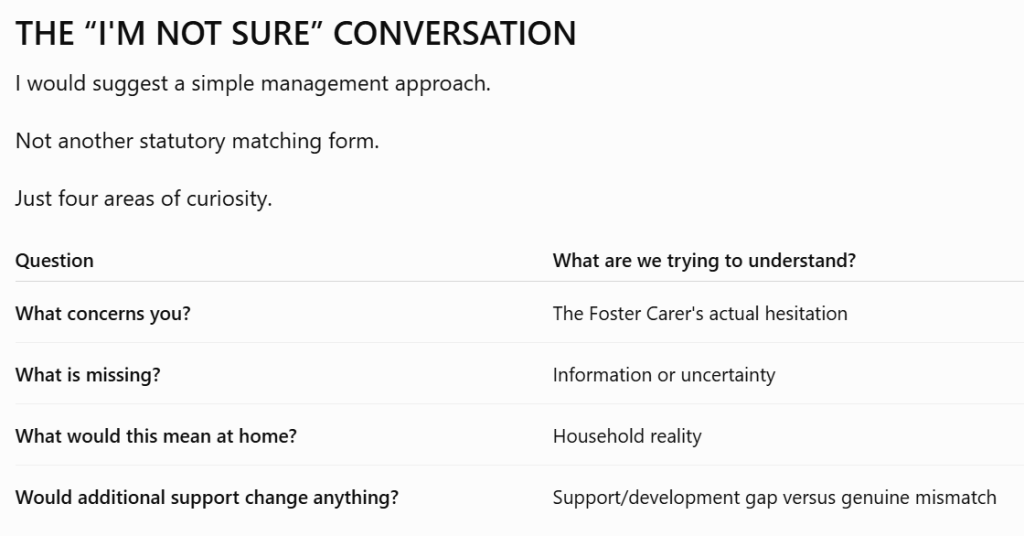
Then there is a crucial fifth question:
“AFTER WE HAVE DISCUSSED ALL OF THAT, HOW DO YOU FEEL NOW?”
The answer may be:
Yes.
No.
or still:
I'm not sure.
All three are information.
“I'm not sure” should buy understanding — not pressure
There may be situations where a decision has to be made urgently.
Emergency placement situations are real.
But urgency should not automatically change:
“I'm not sure”
into:
“We need an answer now, so can we put you down as yes?”
Where there is no realistic opportunity to obtain enough information or confidence, the uncertainty itself may be relevant to the decision.
Sometimes there simply isn't enough basis to proceed confidently.
That may be uncomfortable when a child needs a home.
But pretending uncertainty has disappeared does not actually remove it.
The Foster Carer needs to know a no won't punish them
This is where organisational behaviour becomes crucial.
What happens immediately after a Foster Carer declines?
Is the response:
“Absolutely. Thanks for thinking it through carefully.”
or does the tone change?
Do they stop receiving referrals?
Are they described internally as difficult?
Do people begin questioning their motivation?
Are they repeatedly asked to justify themselves?
A service can officially say:
“Foster Carers can decline placements.”
while culturally communicating:
“But we'd rather you didn't.”
That gap matters.
There is evidence that inappropriate matching matters to retention
We should be cautious not to overstate causation.
The Fostering Network's current recruitment and retention best-practice resource reports that Foster Carers who felt they were not well matched to meet a child's needs were more likely to consider giving up fostering. It therefore identifies Foster Carer involvement in matching as an important element of retention practice.
That does not mean every difficult placement causes a Foster Carer to resign.
It does reinforce something much more reasonable:
matching experience and Foster Carer involvement belong within the retention conversation.
This is why pressure to accept the wrong placement may be remarkably short-sighted.
An empty bed today is visible.
The longer-term consequences of a poor decision may be much less immediately visible.
Financial pressure deserves acknowledgement too
There is another complexity.
For Foster Carers whose income depends significantly on having a child in placement, saying no may carry a financial cost.
The Fostering Network has explicitly raised concern that Foster Carers should not be placed in a position where they feel they must accept a potentially unsuitable match because otherwise they lose income.
That introduces a wider policy issue.
A Foster Carer's decision should ideally be:
“Is this right for the child and our household?”
not:
“Can we afford to say no?”
That is not something an individual placement team can necessarily solve.
But services should at least recognise that the decision may not be occurring in a financially neutral environment.
The decision has to be safe for honesty
This may be the most important management lesson.
The Foster Carer needs to believe that they can say:
“I'm worried.”
“I don't understand that.”
“I need more information.”
“I don't think we're right for this child.”
and:
“No.”
without damaging their relationship with the fostering service.
That is psychological safety.
And it matters increasingly as we move towards retention.
Because future difficulties will require the same honesty.
When a placement becomes challenging, do we want the Foster Carer to say:
“I'm struggling and need help”?
Of course we do.
But if their earliest experiences taught them that expressing uncertainty disappoints the organisation, why would we expect complete openness later?
The first referral teaches the Foster Carer how safe honesty is
This is the deeper retention connection within Point 86.
The decision itself matters.
But the organisational response teaches the Foster Carer something.
Can I be honest here?
Can I disagree?
Can I ask for more information?
Can I admit that I'm frightened?
Can I say no without damaging the relationship?
That learning may follow them into the first placement and beyond.
So don't simply record:
Referral declined.
Try to understand:
Why?
And don't automatically see:
“I'm not sure”
as indecision.
Sometimes it is exactly the response we should want from somebody taking a major responsibility seriously.
SAYING NO TO THE WRONG PLACEMENT MAY BE PART OF SAYING YES TO FOSTERING.
And: