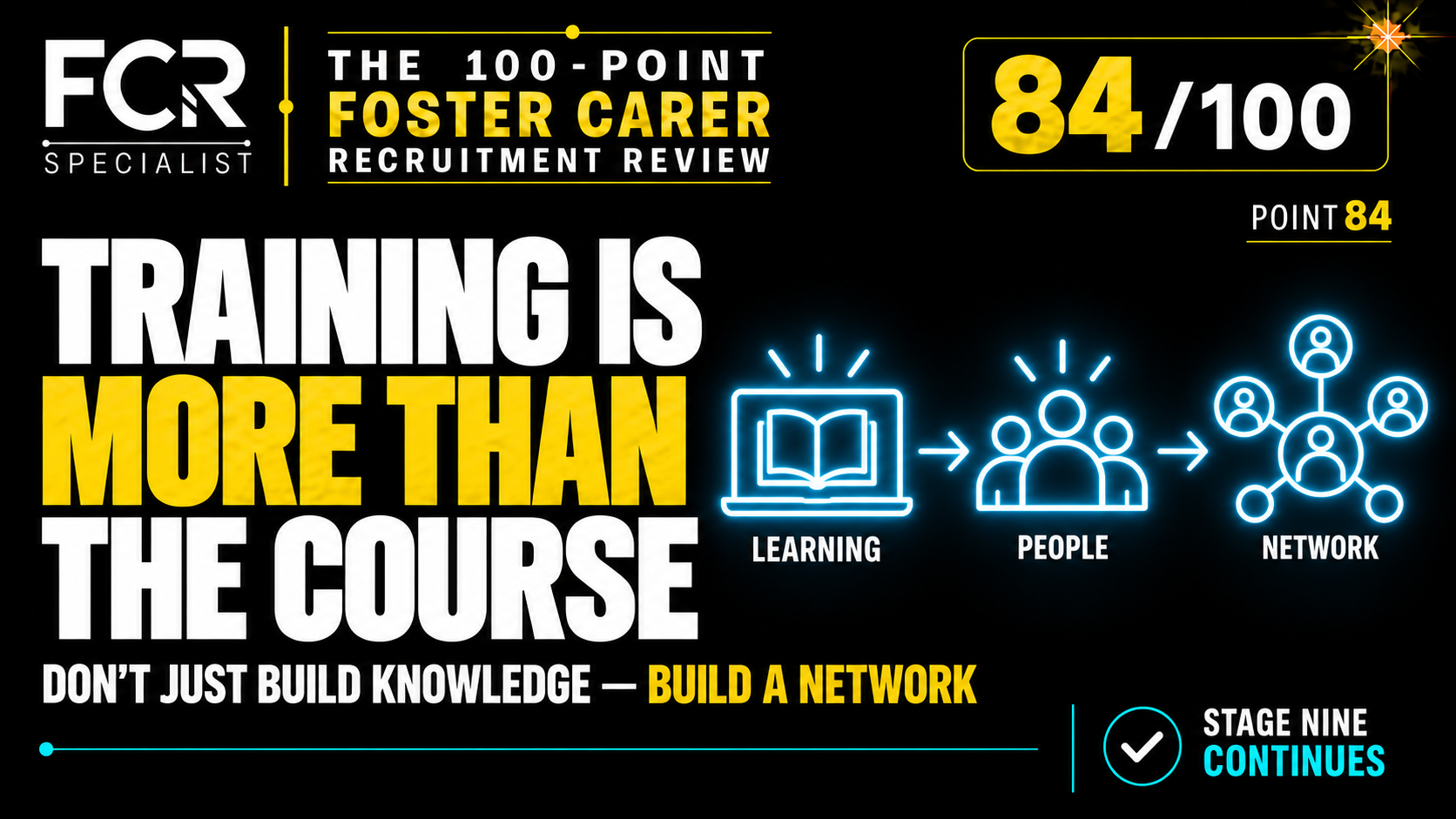
POINT 84/100 — TRAINING IS MORE THAN THE COURSE
POINT 84/100 — TRAINING IS MORE THAN THE COURSE
Training is an obvious part of becoming and remaining a Foster Carer.
There are standards to achieve.
Courses to attend.
Knowledge to develop.
Safer caring to understand.
Policies and procedures to learn.
Development needs to address.
It is therefore understandable that fostering services measure training through things such as:
attendance;
completion;
certificates;
workbooks;
and
training records.
But there is another part of Foster Carer learning that is much harder to record on a spreadsheet.
It is what happens when Foster Carers learn from each other.
FOSTER CARERS LEARN FROM TRAINING. THEY ALSO LEARN FROM EACH OTHER.
For newly approved Foster Carers, that can be particularly important.
“That happened to us too”
Imagine a new Foster Carer attending a training session.
During a discussion they describe something they found difficult.
Perhaps they were unsure how to respond.
Perhaps they worried that they had handled something badly.
Perhaps they wondered privately whether they were really suited to fostering.
Then an experienced Foster Carer says:
“That happened to us too.”
Those five words can be remarkably powerful.
They do not necessarily solve the problem.
But they may change how the new Foster Carer interprets it.
Instead of:
“I'm the only person struggling with this.”
they begin to think:
“Maybe this is something other Foster Carers experience too.”
Then someone says:
“This is what helped us.”
Now the discussion has created:
knowledge;
reflection;
normalisation;
practical insight;
and connection.
That is why training should not simply be viewed as information being transmitted from a trainer to a Foster Carer.
Sometimes the room itself is part of the learning resource.
The professional and the peer provide different things
This Point needs an important boundary.
Peer support does not replace professional support.
An experienced Foster Carer is not a substitute for:
a Supervising Social Worker;
a therapist;
a safeguarding professional;
a child's Social Worker;
or specialist advice.
There will always be situations requiring professional judgement and intervention.
But peer support can provide something different:
lived recognition.
The professional might explain:
“This can happen in fostering.”
Another Foster Carer might say:
“I remember exactly what that felt like.”
Both are useful.
But they are not interchangeable.
THE PROFESSIONAL SUPPORTS PROFESSIONALLY. THE PEER SUPPORTS THROUGH LIVED EXPERIENCE.
A strong fostering service should understand the value of both.
The regulatory framework already recognises peer support
This is not simply a nice additional idea.
Current National Minimum Standard 21.4 explicitly says that peer support, Foster Care associations and/or self-help groups for Foster Carers should be encouraged and supported.
The same standards require Foster Carers to receive the training and development they need and expect ongoing development to reflect their needs and experience.
So there is already a clear foundation for services to think about learning and support as interconnected rather than entirely separate organisational activities.
But there is an important difference between:
having a support group
and
creating a support network that a new Foster Carer actually feels part of.
Don't make the support group another email invitation
Point 81 looked at the post-approval information blizzard.
There is an obvious connection here.
A new Foster Carer may receive an email saying:
“Our Foster Carer support group meets on the second Tuesday of every month. Details attached.”
Technically, they have been informed.
But have they been connected?
Compare that with:
“Our support group is next Tuesday. A few of the Foster Carers you met during training will be there. Sarah, who has been fostering with us for six years, will give you a call beforehand and meet you when you arrive.”
Those are completely different experiences.
DON'T JUST SEND THE INVITATION. BUILD THE CONNECTION.
For somebody walking into an established group for the first time, that personal introduction can matter enormously.
The danger of the established group
Support groups can also unintentionally become difficult environments for newcomers.
A well-established group may contain Foster Carers who:
know each other very well;
use organisational shorthand;
understand historical issues;
share stories;
have longstanding relationships with staff;
and already understand how the service works.
A new Foster Carer may walk into that room and feel like an outsider.
So services should ask:
How do new Foster Carers enter our existing peer community?
Not merely:
Do we have a support group?
Someone should welcome them.
Introduce them.
Explain how the group works.
Help them participate.
And perhaps sit beside them the first time.
The difference between attendance and belonging matters.
Training can be the easiest place to begin the network
Training provides a natural opportunity because people are already together for a shared purpose.
Rather than viewing breaks and discussions as interruptions to course content, recognise their value.
The conversation over coffee may include:
“How did you cope with that?”
“Who did you call?”
“Did your children find that difficult too?”
“I thought I was doing something wrong.”
Those conversations can continue long after the PowerPoint presentation has disappeared from memory.
The Fostering Network's current Skills to Foster course materials themselves highlight the value participants place on hearing directly from Foster Carers about their experience.
That should tell us something about how people learn about fostering.
From training event to learning community
I would therefore suggest a change in management thinking.
Instead of:
COURSE → COMPLETED
think:
COURSE → CONVERSATION → CONNECTION → CONTINUING LEARNING
That does not require every course to become a support group.
It means recognising that learning can create relationships which continue afterwards.
A new Foster Carer might leave training with:
new knowledge;
the trainer's resources;
their next learning objective;
and perhaps two or three Foster Carers they now know well enough to speak to again.
That last outcome may be difficult to put on a training spreadsheet.
It may nevertheless be enormously valuable.
What does current Foster Carer feedback tell us?
The Fostering Network's State of the Nations' Foster Care 2024 surveyed more than 3,000 current and former Foster Carers and 114 fostering services across the UK.
Among its learning and development findings:
67% of Foster Carers rated their pre-approval training as excellent or good;
63% rated post-approval training as excellent or good;
and Foster Carers seeking training they could not access most frequently raised concerns about its timing, format or level.
That is worth considering.
Training quality is not just:
What courses are on our programme?
It is also:
Can Foster Carers actually access them?
Are they relevant when needed?
Do they work around employment and family life?
Does the level reflect where the Foster Carer is in their development?
The Fostering Network similarly argues that learning opportunities need to be flexible and accessible, noting that many Foster Carers combine fostering with employment and childcare responsibilities.
Training and retention
This Point also moves us further towards the retention discussion that will dominate the final stage of the Review.
Again, we need to be careful with causation.
There is not evidence that simply sending somebody on more courses will automatically retain them.
However, State of the Nations 2024 asked fostering services what they considered the most effective things they did to retain Foster Carers.
Among 106 service comments:
78% mentioned support, which included groups, peer support, specialist support, supervision and approaches such as Mockingbird;
and 27% mentioned training.
These are fostering services' reported perceptions of effective retention practice.
They are not experimental evidence proving causation.
But they reinforce the proposition that services themselves see:
support;
relationships;
peer connection;
and
learning
as part of the retention environment.
That is exactly why training should not be viewed in isolation.
DON'T JUST BUILD KNOWLEDGE. BUILD A NETWORK.
If we want to make this practical, I would suggest managers look at every part of their Foster Carer development programme through two lenses.
THE KNOWLEDGE QUESTION
What should the Foster Carer understand differently after this?
and:
THE CONNECTION QUESTION
What opportunity does this create for them to connect with other Foster Carers?
Not every course needs a complicated networking exercise.
Sometimes it is as simple as:
allowing genuine discussion;
using experienced Foster Carers appropriately within learning;
creating small-group conversation;
introducing new Foster Carers to established carers;
making sure new people are not left standing alone during breaks;
or linking training naturally with buddy and support-group arrangements.
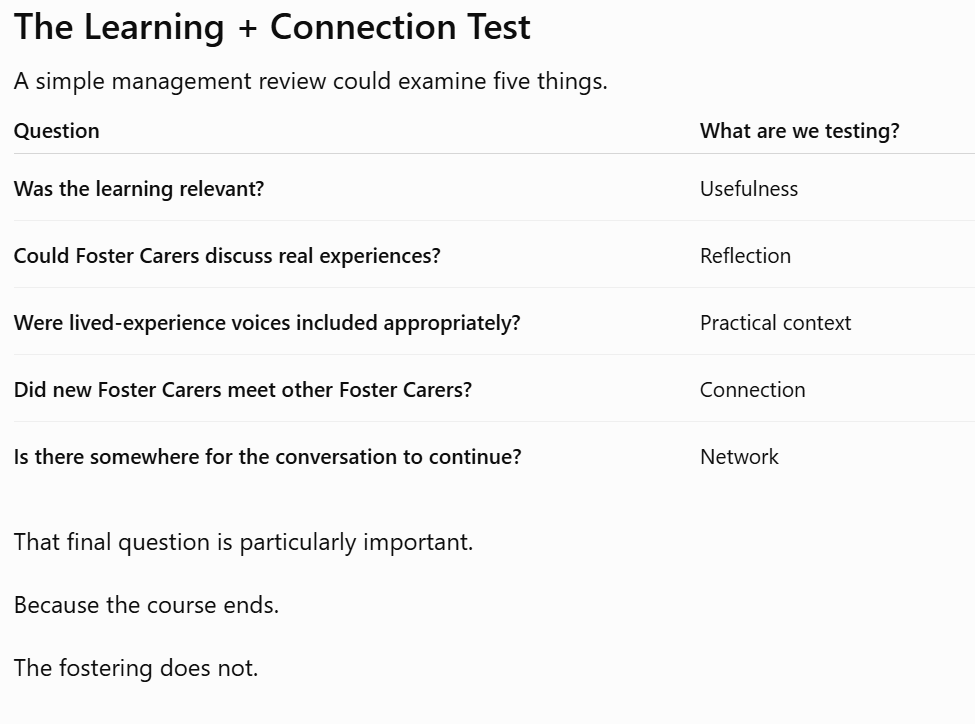
“I thought it was just me”
Some of the most difficult moments in fostering can involve isolation.
A Foster Carer may wonder:
Why am I finding this so difficult?
Why am I reacting like this?
Why isn't this working?
Am I the only Foster Carer who feels this way?
Professional support is essential.
But there is something particularly powerful about another Foster Carer saying:
“No. You're not the only one.”
That should never become reassurance that minimises a serious concern.
Some situations require urgent professional intervention.
But where the issue is the normal complexity and emotional challenge of fostering, peer recognition can help somebody remain reflective rather than isolated.
Support groups are not the poor relation of training
Sometimes support groups can be positioned almost as the social side of fostering.
Training sounds professional.
Supervision sounds professional.
Support groups sound optional.
I think that underestimates them.
A well-functioning support group can provide:
peer learning;
shared experience;
practical ideas;
relationships;
normalisation;
informal mentoring;
and a sense of belonging.
Current NMS explicitly recognise and support peer-support arrangements.
So perhaps the question should not simply be:
“When is the next support group?”
but:
“WHO DOES THIS NEW FOSTER CARER KNOW YET?”
That is a much more revealing question.
The network needs diversity too
There is another practical consideration.
One experienced Foster Carer should not become the model for everybody.
Fostering households differ enormously.
Single Foster Carers.
Couples.
LGBTQ+ households.
Older and younger carers.
Working carers.
Carers from different cultural and faith backgrounds.
Families with birth children.
Carers offering different types of fostering.
Different people may need different points of connection.
A good peer network should therefore provide opportunities for Foster Carers to meet people whose experiences resonate with their own, while also exposing them to a broader fostering community.
The goal isn't:
“Here is your one experienced Foster Carer.”
It is gradually creating:
“These are people I can learn with and from.”
The buddy relationship still has boundaries
Where a service uses buddies or mentors, clarity matters.
The buddy is not the Supervising Social Worker.
They should not be expected to manage safeguarding concerns, professional disputes or matters beyond their role.
Equally, the Foster Carer should understand when something discussed with a peer needs to move into professional support.
So the principle established earlier remains important:
THE PROFESSIONAL SUPPORTS PROFESSIONALLY. THE BUDDY SUPPORTS THROUGH LIVED EXPERIENCE.
That distinction protects both relationships.
Measure more than attendance
At the end of a training year, a service may be able to produce excellent completion data.
But perhaps we should also ask:
How many new Foster Carers participate in support groups?
How many have met experienced Foster Carers?
How many have a buddy where this is offered?
Do working Foster Carers have realistic opportunities to participate?
Do online options create access for geographically dispersed Foster Carers?
What prevents people attending?
Do Foster Carers describe themselves as connected to others?
These are different measures.
They tell us something about the social infrastructure around fostering.
From approved to belonging
This is the deeper purpose of Point 84.
Point 83 asked whether we build sufficient foundations before the first placement.
Point 84 adds another foundation:
other Foster Carers.
A newly approved person needs professional support.
They need learning.
They need information.
But they may also need people who understand fostering without requiring a lengthy explanation.
People who can say:
“I remember my first placement.”
“We struggled with that too.”
“This is what we learned.”
“Speak to your SSW about that — they'll be able to help.”
That is not merely socialising.
It is part of becoming embedded within a fostering community.
And as we move closer towards the final ten Points and the question of retention, that sense of connection becomes increasingly relevant.
FOSTER CARERS LEARN FROM TRAINING. THEY ALSO LEARN FROM EACH OTHER.
So when you review your training programme, don't just ask:
What courses are we delivering?
Ask:
What community are we creating around the people attending them?