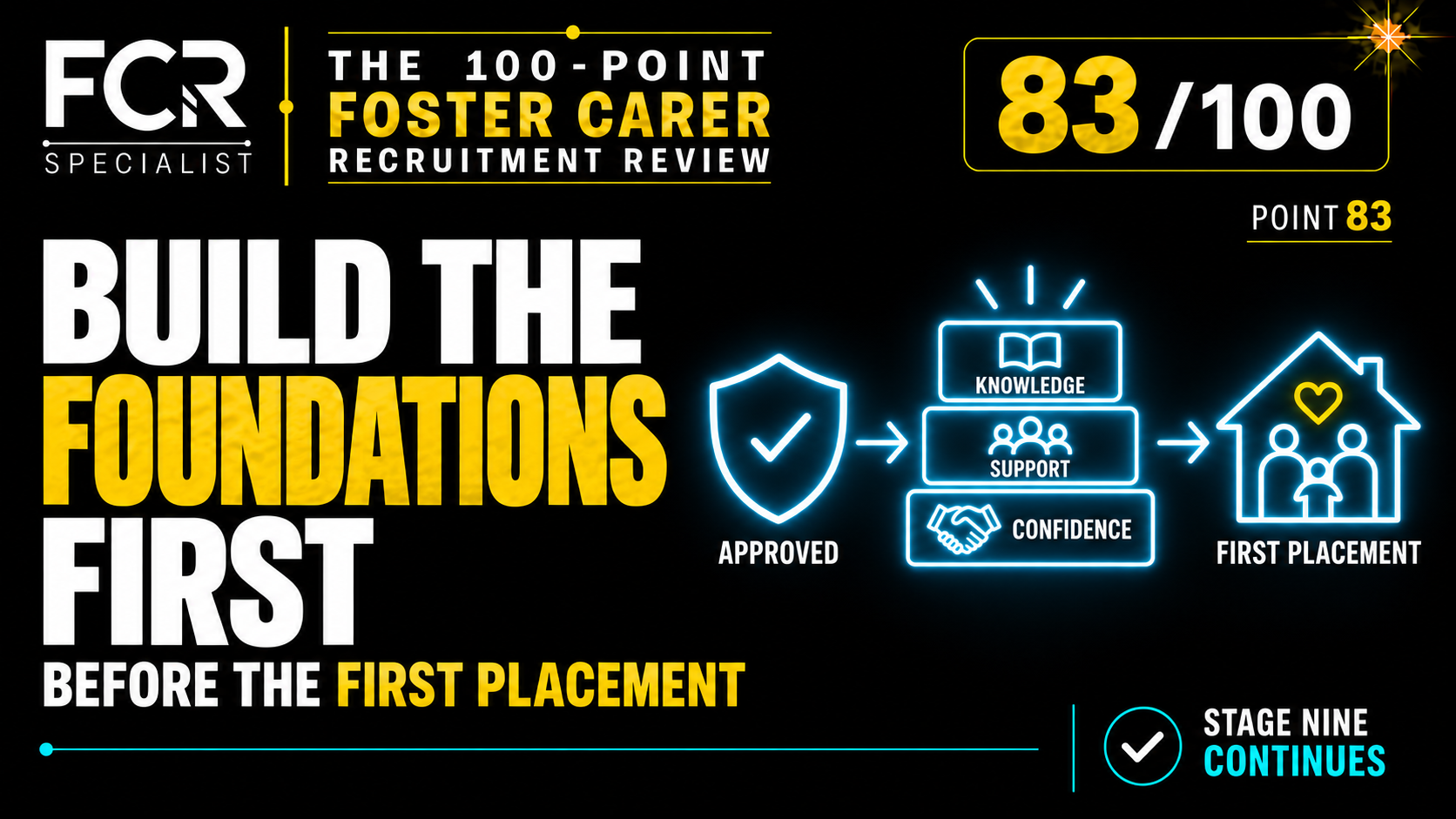
POINT 83 — HAVE YOU BUILT THE FOUNDATIONS BEFORE THE FIRST PLACEMENT?
POINT 83 — HAVE YOU BUILT THE FOUNDATIONS BEFORE THE FIRST PLACEMENT?
Approval has happened.
The congratulations have been given.
The handover should be underway.
Now comes an interesting period in the Foster Carer journey.
What happens before the first placement?
For some Foster Carers that period may be short.
For others it may last considerably longer.
Either way, it should not simply be treated as waiting for the telephone to ring.
WAITING FOR A FIRST PLACEMENT IS NOT EMPTY TIME.
It is an opportunity to convert approval into confidence.
Because:
APPROVAL CONFIRMS SUITABILITY. IT DOESN'T MANUFACTURE CONFIDENCE.
A person can have been thoroughly assessed and quite properly approved while still feeling enormously apprehensive about the reality of an unfamiliar child arriving in their home.
That is entirely different from being unsuitable to foster.
The change from knowing about fostering to actually doing it
Assessment and pre-approval training can prepare people for a great deal.
But there is inevitably a difference between discussing fostering and experiencing it.
Before placement, Foster Carers may have considered:
behaviour;
attachment and relationships;
safer caring;
recording;
family time;
school;
birth-family relationships;
professional meetings;
household routines;
their own children;
and support.
But much of this has still been theoretical.
Then a child arrives.
Suddenly these aren't topics on a training slide.
They are happening in the kitchen, sitting room, car and bedroom.
That transition deserves preparation.
The lesson I learned from my own first placement
This Point is particularly personal for me.
I fostered for approximately ten years.
When my first placement arrived, the child was around nine.
I had expectations about the relationship I would build.
I wanted to make a difference.
I wanted this child to feel comfortable and secure in our home.
But the relationship did not develop in the way I had imagined.
And I began interpreting that as my failure.
My thinking became:
“I'm failing this child.”
And then:
“Maybe somebody else could do this better than I can.”
I came remarkably close to giving notice.
Then I attended training about attachment and about how children's previous experiences can influence relationships and behaviour.
Something important happened.
The child didn't suddenly change.
My understanding changed.
I began to understand why a child might not immediately respond to care, attention and relationships in the way I had expected.
I stopped interpreting everything as evidence that I was failing.
That placement continued.
More than 20 years later, I attended that person's wedding.
I don't tell that story because one training course magically solves fostering.
It doesn't.
I tell it because it illustrates something much more important:
TRAINING CAN TURN “I'M FAILING” INTO “I UNDERSTAND WHAT IS HAPPENING.”
And understanding can change what somebody does next.
Knowledge can change interpretation
This matters enormously.
New Foster Carers will inevitably encounter experiences that challenge them.
The question is not whether we can prepare them for every eventuality.
We can't.
The question is whether we have built enough foundations for them to interpret those experiences constructively.
There is a profound difference between thinking:
“This child doesn't like me.”
and:
“Perhaps trusting adults is difficult for this child.”
Between:
“Nothing I do works.”
and:
“Perhaps what I'm seeing has a history I don't yet understand.”
Between:
“I must be a terrible Foster Carer.”
and:
“I need some help understanding what is happening here.”
That shift can create space for reflection and support rather than immediate self-blame.
Current National Minimum Standard 3 specifically recognises the importance of Foster Carers understanding how children's previous experiences can manifest through behaviour. Standard 20 requires new Foster Carers to receive induction and sets expectations around ongoing learning and development.
Don't make training a compliance exercise
There is a danger that services measure training predominantly through completion.
Attended.
Completed.
Certificate issued.
Workbook progressing.
Those things matter.
But the better question is:
WHAT DOES THE FOSTER CARER NOW UNDERSTAND THAT THEY DIDN'T UNDERSTAND BEFORE?
The current TSD framework is explicitly intended to develop knowledge, understanding, confidence and clarity, with mainstream Foster Carers expected to evidence the standards within 12 months of approval.
So don't try to cram an entire professional development journey into the period before first placement.
That would simply recreate Point 81's information blizzard in another form.
Instead ask:
What knowledge is most useful now?
What can reasonably come later?
What might help this particular Foster Carer understand the experiences they are likely to encounter?
The first-placement foundations
I would suggest services undertake a simple First Placement Foundations Check.
This is not another assessment.
It is not another approval hurdle.
It is a management check that the organisation has done what it reasonably can to help an approved Foster Carer begin well.
1. PEOPLE
Does the Foster Carer know the people around them?
Their SSW?
Out-of-hours support?
Who will talk to them about placements?
Where appropriate, their buddy or peer contacts?
Not merely names.
Relationships.
2. KNOWLEDGE
Have they started developing the knowledge that may help them interpret fostering?
Not everything.
But enough foundation around issues such as:
children's experiences;
relationships and behaviour;
safer caring;
their role;
support;
and the areas identified within their individual development needs.
3. PRACTICAL CONFIDENCE
Do they know what happens when the phone rings?
Who do they ask if something doesn't make sense?
Where are essential contacts?
What happens if they need help outside office hours?
Point 85 will look much more closely at the first referral itself.
At this stage, we are simply asking whether the Foster Carer feels organisationally orientated.
4. HOUSEHOLD
Has the whole household had an opportunity to think again about what is about to change?
Not just the bedroom.
Daily life.
Meals.
Privacy.
Work.
School runs.
Noise.
Visitors.
Pets.
Family time.
Birth children.
Partners.
Point 88 will examine this in much greater depth once a placement actually arrives.
But preparation starts before then.
5. CONFIDENCE
Perhaps the most overlooked question:
“How are you feeling about your first placement?”
Not:
“Are you ready?”
That can invite an automatic:
“Yes.”
Instead:
“What are you most looking forward to?”
“What are you most worried about?”
Those answers tell us far more.
Readiness is not another suitability decision
This distinction is extremely important.
The Foster Carer has been assessed.
They have been approved.
This Point is not advocating another gatekeeping process.
The question is not:
“Should we reconsider whether they should foster?”
It is:
“What can we do now to help this approved Foster Carer succeed?”
Anxiety should not automatically be interpreted as lack of readiness.
Someone can simultaneously think:
“I desperately want to do this.”
and:
“I'm terrified about getting it wrong.”
Both can be true.
Don't let the waiting period become drift
There is another risk.
No appropriate placement is immediately available.
Days become weeks.
Perhaps weeks become months.
Contact becomes less frequent.
Training continues occasionally.
The Foster Carer starts wondering:
“Have they forgotten about me?”
This connects with a principle established earlier in the Review:
WAITING SHOULD ALWAYS HAVE AN OWNER.
Even if there is no placement to discuss, maintain connection.
Use the time intelligently.
Review development.
Introduce people.
Build networks.
Discuss confidence.
Keep them part of the fostering community.
Because someone can be approved without yet feeling that they truly belong.
What does the evidence tell us about training and retention?
Care is needed here.
We should not claim that completing training automatically causes Foster Carers to remain.
However, DfE's analysis of mainstream fostering showed an interesting association.
Among Foster Carers in households approved for more than 12 months as at March 2023, 91% of those remaining approved had completed their TSD workbook compared with 81% of those in deregistered households. Foster Carers in deregistered households were also more likely not to have started mandatory training.
That does not prove that training caused retention.
Many other differences may explain the relationship.
But it reinforces why learning and development should not be regarded as peripheral to the Foster Carer experience.
The same DfE analysis found that 275 mainstream households had both been approved and deregistered during 2022–23 — equivalent to 7% of newly approved households that year. Again, that does not tell us why they left, but it reminds us that approval itself does not guarantee longevity.
Build foundations before they are tested
There will always be learning that only happens through fostering.
No course can recreate:
the first evening;
the first bedtime;
the first difficult conversation;
the first school morning;
the first moment somebody says something that catches you completely off guard.
Experience matters.
But we shouldn't deliberately send Foster Carers into that experience with avoidable gaps.
THE FIRST PLACEMENT SHOULD NOT HAVE TO TEACH EVERYTHING FROM SCRATCH.
Good preparation does not remove difficulty.
It helps people understand difficulty when it arrives.
That matters not only to Foster Carer development.
Increasingly, as this Review moves towards its final section, it matters to retention.
Because when a new Foster Carer encounters difficulty, one of the most important differences may be whether their interpretation becomes:
“I can't do this.”
or:
“I need help understanding this.”
Those are very different starting points.
And sometimes the right knowledge at the right time can help create that difference.