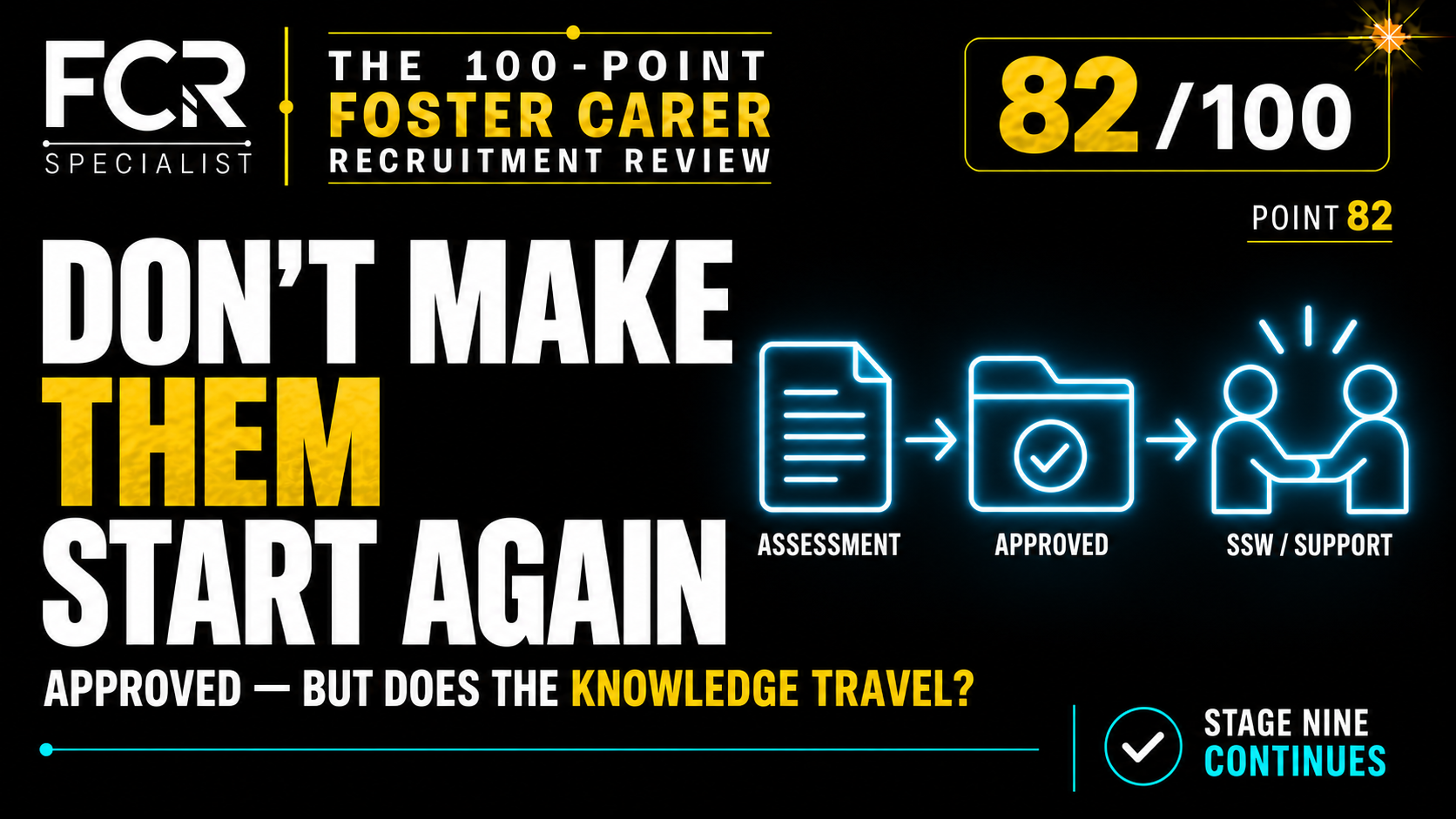
POINT 82/100 — DOES THE HANDOVER WORK — OR DO THEY HAVE TO START AGAIN?
POINT 82/100 — DOES THE HANDOVER WORK — OR DO THEY HAVE TO START AGAIN?
A newly approved Foster Carer may have spent many months being known in considerable depth by their fostering service.
Recruitment may know why they originally enquired.
Their Assessing Social Worker may know their family history, motivation, strengths, anxieties, relationships, household dynamics and support network.
Training staff may have seen how they participate, question, reflect and learn.
The service has invested significant time in understanding them.
Then approval happens.
And potentially the organisational clock resets.
A new relationship begins and the Foster Carer can find themselves explaining things they believed the organisation already knew.
“I discussed that during assessment.”
“Recruitment already knew about that.”
“I thought this had been explained.”
“That's not what I was told before approval.”
This is not simply frustrating.
It can begin to undermine something we have spent the entire recruitment and assessment journey building:
trust.
HAND OVER THE RELATIONSHIP — NOT JUST THE FILE.
The file can transfer while the understanding doesn't
Fostering services necessarily hold substantial information about approved Foster Carers.
There will be assessment material.
Panel documentation.
Approval information.
Training information.
Records.
Terms of approval.
Policies and processes governing what information should be available to whom.
But there is a difference between information existing somewhere within an organisation and the incoming relationship beginning with genuine context.
Someone can have access to a substantial file and still not understand:
Why does this person want to foster?
What are they particularly good at?
What are they anxious about?
What expectations have already been created?
Where may they initially need reassurance?
That is why I think services should consciously guard against what I would describe as:
THE POST-APPROVAL COLD START.
The Foster Carer reaches approval with months of accumulated organisational knowledge behind them — but their next significant professional relationship starts almost from zero.
What does that feel like to the Foster Carer?
This Review repeatedly returns to one important principle:
APPLICANTS DON'T EXPERIENCE YOUR DEPARTMENTS. THEY EXPERIENCE YOUR ORGANISATION.
Approval does not change that.
The Foster Carer probably does not distinguish particularly between something said by:
Recruitment.
An Assessing Social Worker.
Training.
Panel preparation.
A manager.
Their eventual Supervising Social Worker.
They may simply think:
“The fostering service told me.”
So when the next person says:
“I didn't know that.”
or:
“You'll need to explain that to me.”
the Foster Carer may reasonably wonder:
“Why doesn't your organisation know?”
That creates another important principle:
DON'T LET THE FOSTER CARER BECOME THE MESSENGER BETWEEN YOUR TEAMS.
The Warm Handover
I am not suggesting another lengthy process.
Quite the opposite.
This could be remarkably simple.
Where organisational arrangements allow, there should be an intentional transition between the person who has developed substantial knowledge of the applicant during assessment and the professional relationship that will support them after approval.
That might include a conversation involving:
the newly approved Foster Carer;
the Assessing Social Worker;
and
the incoming Supervising Social Worker.
The objective is not another assessment.
The person has been approved.
The purpose is continuity.
A HANDOVER — NOT A REASSESSMENT.
The conversation might simply establish:
This is where we have got to.
This is what we have learned.
These are the strengths we have identified.
These are the areas where confidence is still developing.
These are the expectations we have already discussed.
This is what happens next.
And importantly, the Foster Carer should be able to contribute:
“Is there anything you think we've missed that would be useful for your new SSW to understand?”
That makes them part of the transition rather than the subject of it.
Relevant knowledge should travel appropriately
There does, of course, need to be an important boundary here.
This is not an argument for transferring every comment ever made about somebody or informally passing information between staff without thought.
Information sharing needs to remain relevant, proportionate, professionally appropriate and consistent with organisational information-governance requirements.
The principle is much simpler:
RELEVANT KNOWLEDGE SHOULD TRAVEL APPROPRIATELY.
We have spent months learning about this person for a reason.
We should not organisationally forget them on the day they are approved.
The expectation handover may be particularly important
One of the biggest risks during transitions is not necessarily factual information.
It is expectations.
Perhaps during recruitment or assessment somebody has discussed:
support;
respite;
types of placements;
availability;
communication;
training;
finance;
how referrals happen;
out-of-hours arrangements;
or what the first few months might feel like.
Then someone new becomes involved and describes things differently.
That may sometimes reflect genuine misunderstanding.
Sometimes circumstances change.
Sometimes expectations need to be corrected.
But the incoming professional first needs to understand what expectation already exists.
Otherwise we can inadvertently create:
“But I was told…”
versus
“That's not how it works.”
That is a poor starting point for a new relationship.
And it gives us an important bridge towards the retention issues we will examine later in Stage Nine and Stage Ten:
EXPECTATION GAPS CAN BECOME RELATIONSHIP GAPS.
Approval changes the nature of the relationship
There is a further psychological change taking place.
Throughout assessment, the applicant has understandably been demonstrating their suitability to foster.
Questions have been asked.
Evidence has been gathered.
Their life has been explored in detail.
Approval changes their status.
They are now a Foster Carer.
The organisation's relationship with them therefore changes too.
That does not remove professional oversight, challenge, supervision or safeguarding responsibility.
But the starting emphasis should increasingly become:
How do we help this approved Foster Carer succeed?
rather than leaving them feeling:
Am I still having to prove that I should be here?
APPROVAL CHANGES THE RELATIONSHIP — THE ORGANISATION NEEDS TO CHANGE WITH IT.
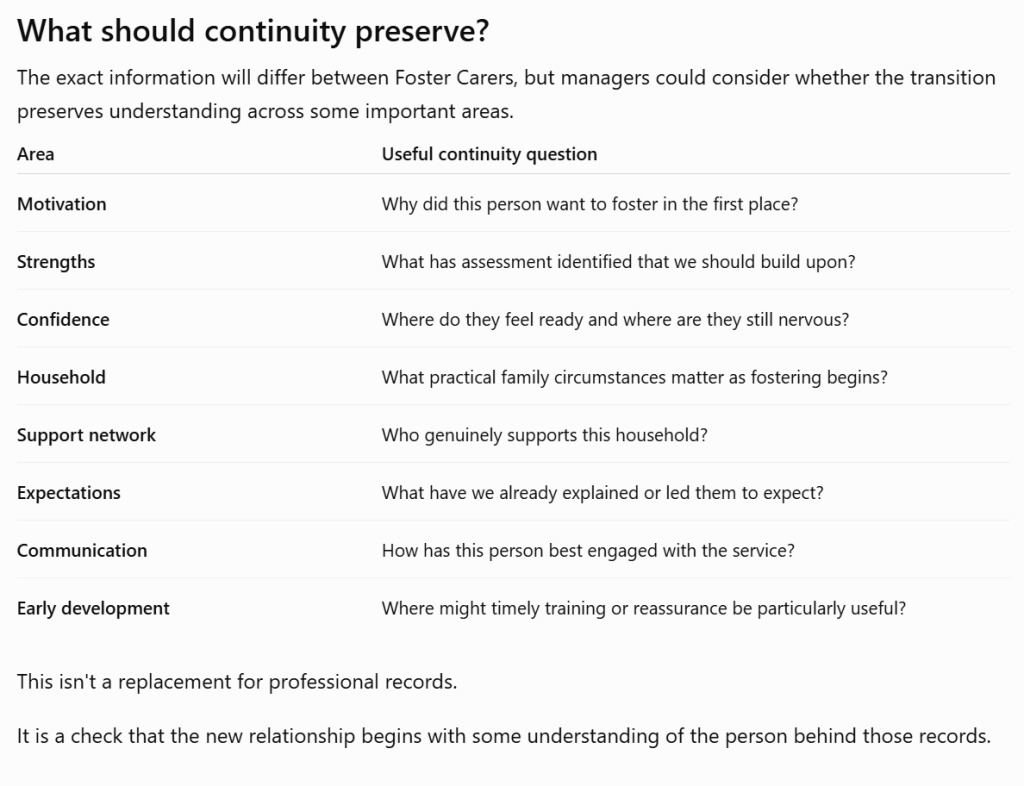
THE FIVE-QUESTION WARM HANDOVER
Before the post-approval relationship really gets underway, I would suggest one very simple management test.
Can the incoming professional answer these five questions?
1. WHO ARE THEY?
Not merely their approval details.
Who is this person and household?
2. WHY DO THEY WANT TO FOSTER?
What has kept them moving through recruitment and assessment?
3. WHAT ARE THEIR STRENGTHS?
What should the organisation now be building upon?
4. WHAT ARE THEY WORRIED ABOUT?
Where might confidence still need developing?
5. WHAT HAVE WE ALREADY EXPLAINED, AGREED OR LED THEM TO EXPECT?
What organisational expectations are they bringing into this new relationship?
If those five questions cannot be answered, there may be a handover gap.
The management test
Managers can test this quite easily.
Take several recently approved Foster Carers.
Ask:
When was their SSW identified?
When were they introduced?
Was there an overlap or transition conversation?
What meaningful information travelled?
Were existing expectations discussed?
Was the Foster Carer involved in the handover?
Then ask the Foster Carer:
DID IT FEEL LIKE THE NEW PERSON ALREADY KNEW SOMETHING ABOUT YOU?
That is a very different measure from:
“Was the file transferred?”
Why this matters for retention
We need to be careful here.
It would be too simplistic to claim that a poor handover automatically causes Foster Carers to resign.
Retention is much more complicated than that.
But research has consistently highlighted the importance Foster Carers place on their professional relationships and support.
Current National Minimum Standards expect each approved Foster Carer to be supervised by a named appropriately qualified social worker, and for Foster Carers to have access to professional support, information and advice.
The Fostering Network's current guidance similarly describes developing a positive working relationship with the fostering service as vital and highlights the importance of clear expectations.
So the beginning of that relationship deserves attention.
If early conversations repeatedly produce:
“Nobody told me that.”
“Nobody knows anything about us.”
“I'm having to explain everything again.”
then trust can begin to erode remarkably quickly.
This is why approval cannot simply be an administrative transfer point.
We spent months building the relationship.
We should carry as much of that relational capital forward as is appropriate.
THE FOSTER CARER SHOULDN'T HAVE TO REINTRODUCE THEMSELVES TO THEIR OWN ORGANISATION.
The next Point will look at what happens during the period before that first placement.
But before we start building confidence for the realities of fostering, we need to make sure we haven't accidentally reset the relationship to zero.