Point 81/100 Approved! Now Stop the Information Blizzard
Approved! Now Stop the Information Blizzard
A new Foster Carer has finally been approved.
For them and their family, this may represent the culmination of months of thinking, preparation, interviews, checks, training and assessment.
Then comes the message they have been waiting for:
Congratulations — you are now an approved Foster Carer.
It should be a significant moment.
But what happens next can tell us a great deal about how well a fostering service understands the transition from recruiting someone to welcoming them into the organisation.
Because approval can sometimes trigger something I would describe as the information blizzard.
Emails start arriving.
Training.
Finance.
Policies.
Portals.
Passwords.
Forms.
Handbooks.
Support groups.
Recording systems.
Supervising Social Worker communication.
Meetings.
Placement information.
Expenses.
TSD requirements.
Online learning.
Individual teams may all be doing exactly what their internal process tells them to do.
But the Foster Carer does not experience those departments separately.
They experience one fostering service.
And suddenly the person who has been carefully guided through recruitment and assessment can find themselves having to work out how the organisation works.
DON'T MAKE THE NEW FOSTER CARER PROJECT-MANAGE YOUR ORGANISATION.
Information is necessary. Information overload isn't.
There is an important distinction to make here.
This is not an argument for withholding information.
Fostering services have clear responsibilities to provide Foster Carers with appropriate training, advice, information and support. Current National Minimum Standards also expect new Foster Carers to receive induction and to be supported in their continuing learning and development.
The question is not:
Should Foster Carers receive the information?
Of course they should.
The better question is:
When do they genuinely need to understand and use each part of it?
That leads to a very different onboarding philosophy.
ACCESS IMMEDIATELY. ABSORB SEQUENTIALLY.
A policy library can be accessible immediately without expecting somebody to read the entire library during their first weekend.
A year's training programme can be available without expecting the new Foster Carer to understand every development requirement during week one.
Finance information can be accessible while somebody separately explains what they actually need to know before their first payment.
There is a difference between:
information availability
and
information expectation.
Good onboarding understands that difference.
Remember what may be happening outside fostering
We can also easily forget that newly approved Foster Carers may still have completely normal lives running alongside this transition.
They may be working full-time.
They may have children.
They may have caring responsibilities.
There may be school runs, jobs, elderly parents, household commitments and everyday family life.
Approval does not suddenly clear their diary.
Then a stream of emails begins arriving, some marked important, some containing attachments, some linking to portals, and some requiring further passwords or actions.
We should not interpret difficulty keeping up with that as a lack of commitment.
Sometimes we have simply created too much noise.
The objective should be to make the first few weeks easier to navigate, not to test how effectively somebody can administer themselves.
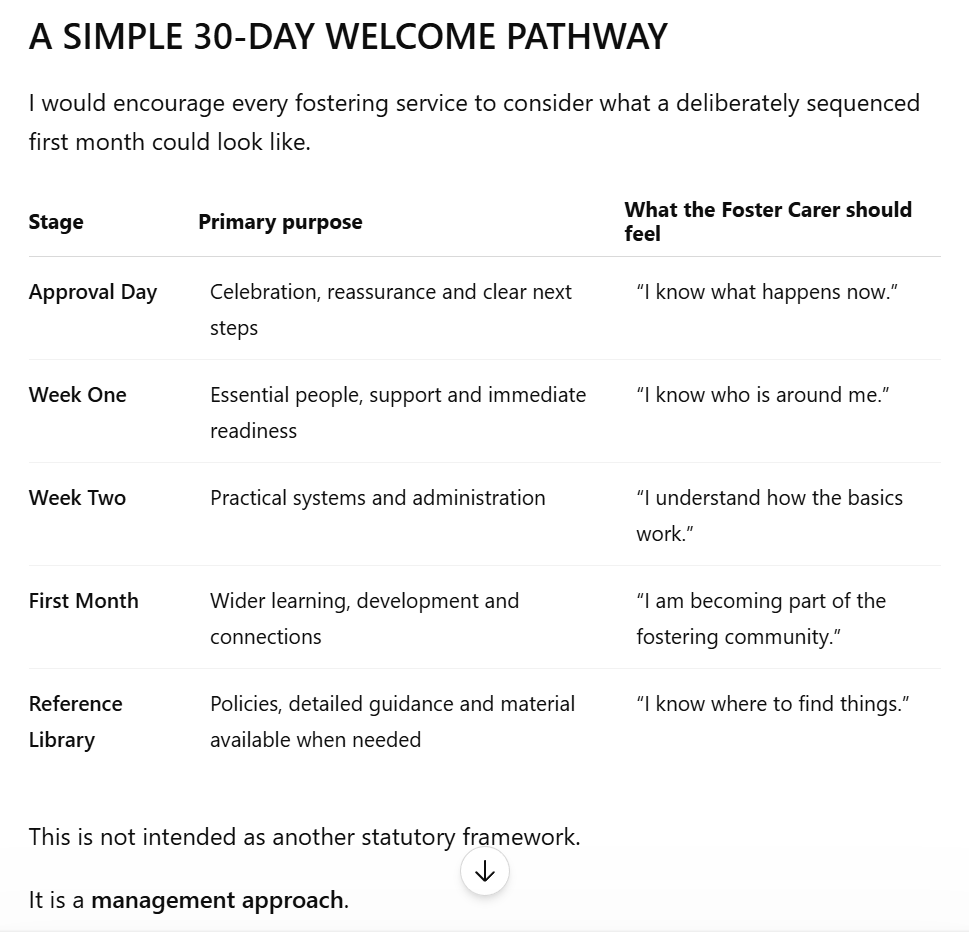
Different services will need different sequences.
But the principle should remain:
NEED TO KNOW NOW
What genuinely matters immediately?
NEED TO DO NOW
What action genuinely cannot wait?
COMING NEXT
What should the Foster Carer know is approaching, without having to deal with it today?
AVAILABLE FOR REFERENCE
What needs to be accessible but does not need to occupy their immediate attention?
This removes a great deal of unnecessary cognitive clutter.
Approval Day — don't let administration swallow the celebration
Approval deserves recognition.
A newly approved Foster Carer should not receive a congratulations email at 10.00am followed by nine administrative emails before lunchtime.
Give them a moment to recognise what they have achieved.
The first communication should answer some very simple questions.
You are approved.
This is what happens next.
This is who will contact you.
This is the one person you can contact if you are confused.
You do not need to deal with everything today.
That final message may be particularly important.
Give people permission to absorb.
Week One — people before portals
Week one should concentrate heavily on relationships.
Who is their Supervising Social Worker?
Who do they contact outside office hours?
Who can answer practical questions?
Is there a buddy or mentor?
Where is the support group?
Who speaks to them about their first referral?
Who is their contact if they are simply unsure where a question belongs?
And wherever practicable:
INTRODUCE PEOPLE AS PEOPLE — NOT EMAIL ADDRESSES.
Consider the difference between receiving:
“Your SSW is Jane Smith. Contact details below.”
and somebody saying:
“Rolfe, I'd like to introduce you to Jane. Jane is going to be your Supervising Social Worker. Let's have a quick Teams call so you can meet.”
Organisationally, that might involve another 20 minutes.
Experientially, it can be entirely different.
Week Two — make the machinery understandable
There will inevitably be systems.
Recording.
Expenses.
Training portals.
Passwords.
Policies.
Forms.
Perhaps electronic placement systems and internal communication tools.
The answer is not to pretend these systems don't exist.
The answer is to introduce them deliberately.
A Foster Carer should not require six emails to discover how to claim mileage.
They should not discover three months later that an important document was hidden behind a portal they had forgotten how to access.
Ask whether your administrative systems are designed around the needs of the service or around the needs of the person using them.
And where there are multiple systems, provide one clear route into them.
The first month — broaden rather than bombard
Once the immediate orientation is established, the wider development journey can begin.
Training.
TSD.
Peer groups.
Support networks.
Development plans.
Further learning.
Service events.
Specialist resources.
Current GOV.UK guidance states that mainstream Foster Carers should complete their TSD standards workbook within 12 months of approval.
That timescale itself illustrates an important point.
Developing as a Foster Carer is a process, not something that needs completing during induction week.
Learning research outside fostering has repeatedly found benefits from distributing learning over time rather than concentrating repeated learning into a single period. That does not prove that a particular fostering onboarding model is superior, but it does provide a sensible supporting principle: people need opportunities to encounter information, use it, revisit it and understand it in context.
So instead of asking:
“Have we sent it?”
perhaps ask:
“Have they had a realistic opportunity to understand it?”
Somebody needs to own the experience
There is another organisational danger.
Training owns training.
Finance owns finance.
IT owns IT.
The SSW owns supervision.
Placements own referrals.
Administration owns administration.
Everyone can therefore complete their task successfully.
Yet the Foster Carer's overall experience can still be poor.
EVERYBODY CAN OWN THEIR BIT WHILE NOBODY OWNS THE EXPERIENCE.
This does not necessarily require another post or another layer of management.
But somebody should have oversight of the newly approved Foster Carer's first few weeks.
Who is checking that introductions happened?
Who notices if six departments contact them on the same day?
Who checks whether they can access the systems?
Who asks whether they know what is coming next?
Who notices that something important has been missed?
Who says:
“Don't worry about that yet. We will come to it next week.”
Sometimes good onboarding is as much about controlling what doesn't happen yet as what does.
THE NEW FOSTER CARER INBOX TEST
Here is one straightforward review I would encourage managers to undertake.
Take a recently approved Foster Carer and reconstruct their first 30 days.
Look at every:
email;
attachment;
link;
form;
login;
training invitation;
meeting request;
telephone contact;
administrative instruction;
policy notification.
Then examine each contact against six questions:TestQuestionPurposeWhy are we sending this?TimingDoes the Foster Carer genuinely need it now?PriorityIs it obvious whether they need to act?DuplicationHas another team already explained this?MethodWould a conversation be better than another email?ExperienceHow does this feel alongside everything else they received?
Then ask the most useful question of all:
IF YOU RECEIVED ALL OF THIS WHILE DOING YOUR NORMAL JOB AND RUNNING YOUR NORMAL FAMILY LIFE, WOULD YOU KNOW WHAT TO DO FIRST?
If the answer is no, redesign it.
A simple traffic-light approach
Services could make every initial communication visibly fall into one of three categories:
NOW — please deal with this.
NEXT — we will come back to this shortly.
REFERENCE — keep this; you don't need to action it now.
It sounds basic.
That is precisely why it could work.
New Foster Carers should not need organisational knowledge to establish the priority of organisational messages.
Approval is the first retention moment
This is why Point 81 belongs within a Foster Carer Recruitment Review.
Recruitment does not suddenly become irrelevant when panel and the decision-making process have finished.
We have spent months persuading someone that fostering is something they can do and supporting them through an exacting approval process.
What happens immediately afterwards tells them something important:
This is what being a Foster Carer with us is going to feel like.
If their first experience is fragmented, confusing and administrative, we have created an unnecessary disconnect.
If instead they experience celebration, clarity, human relationships, paced information and somebody helping them find their feet, we begin the next stage in a much stronger position.
APPROVAL IS THE FIRST RETENTION MOMENT.
The first month should reduce uncertainty.
It should build confidence.
It should connect people.
And it should allow a newly approved Foster Carer genuine time to absorb what they need to know.
Because welcoming somebody into fostering should not feel like an induction endurance test.