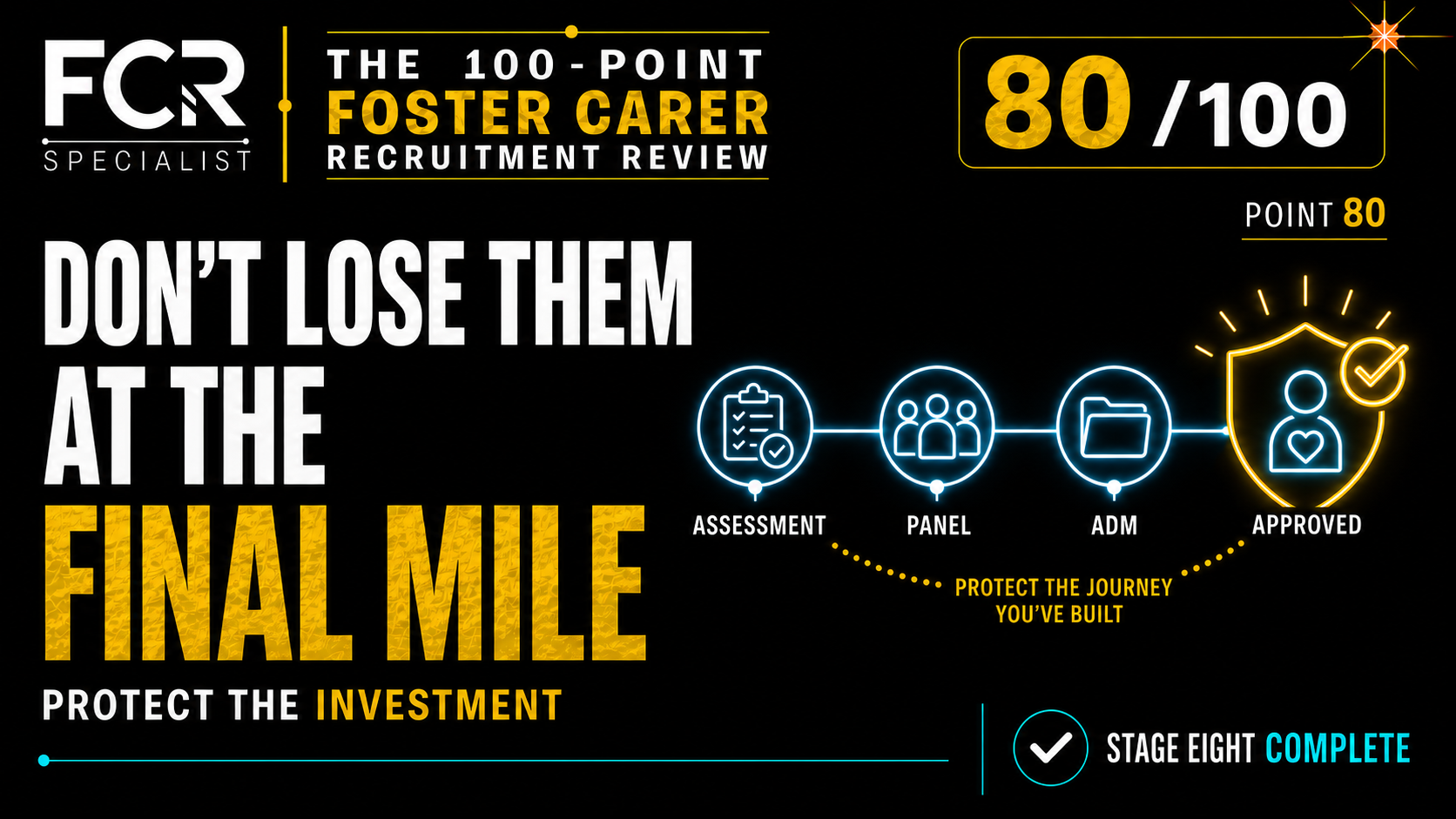
Point 80: Did the Final Mile Protect the Recruitment Investment?
Point 80: Did the Final Mile Protect the Recruitment Investment?
We have now reached the end of Stage Eight of the 100-Point Foster Carer Recruitment Review.
Points 71–79 have looked at what I call:
THE FINAL MILE.
The period from the end of the substantive assessment work through:
report completion;
applicant comments;
quality assurance;
panel;
the Agency Decision Maker;
formal approval;
and the first transition into being an approved Foster Carer.
There is a reason I have spent ten Points looking so closely at this relatively small section of the recruitment journey.
Because by this stage the organisation has already invested enormously in the person.
And so have they.
LOOK AT WHAT IT TOOK TO GET THEM HERE
Before somebody reaches the final stages, they may already have progressed through:
MARKETING
↓
ENQUIRY
↓
INITIAL CONTACT
↓
INITIAL VISIT
↓
APPLICATION / PROGRESSION
↓
TRAINING
↓
CHECKS
↓
REFERENCES
↓
ASSESSMENT
↓
MONTHS OF PROFESSIONAL AND PERSONAL INVESTMENT
That investment has a financial cost.
A professional cost.
An administrative cost.
But the applicant has invested too.
They may have:
rearranged work;
involved their children;
spoken to relatives;
identified support networks;
completed training;
attended appointments;
been medically assessed;
allowed people into their home;
discussed previous relationships;
talked about childhood;
disclosed difficult experiences;
had their parenting explored;
and allowed an organisation to make an extraordinarily detailed assessment of their life.
Then they arrive at the final few weeks.
This is not the point to become less careful with their experience.
It is the point to become more careful.
DON'T LET THE LAST 10% DAMAGE THE FIRST 90%
That is the central message of Point 80.
A fostering service could provide:
excellent advertising;
fast enquiry handling;
a brilliant first telephone call;
a welcoming Initial Visit;
good preparation training;
a supportive assessment relationship;
and thoughtful communication for months.
Then damage confidence almost at the end.
How?
Not necessarily through one catastrophic event.
Through accumulation.
THE FINAL MILE CAN FAIL QUIETLY
Consider this hypothetical journey.
The final assessment meeting takes place.
Then there is little contact.
The applicant eventually receives their report.
There is something in it they were not expecting.
They raise questions.
The report needs further work.
The expected panel date moves.
Then QA takes longer.
Another panel deadline is missed.
A new date is identified.
The applicant gets increasingly anxious about panel because they do not really understand what it will be like.
Panel eventually happens.
It recommends approval.
Everyone says:
“Great.”
Then the applicant waits for the ADM.
There is no update for several days.
Formal approval finally arrives.
They receive an email and several attachments.
Then another part of the service contacts them about availability.
Individually, somebody inside the organisation may have an explanation for every step.
The applicant experiences one organisation.
APPLICANTS DON'T EXPERIENCE YOUR DEPARTMENTS.
THEY EXPERIENCE YOUR SERVICE.
That may be one of the most important lessons from the whole of Stage Eight.
WHAT DID STAGE EIGHT ACTUALLY TEST?
Let's bring Points 71–79 together.
POINT 71 — WHAT HAPPENS WHEN THE ASSESSMENT MEETINGS FINISH?
We identified the hidden gap between the end of substantive assessment meetings and panel.
The key management measures were:
LAST SUBSTANTIVE ASSESSMENT SESSION → NEXT MEANINGFUL CONTACT
and:
LAST SUBSTANTIVE ASSESSMENT SESSION → PANEL
The lesson:
The meetings may have finished. The recruitment journey hasn't.
POINT 72 — SILENCE IS NOT A NEXT STEP
We challenged the assumption that:
“There is nothing new to tell them.”
means:
“There is no reason to contact them.”
The communication structure was:
STATUS → OUTSTANDING → ACTION → NEXT CONTACT
And the principle:
IF THERE IS NOTHING NEW TO REPORT, REPORT THAT.
POINT 73 — DOES THE FORM F CONTAIN ANY SURPRISES?
We separated:
FACT → CONTEXT → ANALYSIS → RECOMMENDATION
The applicant does not own professional judgement.
But there is a major difference between:
“I disagree with the assessment.”
and:
“Nobody ever told me this was a concern.”
The aim was not zero disagreement.
It was:
ZERO UNEXPLAINED MAJOR SURPRISES.
POINT 74 — IS THE REPORT READY — OR JUST THE ASSESSMENT?
We stopped treating assessment as one enormous block of time.
Instead, we asked what each interval actually represented:
ACTIVE WORK?
DEPENDENCY?
QUEUE?
And established:
REMOVE WASTED TIME. PROTECT PROFESSIONAL TIME.
POINT 75 — HAVE YOU PLANNED THE ROUTE TO PANEL?
We looked at panel slippage.
Not simply as another delay.
But as something that can affect:
TIME + CONFIDENCE + TRUST.
The applicant may interpret repeated organisational problems as a preview of what fostering for that organisation will feel like.
We introduced:
ZERO UNEXAMINED PANEL SLIPPAGE.
And:
TARGET ≠ PROMISE.
POINT 76 — PANEL OR ORDEAL?
We asked whether services were properly preparing people for panel or inadvertently making it frightening.
The preparation framework was:
PURPOSE → PEOPLE → PROCESS → QUESTIONS → AFTERWARDS → SUPPORT
With an important professional boundary:
PREPARE THE PERSON. DON'T SCRIPT THE PERFORMANCE.
POINT 77 — PANEL IS A MILESTONE
We recognised that a positive panel recommendation is not formal approval.
The ADM still decides.
But that doesn't mean the milestone should be ignored.
We used:
RECOGNISE → CONGRATULATE → EXPLAIN → CONNECT.
And:
CELEBRATE THE MILESTONE WITHOUT MISREPRESENTING THE DECISION.
POINT 78 — THE ADM GAP
We then identified another easily hidden period:
PANEL → ADM PAPERS → DECISION → APPLICANT TOLD.
Importantly, we distinguished:
the ADM clock
from:
the applicant's clock.
The applicant's waiting began when panel finished.
So:
DON'T ONLY MEASURE THE ADM CLOCK. MEASURE THE APPLICANT'S CLOCK.
POINT 79 — THE MOMENT OF APPROVAL
Finally, we asked whether formal approval actually felt like the achievement it was.
Our proposed first-48-hour approach was:
WELCOME → CLARIFY → CONNECT → PREPARE.
And we established perhaps the most important bridge into the next stage:
APPROVAL IS THE FIRST RETENTION MOMENT.
NOW PUT ALL OF THAT INTO ONE FINAL-MILE SCORECARD
This is where Point 80 becomes useful rather than merely reflective.
Take your last ten or twenty completed assessments.
Do not look first at your policy.
Do not ask staff what is supposed to happen.
Look at what actually happened.
Create one simple review.
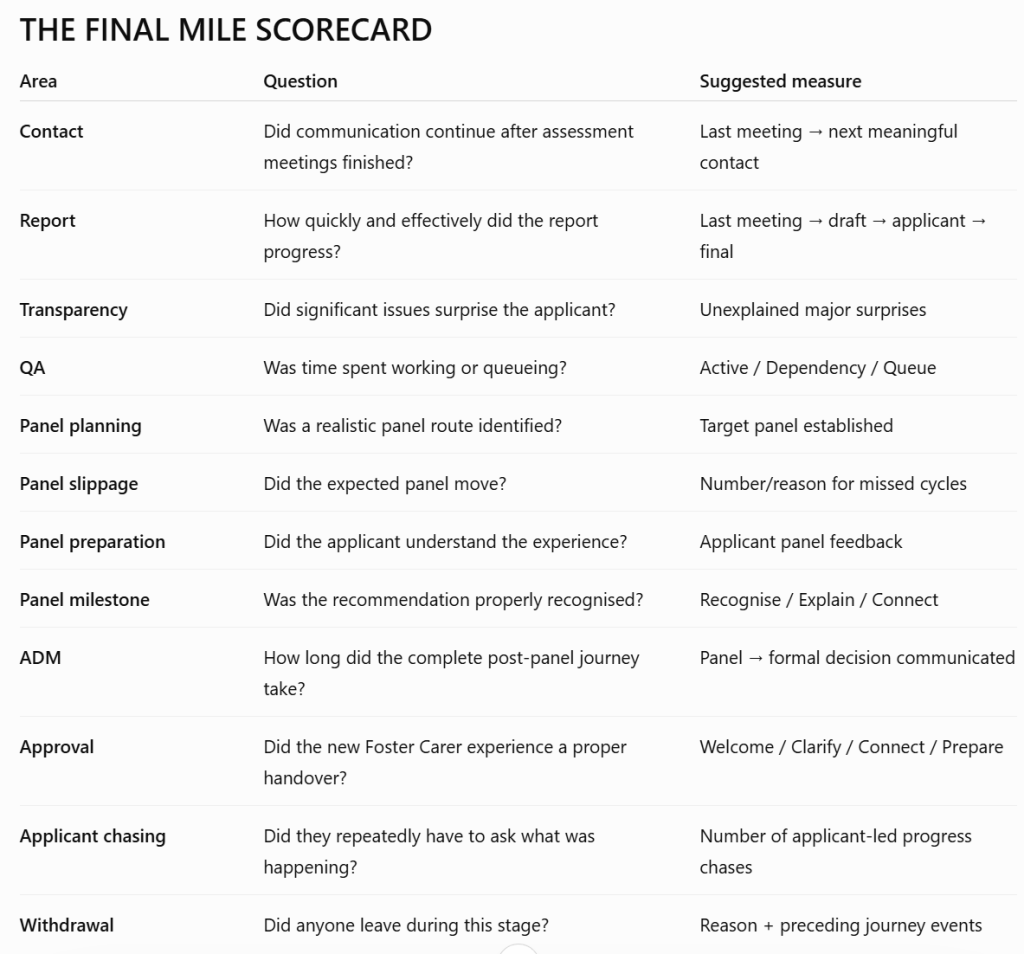
This is not a national statutory dashboard.
It is a management diagnostic.
And I would not turn every measure into a punitive KPI.
The objective is understanding.
A GREEN DASHBOARD CAN STILL HIDE A POOR EXPERIENCE
This is worth emphasising.
Imagine a dashboard showing:
Assessment within expected timescale — GREEN
Panel completed — GREEN
ADM decision within standard — GREEN
Approval achieved — GREEN
Everything looks excellent.
Now speak to the applicant.
They say:
“Nobody contacted us for three weeks.”
“Our panel date moved twice.”
“We had no idea why the ADM decision was taking so long.”
“When we were finally approved we just received an email.”
The internal performance measures say:
GREEN.
The applicant experience says:
SOMETHING ELSE.
That is why journey data needs to sit alongside process data.
OFSTED'S APPLICATION DATA SHOULD MAKE US CURIOUS
The latest published Ofsted figures provide important context.
Of the 5,370 fostering applications completed during 2024–25:
- 2,050 — 38% — were approved
- 3,290 — 61% — were withdrawn
- 30 — 1% — were rejected
Of the withdrawn applications:
- 2,175 — 66% — were withdrawn by applicants
- 1,115 — 34% — were withdrawn by services.
Those figures need careful interpretation. Applications completed in a reporting year do not necessarily all begin and end within that same year, and these figures do not establish that late-stage process failures caused withdrawals.
But they should provoke curiosity.
When applicants leave:
DO WE REALLY UNDERSTAND WHY?
Not just:
withdrawn.
But:
what happened immediately beforehand?
That principle has run all the way through Stages Seven and Eight.
ZERO UNEXAMINED WITHDRAWALS STILL APPLIES
If somebody withdraws in this final stage, look at their journey.
Was the report delayed?
Was there an unexpected concern?
Did panel move?
How many times?
Did communication reduce?
Were they repeatedly chasing?
Did confidence visibly change?
Was the withdrawal after another operational disappointment?
Perhaps none of those things caused it.
Their circumstances may simply have changed.
But unless the service looks, it cannot know.
“WITHDRAWN” IS AN OUTCOME CODE. IT IS NOT AN EXPLANATION.
THE FINAL MILE SHOULD HAVE ONE OWNER AT MANAGEMENT LEVEL
This does not mean one individual completes every task.
Different people legitimately own different professional stages.
ASW.
Administrator.
Panel adviser.
Manager.
ADM.
Recruitment.
SSW.
But somebody at management level should be able to look across the entire journey.
Because without that perspective:
everyone can successfully complete their individual task;
and the complete journey can still fail.
That is a classic hand-off problem.
FUNCTIONAL SUCCESS ≠ JOURNEY SUCCESS
Consider:
The ASW finishes the report.
Success.
The manager completes QA.
Success.
Panel administration schedules panel.
Success.
Panel makes its recommendation.
Success.
The ADM makes the decision.
Success.
The SSW receives the case.
Success.
Yet between every one of those successful actions the applicant waits, chases and becomes increasingly frustrated.
Every function succeeded.
The journey failed.
That gives Point 80 another important principle:
DON'T JUST MANAGE THE TASKS. MANAGE THE HAND-OFFS.
That principle applies far beyond Foster Carer Recruitment.
But here it is particularly important because so many different professional functions touch one applicant.
ASK ONE QUESTION AT EVERY HAND-OFF
Whenever responsibility moves from one part of the organisation to another, ask:
WHO OWNS THE APPLICANT EXPERIENCE NOW?
Not only:
Who owns the document?
Who owns QA?
Who owns panel administration?
But:
Who makes sure the person knows what is happening?
That one question could remove a surprising amount of silence.
RECRUITMENT COST DOES NOT END WITH ADVERTISING SPEND
This is another point for senior managers.
When organisations discuss recruitment investment, attention often goes to:
paid social;
Google;
campaign agencies;
events;
recruitment staff;
and marketing budgets.
But by the time somebody reaches panel, the cost of losing them is much greater than the cost of generating the original enquiry.
The organisation has now invested months of professional labour.
So the further somebody progresses, the more important it becomes to protect the legitimate investment already made.
This must never translate into:
“Approve them because we've spent money on them.”
Absolutely not.
Professional assessment remains independent.
It means:
DON'T LOSE SUITABLE APPLICANTS BECAUSE YOUR PROCESS BECOMES CHAOTIC AROUND GOOD SOCIAL WORK.
That's the distinction.
RIGOUR ≠ DELAY STILL APPLIES
Throughout Stages Seven and Eight we have returned repeatedly to this.
A robust assessment takes professional work.
Checks matter.
References matter.
Analysis matters.
QA matters.
Panel matters.
The ADM matters.
Safeguarding absolutely matters.
None of this Review has argued for weakening those things to improve conversion.
The opposite.
We should protect professional rigour by removing the organisational friction surrounding it.
RIGOUR ≠ DELAY.
And:
RECRUITMENT AWARENESS ≠ RECRUITMENT PRESSURE.
A good recruitment system does not ask an ASW to approve more people.
It creates the conditions in which suitable applicants are less likely to be lost unnecessarily.
WHAT WOULD A GOOD FINAL MILE FEEL LIKE?
Put the procedures aside for a moment.
From the applicant's perspective:
AFTER THE LAST ASSESSMENT MEETING
“I know what happens next.”
WHILE THE REPORT IS COMPLETED
“I haven't been forgotten.”
WHEN I READ MY REPORT
“Nothing significant has appeared from nowhere.”
WHILE QA HAPPENS
“I understand why I'm waiting.”
APPROACHING PANEL
“I know the plan.”
BEFORE PANEL
“I understand what this meeting is.”
AFTER PANEL
“They recognised what this meant to me.”
WAITING FOR ADM
“I know what is happening and when I will hear again.”
WHEN APPROVED
“They genuinely seem pleased I am joining them.”
That is what a connected journey feels like.
NOW COMPARE THAT WITH THE ORGANISATIONAL VERSION
The organisation may use language such as:
assessment completion
QA
panel submission
panel recommendation
ADM
approval
handover
All perfectly legitimate professional terminology.
But applicants do not live in process headings.
They live through experiences.
The strongest services will understand both simultaneously.
THE FINAL-MILE RED FLAGS
For managers, I would particularly watch for:
RED FLAG 1
No meaningful contact after the final assessment meeting.
RED FLAG 2
Nobody can readily explain where the report currently sits.
RED FLAG 3
The applicant discovers a major concern for the first time in the report.
RED FLAG 4
QA repeatedly involves long queue time.
RED FLAG 5
Panel targets repeatedly move.
RED FLAG 6
The applicant has to chase to discover a panel change.
RED FLAG 7
The applicant reaches panel without understanding what it does.
RED FLAG 8
The positive panel recommendation is treated purely administratively.
RED FLAG 9
Nobody communicates during the ADM gap.
RED FLAG 10
Approval is followed by another organisational hand-off and silence.
One case containing one of those does not prove systemic failure.
Repeated patterns do.
THE FINAL-MILE MANAGEMENT REVIEW
Once a quarter, senior managers could take a small cohort of applicants and ask:
Where did time accumulate?
Where did applicants chase?
Where did dates move?
Where did we surprise them?
Where did organisational ownership become unclear?
Where did we create avoidable anxiety?
Where did professional work genuinely require additional time?
Where did our process work particularly well?
What did applicants tell us?
And crucially:
WHAT ARE WE CHANGING AS A RESULT?
Because measurement without action is only documentation.
ASK THE FOSTER CARERS WHO JUST WENT THROUGH IT
Perhaps one of the cheapest and most valuable sources of recruitment consultancy already exists inside every fostering service.
Your newly approved Foster Carers.
Ask them while the experience is still fresh:
“Where did the process feel slow?”
“When did you feel least informed?”
“What made you most anxious?”
“Did anything surprise you?”
“When did you have to chase us?”
“Was panel what you expected?”
“What happened after panel?”
“How did approval feel?”
“At any point did you seriously consider stopping?”
And:
“IF YOU COULD CHANGE ONE THING ABOUT THE FINAL PART OF YOUR JOURNEY, WHAT WOULD IT BE?”
Then listen.
Do not explain why their perception is technically wrong.
Their perception is the data you are asking for.
THIS IS WHERE APPLICANT EXPERIENCE BECOMES FOSTER CARER VOICE
There is a nice transition here.
Throughout recruitment we ask:
What does this feel like to the applicant?
After approval, that person becomes one of your Foster Carers.
Their experience of recruitment is now lived organisational knowledge.
Use it.
New Foster Carers can help improve the journey of the next person behind them.
That creates a positive loop:
APPLICANT EXPERIENCE → FOSTER CARER FEEDBACK → SERVICE IMPROVEMENT → BETTER APPLICANT EXPERIENCE
That is an organisation learning from its own recruitment journey.
THE NATIONAL CONTEXT MAKES THAT LEARNING IMPORTANT
The Government's Renewing Fostering policy paper describes a sharp decline in Foster Carers and sets out an ambition to expand fostering and improve the wider system.
Meanwhile, the Department for Education is currently consulting on revised national fostering standards and guidance intended to simplify and update expectations of fostering services. The consultation remains open until 16 September 2026, so those proposals should not yet be treated as the current framework.
Whatever the future framework ultimately looks like, services do not need to wait for new regulations to understand their own applicant journey.
They can start now.
THE FINAL-MILE SCORE
I would finish Stage Eight by asking every service to score itself from 1 to 5 on five dimensions.
1. VISIBILITY
Do we genuinely know where every applicant is?
2. COMMUNICATION
Does the applicant know too?
3. CONTROL
Do we anticipate hand-offs, dependencies and panel risks?
4. EXPERIENCE
Does the process remain respectful, understandable and human?
5. TRANSITION
Does approval lead smoothly into support rather than another cliff edge?
Total:
/25
The number itself is not the important thing.
The discussion behind it is.
If senior managers give the organisation 24/25 and applicants give it 14/25:
BELIEVE THE GAP.
That is where improvement lives.
FOR SENIOR MANAGERS — DON'T ASK ONLY “HOW MANY DID WE APPROVE?”
Ask:
How many suitable people reached the final stages?
How many ultimately reached approval?
Who did not?
Why?
Where did the time go?
How often did applicants chase us?
How often did panel move?
How did newly approved Foster Carers describe the journey?
What have we changed as a result?
That is a much richer picture of recruitment performance.
AND DON'T STOP MEASURING AT APPROVAL
This becomes the bridge into what follows.
An approved Foster Carer is not yet necessarily:
confident;
experienced;
matched;
placed;
embedded;
or retained.
Approval is an organisational success.
But the next stage determines whether that approval becomes stable fostering capacity.
That is why Point 79 established:
APPROVAL IS THE FIRST RETENTION MOMENT.
Point 80 now takes that one step further:
RECRUITMENT SHOULD HAND OVER INTO RETENTION — NOT FALL OFF A CLIFF.
POINT 80 — FINAL STAGE EIGHT TEST
Before you close an applicant's recruitment journey, can you answer:
TIME
Where did the final-stage time go?
COMMUNICATION
Did they always know what was happening?
TRANSPARENCY
Were significant professional issues discussed rather than stored up?
PANEL
Was the route controlled and the applicant properly prepared?
DECISION
Was the ADM stage visible and timely?
APPROVAL
Did the person feel genuinely welcomed?
LEARNING
Have we asked them what we could improve?
HANDOVER
Is the next team genuinely ready for them?
If you cannot answer those questions, recruitment is not quite finished.
STAGE EIGHT — THE FINAL MILE
The ten Points have moved through one continuous applicant experience:
71
The meetings finish — what happens now?
72
Don't replace information with silence.
73
Professional challenge should not become unexplained surprise.
74
Find out where report-production time actually goes.
75
Plan the route to panel and understand slippage.
76
Prepare people for panel without coaching them.
77
Recognise panel as the milestone applicants experience it to be.
78
Manage and communicate through the ADM gap.
79
Make approval feel like a beginning.
80
Protect the entire investment and hand the Foster Carer forward properly.
And the final principle for Stage Eight is:
DON'T LET THE LAST 10% OF THE JOURNEY DAMAGE THE FIRST 90%.
The person has made it.
The recruitment system has done its job.
Now the organisation has another responsibility: