Point 79: The Moment of Approval — Make Them Feel Wanted
Point 79: The Moment of Approval — Make Them Feel Wanted
There is one moment in Foster Carer Recruitment when the language changes completely.
Before the ADM decision they are:
an enquirer;
an applicant;
a prospective Foster Carer;
somebody in assessment.
Then the formal decision is made.
THEY ARE AN APPROVED FOSTER CARER.
For months the organisation has been trying to reach this exact point.
Marketing generated the interest.
Recruitment converted the enquiry.
Someone conducted the Initial Visit.
The applicant completed preparation.
Checks were undertaken.
An Assessing Social Worker spent months undertaking a professional assessment.
The report was completed.
Panel considered it.
The ADM made the formal decision.
After all of that organisational investment, what does the person experience when the answer finally becomes:
YES?
Because this is where the recruitment journey could finish beautifully.
Or end with an administrative thud.
FORMAL APPROVAL HAS REAL CONSEQUENCES
The distinction we made in Points 77 and 78 is now over.
Panel recommended.
The ADM decided.
Where the fostering service decides to approve the person, Regulation 27 requires the service to provide written notice specifying the terms on which approval has been given and to enter into a written Foster Care Agreement covering the matters set out in Schedule 5.
So there is formal work to do.
But the paperwork should not become the applicant's entire experience of approval.
Because something much larger has happened.
They have moved from:
BEING RECRUITED
to:
BEING A FOSTER CARER.
That transition needs managing.
AFTER MONTHS OF “WE WANT YOU”, DON'T FINISH WITH AN EMAIL
Think about the recruitment messages we use.
Could you Foster?
Foster Carers urgently needed.
Make a difference to a child's life.
We need people like you.
Then somebody responds.
They spend months proving their suitability.
Their home is visited.
Their family is involved.
Their past is examined.
They complete training.
They wait.
They reach panel.
They wait for the ADM.
Then finally:
Approved.
Imagine the conclusion being:
Dear Applicant,
Please find attached confirmation of your approval.
Technically necessary?
Possibly.
Emotionally adequate?
No.
THE LAST IMPRESSION OF RECRUITMENT BECOMES THE FIRST IMPRESSION OF FOSTER CARER SUPPORT.
That transition matters enormously.
YESTERDAY APPLICANT. TODAY FOSTER CARER.
The organisation needs to recognise the identity change.
This isn't sentimental language.
The expectations of the service have changed too.
The current National Minimum Standards say all new Foster Carers receive an induction. They also expect Foster Carers to be supported through the Training, Support and Development Standards, with mainstream Foster Carers evidencing those standards within 12 months of approval.
The standards also expect Foster Carers to understand the nature and level of support available, including effective out-of-hours advice and support, professional support and clarity about the role of the Supervising Social Worker.
So formal approval is not:
“Recruitment finished.”
It is:
“SUPPORT STARTS NOW.”
THE FIRST 48 HOURS AFTER APPROVAL
I would encourage fostering services to develop a simple local First 48 Hours After Approval approach.
That is a management recommendation, not a statutory 48-hour requirement.
Its purpose is to stop newly approved Foster Carers disappearing into the organisational gap between recruitment and operational fostering.
I would build it around four actions:
WELCOME → CLARIFY → CONNECT → PREPARE
1. WELCOME
Someone should personally acknowledge the approval.
Not simply:
“The decision has been recorded.”
But:
“Congratulations. You are now an approved Foster Carer with us.”
Where appropriate, recognise the household too.
Their partner.
Their children.
The people who participated in the assessment.
They have been on the journey as well.
This can be a genuinely important family moment.
2. CLARIFY
Approval should not create another information gap.
Explain clearly:
TERMS OF APPROVAL
What exactly have they been approved for?
Age range?
Number of children?
Type of fostering?
Any relevant terms?
The written approval notice should specify the terms of approval.
Do not assume the Foster Carer understands professional shorthand.
FOSTER CARE AGREEMENT
What is it?
Why does it matter?
What does it set out?
Regulation 27 requires the fostering service to enter into the written Foster Care Agreement with the approved Foster Carer.
Make this part of an understandable induction process rather than another document silently appearing for signature.
WHAT HAPPENS NOW?
This may be the question they want answered most.
They may reasonably wonder:
Am I immediately available for a placement?
Who contacts me?
What training happens now?
Who is my Social Worker?
Who do I ring at night?
When might we hear about a child?
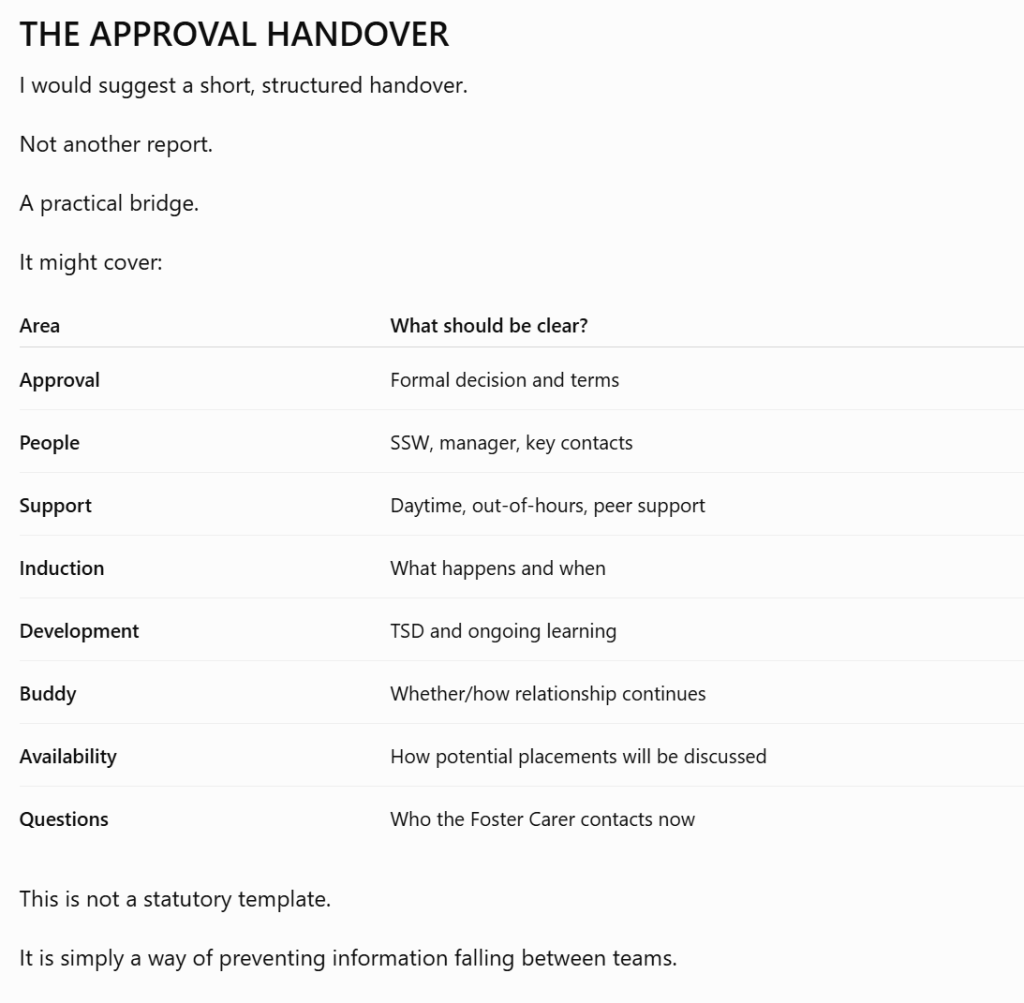
This is where recruitment needs to hand over properly.
3. CONNECT
The new Foster Carer should know their support network.
Current NMS 21 says Foster Carers should understand the nature and level of support provided, have effective out-of-hours advice and support, receive professional support and understand the role of their Supervising Social Worker. Peer support is also encouraged.
So very early after approval, can the new Foster Carer answer:
Who is my Supervising Social Worker?
How do I contact them?
Who do I call when they're unavailable?
What happens outside office hours?
What support groups exist?
Is my Foster Carer buddy continuing?
Who do I speak to if I'm worried about something?
Those answers should not be discovered during the first crisis.
DON'T LET THE RECRUITER DISAPPEAR WITHOUT A HANDOVER
This is where the principle running through Stages Seven and Eight matters again:
THE ASW ASSESSES. THE ORGANISATION STILL RECRUITS.
Now assessment is complete.
But recruitment should not simply vanish.
The recruiter who first spoke to this person might have known them for months.
Imagine receiving:
“I remember your first enquiry. I'm delighted you've reached approval. Congratulations, and welcome to the fostering team.”
That reconnects the whole journey.
Then recruitment can consciously hand over.
Not disappear.
There is a big difference.
THE BUDDY SHOULD NOT SUDDENLY DISAPPEAR EITHER
If a Foster Carer buddy has been supporting the applicant during assessment, approval is not necessarily the moment to remove that relationship.
Indeed, it may become even more valuable.
The new Foster Carer has moved from:
“What will assessment be like?”
to:
“What will fostering actually be like?”
An experienced Foster Carer may now be particularly useful.
The boundary remains:
professional support comes from the appropriate professionals;
lived-experience support comes from the buddy.
But continuity matters.
4. PREPARE
Approval should immediately lead into induction and readiness.
Current NMS 20.1 says all new Foster Carers receive an induction. The standards also require support towards the TSD Standards and ongoing development.
That means newly approved Foster Carers should understand:
what induction looks like;
what mandatory/core learning is still required;
what the TSD Standards are;
how their development will be supported;
what meetings/support groups they can attend;
and:
how the organisation will help them move from assessed competence to real-life fostering practice.
This is important because:
APPROVAL MEANS SUITABLE TO FOSTER. IT DOESN'T MEAN “YOU NOW KNOW EVERYTHING ABOUT FOSTERING.”
Nobody should expect that.
DON'T MAKE THE FIRST CONVERSATION ABOUT FILLING A BED
There is a significant warning here.
The service has finally approved a new Foster Carer.
There may also be immense placement pressure.
Children need homes.
Commissioning teams may be searching.
Placement teams know the household is now available.
Everyone understandably wants the newly created capacity to be useful.
But be careful.
The first message following approval should not feel like:
“Fantastic — we've got a child for you tonight.”
unless the circumstances, preparation, matching and the Foster Carer's readiness make that entirely appropriate.
The Foster Carer needs to understand that saying:
“I need to think about this”
does not immediately make them difficult.
Stage Nine will deal properly with matching and first-placement support.
Point 79 simply establishes the boundary:
DON'T TURN “WELCOME TO FOSTERING” INTO “WE NEED YOUR BED.”
APPROVAL IS NOT THE END OF RECRUITMENT QUALITY
There is a tendency to treat approval as the conversion.
Success.
Applicant approved.
KPI achieved.
Move on.
But imagine measuring recruitment purely that way.
An applicant could have a fantastic first six months, reach approval and then experience:
poor handover;
no induction timetable;
unclear support;
no named contact;
no buddy;
pressure to accept placements;
confusion about allowances or processes;
and silence.
The recruitment dashboard still says:
SUCCESSFUL CONVERSION.
The Foster Carer may have a very different view.
This is why the 100-Point Review does not end at approval.
YOUR NEW FOSTER CARER SHOULD NOT HAVE TO REINTRODUCE THEMSELVES
One of the worst handovers would be:
“Hello, I'm your new Supervising Social Worker. Can you tell me a little bit about yourself?”
after the applicant has just spent months giving the organisation their life history.
Naturally, the new professional relationship needs to develop.
But organisational continuity should mean relevant information travels with the person.
They should not experience the organisation as disconnected departments.
THE PERSON SHOULD MOVE THROUGH THE SYSTEM. THEIR STORY SHOULDN'T HAVE TO START AGAIN AT EVERY HAND-OFF.
WATCH OUT — DON'T OVERLOAD THE MOMENT EITHER
There is an opposite risk.
Approval happens.
The Foster Carer gets:
17 policies;
the Foster Care Agreement;
six training links;
a handbook;
an expenses form;
a portal password;
five new contact numbers;
three meeting dates;
and twelve things they need to read.
Technically they have received information.
Practically they may absorb almost none of it.
So sequence the transition.
WELCOME FIRST.
ORIENTATE NEXT.
BUILD KNOWLEDGE OVER TIME.
Induction is a process, not an attachment folder.
MAKE THE SUPPORT REAL
Saying:
“We're very supportive”
is marketing.
Saying:
“This is your SSW, this is their number, this is what they do, this is our out-of-hours number, this is when the Foster Carer group meets and this is who you call tonight if you're worried”
is operational support.
That difference matters immediately after approval.
A FIRST-WEEK MAP
After the first 48-hour welcome, a simple first-week roadmap could show:
DAY 0
Formal approval communicated.
WITHIN THE FIRST COUPLE OF DAYS
Personal welcome and practical handover.
FIRST WEEK
SSW connection / induction arrangements / support explained.
NEXT
Development plan, TSD, training and readiness planning begin.
Again, those are recommended journey-management stages, not newly invented statutory timescales.
The purpose is simply:
DON'T LET APPROVAL CREATE ANOTHER GAP.
ASK THE NEW FOSTER CARER ONE QUESTION
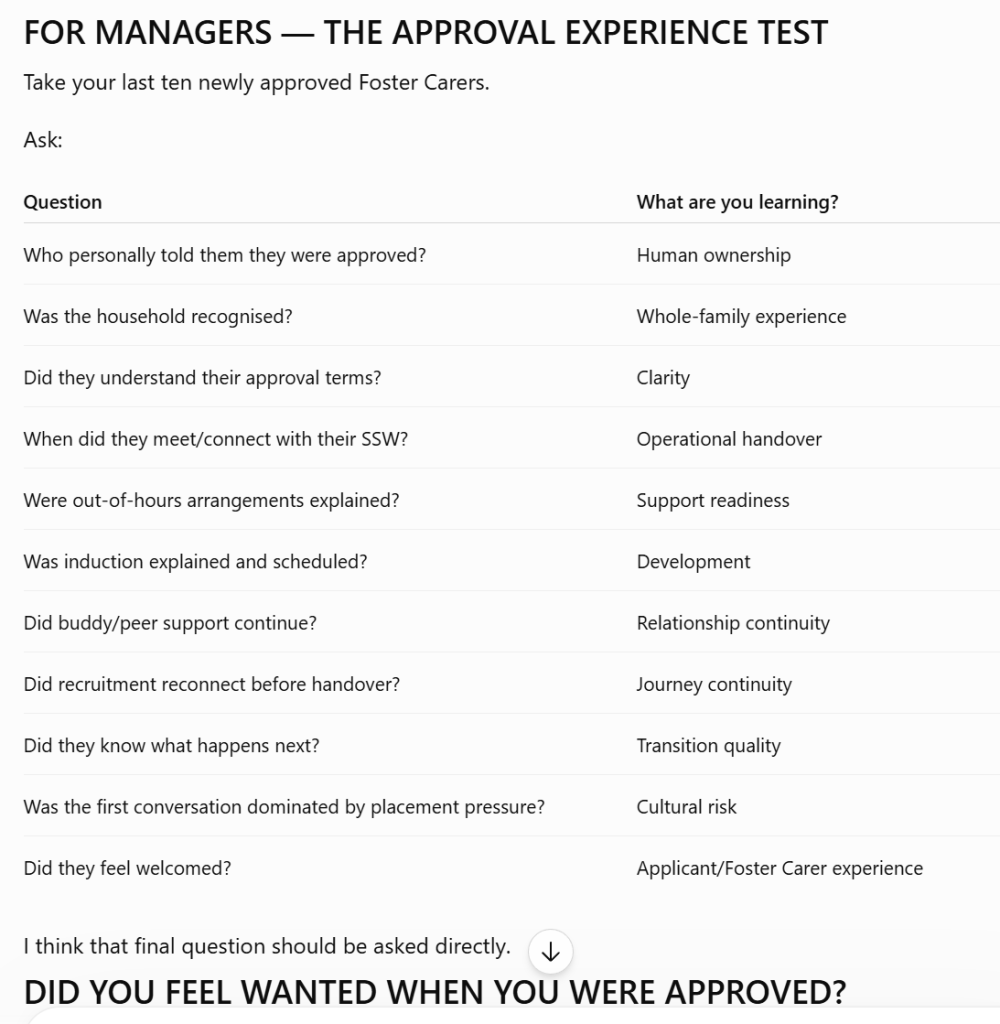
At the end of the first few days, ask:
“DO YOU KNOW WHAT HAPPENS NEXT?”
Not:
“Did you receive the pack?”
Not:
“Have you signed the form?”
Ask:
“Do you know what happens next?”
Their answer will tell you whether the transition worked.
WHAT WOULD “WELCOME” LOOK LIKE IN YOUR ORGANISATION?
It does not need to be elaborate.
Maybe:
a call from the service manager;
a congratulations message from the recruiter;
their SSW contacting them;
their buddy getting in touch;
a welcome card;
an invitation to the Foster Carer group;
an introduction to existing carers;
a small induction meeting;
a clear first-week roadmap.
Different services will create different approaches.
The key requirement is deliberate design.
Don't leave the experience to chance.
THERE IS ALSO A CULTURAL MESSAGE
What happens immediately after approval tells the Foster Carer something about what kind of organisation they have joined.
Does it feel like:
a service that has gained a valued new Foster Carer?
Or:
a system that has gained another available placement?
Those are not the same organisational culture.
And Foster Carers will notice.
APPROVAL IS THE FIRST RETENTION MOMENT
This may be the biggest conceptual point in Point 79.
We normally think:
Recruitment → Approval → Retention
as if retention begins months later.
I don't think it does.
RETENTION STARTS THE MOMENT YOU APPROVE THEM.
The new Foster Carer is already experiencing:
support;
communication;
culture;
responsiveness;
respect;
and organisational competence.
The retention journey has begun before the first child arrives.
That creates our bridge into Stage Nine.
POINT 79 TEST
Within the first few days after approval, can the new Foster Carer answer:
IDENTITY
“I know I am now an approved Foster Carer.”
TERMS
“I understand what I've been approved for.”
PEOPLE
“I know who supports me.”
SUPPORT
“I know who to contact, including out of hours.”
DEVELOPMENT
“I understand what induction and training happen next.”
PLACEMENTS
“I understand how potential placements will be discussed with me.”
CONNECTION
“I still feel connected to the organisation that recruited me.”
VALUE
“I feel they are genuinely pleased I am here.”
If not, the organisation has turned perhaps the greatest success point in recruitment into another hand-off.
YESTERDAY THEY WERE THE PERSON YOU WERE TRYING TO RECRUIT
Today you have succeeded.
Don't suddenly stop trying.
They have not crossed a finishing line and disappeared into somebody else's department.
They have crossed a threshold.
And what happens on the other side matters.
WELCOME → CLARIFY → CONNECT → PREPARE.
DON'T TURN “WELCOME TO FOSTERING” INTO “WE NEED YOUR BED.”
RETENTION STARTS THE MOMENT YOU APPROVE THEM.
And above all: