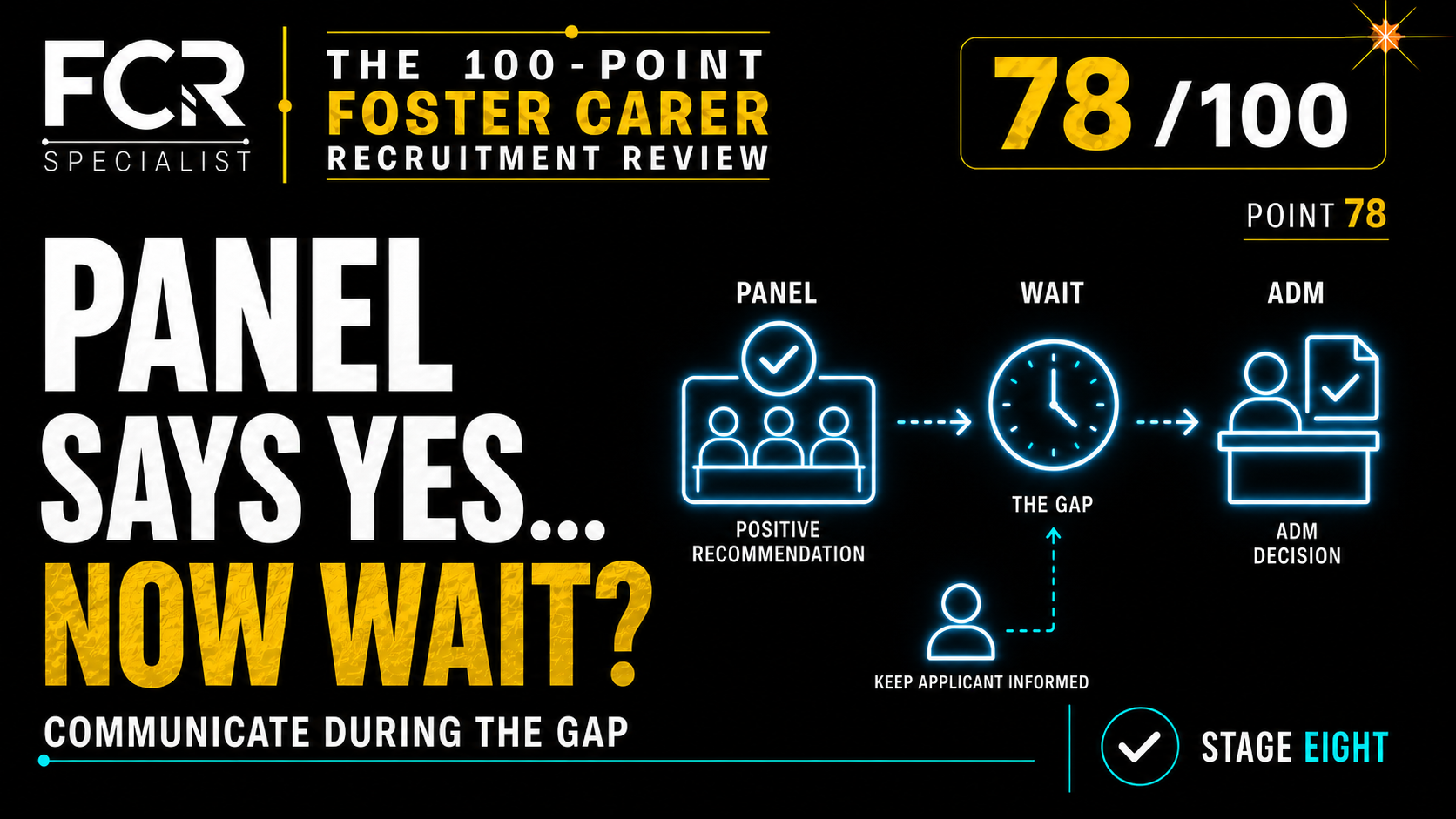
Point 78: What Happens Between Panel and the ADM Decision?
Point 78: What Happens Between Panel and the ADM Decision?
There is a peculiar emotional moment in Foster Carer Recruitment.
The applicant has finally reached panel.
For months it has been the milestone they were working towards.
They attend.
They answer questions.
Panel concludes.
And, where the recommendation is positive, they may hear:
“PANEL IS RECOMMENDING YOUR APPROVAL.”
The relief can be enormous.
Then almost immediately comes another sentence:
“BUT YOU'RE NOT APPROVED YET.”
The formal decision still has to be made by the Agency Decision Maker.
Professionally, that distinction is absolutely correct.
From the applicant's perspective, however, another waiting period has suddenly appeared just beyond what they thought was the finishing line.
That makes this one of the most important communication gaps in Stage Eight.
PANEL RECOMMENDS. THE ADM DECIDES.
The distinction should never be fudged.
Under Regulation 27 of the Fostering Services (England) Regulations 2011, the fostering service provider must take account of the fostering panel's recommendation when deciding whether to approve somebody as a Foster Carer and determining the terms of that approval.
Current statutory guidance describes the decision-maker as a senior member of staff responsible for receiving panel recommendations and making the approval decision. The guidance also makes clear that this should be a considered decision, not simply an administrative endorsement of whatever panel recommended.
So never tell applicants:
“The ADM is only a formality.”
It isn't.
Likewise, don't say:
“You're basically approved.”
if formal approval has not happened.
Accuracy matters.
But so does explaining the process in a way that doesn't suddenly recreate anxiety.
THE EMOTIONAL HIGH CAN BE FOLLOWED BY AN EMOTIONAL DROP
Think about the applicant's journey over perhaps many months:
Enquiry
↓
Initial Visit
↓
application/progression
↓
checks
↓
training
↓
assessment
↓
Form F/report
↓
panel preparation
↓
PANEL
They may have regarded panel as the moment everything was heading towards.
Then panel makes a positive recommendation.
They think:
“We've done it.”
And technically the organisation has to say:
“Nearly.”
That is a strange place emotionally.
Point 77 argued that we should recognise the panel milestone rather than immediately flattening it with procedural language.
Point 78 now says:
DON'T FOLLOW THAT MILESTONE WITH A COMMUNICATION VACUUM.
THE CURRENT TIMESCALES ARE IMPORTANT — BUT UNDERSTAND WHAT THEY ACTUALLY SAY
The current National Minimum Standards provide useful clarity.
Standard 14.9 says the fostering service provider's decision-maker should make a considered decision within:
SEVEN WORKING DAYS
of receiving the panel's recommendation and the final set of panel minutes.
Standard 14.10 then says the prospective Foster Carer should be:
INFORMED ORALLY WITHIN TWO WORKING DAYS
of the decision;
and receive:
WRITTEN CONFIRMATION WITHIN FIVE WORKING DAYS.
Those are valuable expectations.
But there is an important management issue hiding inside them.
THE APPLICANT'S CLOCK AND THE ORGANISATION'S CLOCK MAY START AT DIFFERENT TIMES
Imagine panel takes place on Monday.
From the applicant's perspective:
MONDAY = THE WAIT STARTS.
But the seven-working-day NMS expectation is expressed from the point when the ADM receives the recommendation and final panel minutes.
That means there can potentially be another operational interval:
PANEL → FINAL MINUTES / RECOMMENDATION READY FOR ADM
before:
ADM RECEIVES COMPLETE MATERIAL → ADM DECISION
That first period matters.
If you only monitor compliance with:
“ADM made the decision within seven working days of receiving the papers”
you may miss how long the applicant has actually been waiting since panel.
This gives us one of the strongest management principles in Point 78:
DON'T ONLY MEASURE THE ADM CLOCK. MEASURE THE APPLICANT'S CLOCK.
THE ADM-GAP TIMELINE
I would suggest services make four dates visible:
1. PANEL DATE
When did panel make its recommendation?
↓
2. ADM RECEIVED THE REQUIRED MATERIAL
When were the recommendation and final minutes available to the decision-maker?
↓
3. ADM DECISION
When was the formal decision actually made?
↓
4. APPLICANT INFORMED
When did the prospective Foster Carer actually hear the formal decision?
That produces:
PANEL → ADM PAPERS → DECISION → APPLICANT
It is a very simple journey.
But if you cannot readily identify those four dates, you cannot see where the gap is occurring.
THE ADM IS NOT AN ADMINISTRATIVE SIGNATURE
This deserves emphasis.
A badly explained process can create the impression that:
panel makes the real decision
and:
the ADM signs it off afterwards.
That isn't an accurate description of the current framework.
Statutory guidance says the decision-maker should consider the material, identify key arguments, consider the reasoning and fairness of the relevant panel process, consider any additional information and identify the reasons for their decision.
That means the applicant should understand:
“Panel has made a recommendation. A senior decision-maker now considers the information and makes the formal decision.”
That makes sense.
What doesn't make sense is:
“The ADM has to look at it.”
followed by unexplained silence.
EXPLAIN THE ADM BEFORE PANEL — NOT AFTER IT
This is another simple improvement.
The first time applicants hear the letters ADM should not be immediately after panel.
By then they should already understand:
WHAT IS THE ADM?
A senior decision-maker within the fostering service.
WHAT DO THEY DO?
Consider the information and panel recommendation and make the formal approval decision.
IS PANEL'S RECOMMENDATION THE FINAL DECISION?
No.
HOW LONG SHOULD THIS STAGE TAKE?
Under the current National Minimum Standards, the decision should be made within seven working days of the ADM receiving the panel recommendation and final minutes.
HOW WILL I FIND OUT?
Current standards say orally within two working days of the decision and written confirmation within five working days.
That conversation should happen before the anxiety starts.
DON'T SAY “YOU'LL HEAR SOON”
That phrase is almost useless.
What does soon mean?
Tomorrow?
Friday?
Next week?
Two weeks?
Give the applicant a realistic framework.
For example:
“Panel has made a positive recommendation. The formal decision now goes to our Agency Decision Maker. They need the panel recommendation and final minutes before making their decision. The current National Minimum Standard expects that decision within seven working days of those being received. I will keep you updated and contact you again on Friday even if the formal decision has not yet been made.”
That tells the applicant:
what;
why;
when;
and:
who.
POINT 72 RETURNS HERE
Earlier in Stage Eight we established:
IF THERE IS NOTHING NEW TO REPORT, REPORT THAT.
There may be no better place to apply it.
Friday arrives.
The ADM decision has not yet happened.
What should the service do?
Nothing?
Wait until there is an outcome?
No.
Tell the applicant:
“Just keeping you updated. The formal decision has not yet been made. There is nothing further required from you and I will update you again on Tuesday.”
That update has not changed the case.
It has changed the experience.
“WAITING FOR ADM” SHOULD HAVE AN OWNER
Stage Seven established:
“WAITING” SHOULD ALWAYS HAVE AN OWNER.
So who owns this particular wait?
Is it:
the Assessing Social Worker?
panel administration?
a team manager?
recruitment?
the ADM's office?
somebody else?
Different organisations may use different arrangements.
That is fine.
But the applicant should never become the person responsible for discovering that the decision has happened.
Somebody should own:
PANEL → ADM → APPLICANT COMMUNICATION.
WATCH OUT FOR ANOTHER HIDDEN GAP: PANEL MINUTES
This is where Point 78 becomes particularly useful operationally.
Because the seven-working-day decision expectation starts on receipt of the recommendation and final panel minutes, management should understand how quickly those materials move from panel to the ADM.
Ask:
When did panel take place?
When were the minutes drafted?
When were they agreed/finalised?
When did the ADM receive them?
If the ADM makes a decision quickly once the papers arrive but the papers took a long time to arrive, telling management:
“ADM performance is within standard”
does not explain the applicant's wait.
This is another example of the Stage Eight principle:
A PROCESS CAN BE COMPLIANT AT ONE HAND-OFF AND STILL FEEL SLOW END-TO-END.
DON'T TURN MINUTE QUALITY INTO A SPEED CONTEST EITHER
The opposite mistake is also possible.
Panel minutes matter.
They need to reflect the relevant discussion and reasons for the recommendation sufficiently for the decision-maker to undertake their role properly.
So the answer is not:
“Get the minutes done immediately regardless.”
It is the same principle we have used throughout this stage:
REMOVE WASTED TIME. PROTECT PROFESSIONAL TIME.
Good records take time.
Unowned queues add time.
Those are different.
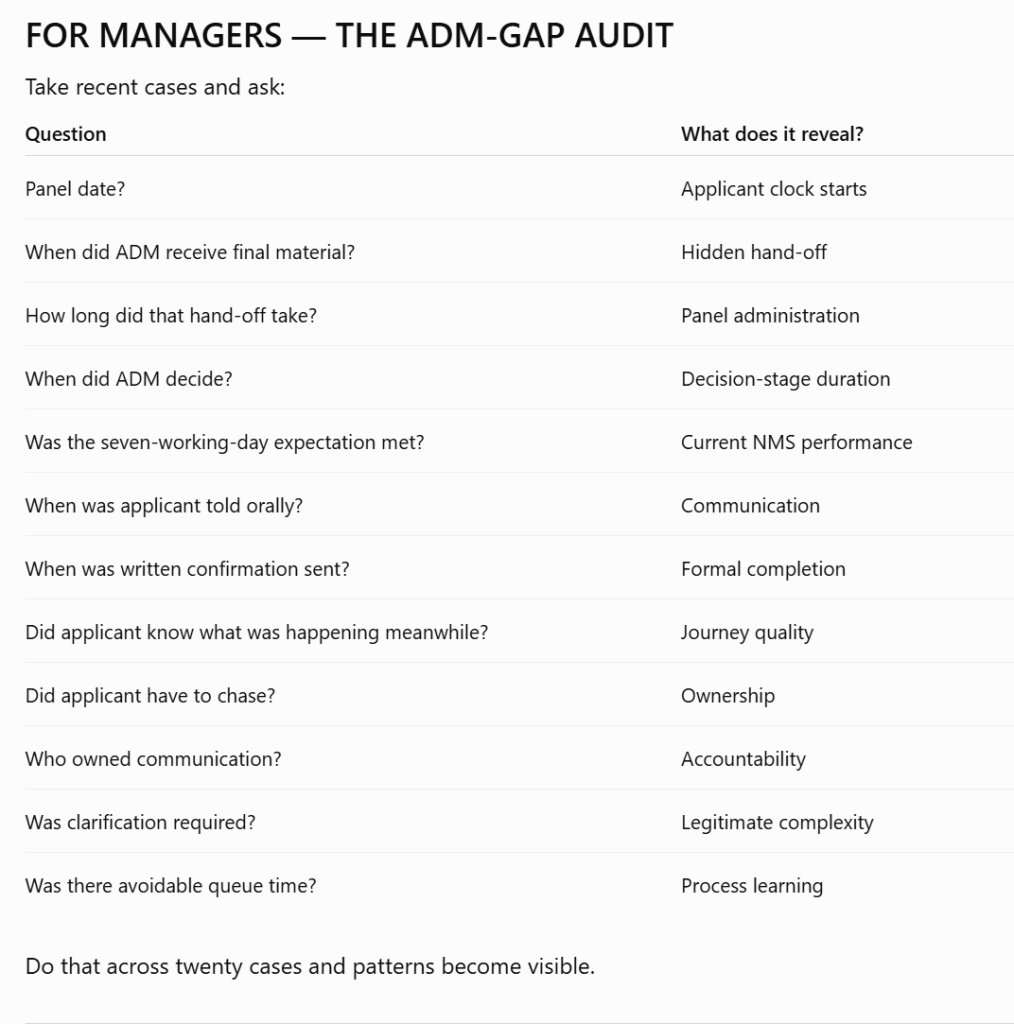
THE ADM GAP TEST
Take your last ten newly approved Foster Carers.
For each one, record: StageDatePanel heldRecommendation communicatedFinal panel material received by ADMADM decision madeApplicant verbally informedWritten confirmation sent
Then calculate:
PANEL → ADM RECEIPT
ADM RECEIPT → DECISION
DECISION → VERBAL NOTIFICATION
DECISION → WRITTEN CONFIRMATION
And most importantly:
PANEL → APPLICANT KNOWS THE FORMAL DECISION
That final figure is the one the applicant experiences.
DON'T JUST ASK “DID WE MEET THE STANDARD?”
Ask:
How long did the person actually wait?
Those questions are related but not identical.
A service could theoretically meet the seven-working-day expectation once the final material reaches the ADM and still have had a longer panel-to-decision journey because of an earlier hand-off.
So the managerial question should be:
WHERE DID EVERY WORKING DAY GO?
Again, not to manufacture speed.
To identify unnecessary inactivity.
WHAT IF THE ADM NEEDS CLARIFICATION?
This possibility should be explained too.
The decision-maker is expected to make a considered decision.
There may therefore be circumstances in which clarification or additional information is required before that decision can properly be made.
That does not automatically mean something has gone wrong.
It certainly should not automatically be translated for the applicant as:
“The ADM has a problem with your application.”
Explain accurately:
what is happening;
whether anything is required from them;
what this means for timing;
and:
when the next communication will happen.
The principle is the same.
UNCERTAINTY SHOULD TRIGGER COMMUNICATION — NOT SILENCE.
WHAT IF THE ADM DOESN'T AGREE WITH THE POSITIVE MOMENT THE APPLICANT EXPECTED?
This is why we were careful in Point 77.
Panel recommendation and formal decision are separate.
If the service reaches a qualifying determination that an applicant is not suitable, Regulation 27 provides for written reasons and gives the applicant routes to make representations or seek review through the Independent Review Mechanism within the applicable process.
We do not need to turn Point 78 into a detailed guide to the IRM.
But applicants should never be led to believe that a positive panel recommendation makes the formal outcome legally inevitable.
That is precisely why:
CELEBRATE THE PANEL MILESTONE WITHOUT MISREPRESENTING THE DECISION.
THE MOMENT THE DECISION IS MADE, DON'T LET IT SIT THERE
This seems obvious.
Yet it is worth measuring.
Current NMS 14.10 expects the prospective Foster Carer to be informed orally within two working days of the decision-maker's decision and written confirmation within five working days.
But from an applicant-experience perspective, ask an even simpler question:
WHY WOULD WE WANT SOMEBODY WHO HAS WAITED MONTHS TO WAIT ANY LONGER THAN NECESSARY TO HEAR GOOD NEWS?
The statutory standard should be a boundary.
It does not have to become the organisational ambition.
Where appropriate and practicable, communicate promptly.
WHO SHOULD TELL THEM?
This matters.
After months of relationship-building, formal approval should not simply arrive unexpectedly in an automated inbox if a better human route is available.
Services may make different arrangements.
But think deliberately about:
Who delivers the decision?
Do they understand what it means to this person?
Can they answer immediate questions?
Do they know what happens next?
This starts creating the bridge into Point 79.
Because once the ADM has said yes, something fundamental changes.
Yesterday:
prospective Foster Carer.
Today:
approved Foster Carer.
That deserves more than an administrative status change.
A BETTER END-TO-END MEASURE
Perhaps the most useful measure Point 78 can introduce is:
PANEL → FORMAL DECISION COMMUNICATED
Because that is the elapsed period the applicant experiences.
Then break it into the internal stages underneath.
This prevents a service from claiming:
“Our ADM decisions are very quick.”
while overlooking a much longer overall gap before the case reaches them.
DON'T CREATE A SECOND FINISH LINE AND THEN LEAVE PEOPLE STANDING IN FRONT OF IT
Panel has already been built into a major milestone.
The applicant gets through it.
A positive recommendation follows.
Then they discover there is one final professional decision.
That is entirely legitimate.
But this is exactly where communication quality matters most.
They should know:
WHAT
What happens now?
WHY
Why is the ADM decision separate?
WHEN
What timescale applies?
WHO
Who owns the next communication?
STATUS
Where is the process currently?
That gives us another very simple model:
WHAT → WHY → WHEN → WHO → STATUS
POINT 78 TEST
The day after a positive panel recommendation, can the prospective Foster Carer answer:
WHAT?
“I know what the ADM does.”
STATUS?
“I know where my case currently is.”
TIMESCALE?
“I understand when a decision should happen.”
CONTACT?
“I know who will update me.”
NEXT UPDATE?
“I know when I will hear something even if the decision hasn't happened.”
If they cannot, the organisation has created unnecessary uncertainty immediately after one of the biggest moments of the entire recruitment journey.
THE APPLICANT'S CLOCK STARTS AT PANEL
This is perhaps the most important management lesson.
The regulatory and professional process has legitimate internal stages.
But applicants experience the journey continuously.
They do not mentally restart their clock when:
minutes are agreed;
papers are transferred;
the ADM's seven-day period begins;
or an internal workflow status changes.
Their clock started when they walked out of panel.
PANEL → WAITING → FORMAL DECISION.
That is the journey they experience.
So measure it that way.
Communicate through it that way.
And manage it that way.
PANEL RECOMMENDS. ADM DECIDES.
THE ADM IS A DECISION-MAKER — NOT A RUBBER STAMP.
DON'T ONLY MEASURE THE ADM CLOCK. MEASURE THE APPLICANT'S CLOCK.
And above all: