Point 77: Panel Is a Milestone — Make It Feel Like One
Point 77: Panel Is a Milestone — Make It Feel Like One
For months, prospective Foster Carers can be working towards one particular moment:
PANEL.
The assessment has been completed.
The report has been read.
Questions have been answered.
Checks have been completed.
Training has taken place.
Family members may have been involved.
The applicant has discussed some of the most personal aspects of their life.
Then panel day arrives.
They are nervous.
They attend.
They answer questions.
They leave.
And, where panel makes a positive recommendation, they hear something they may have been hoping to hear for months:
Panel is recommending approval.
What happens next?
This is where fostering services need to balance two things extremely carefully:
technical accuracy
and:
human recognition.
PANEL RECOMMENDATION IS NOT FORMAL APPROVAL
We need to get this right.
Under the current England framework, fostering panel makes a recommendation.
The subsequent approval decision is made by the fostering service's decision-maker, commonly referred to as the Agency Decision Maker or ADM. Current statutory guidance says the decision-maker must take account of panel's recommendation before deciding whether or not to approve a person as a Foster Carer and on what terms.
So do not tell somebody:
“Congratulations, you're now an approved Foster Carer.”
if that formal decision has not yet been made.
But accuracy does not require emotional flatness.
There is a considerable difference between:
“Panel has recommended approval. You're not approved yet. We now wait for the ADM.”
and:
“Congratulations on reaching such an important milestone. Panel has made a positive recommendation. That isn't yet formal approval because the decision now goes to our Agency Decision Maker, but we absolutely recognise how much work you and your family have put into reaching today.”
Both are technically accurate.
Only one properly recognises the person.
DON'T LET TECHNICAL ACCURACY ERASE THE MOMENT
This is particularly important because fostering services themselves have spent months making panel significant.
We tell applicants:
“We're working towards panel.”
“This needs to be ready for panel.”
“Your panel date is...”
“We'll prepare you for panel.”
“Panel may want to ask...”
Then, after building that moment for months, we risk treating its completion like another administrative box being ticked.
That is inconsistent with the journey we have created.
IF YOU BUILD PANEL INTO A MAJOR MILESTONE, RECOGNISE IT WHEN THEY REACH IT.
WHAT HAS THE APPLICANT ACTUALLY ACHIEVED?
Even before formal ADM approval, consider what they have travelled through.
Potentially:
ENQUIRY
↓
INITIAL CALL
↓
INITIAL VISIT
↓
APPLICATION / PROGRESSION
↓
CHECKS
↓
PREPARATION TRAINING
↓
ASSESSMENT
↓
PERSONAL DISCLOSURE
↓
REPORT
↓
APPLICANT COMMENTS
↓
QUALITY ASSURANCE
↓
PANEL
This isn't an ordinary appointment.
It is the culmination of months of effort.
And not just from the individual applicant.
Partners, children, wider family members, referees and support networks may have participated in that journey too.
Recognition can therefore include the household, where appropriate.
RELIEF CAN BE ENORMOUS
Point 76 explored how intimidating panel can become.
Now consider what happens psychologically when it finishes.
An applicant who has spent days or weeks worrying may suddenly experience enormous relief.
They may laugh.
Cry.
Become quiet.
Want to telephone family immediately.
Feel exhausted.
Feel proud.
Feel all of those things at once.
This is one of those moments where the organisation's internal process language can sit miles away from the applicant's emotional experience.
Internally:
Panel recommendation recorded.
Applicant:
“We did it.”
Those two realities need to be connected.
“WE DID IT” — BUT NOT QUITE “YOU'RE APPROVED”
This is where language really matters.
The applicant may naturally say:
“We've been approved!”
Don't turn the moment into a legal lecture.
But somebody should gently and clearly explain the distinction.
For example:
“This is a really positive milestone. Panel has recommended your approval. The formal decision now goes to the Agency Decision Maker, so technically you're not approved until that decision has been made. We'll keep you informed about that next stage.”
Simple.
Accurate.
Human.
A SIMPLE PANEL-MOMENT MODEL
I would suggest services think about four things immediately after a positive panel recommendation.
RECOGNISE → CONGRATULATE → EXPLAIN → CONNECT
1. RECOGNISE
Acknowledge the significance of what has happened.
Not:
“That's panel done.”
But:
“You've reached a really important milestone.”
2. CONGRATULATE
Where panel has positively recommended approval, congratulate the applicant appropriately.
This is not premature formal approval.
It is recognition of the positive recommendation and the work involved in reaching it.
3. EXPLAIN
Immediately explain:
- what panel has recommended;
- what that recommendation means;
- that formal approval has not yet occurred;
- what the ADM stage is;
- what happens if clarification is needed;
- what timescale the applicant should currently expect.
4. CONNECT
Do not finish the conversation with:
“We'll be in touch.”
Tell them:
- who is contacting them next;
- when;
- what happens during the wait;
- whether their buddy/recruitment contact remains available.
That creates the bridge into Point 78.
RECOGNITION DOESN'T NEED TO BE EXPENSIVE
There is a risk that “celebrate panel” starts sounding like another budget line.
It doesn't need to be.
Recognition could be:
a genuine personal congratulations from the ASW;
a call from the recruitment team;
a message from the Foster Carer buddy;
a card;
a short note from a manager;
a photograph marking the occasion where appropriate and consented;
a small welcome gesture;
or simply several people taking the time to say:
“Well done. We know how much you've put into this.”
The cost may be negligible.
The meaning may not be.
SHOULD SOMEBODY SENIOR ACKNOWLEDGE IT?
I think this is worth considering.
Not necessarily in every service or every case.
But imagine the difference between an applicant receiving only:
“Panel has recommended approval.”
and occasionally receiving:
“I just wanted to personally congratulate you on reaching this stage and thank you and your family for choosing to Foster with us.”
from a senior manager.
That communicates something more than administrative progression.
It says:
we know you exist;
we value the commitment you're making;
and:
you are beginning to become part of this organisation.
That becomes even more important at formal approval in Point 79.
RECRUITMENT SHOULD KNOW THE OUTCOME
Another organisational question:
Does the recruitment person who originally supported the applicant even know that they have reached panel?
They may have:
answered the first enquiry;
conducted the first call;
arranged the Initial Visit;
encouraged the applicant through uncertainty;
kept them warm during a Not Now period;
introduced them to the service.
Then months later the applicant reaches panel and nobody tells recruitment.
Why?
This is the same organisational continuity theme we have carried since Stage Seven.
Professional responsibility has moved.
The relationship does not have to vanish.
A short message saying:
“I heard panel went well — congratulations on reaching this milestone.”
can reconnect the beginning and end of the recruitment journey.
THE BUDDY CAN REAPPEAR AT EXACTLY THE RIGHT MOMENT
The Foster Carer buddy can also play a valuable role.
They have been there.
They know the nerves before panel.
They know the relief afterwards.
So a simple:
“I've been thinking about you today — really pleased you've reached this point.”
can mean something different coming from somebody with lived experience.
Again, the buddy is supporting.
Not assessing.
Not interpreting the recommendation.
Not promising the ADM outcome.
WATCH OUT: DON'T USE CELEBRATION TO OVER-PROMISE
There is an important boundary.
The organisation must not create the impression that the formal decision is guaranteed.
Panel's recommendation is important.
The Agency Decision Maker still has a distinct role within the current framework.
So avoid:
“That's it now.”
“You're definitely approved.”
“The ADM is just a formality.”
Even if that is how somebody informally thinks about the next stage.
The correct approach is:
CELEBRATE THE MILESTONE WITHOUT MISREPRESENTING THE DECISION.
WHAT IF PANEL DOES NOT MAKE A STRAIGHTFORWARD POSITIVE RECOMMENDATION?
This Point also needs to deal with reality.
Not every panel ends with the applicant receiving the outcome they hoped for.
Panel may require further information or the recommendation may not be positive.
In those circumstances, obviously:
do not manufacture celebration.
The organisational requirement changes.
The applicant then needs:
clarity;
accurate explanation;
time to absorb what has happened;
clear next steps;
appropriate professional support;
and communication about what follows.
The principle is not:
every panel is a celebration.
It is:
EVERY PANEL OUTCOME SHOULD BE TREATED AS A SIGNIFICANT MOMENT FOR THE APPLICANT.
Where the recommendation is positive, recognise the achievement.
Where it is not, recognise the significance and communicate properly.
DON'T LET THE APPLICANT LEAVE CONFUSED
One of the worst outcomes would be for the applicant to leave panel unsure what just happened.
They should know:
What did panel recommend?
Was anything outstanding?
What happens next?
Who makes the formal decision?
When should I expect contact?
Who can I speak to if I have questions afterwards?
That is especially important because emotional relief can make it difficult to absorb procedural information.
So consider providing a simple written follow-up too.
FROM “CASE” BACK TO “PERSON”
There is something else happening around panel.
Over months, the prospective Foster Carer can gradually become:
an assessment;
a Form F;
a panel paper;
a case number.
Panel is a good moment to consciously reverse that.
This is a person.
A couple.
A family.
They have chosen to open their home and lives to assessment because they are considering caring for children.
Whatever the eventual professional decision, the process should retain that human perspective.
PANEL IS ALSO AN ORGANISATIONAL MEMORY POINT
Services could record more than:
Panel date: 15 November.
They could also record:
panel recommendation communicated: when/how;
applicant contacted afterwards: yes/no;
next-stage explanation provided: yes/no;
ADM update date given: yes/no.
Again, not because every human interaction needs to become a KPI.
But because if nobody owns these moments, they can disappear.
THE “ANTI-CLIMAX TEST”
Here is a very simple management question.
Ask recently approved Foster Carers:
“WHAT HAPPENED IMMEDIATELY AFTER PANEL?”
Listen to the answers.
Was it:
“Everyone congratulated us. Our Social Worker explained the next stage and our buddy called that evening.”
Or:
“We went home and waited.”
Or even:
“I'm not really sure what happened next.”
That single question could tell you a great deal about the final recruitment experience.
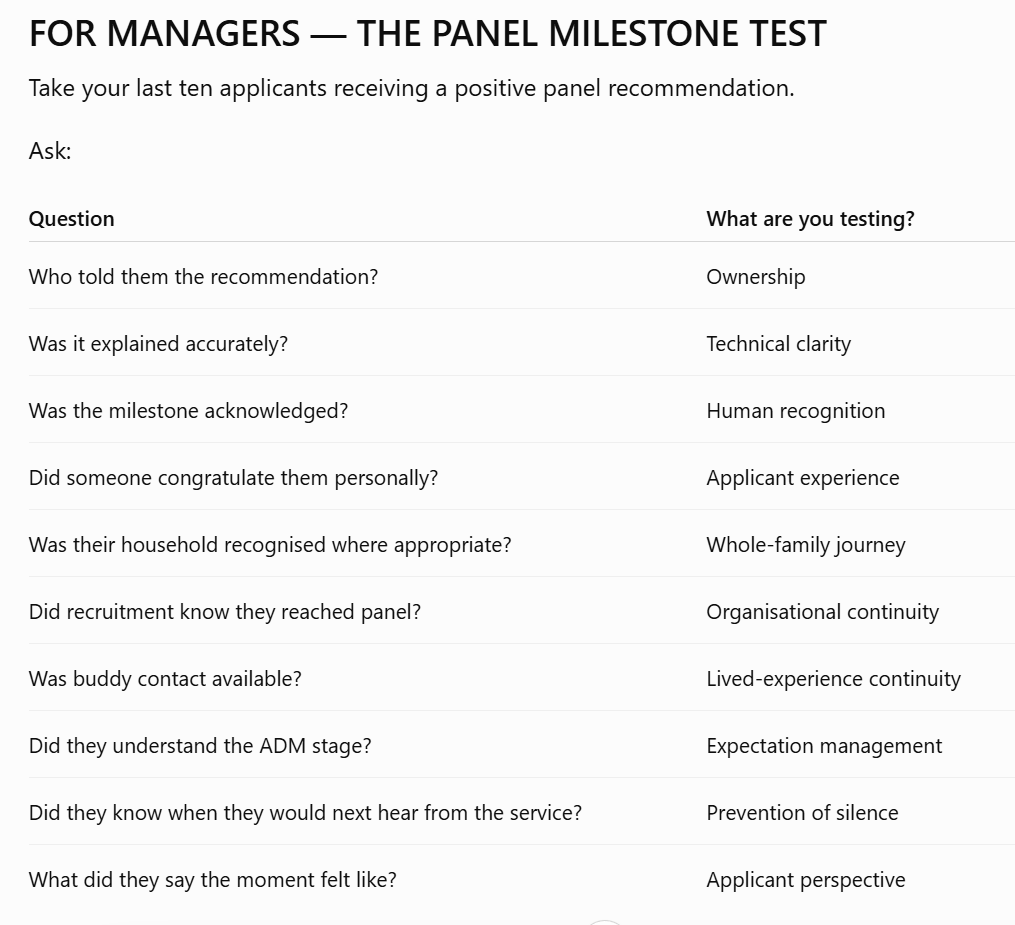
This isn't about manufacturing celebration.
It is about noticing whether one of the biggest moments in the journey has somehow become administrative.
DON'T SAY “JUST WAIT FOR THE ADM”
This line is especially important because Point 78 follows immediately.
Imagine the emotional curve:
months of work;
increasing panel anxiety;
panel day;
positive recommendation;
huge relief;
then:
“Great. Now just wait.”
That can create an immediate emotional drop.
The ADM stage is necessary.
The applicant needs to understand it.
But we can manage that transition much better.
Point 78 will deal specifically with the gap between panel and formal decision.
Point 77 has one job first:
RECOGNISE WHAT JUST HAPPENED.
POINT 77 TEST
After a positive panel recommendation, can the applicant say:
RECOGNITION
“They understood that this was a big moment for us.”
ACCURACY
“I know I'm not formally approved yet.”
UNDERSTANDING
“I know what panel recommended.”
NEXT STEP
“I understand the ADM stage.”
CONNECTION
“I know who is contacting me and when.”
If all five are true, the service has managed the milestone well.
THE ORGANISATION MAY SEE A RECOMMENDATION. THE APPLICANT MAY SEE MONTHS OF THEIR LIFE CULMINATING IN ONE MOMENT.
That's really what Point 77 is about.
Technical accuracy matters.
Safeguarding matters.
Professional decision-making matters.
None of that prevents warmth.
We do not need to choose between:
professional
and:
human.
We can be both.
PANEL IS A MILESTONE — MAKE IT FEEL LIKE ONE.
THEY MAY NOT YET BE FORMALLY APPROVED. THEY HAVE STILL ACHIEVED SOMETHING.
And: