Point 75: Have You Planned the Route to Panel?
Point 75: Have You Planned the Route to Panel?
Panel slippage as a late-stage Foster Carer Recruitment risk
The final stages of Foster Carer Recruitment contain an important paradox.
As applicants move closer to approval, the remaining administrative and professional steps become fewer.
Yet the emotional significance of each remaining step can increase.
Fostering panel is perhaps the clearest example.
For practitioners and managers, panel is a recurring organisational mechanism within the assessment and approval system.
For the prospective Foster Carer, it may represent the culmination of many months of personal investment.
Consequently, slippage at this stage may have effects beyond the additional elapsed time.
It can affect applicants' confidence in the competence, organisation and reliability of the fostering service itself.
Panel slippage and national evidence
There does not appear to be robust national evidence quantifying panel slippage specifically as a cause of Foster Carer withdrawal.
It would therefore be inappropriate to state that a known percentage of applicants leave because panel dates move.
There is, however, relevant evidence concerning the broader effects of lengthy approval processes and waiting.
The Department for Education's 2023 qualitative research into recruitment and conversion involved ten fostering-service case studies and found that participants viewed lengthy approval processes as frustrating, with long periods of waiting potentially compromising prospective Foster Carers' motivation and morale. Because the study was small-scale and qualitative, it should not be generalised into national prevalence estimates.
The February 2026 Government policy paper Renewing Fostering: homes for 10,000 more children reports that, within local authorities, 59% of assessments take more than six months and 29% more than eight months, and describes applicants dropping out during the process. The policy paper argues for a recruitment and assessment system that remains robust while becoming more streamlined.
These sources justify closer examination of late-stage waiting without attributing withdrawals to panel slippage where evidence does not support such a causal claim.
Why panel may become psychologically different from earlier milestones
During early recruitment, applicants can encounter multiple stages without necessarily having a specific destination date.
Once panel is discussed, the journey becomes more concrete.
A provisional panel can function psychologically as a finishing point.
The applicant may:
organise leave from employment;
adjust family commitments;
tell relatives;
prepare emotionally;
discuss the milestone with their household;
and begin imagining themselves as an approved Foster Carer.
Moving that date can therefore have greater significance than moving an earlier routine appointment.
Organisational time and applicant time are experienced differently
A fostering service may classify several late-stage events independently:
a check delay;
ASW availability;
report finalisation;
quality assurance;
panel-paper deadline;
panel capacity.
The applicant may aggregate them into one overall judgement:
“This keeps being delayed.”
This creates an important applicant-experience principle:
APPLICANTS DON'T EXPERIENCE ORGANISATIONAL DELAYS IN SILOS.
They experience the cumulative process.
That distinction should influence how services interpret apparently minor slippage.
Trust as a recruitment outcome
Foster Carer Recruitment is necessarily relational.
Applicants are considering entering a continuing relationship with the fostering service that extends far beyond approval.
The recruitment and assessment process therefore does more than determine suitability.
It exposes applicants to the organisation's operating culture.
They observe:
responsiveness;
professionalism;
reliability;
communication;
ownership;
and problem resolution.
Repeated late-stage instability may therefore influence not merely frustration with the current application but confidence in the future relationship.
This creates a useful conceptual model:
PANEL SLIPPAGE = TIME + CONFIDENCE + TRUST
This is proposed as a management framework rather than an empirically validated equation.
Its purpose is to remind services that elapsed time is only one potential consequence.
Current assessment and panel framework
The Department for Education's currently published statutory guidance says that upon completion of Stage 2 a full assessment report should be compiled.
The applicant should be notified that the report is going to panel, provided with a copy and given 10 working days from notification to submit observations.
The guidance also says the full assessment should be undertaken within a timescale allowing fostering panel to make its recommendation within eight months of the applicant first applying to be assessed.
These requirements illustrate why panel planning cannot sensibly commence only once the assessment report has been completed.
There are known stages that precede panel consideration.
Reverse planning
A service can therefore distinguish panel planning from panel preparation.
Panel preparation may appropriately occur towards the end.
Panel planning can begin earlier.
A proposed reverse-planning sequence is:
PANEL
↓
PANEL-PAPER DEADLINE
↓
INTERNAL QA
↓
APPLICANT REPORT/OBSERVATION STAGE
↓
REPORT COMPLETION
↓
REMAINING PROFESSIONAL ASSESSMENT
This is not a statutory model.
It is a management tool designed to make known dependencies visible.
Target panel, confirmed panel and actual panel
One potential cause of poor expectation management is a binary approach in which applicants have either:
no panel date
or:
a panel date.
A more nuanced approach could distinguish:
TARGET PANEL
The service is currently planning towards this panel if the assessment continues appropriately.
CONFIRMED PANEL
The case has reached the stage at which the provider can reasonably confirm the panel arrangement under its local processes.
ACTUAL PANEL
The date on which the case is considered.
This distinction helps services plan and communicate without presenting provisional arrangements as guarantees.
TARGET ≠ PROMISE.
Professional assessment must remain independent
Any introduction of forward panel planning carries a risk.
A target panel could accidentally become a practitioner deadline.
That would be inappropriate.
The need to:
complete additional assessment;
explore newly emerging information;
consider professional concerns;
or undertake further analysis
must take precedence over an administrative target.
The appropriate principle is therefore:
PLAN AROUND PROFESSIONAL WORK. DON'T DISTORT PROFESSIONAL WORK TO FIT THE PLAN.
Panel planning should create operational visibility.
It should not create recruitment pressure on Assessing Social Workers.
Small operational failures can have larger elapsed consequences
Panel systems operate to timetables.
Paper deadlines and panel capacity mean that missing one internal milestone may have effects considerably greater than the original delay.
A report missing an internal submission date by a small margin may result in the applicant moving to a later panel opportunity.
The precise additional time will vary between services and should not be generalised into a national four-, five- or six-week figure.
The general principle remains:
A SMALL MISSED DEADLINE CAN CREATE A MUCH LARGER END-TO-END DELAY.
This is why transition-point performance matters.
Missed panel cycle as a diagnostic
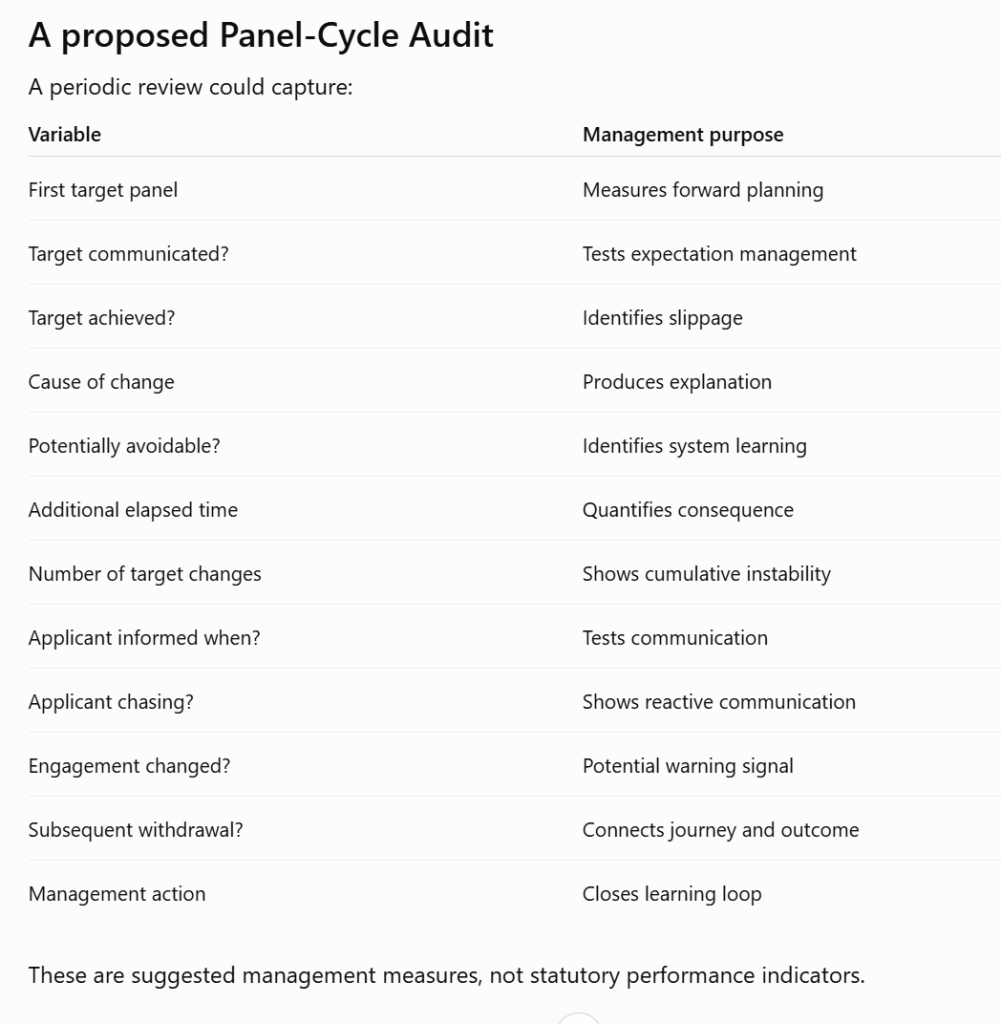
Services could capture a missed panel cycle measure.
For each application:
Was there an earlier target panel than the panel ultimately attended?
If so:
Why did it change?
Possible categories might include:
- further professional assessment;
- new information;
- applicant circumstances;
- outstanding external information;
- report-writing capacity;
- QA;
- administrative error;
- missed paper deadline;
- panel capacity;
- panel cancellation.
Categories should reflect the service's own workflow.
The intention is diagnosis rather than performance ranking.
Avoidable and unavoidable slippage
A service should not assume that all movement is avoidable.
Legitimate/unavoidable change
May arise from professional requirements, applicant circumstances or genuinely external dependencies.
Potentially avoidable change
May arise from organisational planning, capacity, administration, queueing or hand-off failure.
The goal should not be to eliminate all panel movement.
Doing so could create incentives to advance assessments inappropriately.
A stronger management aspiration is:
ZERO UNEXAMINED PANEL SLIPPAGE.
Applicant communication
Where a panel target changes, communication becomes part of risk management.
The applicant should ideally understand:
what changed;
why;
whether the issue affects their assessment substantively or only the timetable;
what happens next;
the next likely panel opportunity;
when another update will be provided.
This directly connects Point 75 to Point 72:
explaining the process once is not equivalent to keeping somebody informed while it changes.
A particularly damaging scenario is one in which the organisation already knows a target panel is no longer achievable but the applicant discovers this only by chasing for information.
Predictable absence versus organisational surprise
Staff availability is an important example.
Annual leave is normal and necessary.
The aim should not be to discourage practitioners from taking leave because an applicant is nearing panel.
The management question concerns planning.
If a worker's absence has been known for weeks, its likely effect on report completion or panel readiness can often be considered in advance.
Predictable absence becoming a last-minute surprise to the applicant points towards a workflow issue rather than an individual staff issue.
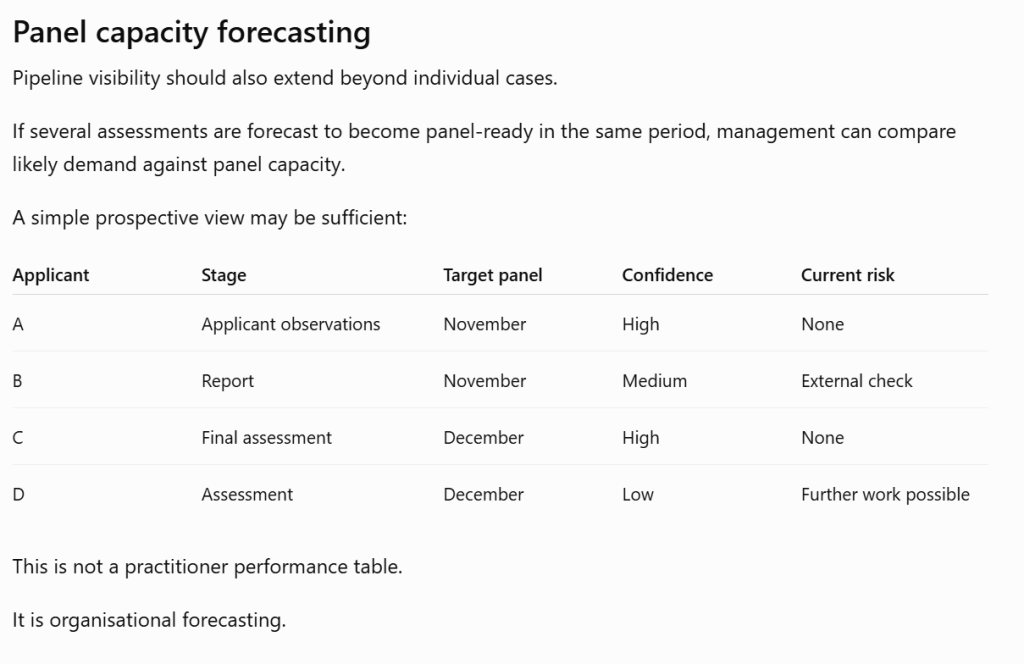
Panel readiness status
Services might supplement this with a simple status:
GREEN
Target remains realistic.
AMBER
Known dependency could affect target.
RED
Current target is no longer realistic.
The RAG status itself is of limited value without explanation.
The required management questions are:
Why?
Who owns it?
What action is possible?
Has the applicant been told?
Linking slippage and attrition data
Late-stage withdrawal analysis should consider the immediately preceding journey.
Where an applicant withdraws after panel has been discussed, managers might ask:
- Was a target panel communicated?
- Did it move?
- How many times?
- What caused the movement?
- Had the applicant expressed frustration?
- Had communication become applicant-led?
- What reason was ultimately given for withdrawal?
A relationship should not be assumed.
The applicant's circumstances may have changed independently.
However, without examining the journey, services cannot know whether recurring organisational factors exist.
This extends the earlier Stage Seven principle that an outcome code such as “withdrawn” is not itself an explanation.
Applicant experience should influence how slippage is handled
A service may internally describe a delayed panel as:
“Moved to the next available date.”
That wording can obscure the applicant experience.
For somebody who has invested many months, “next available” may represent another significant period of uncertainty.
Good communication should therefore acknowledge both:
the operational explanation;
and the significance of the change for the applicant.
That does not require excessive apology or the creation of blame.
It requires recognition.
Planning should reduce chaos without creating false certainty
The correct balance is therefore between two extremes.
Too little planning
“We'll think about panel when the report is ready.”
Too much certainty
“You must be at panel on this date regardless.”
Between them sits effective journey management:
“We are currently working towards this panel. Here is what needs to happen for that to remain realistic. If professional circumstances change the plan, we will adjust it and communicate with you.”
That approach respects both professional independence and applicant experience.
Current reform context
As at 2 September 2026, the Department for Education is consulting on revised fostering standards and guidance. The consultation opened on 8 July 2026 and closes on 16 September 2026. The revised material remains proposed rather than the current framework.
The currently published assessment and approval statutory guidance therefore remains the basis for the regulatory statements used in this Point.
Conclusion
Panel should not first enter management thinking when a completed report appears.
It is a foreseeable destination in the applicant journey.
The service should therefore know:
what panel it is broadly working towards;
what milestones sit before it;
what could cause movement;
who owns those dependencies;
and what the applicant has been told.
Where the target changes, the organisation should understand why.
Where it repeatedly changes, management should understand the cumulative effect.
The applicant has already spent months learning whether the service can be trusted.
Late-stage organisational instability may influence that judgement.
DON'T DISCOVER THE PANEL CALENDAR AT THE END OF THE ASSESSMENT.
TARGET ≠ PROMISE.
ZERO UNEXAMINED PANEL SLIPPAGE.
PLAN AROUND PROFESSIONAL WORK. DON'T DISTORT PROFESSIONAL WORK TO FIT THE PLAN.
And perhaps most importantly:
YOU MAY SEE A DELAY IN THE PROCESS. THE APPLICANT MAY SEE A PREVIEW OF WHAT IT WILL BE LIKE TO FOSTER WITH YOU.
References
Department for Education (2013), Fostering services: assessment and approval of foster carers. Current published statutory guidance for the assessment and approval process, including applicant observations and the eight-month panel-recommendation timescale.
Department for Education / Ipsos (2023), Foster Carer Recruitment and Conversion Rates. Small-scale qualitative research examining recruitment and conversion, including reported concerns about lengthy approval processes and waiting.
Department for Education (2026), Renewing Fostering: homes for 10,000 more children. Government policy paper reporting current assessment-duration challenges and proposed reform direction.
Department for Education (2026), Updating foster care standards and guidance. Current consultation on proposed revised standards and guidance, closing 16 September 2026.