Point 74: Is the Report Ready — Or Just the Assessment?
Point 74: Is the Report Ready — Or Just the Assessment?
There is a phrase used routinely in Foster Carer Recruitment that can hide a surprising amount of time:
“The assessment is finished.”
But what does that actually mean?
Does it mean:
the main assessment meetings are complete?
all the evidence has been gathered?
the analysis is complete?
the written report has been drafted?
the applicant has received it?
the applicant has responded?
the report has been finalised?
management quality assurance has been completed?
panel papers have been prepared?
or the case is actually ready to go to panel?
Those are very different positions.
Yet they can all sit underneath one broad organisational status:
ASSESSMENT.
And if we only measure the beginning and end of that single category, we can miss where substantial periods of time actually accumulate.
FINISHING THE CONVERSATIONS IS NOT THE SAME AS FINISHING THE REPORT
This needs to be stated clearly.
A Foster Carer assessment is not simply a series of interviews.
The Assessing Social Worker has to bring together:
information;
evidence;
observations;
checks;
professional analysis;
strengths;
areas of concern;
and recommendations.
That then has to be expressed in a coherent professional report capable of supporting panel and the subsequent decision-making process.
Current statutory guidance says that at the end of Stage 2 a written report covering the assessment should be compiled, including recommendations about suitability and any proposed terms of approval. The applicant must then receive the report and be given 10 working days to submit observations before the material goes to fostering panel.
So when the last substantial assessment meeting finishes, the organisation may still be some distance from being panel-ready.
That is not necessarily a failure.
But it should be visible.
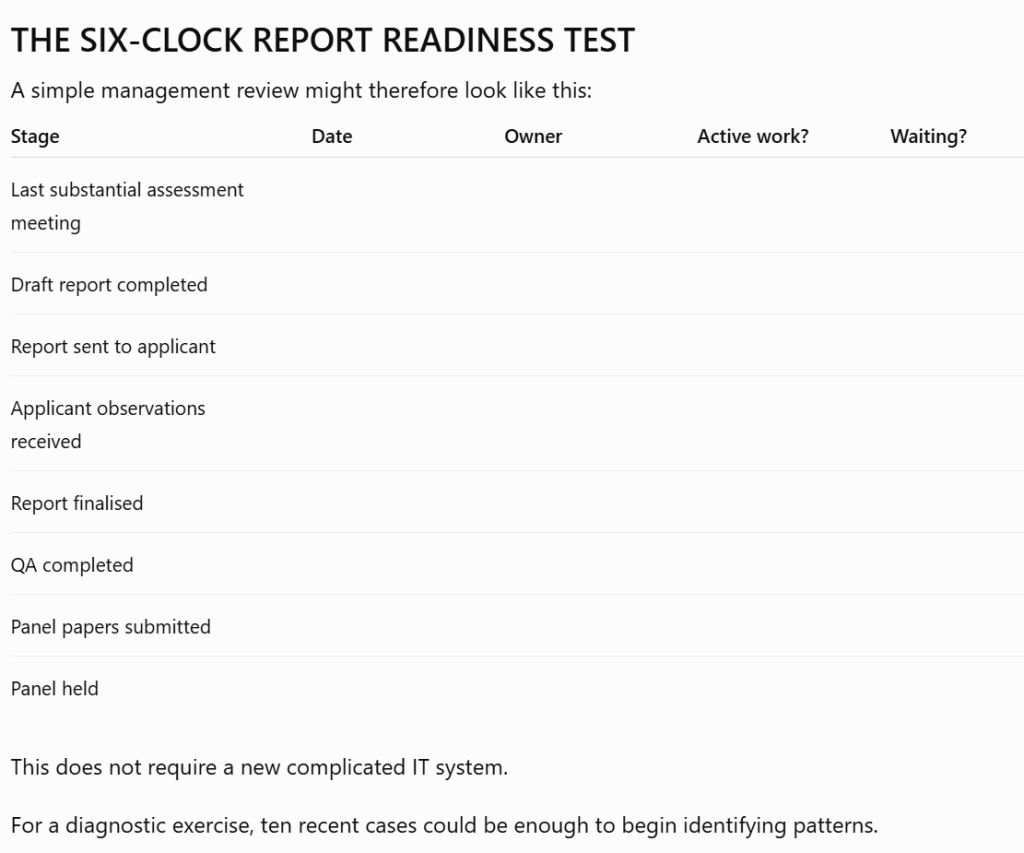
“THE ASSESSMENT IS FINISHED” CAN HIDE SIX DIFFERENT CLOCKS
I would suggest services stop treating this period as one block of time.
Break it down.
CLOCK 1
FINAL SUBSTANTIVE ASSESSMENT SESSION → DRAFT REPORT
This is primarily professional report-writing and analysis time.
Questions might include:
- Is the ASW carrying several assessments?
- Do they have protected writing time?
- Is all necessary evidence actually available?
- Are operational emergencies repeatedly displacing assessment work?
- Is report writing being started throughout assessment or left almost entirely until the end?
A longer interval may be completely legitimate.
The point is to understand it.
CLOCK 2
DRAFT REPORT → APPLICANT
Once the report is sufficiently complete to share, how long does it take actually to reach the applicant?
If the answer is several additional days or weeks, ask why.
Is something still being checked?
Is it waiting for management review?
Is there an administrative delay?
Is there an established workflow?
Again, the answer may be reasonable.
But it should not be invisible.
CLOCK 3
APPLICANT RECEIVES REPORT → APPLICANT OBSERVATIONS
Here there is a clear current statutory process.
Applicants are given 10 working days in which to submit observations on the full assessment report.
That is therefore not organisational waste.
It is a legitimate part of the current process.
And it illustrates exactly why we need to separate different kinds of elapsed time.
Not all time is delay.
CLOCK 4
APPLICANT OBSERVATIONS → REPORT FINALISATION
Once applicant comments arrive, what happens?
Some may involve straightforward factual corrections.
Some may add relevant context.
Some may involve disagreement with professional analysis.
Some may require the ASW to consider whether anything changes.
Point 73 covered those professional boundaries.
Point 74 asks the process question:
How quickly does the case move again once the observations have arrived?
CLOCK 5
FINAL REPORT → QUALITY ASSURANCE
Many services will have internal QA arrangements.
The precise model will vary.
This is where I would be particularly careful not to invent a statutory requirement that every service must use exactly the same QA process.
The management question is simpler:
Whatever QA system you use, how long does it take and what value does it add?
Does it:
strengthen analysis?
identify genuine omissions?
check that panel has what it needs?
Or does a report sit in a management queue waiting for somebody to find time to read it?
Those are not the same thing.
CLOCK 6
QA COMPLETE → PANEL PAPERS → PANEL
Once professional work and internal assurance are complete, there is still the panel timetable.
Paper deadlines may already be set.
A case that misses one deadline can potentially move into a later panel cycle.
That issue becomes the central focus of Point 75.
For Point 74, we simply need to expose the final operational hand-offs.
ACTIVE WORK, DEPENDENCY OR QUEUE?
There is another useful distinction.
For every elapsed period, ask which of these three states applies.
ACTIVE WORK
Somebody is undertaking necessary professional or administrative work.
Examples:
report analysis;
writing;
consideration of new information;
applicant observations;
quality assurance.
DEPENDENCY
Progress genuinely depends upon something else.
For example:
missing evidence;
applicant response;
professional clarification;
another required piece of information.
QUEUE
The work is ready to progress but is waiting for organisational capacity.
For example:
report waiting for management QA;
paperwork waiting for administrative processing;
case waiting because the person responsible is unavailable.
That third category is particularly important.
QUEUE TIME IS NOT THE SAME AS PROFESSIONAL ASSESSMENT TIME.
Some queueing will be unavoidable in any organisation.
But repeated queueing at the same point is a management issue worth understanding.
DON’T PUT A STOPWATCH ON THE ASW
This Point could be badly implemented.
A manager could take:
FINAL ASSESSMENT SESSION → REPORT COMPLETION
and turn it into:
“Every ASW must complete the Form F within X days.”
That is not what I am advocating.
Cases are different.
Complexity differs.
Information emerges at different times.
Professional analysis takes different amounts of work.
The 2023 DfE/Ipsos qualitative study is useful here. Services participating in that research said that dedicated assessment capacity helped assessments progress, while workers combining assessments with responsibilities for existing Foster Carers could face disruption because emergencies involving current placements understandably took priority. The same research highlighted the value of dedicated administrative support. It was a small-scale study involving ten fostering services, so these findings should be treated as qualitative evidence rather than nationally representative measurement.
That changes the management question from:
“Why is the ASW taking too long?”
to:
“WHAT CONDITIONS HAVE WE CREATED FOR THEM TO COMPLETE THE WORK?”
That is a much more useful question.
PROTECTED WRITING TIME IS A MANAGEMENT ISSUE
If an organisation expects complex, analytical reports to be completed well, workers need realistic opportunities to write them.
If report writing is continually fitted around:
urgent placement matters;
duty;
meetings;
supervision;
other assessments;
existing Foster Carer support;
and administrative demands,
then late report completion may be a predictable consequence of the operating model.
That does not mean every service needs a separate assessment team.
It means senior managers should understand the relationship between:
capacity → workload → report completion → panel readiness.
The 2023 DfE/Ipsos research reported precisely this tension between dedicated assessment capacity and competing responsibilities.
GOOD QA SHOULD IMPROVE QUALITY — NOT MERELY ADD TIME
Quality assurance is important.
A Foster Carer assessment report supports a significant professional decision.
Management oversight and QA can identify:
missing analysis;
inconsistent evidence;
unclear recommendations;
factual problems;
areas requiring further exploration.
But there is a useful question:
HOW MUCH OF YOUR QA TIME IS QUALITY ASSURANCE — AND HOW MUCH IS WAITING FOR QUALITY ASSURANCE?
Those are different things.
For example:
Report reaches manager Monday.
Manager reads it Thursday.
Two issues are discussed Friday.
ASW resolves them Monday.
That may be perfectly reasonable.
Compare:
Report reaches manager Monday.
Nothing happens for three weeks because the manager's workload prevents review.
The actual QA work still takes two days.
The elapsed QA stage takes nearly a month.
If your dashboard only records:
assessment completed → panel
you will never see the difference.
REWORK IS DATA
There is another useful measure I would introduce.
REPORT REWORK
How often does QA result in a report being returned for substantial further work?
Again, this should not become an ASW performance league table.
Some reworking is an entirely healthy part of professional assurance.
But patterns may tell managers something.
For example:
Are the same sections repeatedly incomplete?
Are expectations inconsistent between managers?
Are ASWs clear about the standard required?
Do newer workers need additional Form F/report-writing support?
Is evidence being gathered too late?
Are cases being sent to QA before they are genuinely ready?
Repeated rework consumes capacity twice:
once in the original work;
and again in the correction.
The appropriate response may be training, clearer guidance, supervision or better templates — not pressure.
FIRST-TIME-READY RATE
Services could therefore test another diagnostic.
FIRST-TIME-READY RATE
Of reports submitted for QA, how many require only normal minor amendments rather than substantial reworking?
This is not a national standard.
It is not a proposed target.
It is simply a way of understanding process quality.
If almost every report requires extensive restructuring at QA, something earlier in the system may need attention.
THE 2026 NATIONAL CONTEXT MAKES THIS MORE IMPORTANT
The Government's Renewing Fostering plan reports that within local authorities:
59% of fostering assessments take more than six months
and:
29% take more than eight months.
The document says the present system can involve delays and argues that recruitment should remain robust while becoming quicker and more streamlined.
These figures should not be used to accuse Social Workers of being slow.
They do something much more useful.
They justify asking:
WHERE DOES THE TIME ACTUALLY GO?
If three months involve essential professional assessment and six weeks involve avoidable queueing, those are different management problems.
Without stage-level data, they look identical.
“THE REPORT IS BEING WRITTEN” IS TOO BROAD
Another phrase worth challenging is:
“The report is being written.”
That may mean:
the ASW is actively writing it today;
the ASW has begun but is waiting for information;
the report is complete but awaiting supervision;
it is in QA;
it has been returned for amendments;
the applicant has it;
or nothing has happened to it for two weeks.
A broad status can create false visibility.
Managers think they know where a case is.
Applicants are told it is “progressing”.
But nobody has separated the underlying activity.
FOR MANAGERS — TAKE TEN CASES
Take the last ten applicants who reached panel.
For each case, record:
Last substantial assessment session
Draft report completed
Report issued to applicant
Applicant observations received
Report finalised
QA started
QA completed
Panel papers submitted
Panel date
Then calculate:
TOTAL ELAPSED TIME
and, more importantly:
TIME BETWEEN EACH HAND-OFF.
Then ask:
Which stage varies most?
Where are cases repeatedly waiting?
Where does rework happen?
Which dependencies are genuinely external?
Which delays are created internally?
Is workload affecting report completion?
Does QA have sufficient capacity?
Do administrative hand-offs happen quickly?
Are panel deadlines then being missed?
This begins to create operational intelligence.
WATCH OUT — DON’T SIMPLY MOVE THE PRESSURE EARLIER
There is a temptation in process improvement to solve one bottleneck by pushing unfinished work into the next stage.
For example:
“Get it to QA faster.”
That achieves nothing if incomplete reports then require extensive rework.
Or:
“Get it to panel.”
That is not success if the professional work is not ready.
The objective is not to move paperwork faster.
It is to reduce time that adds no professional value.
That distinction is fundamental.
SPEED UP THE WASTE — NOT THE PROFESSIONAL THINKING.
Perhaps even better:
REMOVE WASTED TIME. PROTECT PROFESSIONAL TIME.
That is the principle I would want managers to adopt.
ASK YOUR TEAM
When someone says:
“This assessment is finished.”
ask:
What exactly is finished?
Then ask:
What still needs to happen before panel?
If the answer contains six separate activities, the assessment is not operationally finished.
It has simply entered another stage.
THE REPORT-READY TEST
Before describing a case as approaching panel readiness, can you answer:
EVIDENCE
Is the necessary information available?
ANALYSIS
Has the professional assessment been brought together?
REPORT
Is the written report complete enough to progress?
APPLICANT
Has the applicant had the required opportunity to receive and comment on it?
QA
Has your local assurance process been completed?
PANEL
Are the papers ready within the panel timetable?
That creates a more useful definition of readiness.
THIS IS NOT ABOUT WRITING FASTER
The central point needs repeating.
A Foster Carer assessment report should not be rushed simply to improve a KPI.
The statutory guidance expects a full professional assessment report capable of supporting the panel and decision-maker.
The management task is therefore to protect the time needed for good professional work while reducing time that adds nothing to it.
That means understanding:
workload;
protected writing time;
administrative support;
management capacity;
applicant response;
QA;
rework;
hand-offs;
and panel deadlines.
POINT 74 TEST
If I asked your service:
“How long does it take from the final assessment meeting to panel?”
could you tell me?
More importantly:
could you explain why?
Because one figure saying:
“Seven months from application to panel”
is not enough.
It tells us elapsed time.
It does not tell us:
professional time;
applicant time;
external dependency;
management time;
administration;
queueing;
or:
avoidable inactivity.
And until those are separated, it is difficult to improve the system intelligently.