Point 72/100: Silence Is Not a Next Step
Point 72: Silence Is Not a Next Step
There is an important difference between these two statements:
“We explained what happens next.”
and:
“We kept them informed while it happened.”
They are not the same thing.
Point 71 of this Review examined what happens after the last substantial Foster Carer assessment meeting.
Point 72 looks specifically at what the prospective Foster Carer experiences during the periods in which there may be little visible progress.
And that leads to one of the simplest principles in the whole 100-Point Review:
IF THERE IS NOTHING NEW TO REPORT, REPORT THAT.
That may sound almost too obvious.
Yet I suspect significant periods of silence remain completely normal within parts of Foster Carer Recruitment.
“They know we're waiting.”
Do they?
An Assessing Social Worker might finish an appointment and explain:
The report needs completing, it will then go through quality assurance and we will be looking towards panel.
The applicant nods.
They understand.
At that moment.
Then life continues.
A week passes.
Another week passes.
Perhaps a third.
Inside the organisation, very little may be wrong.
The ASW could be writing the report.
Information might be being incorporated.
A manager may have scheduled quality assurance.
Panel papers might not yet be due.
Everyone within the organisation understands the process.
The prospective Foster Carer does not have access to any of that internal visibility.
From their side, there has simply been:
no contact.
And silence gives people room to create their own explanations.
Has something gone wrong?
Have they found something?
Is the Social Worker concerned about us?
Are we still going to panel?
Why hasn't anybody contacted us?
That is the recruitment issue.
THE ORGANISATION KNOWS WHAT THE SILENCE MEANS. THE APPLICANT DOESN'T.
That is why communication at this stage cannot rely exclusively on explaining the process once.
The applicant needs sufficient visibility while the process unfolds.
The current National Minimum Standards state that prospective Foster Carers should receive timely and relevant information and should be kept informed about the progress of subsequent applications. They also say that the stages of the assessment process and, where possible, the timescales should be set out clearly.
Point 72 is therefore not arguing for constant contact.
It is arguing against unexplained silence.
Three weeks feels different depending on which side of the process you are on
This is worth understanding.
Three weeks within a busy fostering service can disappear remarkably quickly.
Cases.
Meetings.
Supervision.
Visits.
Training.
Annual leave.
Panel deadlines.
Emergencies.
Other assessments.
For the prospective Foster Carer, those same three weeks can feel very different.
They have spent months trying to reach this point.
They have reorganised work and family commitments.
They have completed training.
They may have had medical checks and references.
They have discussed highly personal parts of their lives.
They may have been thinking about fostering every day for months.
Then suddenly:
nothing.
The Department for Education's qualitative research into Foster Carer Recruitment and conversion identified lengthy approval processes as a challenge and reported participants' views that long periods of waiting could compromise prospective Foster Carers' motivation and morale. This was a small-scale study involving ten fostering-service case studies, so it should not be interpreted as a nationally representative measurement, but it reinforces the importance of examining the experience of waiting.
No news is still information
This is perhaps the most important operational shift.
Services sometimes appear reluctant to contact applicants unless there is something new to say.
I would reverse that thinking.
If somebody is expecting an update, then:
“There has been no change”
is itself an update.
Compare these two experiences.
EXPERIENCE A
Last conversation:
“We're waiting for the report to go through QA.”
Then:
21 days of silence.
EXPERIENCE B
Last conversation:
“We're waiting for the report to go through QA.”
Seven days later:
“Just keeping you updated. Your assessment remains with our QA process. Nothing is required from you and there are no new issues I need to discuss with you. I will contact you again next Friday, even if there has been no change.”
Nothing substantive has changed.
But the applicant's experience has.
A SIMPLE FINAL-MILE UPDATE
I would suggest services test a very simple structure.
Every update does not need to become another meeting.
It may only require four pieces of information.
1. STATUS
Where are we?
For example:
“Your assessment report is currently being finalised.”
2. OUTSTANDING
What are we waiting for?
For example:
“We are waiting for management quality assurance.”
Or:
“One piece of information remains outstanding.”
3. ACTION
Does the applicant need to do anything?
For example:
“There is nothing you need to do at present.”
That sentence can be enormously useful.
4. NEXT CONTACT
When will they hear from you again?
For example:
“I will update you again next Friday even if there has been no change.”
Put together:
STATUS → OUTSTANDING → ACTION → NEXT CONTACT
That is not a statutory model.
It is a simple management recommendation services could test.
THE MOST IMPORTANT PART IS THE LAST ONE
If you say:
“I will update you next Friday”
then update them next Friday.
Even if the update is:
“Nothing has changed.”
Because otherwise the communication promise itself becomes another source of uncertainty.
This is why Point 72 is not merely about sending more emails.
It is about reliability.
A predictable communication rhythm can be more reassuring than frequent but erratic contact.
WHO OWNS THE COMMUNICATION?
There is another potential gap.
Once the main assessment work is nearing completion, who is responsible for keeping the prospective Foster Carer informed?
The ASW?
Recruitment?
A coordinator?
An administrator?
A manager?
There is no need for every organisation to use the same model.
But somebody should know.
The dangerous answer is:
“Everyone thought somebody else was doing it.”
Stage Seven established the principle:
“WAITING” SHOULD ALWAYS HAVE AN OWNER.
Point 72 adds:
COMMUNICATION DURING WAITING SHOULD HAVE AN OWNER TOO.
THIS DOES NOT HAVE TO SIT ENTIRELY WITH THE ASW
That matters.
The answer to every applicant-experience issue cannot simply be:
“Ask the Social Worker to do more.”
An Assessing Social Worker may already be managing assessment work, analysis, visits, report writing, checks, supervision and multiple cases.
A fostering service should therefore examine whether some routine journey communication can be supported organisationally.
For example:
- recruitment could remain connected;
- administration could support scheduled progress messages;
- case-management systems could generate reminders;
- managers could establish agreed contact intervals;
- another named person could maintain applicant contact during predictable administrative stages.
The professional content of the assessment remains with the appropriate professional.
But not every message saying:
“Everything remains on track”
requires a new piece of Social Work assessment.
The principle from Stage Seven still applies:
THE ASW ASSESSES. THE ORGANISATION STILL RECRUITS.
SHOULD YOU HAVE A COMMUNICATION STANDARD?
Possibly.
Not a national statutory timescale invented for this Review.
A local service standard.
For example, a service might decide that no prospective Foster Carer approaching panel should normally go longer than an agreed number of working days without meaningful progress communication.
The correct interval will depend on the organisation and stage.
The important issue is not whether it is seven days, ten days or another reasonable interval.
The important questions are:
Have you agreed one?
Does somebody own it?
Can you tell whether it happened?
WATCH OUT — AUTOMATION IS NOT RELATIONSHIP
Technology can help.
A case-management system may be able to remind workers that an update is due.
A CRM may identify that somebody has had no contact for a defined period.
An automated message might even be appropriate in certain circumstances.
But do not allow:
“Your case remains in progress.”
to become a substitute for human communication throughout the final stage of a deeply personal assessment journey.
Automation should support the relationship.
Not replace it.
ASK YOUR TEAM
Take a prospective Foster Carer currently nearing panel and ask:
What do we know?
You might know:
- report status;
- outstanding checks;
- QA date;
- likely panel;
- administrative position.
Then ask:
What do they know?
If those answers are significantly different, you have found a communication gap.
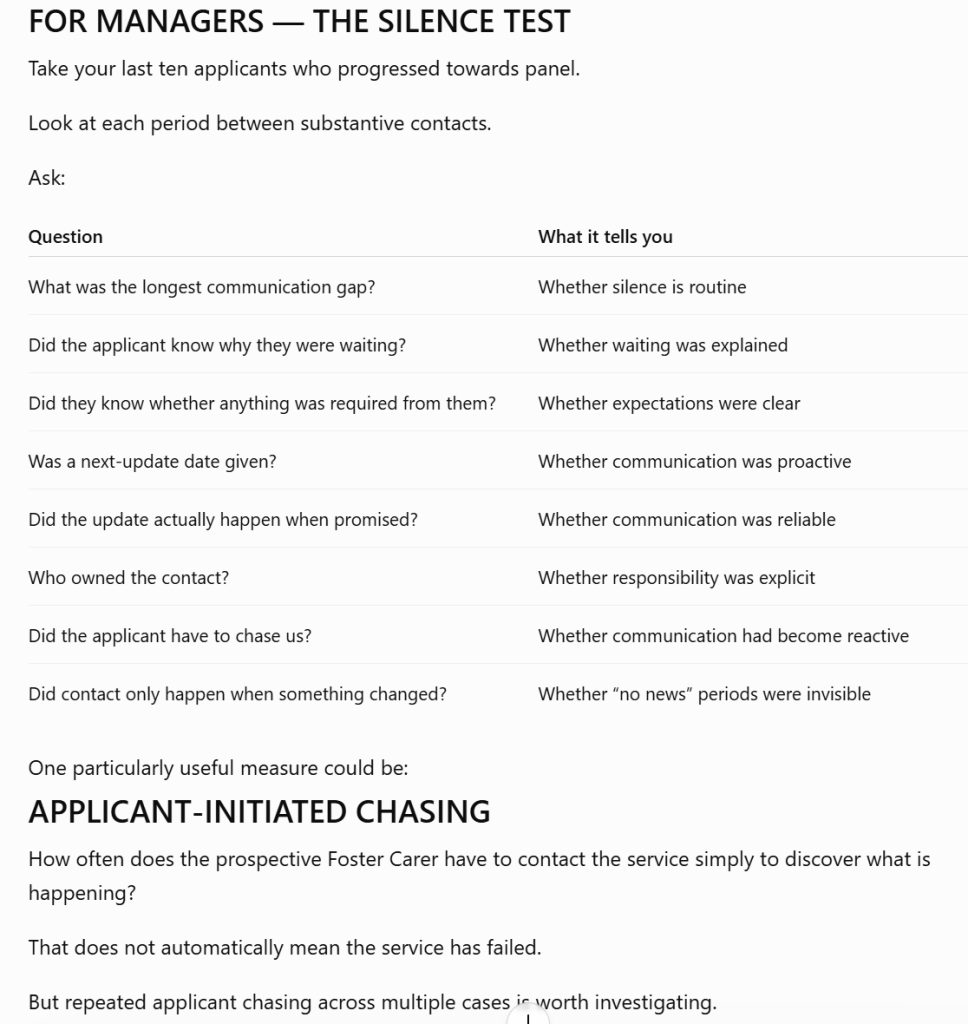
DON'T MAKE THE APPLICANT MANAGE YOUR PROCESS
There is a subtle change that happens when communication becomes reactive.
The organisation stops managing the journey.
The applicant starts managing it.
“Any news?”
“Do you know when panel is?”
“Have you received the report?”
“Is everything OK?”
“Should we have heard something by now?”
That should not become the normal communication model for people who have already spent months being recruited and assessed.
A GOOD UPDATE CAN BE VERY SHORT
This does not require an essay.
For example:
Everything remains on track. We are still waiting for management QA of your assessment report. There is nothing you need to do at present. I will update you again next Thursday even if there has been no change.
That message answers four important questions:
Are we still progressing? — Yes.
What is happening? — QA.
Do I need to do anything? — No.
When will I hear again? — Thursday.
That is useful communication.
DO NOT OVER-PROMISE
There is an important counterbalance.
Communication should not create certainty where professional uncertainty genuinely exists.
Do not say:
“You will definitely be at panel on the 18th.”
if the assessment has not been completed and the panel date remains provisional.
Do not say:
“Everything is absolutely fine.”
if substantive professional issues remain unresolved.
Accurate communication might instead say:
“We are currently working towards the panel on the 18th, but that remains provisional until the assessment and QA process are complete.”
Good communication is not reassurance at any cost.
It is clarity.
SILENCE CAN DAMAGE THE JOURNEY WITHOUT ANYONE INTENDING IT
This is an important management point.
Most periods of silence are probably not caused by somebody deciding:
“We won't bother contacting them.”
They emerge because everybody is busy.
The process makes sense internally.
The applicant has already been told what comes next.
There has been nothing substantive to report.
And suddenly three weeks have gone.
That is exactly why a system is needed.
Not because staff do not care.
Because busy systems need prompts, ownership and expectations.
POINT 72 TEST
For every prospective Foster Carer nearing approval, can they answer these four questions today?
1. Where am I?
2. What are we waiting for?
3. Is there anything I need to do?
4. When will I hear from you again?
If they cannot, the organisation may know exactly what is happening while the person being recruited does not.
And that is the gap.
THE COMMUNICATION PROMISE
The final recommendation from Point 72 is extremely simple.
When somebody enters a waiting period:
Tell them what is happening.
Tell them what is outstanding.
Tell them whether they need to act.
Tell them when you will contact them again.
Then keep that promise.
Even when the next update is:
“There is still nothing new to report.”
Because at this stage of Foster Carer Recruitment:
IF THERE IS NOTHING NEW TO REPORT, REPORT THAT.
And above all: