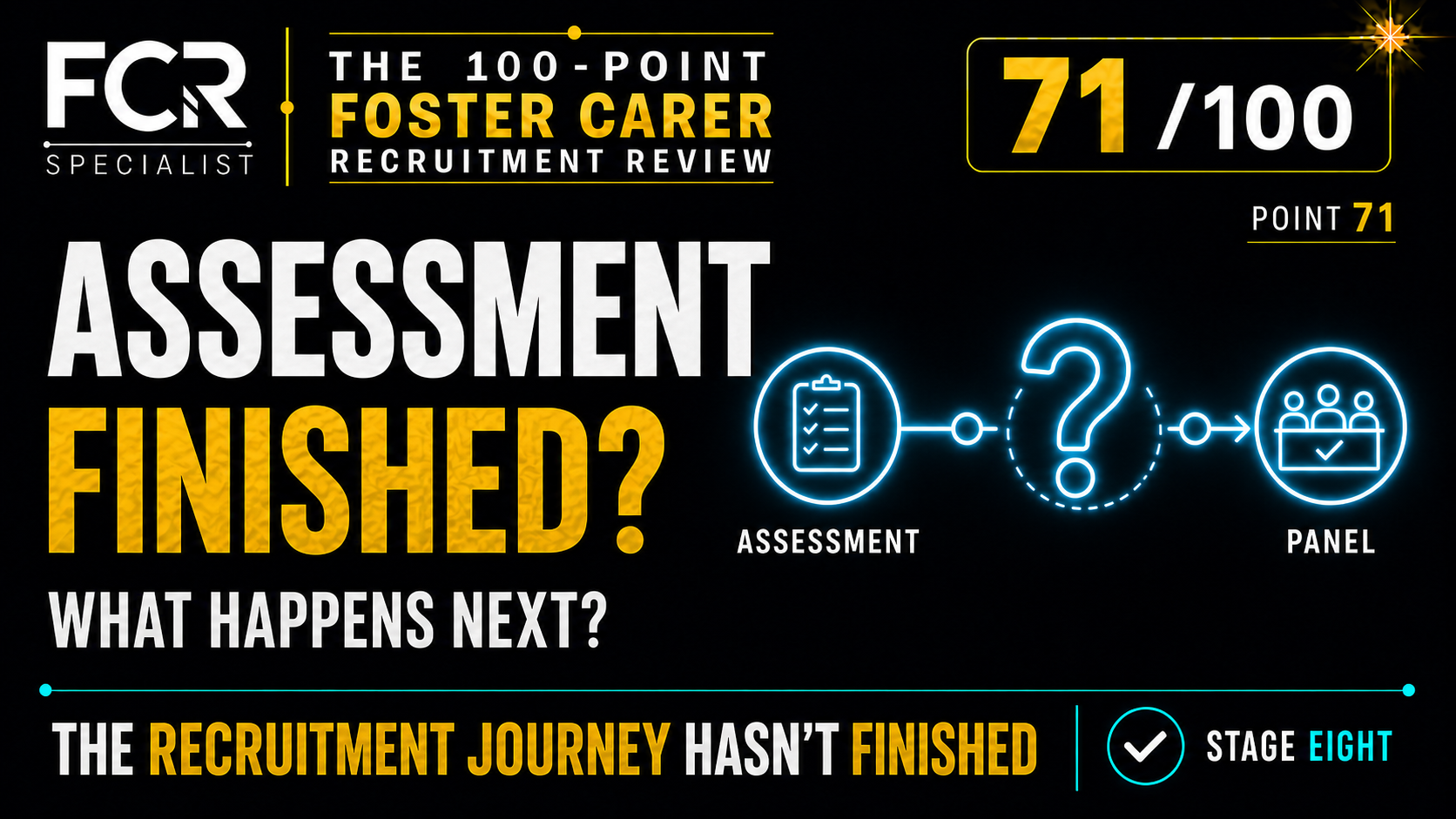
Point 71: What Happens When the Assessment Meetings Finish?
Point 71: What Happens When the Assessment Meetings Finish?
There is a point in the Foster Carer Recruitment journey that receives surprisingly little attention.
It is the period immediately after the main assessment meetings have finished.
For the organisation, this may simply be another stage in a well-understood professional process.
For the prospective Foster Carer, it can feel completely different.
After months of appointments, questions, training, checks and regular contact, the Assessing Social Worker may say something along the lines of:
“That is probably our last main assessment session.”
What does the applicant hear?
Quite possibly:
“We've finished.”
But they haven't.
There may still be considerable work to do before their case reaches panel.
The written assessment report needs completing. Information may still need checking. The applicant may need to read and comment on the report. Management quality assurance may be required. Amendments may follow. Panel paperwork needs preparing and submitting within the organisation's timetable.
None of those activities is inherently a problem.
The problem occurs when the applicant does not understand that they are happening.
There are two versions of the same journey
Inside the organisation, the journey might look like this:
Final assessment meeting → report writing → outstanding evidence → applicant comment → QA → amendments → panel papers → panel
To the prospective Foster Carer, it may look like this:
Final assessment meeting → nothing
That difference matters.
The organisation sees activity.
The applicant experiences absence.
And this is where relatively ordinary operational time can begin to feel emotionally significant.
“I thought we'd finished.”
Imagine somebody who has spent six or seven months being assessed.
They have discussed their childhood.
Their relationships.
Their family.
Their finances.
Their health.
Their parenting.
Previous partners.
Significant events in their life.
Other people may have been contacted about them.
Their home and family life have been examined in considerable depth.
Then the regular meetings stop.
A week passes.
Then another.
Perhaps there is nothing particularly wrong.
The ASW is writing.
A manager is reviewing something.
An outstanding document is being chased.
The panel-paper deadline is still three weeks away.
Internally, everybody may understand this.
The applicant may understand none of it.
Their questions can quickly become very different:
Has something gone wrong?
Has something come back from one of our checks?
Was something said at the last meeting that concerned them?
Are they having doubts about us?
Why hasn't anybody contacted us?
That is the hidden gap Point 71 is designed to expose.
The current standards already recognise the importance of keeping people informed
The existing National Minimum Standards say prospective Foster Carers should receive timely and relevant information and be kept informed about the progress of an application. They also say the assessment process should be clearly explained, including the stages of the process and, where possible, the timescales involved.
The standards also make clear that the written report is an important professional document: it should provide the information panel and the decision-maker need to make an objective decision and distinguish appropriately between fact, opinion and third-party information.
So this Point is emphatically not saying:
“The ASW has finished the meetings, so why haven't they written the report by Friday?”
A high-quality assessment report takes professional time.
This is about understanding what happens around that work.
COMPLETING THE MEETINGS IS NOT THE SAME AS COMPLETING THE ASSESSMENT PROCESS
That distinction should be made explicit to the applicant.
At the final substantial assessment meeting, somebody should be able to explain something similar to:
“The main face-to-face assessment work is now nearing completion. That doesn't mean everything is finished. I now need to complete the report, bring together the evidence, and there will be further stages before panel. Here is broadly what happens next.”
That sentence alone changes the applicant's understanding of where they are.
They have not disappeared into a process.
They can see the process.
Measure the hidden gap
For most recruitment dashboards, I suspect this period barely exists.
Services commonly know dates such as:
- application date;
- assessment start;
- panel date;
- approval date.
But those broad dates can conceal considerable periods of inactivity or perfectly legitimate professional work.
Point 71 therefore introduces two simple management measures.
Measure 1
LAST SUBSTANTIVE ASSESSMENT SESSION → NEXT MEANINGFUL CONTACT
The wording meaningful contact is deliberate.
An automatically generated email is not necessarily meaningful contact.
A meaningful contact tells the applicant enough to understand where they currently are in the journey.
For example:
- the main assessment sessions have finished;
- report writing is underway;
- one piece of evidence remains outstanding;
- there is nothing currently required from them;
- the likely next stage is X.
Point 72 will look much more closely at communication during waiting periods.
For Point 71, the important thing is simply discovering whether a gap exists.
Measure 2
LAST SUBSTANTIVE ASSESSMENT SESSION → PANEL
This does not become a simplistic performance target.
There will be legitimate differences between assessments.
Some reports will be more complex.
New information can emerge.
Checks can remain outstanding.
Applicants may need time to respond.
Additional professional work may legitimately be required.
But if you never measure this period, you cannot know whether a recurring organisational problem exists.
Do not turn this into another ASW stopwatch
This is important.
The purpose is not to create a league table showing:
ASW A takes 18 days to write reports. ASW B takes 27.
That could easily become counterproductive.
Report-writing time can be affected by case complexity, workload, experience, supervision, outstanding evidence, applicant circumstances, protected writing time and management processes.
The management question should therefore be:
WHAT CONDITIONS ARE WE CREATING AROUND THE ASW TO ENABLE THE ASSESSMENT TO PROGRESS?
Not:
“Why aren't they working faster?”
The distinction we established in Stage Seven still applies:
RIGOUR ≠ DELAY.
Good-quality Social Work requires time.
Poor organisational process also consumes time.
The task is to distinguish between them.
National evidence tells us that time matters
The Department for Education's 2023 qualitative research into Foster Carer Recruitment found that lengthy approval processes and long periods of waiting could compromise the motivation and morale of prospective Foster Carers. The research involved ten fostering-service case studies, so this should not be treated as a nationally representative measurement of applicant experience, but it provides useful evidence of the issue.
The Government's 2026 Renewing Fostering plan has subsequently reported that 59% of local-authority fostering assessments take more than six months and 29% more than eight months. The Government is explicitly seeking a more streamlined end-to-end recruitment, assessment and approval system.
Again, this does not mean all time beyond six months represents avoidable delay.
It means services should be curious about where that time is being spent.
The final meeting should create a new roadmap
I would make the end of the substantive assessment meetings a deliberate transition point.
Not a vague ending.
Something changes.
The applicant should broadly understand:
What has finished?
The majority of the direct assessment work.
What has not finished?
The overall assessment and approval process.
What happens next?
Report completion, remaining evidence where applicable, applicant involvement, quality assurance, panel preparation and panel.
Who remains their contact?
Someone identifiable.
Is anything required from them?
They should know.
What is the next significant milestone?
They should have an answer, even where the date remains provisional.
That is basic journey management.
A useful management distinction: WORKING TIME versus WAITING TIME
There is another way to analyse this period.
Ask whether each part of the gap represents:
WORKING TIME
Someone is actively completing necessary professional or administrative work.
Or:
WAITING TIME
Nothing can progress until something else happens.
If it is waiting time, ask:
Waiting for what?
Waiting for whom?
Since when?
Who owns the follow-up?
This does not imply that waiting can always be eliminated.
It simply makes it visible.
Stage Seven established an important principle:
“Waiting” should always have an owner.
That principle becomes even more important as applicants approach panel.
WATCH OUT: THE PERSON MAY BELIEVE THEY HAVE CROSSED THE FINISH LINE
Language matters.
If you say:
“That's the assessment finished.”
and then disappear for four weeks while the report progresses internally, the applicant's expectation and organisational reality immediately diverge.
A more accurate message might be:
“That's the main assessment meeting work completed. There are still several stages before panel, and I'll explain those now.”
Small wording change.
Very different expectation.
FOR MANAGERS — ASK YOURSELF
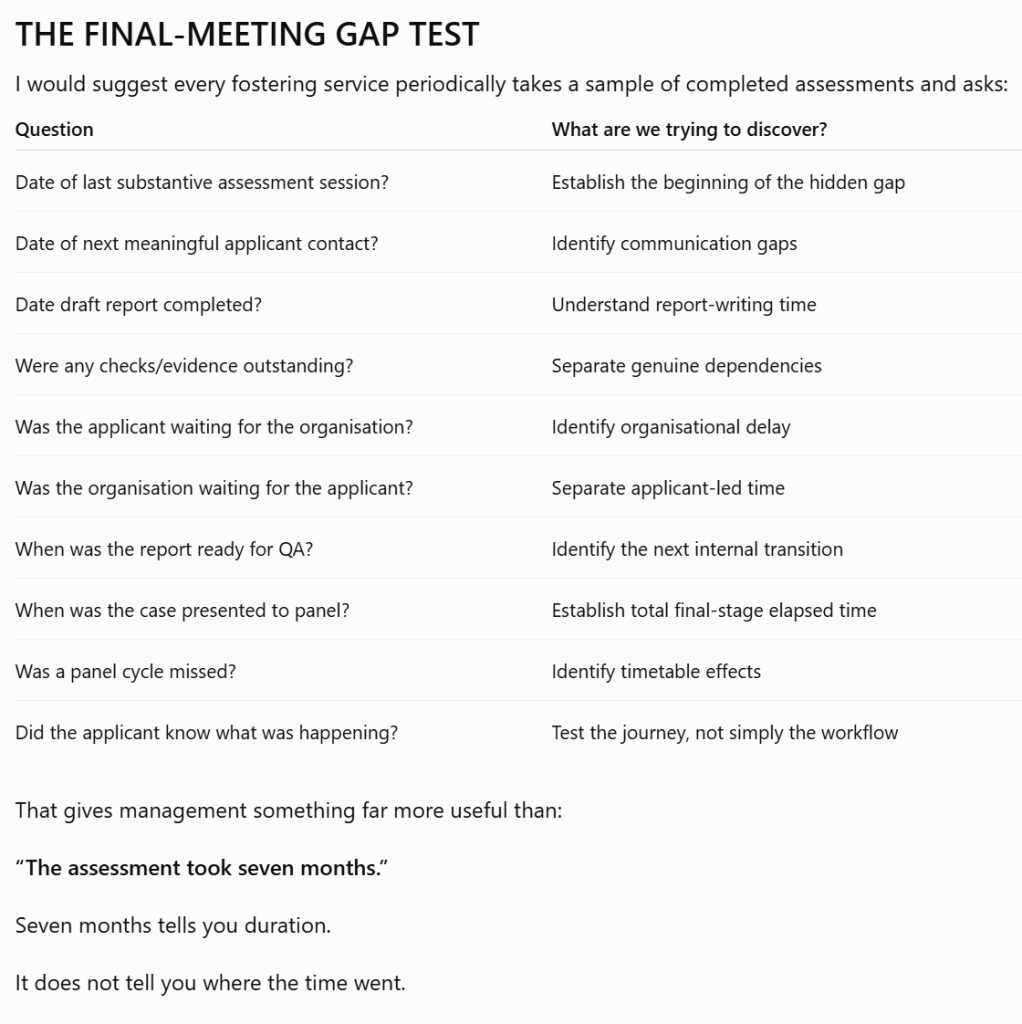
Take your last ten applicants who reached panel.
Can you answer these questions?
How long was the average gap between their final substantial assessment meeting and panel?
How much of that time involved active work?
How much involved waiting?
What were you waiting for?
Who owned each dependency?
Were there repeated causes?
Did any applicant miss a panel cycle?
How long did applicants go without meaningful contact?
Would the applicant's account of what was happening match the organisation's account?
That final question is perhaps the most important.
WHAT DOES THIS FEEL LIKE TO THE PERSON WAITING?
Stage Eight is going to repeatedly ask this question.
The organisation may see:
report writing
QA
panel administration
workflow
deadlines
The applicant may simply see:
silence
That is why Point 71 should become the starting point for analysing the final mile.
The main assessment meetings finishing is not an insignificant administrative moment.
It is a transition.
Manage it deliberately.
Measure it.
Explain it.
And make sure that when the meetings stop, the applicant does not mistake the end of regular contact for the end of organisational interest.