POINT 70/100 — CAN SENIOR MANAGEMENT ACTUALLY SEE WHY APPLICANTS ARE LEAVING ASSESSMENT?
POINT 70/100 — CAN SENIOR MANAGEMENT ACTUALLY SEE WHY APPLICANTS ARE LEAVING ASSESSMENT?
At the end of Stage Seven, I want senior managers to look at one word:
WITHDRAWN
What does it actually mean?
A person enquired about fostering.
They had conversations.
Someone visited their home.
They made a decision to proceed.
They formally applied.
The organisation initiated checks.
An Assessing Social Worker may have spent hours with them.
Training may have taken place.
Managers, administrators, recruitment staff and others have all invested time.
Then the system says:
WITHDRAWN.
And too often that becomes the end of the analysis.
That isn't enough.
THE NATIONAL FIGURES SHOULD MAKE EVERY SENIOR MANAGER ASK WHY
Ofsted recorded 8,290 fostering applications received during 2024–25.
By 31 March 2025:
5,370 had been completed.
2,925 remained in progress.
Among the 5,370 completed applications:
2,050 — 38% — were approved.
3,290 — 61% — were withdrawn.
30 — 1% — were rejected.
Of the 3,290 withdrawals:
2,175 — 66% — were withdrawn by the applicant.
1,115 — 34% — were withdrawn by the service.
We should not conclude that all 3,290 represent failures.
They don't.
Some people quite properly discover that fostering isn't right for them.
Household circumstances change.
Some applicants make informed decisions to stop.
Assessment may uncover information that appropriately prevents progression.
The service may quite correctly decide not to continue.
Those outcomes are part of a rigorous recruitment and assessment system.
But that does not make the scale of attrition unimportant.
It makes understanding it more important.
61% WITHDRAWN IS NOT AN EXPLANATION
Imagine reporting to a senior management meeting:
“61% of the completed applications were withdrawals.”
The obvious next question should be:
WHY?
But the Department for Education's qualitative research found fostering services collecting substantially more quantitative recruitment information than qualitative information.
Services knew about:
enquiries;
applications;
withdrawals;
approvals;
and demographics.
But participants wanted much better information explaining why prospective Foster Carers did not progress and why applicants withdrew.
The researchers noted that potentially useful qualitative information could already exist in conversations and case notes but remain difficult to retrieve or analyse.
That gives us the central management challenge for Point 70:
DON'T JUST COUNT ATTRITION.
UNDERSTAND IT.
WHAT DOES “APPLICANT WITHDREW” ACTUALLY CONTAIN?
Potentially dozens of completely different stories.
One applicant might say:
“We've understood fostering properly now and decided it isn't right for our family.”
That may be a good recruitment outcome.
Another might say:
“My circumstances have changed. I would like to come back next year.”
That may be Not Now.
Another:
“I've decided to Foster with another provider.”
That needs understanding.
Another:
“I didn't realise assessment would involve this level of personal exploration.”
That may raise an expectation-management question.
Another:
“We still want to Foster but we've lost confidence in this organisation.”
That is a very different problem.
Another simply stops answering.
The database may eventually record:
Applicant withdrew / unable to contact.
But:
WHAT HAPPENED BEFORE THEY STOPPED ANSWERING?
That is the information management needs.
OFSTED ALREADY TELLS US THE PROCESS SOMETIMES MATTERS
Ofsted reports that among applications begun during 2024–25 and withdrawn by the applicant by year-end, the most commonly cited reasons included:
36% — change in household circumstances, excluding financial change
35% — other or unknown
20% — fostering process not being as the applicant expected.
That 35% other or unknown should itself provoke a management question.
What does unknown mean?
The applicant wouldn't tell us?
We couldn't contact them?
We never asked?
The information exists but isn't coded?
Nobody recorded enough detail?
Those are very different explanations.
And the 20% process figure should not be misused.
It does not mean 20% were lost because Social Workers conducted poor assessments.
It does not prove that those people would otherwise have been approved.
But it does tell us that the experience of the process appears prominently enough within applicant withdrawal reasons to deserve management attention.
STAGE SEVEN HAS REALLY BEEN ABOUT ONE QUESTION
Points 61–69 have looked at different elements.
But underneath all of them is one fundamental question:
ONCE SOMEBODY SAYS YES TO FOSTERING, DOES THE ORGANISATION STILL MANAGE THEM AS SOMEBODY IT IS TRYING TO RECRUIT?
Not persuade.
Not sell to.
Not push through assessment.
Not protect from professional scrutiny.
But continue to treat them as somebody who has voluntarily entered a demanding recruitment journey and who could still leave.
That is the Stage Seven distinction.
THE ASW ASSESSES.
THE ORGANISATION STILL RECRUITS.
POINT 61 — DID WE CREATE AN UNNECESSARY APPLICATION BARRIER?
We began by challenging the application stage itself.
Someone has already:
made an enquiry;
spoken to recruitment;
provided information;
had an Initial Visit;
and decided to proceed.
Then some services effectively tell them:
“Now start again and complete this application.”
But is a traditional standalone application form always the only way to progress?
Some services are already using information gathered through earlier conversations and digital systems, allowing applicants to complete, confirm or add information directly and obtain the necessary declarations, permissions and signatures without rebuilding the whole record.
The management question from Point 61 was:
ARE WE USING APPLICATION TO PROGRESS PEOPLE — OR CREATING ANOTHER ATTRITION WINDOW?
POINT 62 — DID THE RELATIONSHIP SURVIVE THE HANDOVER?
Recruitment builds trust.
Then assessment begins.
If the recruiter disappears, the applicant receives a new person and the Assessing Social Worker knows little about the journey so far, the organisation has created a discontinuity.
The professional role must change.
The organisational relationship need not.
Point 62 therefore established:
ASSESSMENT OWNERSHIP ≠ RECRUITMENT ABANDONMENT.
Senior managers should know whether the recruitment-to-assessment handover is genuinely joined up.
POINT 63 — HOW MANY TIMES ARE WE MAKING PEOPLE TELL US THE SAME THING?
DfE research specifically identified repetition across enquiry, home visit, application and assessment.
The ASW may legitimately need to revisit information.
That is professional assessment.
But asking for the same factual information again because one system cannot see another is different.
Point 63 established:
REVISIT WITH PURPOSE. DON'T REPEAT THROUGH HABIT.
The management question is whether the organisation has:
one household;
one developing journey record;
and:
multiple professional touchpoints.
POINT 64 — DID WE GIVE THEM A ROADMAP?
Assessment can take time.
But the applicant should not spend months repeatedly wondering:
“What happens next?”
Point 64 argued for planning what can reasonably be planned:
assessment sessions;
training;
checks;
applicant activity;
future milestones;
and an indicative route towards panel.
Not a rigid assessment timetable.
Professional work still changes.
But:
MOVING A PLANNED APPOINTMENT IS DIFFERENT FROM HAVING NO APPOINTMENT TO MOVE.
Senior management should therefore understand not simply total assessment duration but the gaps inside it.
POINT 65 — ARE CHECKS MANAGED OR JUST WAITED FOR?
Checks remain essential.
Point 65 was never about reducing safeguarding.
It asked what happens around the checks.
When was the request actually sent?
Who owns it?
When was it chased?
What is external delay?
What is internal delay?
What can appropriately continue meanwhile?
Because:
“WAITING” SHOULD ALWAYS HAVE AN OWNER.
A check taking six weeks is one piece of information.
Discovering that the organisation waited three weeks before requesting it is another.
POINT 66 — DOES RIGOUR REALLY EXPLAIN THE TIME?
The Government's 2026 fostering plan says that within local authorities, 59% of fostering assessments take more than six months and 29% more than eight months. It also describes applicants dropping out along the way.
That does not demonstrate poor assessment practice.
But it makes the management question unavoidable:
WHAT PART OF THAT TIME WAS PROFESSIONALLY NECESSARY — AND WHAT PART DID THE ORGANISATION CREATE?
Point 66 therefore separated:
professional assessment time;
necessary professional pauses;
applicant time;
external dependencies;
workforce capacity;
administration;
diary gaps;
quality assurance;
and unexplained inactivity.
The principle:
RIGOUR ≠ DELAY.
And equally:
DON'T TELL ASWs TO ASSESS FASTER.
BUILD A SYSTEM THAT WASTES LESS OF THEIR TIME.
POINT 66 ALSO RAISED ANOTHER SENIOR MANAGEMENT RESPONSIBILITY
Assessing Social Workers enter fostering with different backgrounds.
Some have extensive fostering-specific experience.
Others may have substantial Social Work assessment experience but be newer to Foster Carer assessment.
Others may be earlier in their careers.
The point was never to criticise ASWs.
The question is:
WHAT DO WE INVEST IN WHEN SOMEONE BECOMES AN ASSESSING SOCIAL WORKER?
Not simply:
Can they complete a Form F?
But also:
Do they understand the recruitment journey?
Do they know the organisation's applicant withdrawal data?
Do they understand where applicants typically disengage?
Do they know what applicants have already been told?
Do they understand how their professional role connects with recruitment?
That is:
RECRUITMENT AWARENESS WITHOUT RECRUITMENT PRESSURE.
No sales targets.
No pressure to recommend approval.
Just organisational context.
AND WHO IS CHECKING LOCAL PRACTICE?
Social Workers quite properly learn from colleagues.
But senior management should periodically distinguish:
regulation;
statutory guidance;
professional assessment need;
local policy;
and:
“that's how we've always done it.”
The National Minimum Standards already require managers to monitor records, identify patterns and trends and take action on issues identified.
So the question isn't whether experienced practitioners should support less experienced colleagues.
Of course they should.
It is whether management also provides challenge, supervision and evidence so that local custom does not simply become self-reinforcing practice.
POINT 67 — DID WE KEEP THE BUDDY?
An experienced Foster Carer can provide something the ASW cannot:
“I've sat where you're sitting.”
DfE research found prospective Foster Carers often regarded people with lived experience as trusted and compelling sources and easier people to ask questions of. Some participating services were already using mentoring during recruitment and through assessment.
But the boundary matters:
THE ASW ASSESSES. THE BUDDY SUPPORTS.
The buddy is not a shadow assessor.
They don't coach.
They don't report private impressions about suitability.
They provide lived-experience continuity.
POINT 68 — DID WE NOTICE THEM LEAVING?
A formal withdrawal is a lagging indicator.
The person has already gone.
Point 68 asked whether we notice:
unusually long contact gaps;
repeated cancellations;
lost momentum;
process confusion;
expressed frustration;
missed activity;
or changing engagement.
Not as suitability flags.
This remains critical:
AN ENGAGEMENT SIGNAL SHOULD TRIGGER A CONVERSATION — NOT A JUDGEMENT.
The objective isn't to retain somebody regardless of suitability.
It is to find out whether something is going wrong before the person simply disappears.
POINT 69 — IF WE FOUND A PROBLEM, COULD WE PUT IT RIGHT?
Applicants should have a route for raising concerns.
The National Minimum Standards recognise that prospective Foster Carers should be able to complain about aspects of the service affecting them and require managers to use complaints and monitoring information to improve practice.
But not every simple operational problem should have to become a formal complaint first.
Point 69 therefore created the boundary:
FIX THE PROCESS. DON'T INTERFERE WITH THE ASSESSMENT.
An appointment problem can be fixed.
A lost document can be fixed.
Conflicting information can be corrected.
An unexplained gap can be investigated.
But recruitment should never tell an ASW to abandon necessary professional exploration because the applicant dislikes it.
THE SENIOR MANAGEMENT VIEW
For each application, management increasingly needs visibility of four things:
1. WHERE ARE THEY?
Enquiry?
Initial Visit?
Progression/application?
Stage 1?
Stage 2?
Training?
Assessment completion?
Quality assurance?
Panel?
2. WHAT IS HAPPENING?
Meaningful assessment work?
Waiting for an external response?
Applicant action?
Professional pause?
Administrative delay?
No activity?
3. WHO OWNS THE NEXT ACTION?
Recruitment?
ASW?
Administration?
Manager?
Applicant?
External organisation?
4. HOW IS THE APPLICANT EXPERIENCING IT?
On track?
Uncertain?
Frustrated?
Considering stopping?
Raised a concern?
Not Now?
Withdrawn?
That starts creating genuine end-to-end management information.
DON'T BUILD ANOTHER MONSTER DASHBOARD
This does not need 70 metrics.
It needs the right ones.
A senior manager should probably be able to see something like this:
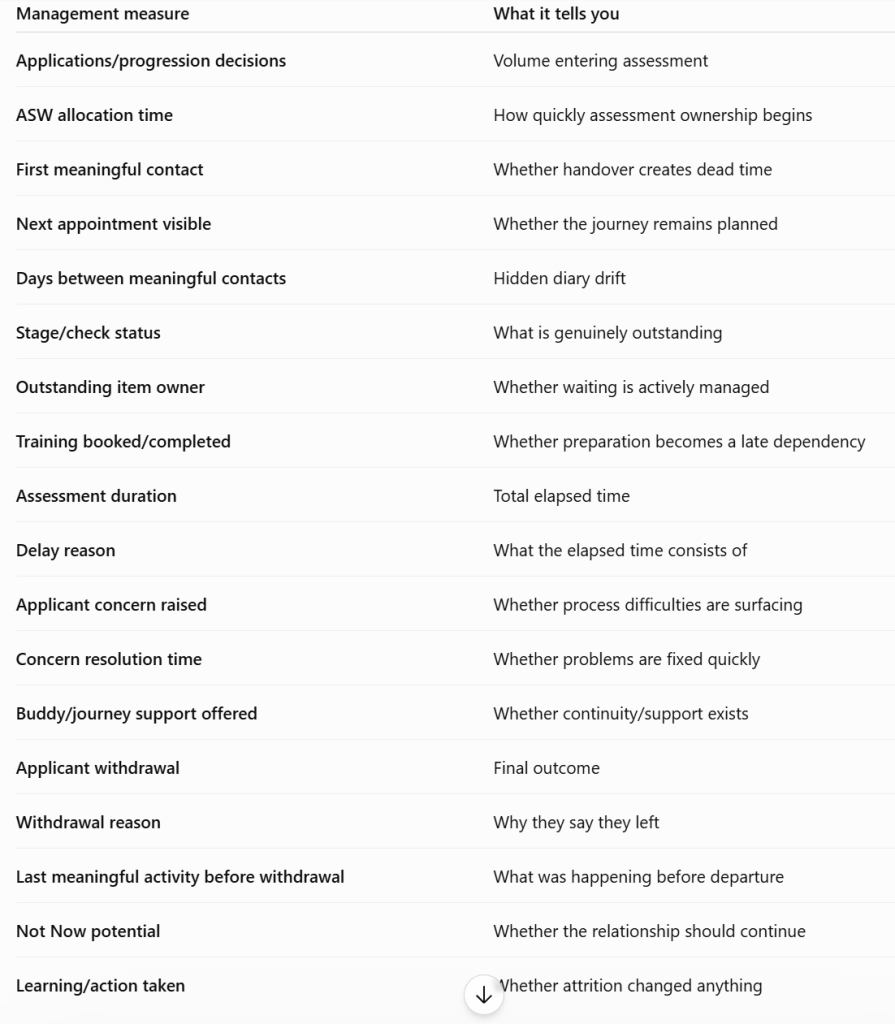
That is not assessment evidence.
It is management information about the recruitment journey.
DON'T ONLY MEASURE HOW MANY WITHDREW — MEASURE WHERE
This could reveal very different problems.
Imagine 40 applicant withdrawals.
Ten happen almost immediately after application.
Another eight after ASW allocation but before meaningful assessment begins.
Ten after several months.
Five immediately following preparation training.
Four after repeated diary disruption.
Three after professional assessment concerns arise.
The headline remains:
40 withdrawals.
The management implications are completely different.
So:
WHERE IN THE JOURNEY ARE PEOPLE LEAVING?
That should be routinely visible.
AND MEASURE WHEN
Suppose applicants commonly withdraw:
within two weeks of application.
That raises one set of questions.
Suppose withdrawal peaks around month four.
That raises another.
Suppose it happens after long contact gaps.
Another.
After training?
Another.
After particular external checks?
Another.
Immediately after specific professional issues arise?
Potentially entirely appropriate.
Time and stage create context.
THEN ASK WHY
The most important field still isn't:
withdrawal = yes/no.
It is:
WHY?
And the answer should not automatically be a dropdown chosen by somebody who never spoke to the applicant.
Where reasonably possible, obtain the applicant's own explanation.
Perhaps:
“Would you mind telling us what led to your decision? We aren't trying to persuade you to change it. We want to understand your experience.”
That sentence changes the purpose of the conversation.
DID THEY WITHDRAW FROM FOSTERING — OR FROM US?
Senior managers should particularly want to know this.
These are not equivalent:
“I've decided I don't want to Foster.”
and:
“I still want to Foster, but I don't want to continue with your organisation.”
The second raises competitive and organisational questions.
Where did they go?
Another LA?
An IFA?
A regional hub partner?
Did they restart elsewhere?
Why?
That information could be extremely valuable.
NOT NOW SHOULD NOT DISAPPEAR INTO WITHDRAWN
A household may stop because:
housing needs changing;
employment isn't currently viable;
health circumstances intervene;
family caring responsibilities arise;
a relationship changes;
or they simply need time.
That person may still want to Foster later.
The outcome could therefore be:
NOT NOW — AFTER APPLICATION.
If future contact is appropriate and consented, why throw away the relationship?
Point 70 should make sure senior management can distinguish temporary barriers from permanent disengagement.
APPLICANT-LED AND SERVICE-LED WITHDRAWALS MUST NOT BE BLENDED TOGETHER
Ofsted already distinguishes the two nationally.
Local management should go further.
Service-led withdrawal might arise because:
information indicates progression is inappropriate;
the service determines it cannot continue;
eligibility or circumstances change;
or another legitimate professional reason exists.
Applicant-led withdrawal may arise for completely different reasons.
If management analyses all withdrawals together, useful information disappears.
DON'T USE WITHDRAWAL DATA TO PRESSURE ASWs
This safeguard is essential.
Suppose one ASW appears to have more applicant withdrawals.
That fact alone proves nothing.
Their assessments may be:
more complex;
inherited later;
more challenging;
allocated differently;
or appropriately identifying concerns.
The correct sequence remains:
FIND THE VARIATION.
UNDERSTAND THE CONTEXT.
THEN ASK WHETHER THERE IS A SYSTEM ISSUE.
Withdrawal data is for learning.
It should not become an approval target.
THE ASW SHOULD NEVER THINK:
“I NEED TO KEEP THIS APPLICANT IN”
That would be dangerous.
The correct organisational message is:
Undertake the assessment rigorously.
Reach the appropriate professional judgement.
Communicate clearly.
Tell management when the process around you is obstructing progress.
Understand that the organisation also wants to learn from applicant experience.
That is fundamentally different from sales pressure.
SENIOR MANAGEMENT HAS TO OWN THE SYSTEM
This is probably the most important conclusion from Stage Seven.
It is easy to individualise failure.
Recruitment should have explained it better.
The ASW should have contacted them sooner.
Administration should have chased the check.
The applicant should have returned the document.
Training should have booked them.
The buddy should have noticed.
But when the same problems appear repeatedly:
THAT IS NO LONGER AN INDIVIDUAL PROBLEM.
IT IS A MANAGEMENT SYSTEM.
National Minimum Standard 25 already requires clear monitoring procedures, management review of records to identify patterns and trends, and immediate action where monitoring exposes concerns.
So senior management cannot reasonably say:
“We didn't know.”
if the organisation repeatedly generates the information but never joins it together.
THE GOVERNMENT IS MOVING IN EXACTLY THIS DIRECTION
The February 2026 Renewing Fostering plan explicitly says the current recruitment-hub model is too fragmented where hubs operate mainly as entry points and then pass applicants into individual local authorities.
Government now proposes an end-to-end approach extending through assessment and approval.
Its seven principles include:
a single front door;
a journey guide from enquiry to approval;
a regional assessment function;
and enhanced regional data.
The paper says many hubs already hold regular pipeline meetings with partner local authorities to track progress and identify delays.
That is extremely important for this Review.
The direction of travel is no longer simply:
GENERATE MORE ENQUIRIES.
It is:
UNDERSTAND THE WHOLE PIPELINE.
And that is precisely what Points 61–70 have been arguing.
CURRENT REFORM MAKES THIS A GOOD TIME TO REVIEW THE SYSTEM
There is another timely consideration.
As of 1 September 2026, the Department for Education is consulting on revised fostering standards and guidance, with the consultation due to close on 16 September 2026. The stated purpose is to simplify and update the national framework.
Services should obviously respond to whatever final regulatory framework emerges.
But senior managers do not need to wait for new guidance before asking:
Do we actually understand our applicant journey today?
That is an operational question they can answer now.
THE STAGE SEVEN MANAGEMENT REVIEW
I would recommend that senior managers periodically take a sample of completed and withdrawn applications and reconstruct the journey rather than relying entirely on headline reports.
For each one:
APPLICATION
What happened when they decided to proceed?
Was a separate form required?
How much information was repeated?
HANDOVER
How quickly was an ASW allocated?
Did the handover feel continuous?
INFORMATION
Could the ASW see what recruitment already knew?
What was unnecessarily collected again?
ROADMAP
Did the applicant understand the complete journey?
Were future meetings and training planned?
CHECKS
Were they initiated early?
Who owned outstanding items?
What was internal versus external delay?
ASSESSMENT TIME
What time was professionally necessary?
What time was organisational?
ASW SUPPORT
Did the practitioner have appropriate capacity, induction, supervision and recruitment context?
BUDDY/JOURNEY SUPPORT
Was the applicant still supported outside formal assessment?
DISENGAGEMENT
When did engagement first appear to change?
Did anyone notice?
REDRESS
If the applicant raised a problem, how quickly was it addressed?
WITHDRAWAL
Why did they leave?
Was the reason obtained from them?
FUTURE
Was this permanent withdrawal, appropriate closure or potentially Not Now?
LEARNING
What changed because of this case?
That is a senior-management review worthy of the name.
THREE QUESTIONS SHOULD FOLLOW EVERY WITHDRAWAL
If we stripped everything down to three questions, I would use these:
1. WHY DID THEY LEAVE?
Not just the system category.
The actual reason.
2. COULD OR SHOULD WE HAVE DONE ANYTHING DIFFERENTLY?
Sometimes the answer will be:
No.
And that's important.
3. WHAT HAVE WE LEARNED?
If the same avoidable reason occurs repeatedly without a change in process, the organisation is collecting data rather than using it.
WE SHOULD ALSO RECORD THE GOOD WITHDRAWALS
This may sound strange.
But a service should recognise when the process worked properly.
For example:
An applicant entered assessment.
Their understanding increased.
They reflected honestly.
They and the ASW concluded fostering wasn't right for them.
The decision was respectful.
They understood why.
Nobody was unnecessarily delayed.
They left with a positive view of fostering.
That is a much healthier outcome than forcing somebody towards panel because the organisation wants better conversion figures.
It might even leave them as a future supporter of fostering.
So:
WITHDRAWAL ≠ AUTOMATIC FAILURE.
That is exactly why we need better information.
THE REAL FAILURE IS NOT KNOWING
If a senior manager knows:
why applicants are leaving;
where;
when;
whether the reasons are appropriate;
which problems are systemic;
what is being changed;
and whether those changes work,
then management can make informed decisions.
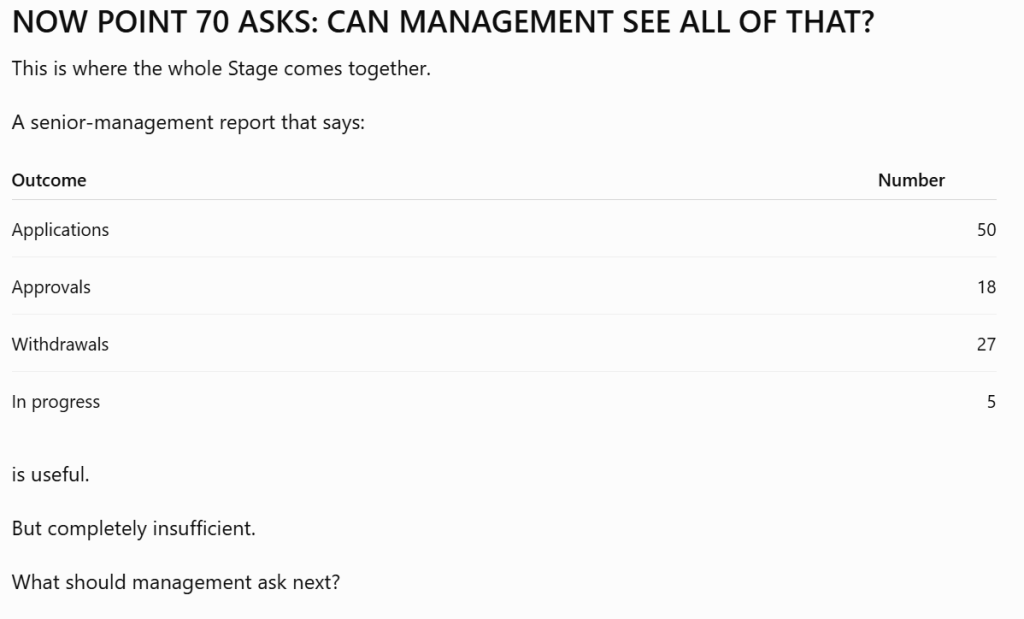
If the dashboard simply says:
27 withdrawn
the organisation is effectively flying blind.
That leads to one of the strongest principles of this entire Stage:
A WITHDRAWAL MAY BE ENTIRELY APPROPRIATE.
AN UNEXPLAINED PATTERN OF WITHDRAWALS IS A MANAGEMENT BLIND SPOT.
THE STAGE SEVEN BOARD QUESTION
At the next fostering management meeting, instead of asking:
“How many applications have we got?”
ask:
“TALK ME THROUGH THE PEOPLE WE LOST.”
Not as numbers.
As journeys.
Which were appropriate?
Which were Not Now?
Which were professional assessment outcomes?
Which chose somebody else?
Which encountered an organisational problem?
Which disappeared?
Which do we genuinely not understand?
And then:
WHAT ARE WE GOING TO DO DIFFERENTLY?
That could tell senior management considerably more about Foster Carer Recruitment than another marketing campaign report.
STAGE SEVEN — THE COMPLETE MODEL
This Stage has moved us from:
APPLICATION
to:
ASSESSMENT CONTINUITY
to:
APPLICANT EXPERIENCE
to:
MANAGEMENT ACCOUNTABILITY.
The principles across Points 61–70 now fit together:
Don't create unnecessary application barriers.
Don't drop the recruitment relationship.
Don't repeatedly collect information without purpose.
Give applicants a visible roadmap.
Manage checks rather than simply waiting.
Separate rigour from avoidable delay.
Keep appropriate lived-experience support alongside the applicant.
Notice disengagement before formal withdrawal.
Fix process problems quickly without interfering in professional assessment.
And finally:
MAKE SENIOR MANAGEMENT UNDERSTAND WHY PEOPLE LEAVE.
That closes the loop.
THIS IS NOT ABOUT TURNING SOCIAL WORK INTO SALES
This Stage has deliberately avoided that mistake.
The assessment must remain professionally rigorous.
The ASW's judgement remains independent.
Recruitment does not pressure.
Management does not chase an approval percentage.
The applicant is not “retained” regardless of evidence.
What we are saying is much simpler:
PROFESSIONAL RIGOUR DOES NOT REQUIRE ORGANISATIONAL INDIFFERENCE TO THE APPLICANT EXPERIENCE.
A fostering service can assess somebody properly and manage their journey properly.
Those objectives support one another.
AND THAT IS WHY ASSESSMENT ATTRITION BELONGS IN FOSTER CARER RECRUITMENT
It would be easy to say:
Recruitment ends at application.
But if 2,175 applicants nationally are recorded as choosing to withdraw from completed applications in a single reporting year, senior recruitment leadership cannot simply say:
“They're assessment's figures now.”
The professional assessment belongs to Social Work.
But the loss of an appropriate applicant remains relevant to Foster Carer Recruitment.
So the Stage Seven principle we established at the beginning survives intact:
THE ASW ASSESSES.
THE ORGANISATION STILL RECRUITS.
And Point 70 adds the final responsibility:
SENIOR MANAGEMENT MUST BE ABLE TO SEE BOTH.
HERE IS THE FINAL TEST FOR STAGE SEVEN
Can your senior management team answer these questions without asking somebody to manually investigate every case?
- How many people agreed to progress after Initial Visit but never actually entered assessment?
- How many applications are currently in assessment?
- How long are they taking?
- Where is the time actually being spent?
- How quickly are ASWs allocated?
- How large are the gaps between meaningful contacts?
- Which checks are outstanding and why?
- Is preparation training already planned?
- Do applicants know what happens next?
- Are application and recruitment records flowing properly into assessment?
- How much unnecessary repetition exists?
- How many applicants have raised concerns about the process?
- How quickly were those concerns addressed?
- Where are applicants beginning to disengage?
- How many applicants withdrew?
- How many were applicant-led versus service-led?
- What were the real reasons?
- How many still wanted to Foster?
- How many could reasonably be categorised as Not Now?
- What changes were made as a result?
If the answer to several of those questions is:
“We don't know.”
then that is probably the most important finding from Point 70.
STAGE SEVEN COMPLETE
This Stage began with somebody saying:
“Yes, I want to become a Foster Carer.”
It ends by asking whether the organisation understands what happened to them after that decision.
Some will be approved.
Some will appropriately stop.
Some will be stopped by the service for sound professional reasons.
Some circumstances will change.
But there may also be people who could have become excellent Foster Carers and who disappear through:
duplication;
delay;
poor handover;
uncertainty;
weak communication;
unmanaged checks;
loss of support;
or a process problem nobody fixed.
Those are the people senior management needs to be able to see.
Because:
“WITHDRAWN” IS AN OUTCOME CODE — NOT AN EXPLANATION.
A WITHDRAWAL MAY BE ENTIRELY APPROPRIATE.
AN UNEXPLAINED PATTERN OF WITHDRAWALS IS A MANAGEMENT BLIND SPOT.
And the final principle for Stage Seven: