POINT 69/100 — IF SOMETHING GOES WRONG DURING ASSESSMENT, CAN IT BE PUT RIGHT QUICKLY?
POINT 69/100 — IF SOMETHING GOES WRONG DURING ASSESSMENT, CAN IT BE PUT RIGHT QUICKLY?
Point 68 asked whether fostering services notice applicants becoming disengaged before they formally withdraw.
Point 69 asks what happens when they do.
Suppose the applicant tells you:
“I'm really struggling with this process.”
What happens next?
Does somebody respond quickly?
Can anyone actually do anything?
Or does the applicant receive:
“You can make a complaint if you want to.”
There absolutely needs to be a complaints process.
But a formal complaint should not be the only mechanism available for correcting an ordinary but potentially damaging problem in the applicant journey.
Because sometimes what is going wrong is very simple.
An appointment has been cancelled twice.
Nobody has arranged another one.
The applicant was told training would be booked but it wasn't.
A medical request appears to have disappeared.
Recruitment gave one timescale and assessment another.
An email hasn't been answered.
The applicant doesn't understand why something has changed.
Their Assessing Social Worker is away and nobody has explained what happens next.
None of those necessarily requires an investigation.
Some require:
SOMEONE TO TAKE OWNERSHIP AND SORT IT OUT.
THE NATIONAL STANDARDS ALREADY RECOGNISE THE APPLICANT'S RIGHT TO RAISE CONCERNS
There is an important existing foundation for this.
The current Fostering Services National Minimum Standards state:
current and prospective Foster Carers are able to make a complaint about any aspect of the service which affects them directly.
The standards also say records should be kept of representations and complaints, how they were dealt with, their outcomes and action taken, with those records reviewed so that practice can improve.
Standard 25 goes further on management.
Managers should monitor records to identify individual concerns, patterns and trends, and take immediate action to address issues identified through that monitoring.
That provides an important principle for this Review:
THE ORGANISATION SHOULD NOT NEED TO WAIT FOR WITHDRAWAL BEFORE IT RESPONDS TO A PROBLEM.
BUT DON'T TURN EVERY PROBLEM INTO A FORMAL COMPLAINT
Formal complaints have an important purpose.
Some issues absolutely require them.
But consider the applicant who says:
“My assessment meeting was cancelled three weeks ago and nobody has rearranged it.”
Do we really need to begin with:
“Here is our complaints procedure”?
Or can somebody simply say:
“That's not right. Let me find out what has happened and get back to you.”
Then actually do it.
Good organisations should be capable of informal resolution without defensiveness where that is appropriate.
Indeed, for independent fostering agencies, Regulation 18 specifically requires their complaints procedure to provide an opportunity for informal resolution at an early stage, although the regulatory scope of that provision is not identical to every prospective-applicant circumstance.
The broader operational lesson is useful:
FIX SIMPLE THINGS SIMPLY.
THERE ARE DIFFERENT TYPES OF PROBLEM
This is where services need to be careful.
Not everything an applicant dislikes is a service failure.
And not everything raised by an applicant belongs in the same process.
A useful distinction is:
1. PROCESS PROBLEM
For example:
appointment not arranged;
information lost;
training not booked;
wrong paperwork;
conflicting communications;
unexplained delay;
no response.
These may often be capable of rapid operational resolution.
2. RELATIONSHIP OR COMMUNICATION PROBLEM
For example:
the applicant feels conversations have become difficult;
they do not understand what is happening;
they feel they are not being listened to;
communication between applicant and service is deteriorating.
These may require management support, clarification or a facilitated conversation.
3. PROFESSIONAL ASSESSMENT MATTER
For example:
the applicant disagrees that an area needs further exploration;
the ASW has identified information or concerns relevant to suitability;
additional professional work is required.
This cannot simply be “fixed” by recruitment.
4. FORMAL COMPLAINT, CONDUCT OR SAFEGUARDING ISSUE
Some matters require the organisation's formal procedures and appropriate senior or safeguarding oversight.
Those distinctions protect everybody.
FIX THE PROCESS. DON'T INTERFERE WITH THE ASSESSMENT.
This needs to become the core professional boundary for Point 69.
Suppose an applicant says:
“My ASW wants to explore my previous relationship again and I don't think they should.”
The recruiter or journey contact should not say:
“I'll tell them to stop asking about it.”
That would be inappropriate.
The ASW owns the assessment.
But perhaps the applicant actually means:
“Nobody has explained why I'm being asked about it again and I'm beginning to think they haven't read anything I've already told the service.”
That may be partly a communication issue.
The response could instead be:
“Your ASW may have a professional reason for exploring that in greater depth. Would it help if we made sure that reason is explained clearly?”
The professional requirement remains intact.
The applicant experience improves.
That is the difference.
DISAGREEMENT DOES NOT AUTOMATICALLY MEAN SOMETHING HAS GONE WRONG
Assessment is not supposed to be comfortable at every point.
A rigorous ASW may challenge an applicant.
They may identify inconsistencies.
They may ask difficult questions.
They may require evidence the applicant does not particularly want to provide.
They may reach a view the applicant dislikes.
That does not automatically constitute poor applicant experience or bad practice.
A fostering service should therefore resist a dangerous interpretation:
“Applicant unhappy = ASW has done something wrong.”
Absolutely not.
Sometimes professional assessment is appropriately difficult.
The relevant question is:
IS THE DIFFICULTY PROFESSIONALLY NECESSARY — OR ORGANISATIONALLY CREATED?
APPLICANTS NEED TO FEEL SAFE RAISING A PROCESS CONCERN
This is one of the most important parts of Point 69.
Imagine being halfway through an assessment that determines whether you may be approved to Foster.
The person assessing you is part of the organisation whose process you want to complain about.
Would you feel completely comfortable raising a concern?
Perhaps.
Perhaps not.
An applicant may think:
“Will this count against me?”
Whether that fear is justified is almost secondary.
If they believe it, they may stay silent.
The organisation therefore needs to say clearly:
You are entitled to raise concerns about the service or process.
The National Minimum Standards explicitly envisage prospective Foster Carers being able to complain about aspects of the service affecting them.
That should translate into practice.
A PROCESS CONCERN SHOULD NOT AUTOMATICALLY BECOME ASSESSMENT EVIDENCE
This needs another careful boundary.
An applicant saying:
“I'm frustrated that nobody has contacted me for three weeks”
should not automatically be interpreted as:
“Applicant displays poor emotional regulation.”
Likewise, challenging an administrative error should not automatically become evidence that somebody is “difficult”.
Applicants should be able to question their journey.
Of course, situations can be more complicated.
How somebody behaves may sometimes genuinely become relevant to professional assessment.
The ASW cannot be instructed to ignore relevant information.
But the organisation should avoid casually collapsing:
raising a legitimate service concern
into:
evidence against suitability.
That would make honest applicant feedback almost impossible.
THE APPLICANT NEEDS SOMEWHERE ELSE TO GO
This connects with the journey owner introduced in Point 68.
During assessment the applicant should know:
My ASW is responsible for my professional assessment.
But also:
If I think the process itself isn't working, this is who I can contact.
That could be:
a recruitment manager;
a fostering team manager;
a journey guide;
a designated recruitment contact;
or another appropriate person.
The job title matters less than the function.
There needs to be somewhere to say:
“SOMETHING ISN'T WORKING. CAN SOMEONE LOOK AT THIS?”
THE FIRST RESPONSE MATTERS
An applicant raises a concern.
The worst initial responses include:
“That's just how assessment works.”
“You'll need to speak to your ASW.”
“We're very busy at the moment.”
“Everyone has to go through this.”
“If you want to complain, here's the link.”
All may contain some element of truth.
None necessarily addresses what the applicant actually said.
A stronger response begins with:
“Tell me what's happened.”
Then:
“Let me establish whether this is something we can resolve, something that needs management involvement, or something that belongs properly within your professional assessment.”
That is both applicant-centred and professionally safe.
ACKNOWLEDGE. UNDERSTAND. OWN. ACT. CLOSE THE LOOP.
A very simple rapid-redress model could be:
ACKNOWLEDGE
Confirm quickly that the concern has been heard.
UNDERSTAND
What exactly has gone wrong?
Process?
Communication?
Professional disagreement?
Something requiring formal escalation?
OWN
Who is responsible for the response?
The applicant should not be passed around the organisation.
ACT
Fix what can legitimately be fixed.
Escalate what requires escalation.
Explain what cannot be changed and why.
CLOSE THE LOOP
Go back to the applicant.
Don't assume the problem is solved because an internal action was taken.
Ask:
“Has that now resolved the issue you raised?”
That final step matters.
DON'T CONFUSE AN INTERNAL EMAIL WITH A RESOLUTION
Imagine the applicant says:
“I still don't have another assessment date.”
A manager emails the ASW.
Technically an action has occurred.
But unless another date is actually agreed, nothing has been resolved for the applicant.
This is a useful management discipline:
THE ACTION ISN'T COMPLETE UNTIL THE APPLICANT CAN SEE THE RESULT.
SPEED MATTERS WHEN THE PROBLEM IS FIXABLE
The Government's 2026 fostering plan emphasises responsive support, consistent points of contact and an end-to-end journey guide from enquiry to approval. It also highlights the need for pipeline oversight to identify delay.
That reinforces the logic of quick intervention.
If an applicant says on Monday:
“I'm thinking of stopping because nobody knows what is happening with my assessment,”
waiting two weeks to respond may make the response irrelevant.
Point 69 does not need to invent a statutory response time.
There isn't one universal national rapid-redress clock for this purpose.
But services could adopt their own internal expectations.
For example:
acknowledge quickly;
identify an owner immediately;
resolve simple operational issues within days rather than weeks;
and:
give the applicant a clear timescale where the issue is more complex.
The exact standard should be locally defined and then measured.
MAKE THE ESCALATION PROPORTIONATE
Not every issue requires the Head of Service.
A useful model might be:
LEVEL 1 — FIX IT
Simple process issue.
Named worker resolves it.
LEVEL 2 — RESET IT
Repeated problem, relationship breakdown or stalled journey.
Manager becomes involved and agrees a recovery plan.
LEVEL 3 — FORMALISE IT
Serious, unresolved or conduct-related concern.
Formal complaints, safeguarding or other relevant procedure.
The purpose is not to discourage formal complaints.
Applicants should retain that right.
The purpose is to prevent small, correctable problems from unnecessarily reaching Level 3 simply because nobody acted at Level 1.
A MANAGER SHOULD BE ABLE TO RESET THE JOURNEY
Suppose the problem is not one individual error.
The assessment has simply drifted.
Three appointments have moved.
Training has slipped.
Checks are outstanding.
Nobody is sure what happens next.
A manager may need to perform a journey reset.
Bring together the relevant people.
Establish:
what is completed;
what is outstanding;
what is professionally required;
what has gone wrong;
who owns each action;
what dates can now be agreed;
what the applicant needs;
and when progress will be reviewed.
Then tell the applicant.
This is not changing professional assessment.
It is restoring organisational control around it.
SOMETIMES THE RELATIONSHIP ITSELF MAY NEED REPAIR
This is sensitive.
An applicant and ASW may sometimes struggle to establish an effective working relationship.
That does not automatically mean either person is at fault.
Assessment can involve difficult material.
Different communication styles can clash.
An applicant may feel misunderstood.
The ASW may feel important professional issues are being resisted.
A manager should not immediately respond by reallocating every applicant who dislikes being challenged.
That would undermine assessment.
But neither should a relationship be allowed to deteriorate without anyone examining whether it can be repaired.
Possible responses might include:
clearer explanation;
supervision;
a manager-supported conversation;
agreement about communication;
or, in unusual circumstances and where organisationally appropriate, consideration of whether a different arrangement is necessary.
Again:
REPAIR WHERE POSSIBLE. DON'T PRE-JUDGE THE ASSESSMENT.
SUPERVISION IS PART OF THE SAFETY NET
This connects directly with our earlier discussion about ASW investment.
The National Minimum Standards require staff to receive appropriate support and regular supervision.
That matters here.
If an applicant relationship is deteriorating, the ASW should also have somewhere professionally safe to reflect on it.
The answer isn't:
“The applicant complained, therefore the ASW is the problem.”
Nor:
“The ASW is the professional, therefore the applicant must be wrong.”
Good management considers:
what has happened;
what professional work is required;
what communication may improve;
whether organisational factors are contributing;
and what support both the assessment and applicant journey need.
THIS IS WHY NEW ASWs NEED MORE THAN TECHNICAL FORM F KNOWLEDGE
The Stage Seven workforce principle becomes especially relevant here.
An ASW entering fostering practice may receive excellent technical support in conducting a Form F.
But are they also told:
what happens when an applicant becomes dissatisfied?
who manages process concerns?
what the service's withdrawal patterns look like?
how applicant complaints and feedback are used?
how to distinguish a recruitment-process concern from professional assessment?
and when management should become involved?
If not, everyone may improvise.
And where people learn mainly through:
“Ask one of the other ASWs what we normally do,”
local practice can reproduce itself without management necessarily knowing whether it is working.
This is why:
MANAGEMENT NEEDS TO DESIGN THE RESPONSE — NOT LEAVE IT TO PERSONAL STYLE.
COMPLAINTS SHOULD PRODUCE LEARNING, NOT JUST CLOSURE
The National Minimum Standards are explicit that complaint records should be reviewed so service practice can improve, and that managers should identify patterns and trends.
That matters.
Suppose five applicants in a year complain about:
long gaps between assessment appointments.
If each complaint is resolved individually but the underlying scheduling model remains untouched, the organisation has dealt with complaints.
It has not learned from them.
Similarly:
three complaints about contradictory information;
four about difficulty getting responses;
several applicants worrying that raising concerns could prejudice their assessment.
Those are patterns.
Senior management should see them.
CONNECT COMPLAINTS TO WITHDRAWAL DATA
This is where Point 69 becomes particularly important to Foster Carer Recruitment.
Don't keep:
complaints data
over here,
and:
withdrawal data
over there.
Ask whether they intersect.
For example:
How many applicants who withdrew had previously raised a concern?
What was the concern?
Was it resolved?
How quickly?
Did they say it contributed to leaving?
How many people raised similar issues but remained?
Do certain process concerns recur?
Did a complaint expose something subsequently fixed for everybody else?
That becomes meaningful recruitment intelligence.
AND REMEMBER THE SCALE OF ATTRITION
Ofsted recorded 5,370 fostering applications as completed during 2024–25.
Of those:
2,050 — 38% — were approved.
3,290 — 61% — were withdrawn.
30 — 1% — were rejected.
Of the withdrawn applications, 2,175 were applicant-led.
As throughout Stage Seven, those figures are reporting-year flows rather than a single cohort and many withdrawals are entirely appropriate.
The issue is not that every complaint leads to withdrawal.
There is no evidence supporting that claim.
The issue is that where applicant attrition is this significant, a service should not allow a known and fixable process problem to sit unresolved while somebody decides whether to continue.
THE 20% FIGURE MAKES RAPID REDRESS PARTICULARLY RELEVANT
Among applications started in-year and withdrawn by the applicant before year-end, Ofsted reported that 20% recorded the fostering process not being what the applicant expected.
Again, we cannot assume a rapid-redress system would have prevented those withdrawals.
But we can ask:
When somebody tells us:
“This process isn't what I expected,”
what happens?
Is that simply logged?
Or does somebody ask:
“Which part?”
Then:
“Is this something intrinsic to rigorous Foster Carer assessment that we need to explain properly — or is there an organisational problem we could put right?”
That distinction could be enormously valuable.
SOMETIMES THE ANSWER WILL BE: WE CANNOT CHANGE THAT
Good applicant support also requires honesty.
The applicant may say:
“I don't want my previous relationships discussed.”
If that information is professionally relevant to assessment, the organisation cannot simply remove it to retain them.
The response may need to be:
“I understand why that feels difficult, but this is part of what the assessment needs to explore. What we can do is make sure you understand why and that the discussion is handled appropriately.”
That is not failure to resolve the complaint.
It is clarity.
RAPID REDRESS DOES NOT MEAN THE APPLICANT ALWAYS GETS THE OUTCOME THEY WANT.
It means they receive a timely, clear and properly owned response.
SOMETIMES THE ANSWER SHOULD BE: YES, WE GOT THAT WRONG
Organisations also need to be able to say this.
“We should have contacted you sooner.”
“That training date should have been booked.”
“You shouldn't have had to provide that information again.”
“We gave you inconsistent information.”
“We didn't manage that handover well.”
Then:
“This is what we're doing about it.”
A defensive organisation turns a small error into a relationship problem.
An accountable organisation can sometimes strengthen trust by acknowledging the error and fixing it.
DON'T PROMISE A COMPLAINT CAN'T AFFECT ANYTHING
We should be precise here.
A service should reassure applicants that they are entitled to raise concerns and should not be disadvantaged merely for doing so.
But it would be too absolute to promise that nothing discussed during a concern could ever become relevant to assessment.
Sometimes the substance of an interaction may genuinely intersect with professional issues.
The safeguard is not pretending those domains can never overlap.
The safeguard is:
transparent professional reasoning;
appropriate supervision;
clear recording;
and:
not treating the mere act of complaining as evidence of unsuitability.
That is a much more defensible standard.
HERE IS THE TEST…
Take every complaint, concern or significant expression of dissatisfaction raised by prospective Foster Carers during assessment over the last 12 months.
Then ask:
1. ACCESS TEST
Did the applicant know who they could speak to other than their ASW?
2. SAFETY TEST
Did they appear comfortable raising the concern?
Or did they worry that doing so might affect assessment?
3. RESPONSE TEST
How quickly was the concern acknowledged?
4. OWNER TEST
Was one person clearly responsible for resolving it?
5. CATEGORY TEST
Was it correctly understood as:
process;
communication;
professional assessment;
formal complaint;
or safeguarding/conduct?
6. RESOLUTION TEST
Was the actual problem resolved?
Not merely discussed internally.
7. PROFESSIONAL-BOUNDARY TEST
Did anybody attempt to influence legitimate assessment activity simply to keep the applicant happy?
8. APPLICANT-FEEDBACK TEST
Was the outcome explained to the applicant?
9. LOOP-CLOSURE TEST
Did somebody check that they understood the response and knew what happened next?
10. SPEED TEST
Did a simple fix take days — or weeks?
11. PATTERN TEST
Have other applicants raised the same issue?
12. WITHDRAWAL TEST
Did the applicant subsequently withdraw?
If yes, did the unresolved or resolved concern play any part?
13. LEARNING TEST
What changed as a result?
If the answer is:
nothing
then the complaints process may be closing cases rather than improving recruitment.
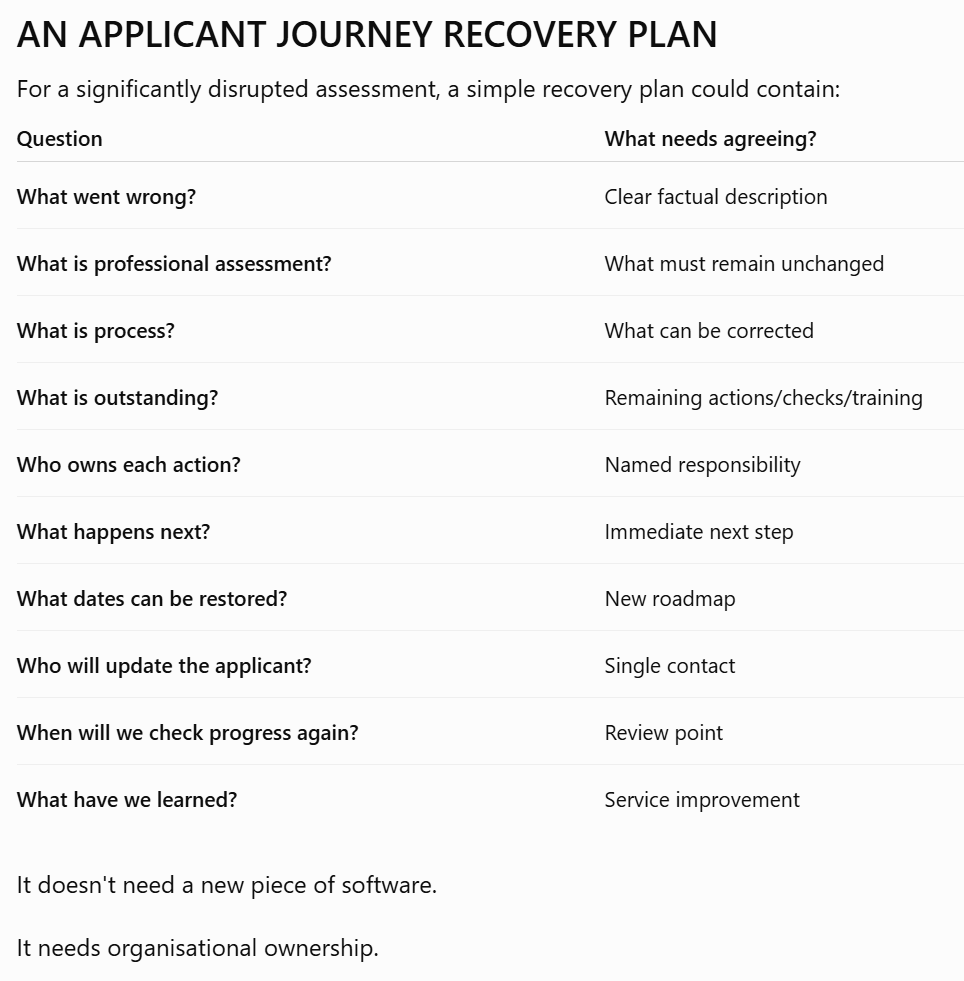
It doesn't need a new piece of software.
It needs organisational ownership.
RAPID REDRESS IS NOT ABOUT CUSTOMER SERVICE LANGUAGE
Some professionals may dislike terminology that sounds commercial:
service recovery
customer complaint
retention intervention
We don't need it.
This is simply good management of a prospective Foster Carer's journey.
The person is voluntarily giving an organisation extensive access to their private life because they are considering caring for children.
If the organisation gets something wrong, it should be capable of addressing it properly.
That is not sales.
It is respect.
THE BEST COMPLAINT MAY BE THE ONE THAT NEVER NEEDS TO BECOME FORMAL
Not because the organisation suppresses it.
Because somebody listened early.
An error was recognised.
An appointment was rebooked.
The applicant understood what was happening.
The journey restarted.
And where formal complaint is required, the applicant knows they can use it.
The goal is not:
fewer recorded complaints at any cost.
A low complaints number can simply mean people don't feel able to complain.
The better goal is:
PROBLEMS SURFACE EARLY AND ARE DEALT WITH PROPERLY.
DON'T DEFEND THE PROCESS BEFORE YOU UNDERSTAND THE PROBLEM
That might be the simplest lesson in Point 69.
The applicant says:
“This isn't working.”
Before explaining policy...
Before defending the ASW...
Before sending them a complaints form...
Before deciding they're being difficult...
Ask:
“WHAT HAS HAPPENED?”
Then determine what kind of issue it is.
Then respond.
The principles for Point 69 are:
FIX THE PROCESS. DON'T INTERFERE WITH THE ASSESSMENT.
PROBLEMS SHOULD SURFACE EARLY AND BE DEALT WITH PROPERLY.
THE ACTION ISN'T COMPLETE UNTIL THE APPLICANT CAN SEE THE RESULT.
And:
DON'T LET A FIXABLE PROBLEM BECOME A WITHDRAWAL.
Point 70 will complete Stage Seven by moving all of this to senior management: