POINT 68/100 — WHO IS WATCHING FOR ASSESSMENT DROPOUT BEFORE IT HAPPENS?
POINT 68/100 — WHO IS WATCHING FOR ASSESSMENT DROPOUT BEFORE IT HAPPENS?
There is a problem with the word:
WITHDRAWN.
It appears definitive.
An applicant was progressing through Foster Carer assessment.
Then they weren't.
The database changes status.
The application closes.
A withdrawal reason may be recorded.
Management eventually sees the number.
But that raises a much more important question:
WHEN DID THAT APPLICANT ACTUALLY START LEAVING?
It may not have been the day they formally withdrew.
It could have started weeks earlier.
That is the issue behind Point 68.
DROPOUT IS AN EVENT. DISENGAGEMENT CAN BE A PROCESS.
Imagine an applicant who has been enthusiastic throughout recruitment.
They replied quickly.
They attended appointments.
They completed actions.
They asked questions.
They engaged with their Foster Carer buddy.
Assessment begins.
Then things start changing.
A meeting is cancelled and another isn't immediately booked.
A check takes longer than expected.
The applicant has to repeat information.
Their preparation training date moves.
They send an email and wait several days for a response.
Their next ASW meeting is three weeks away.
Nothing individually looks catastrophic.
Then they begin responding more slowly.
They miss a call.
They say:
“I'm not sure about all this anymore.”
Then:
“We'll have to think about whether we want to continue.”
Eventually:
“We've decided to withdraw.”
At which point the organisation records:
Applicant withdrew.
But the withdrawal may have been developing for weeks.
THE NATIONAL NUMBERS MAKE THIS IMPORTANT
Ofsted recorded 5,370 fostering applications as completed during 2024–25.
Of these:
2,050 — 38% — were approved.
3,290 — 61% — were withdrawn.
30 — 1% — were rejected.
Among those 3,290 withdrawals:
2,175 — 66% — were applicant-led.
1,115 — 34% — were service-led.
As throughout Stage Seven, these are reporting-year flows, not a single cohort of applicants followed neatly from application to outcome.
Many withdrawals will also be appropriate.
Circumstances change.
Some people realise fostering isn't right for them.
Professional assessment may reveal issues that properly affect progression.
An applicant is entitled to change their mind.
But the scale of withdrawal means senior management should want to understand much more than the final status.
And Ofsted provides another important clue.
Among applications started during the year and withdrawn by applicants by year-end, 20% recorded the fostering process not being as the applicant expected.
That does not mean those applicants should necessarily have continued.
It certainly doesn't tell us that poor practice caused every one of those withdrawals.
But it gives us a reason to ask:
DID WE KNOW THEY WERE BECOMING UNHAPPY BEFORE THEY LEFT?
DfE RESEARCH IDENTIFIED THE SAME DATA PROBLEM
The Department for Education's 2023 qualitative research found that fostering services tended to collect substantial quantitative recruitment information:
enquiries;
applications;
withdrawals;
approvals.
But much less qualitative information was collected explaining why prospective Foster Carers failed to progress or withdrew after application.
The research contains an especially important observation.
Some of the most useful information about why people withdraw is already being heard in conversations between staff and prospective Foster Carers.
But it can become:
buried in case notes;
recorded somewhere separate;
or:
not recorded at all.
That should make senior managers uncomfortable.
The organisation may actually have the answer.
It just cannot see it.
“WITHDRAWN” IS AN OUTCOME CODE — NOT AN EXPLANATION
This principle has appeared several times during Stage Seven, and Point 68 is where it becomes operational.
If your management report says:
12 applicant withdrawals this quarter
you know what happened.
You don't necessarily know why.
And even if a withdrawal reason is recorded, you may still not understand the journey towards it.
For example:
“Changed mind about fostering.”
What happened before they changed their mind?
“Process wasn't what they expected.”
What part?
“Personal circumstances.”
Was the change temporary?
Could they have become a Not Now rather than disappearing permanently?
“Stopped responding.”
What happened immediately before they stopped responding?
The outcome needs a story behind it.
DON'T WAIT FOR PEOPLE TO ANNOUNCE THAT THEY ARE DISENGAGING
People rarely say:
“I am now entering the early stages of recruitment attrition.”
They communicate differently.
Perhaps:
“This is taking forever.”
“I thought we'd be further on by now.”
“Why am I being asked this again?”
“Nobody seems to know what's happening.”
“I'm not sure my partner wants to carry on.”
“I didn't realise assessment would be like this.”
“Maybe now isn't the right time.”
Or sometimes there is no statement at all.
Behaviour changes.
Responses become slower.
Appointments become harder to arrange.
Training is missed.
Documents remain outstanding.
Engagement with the buddy reduces.
The applicant stops asking questions.
None of those individually proves an applicant is about to withdraw.
But they can justify a conversation.
THESE ARE ENGAGEMENT SIGNALS — NOT ASSESSMENT EVIDENCE
This distinction is absolutely essential.
An applicant taking two days longer to answer an email does not become evidence that they lack commitment.
Missing a training session does not automatically say something about suitability.
Feeling frustrated with the assessment does not make somebody a poor prospective Foster Carer.
Questioning the process should not count against them.
So Point 68 is not proposing another assessment tool.
It is not an applicant risk score.
It is not surveillance.
It is not a mechanism for the ASW to record:
“Applicant appears insufficiently committed.”
The correct principle is:
AN ENGAGEMENT SIGNAL SHOULD TRIGGER A CONVERSATION — NOT A JUDGEMENT.
That distinction must be protected.
SO WHAT MIGHT WE NOTICE?
Rather than creating another bureaucratic checklist, services could agree a handful of journey signals that warrant contact.
For example:
NO NEXT DATE
An assessment meeting ends without another meaningful action or appointment being identified.
AN UNUSUALLY LONG CONTACT GAP
The applicant moves beyond the contact interval the service would normally expect without explanation.
REPEATED CANCELLATION
Appointments are repeatedly cancelled by either side and momentum begins to disappear.
SLOWER OR CHANGED ENGAGEMENT
A previously responsive applicant becomes unusually difficult to reach.
TRAINING DISENGAGEMENT
Preparation training is missed, cancelled or repeatedly deferred.
UNCOMPLETED ACTIONS
Information previously being returned promptly starts remaining outstanding.
EXPRESSED FRUSTRATION
The applicant says something such as:
“This isn't what I expected.”
PROCESS CONFUSION
The applicant no longer seems clear about what happens next or why something is happening.
RELATIONSHIP DIFFICULTY
The applicant indicates that something about their relationship with the service is affecting their confidence.
BUDDY CONCERN
The applicant tells their Foster Carer buddy that they are considering stopping because of the journey.
Again:
NONE OF THESE MEANS “UNSUITABLE”.
They mean:
perhaps somebody should ask how things are going.
ASK THE QUESTION BEFORE THEY WITHDRAW
The intervention doesn't need to be sophisticated.
A simple call might begin:
“You've been going through assessment for a while now. I wanted to check in separately from the assessment itself. How is the process feeling from your side?”
Then listen.
Perhaps everything is fine.
Perhaps they've simply been busy.
Perhaps something genuinely has changed and they no longer want to Foster.
But perhaps they say:
“Actually, I'm getting really frustrated.”
Now there is something to understand.
Not persuade away.
Understand.
THE PURPOSE ISN'T TO TALK PEOPLE OUT OF LEAVING
This needs to be explicit.
If an applicant wants to withdraw, they are allowed to withdraw.
There should be no pressure.
No guilt.
No:
“We've invested so much time in you.”
No attempt to protect conversion statistics.
And certainly no suggestion that expressing doubt could affect their assessment.
Sometimes the right answer is:
“It sounds as though stopping is right for you.”
Sometimes it is:
“Would you prefer to pause rather than close this completely?”
And sometimes it may be:
“What you've described is something the organisation can put right. Would you like us to try?”
The objective isn't retention at all costs.
It is:
DON'T LOSE SOMEONE THROUGH A FIXABLE PROBLEM WITHOUT EVEN KNOWING THERE WAS A PROBLEM.
DID THEY WITHDRAW FROM FOSTERING — OR FROM OUR PROCESS?
This remains one of the strongest questions in Stage Seven.
If someone says:
“We've realised fostering isn't right for our family.”
that is one thing.
If they say:
“We still want to Foster, but we can't continue with this process.”
that is another.
And if they simply disappear?
Find out where possible.
The organisation needs to know the difference.
WHO SHOULD BE WATCHING?
This is where responsibility can become blurred.
The ASW might assume recruitment is no longer involved.
Recruitment might assume the ASW now owns everything.
Administration sees outstanding information but not the applicant relationship.
The buddy hears frustration but doesn't know where it should go.
Management sees the withdrawal only after the case closes.
Everyone has a piece.
Nobody has the whole picture.
So there needs to be a clear answer to:
WHO OWNS THE APPLICANT JOURNEY DURING ASSESSMENT?
Not the assessment.
The journey.
THE ASW SHOULD NOT HAVE TO CARRY THIS ALONE
Point 66 established the danger of making every systemic issue the responsibility of individual Assessing Social Workers.
Point 68 is no different.
The ASW will undoubtedly notice changes in applicant engagement.
But they are simultaneously undertaking the professional assessment.
That relationship may itself be part of what the applicant wants to discuss.
So services should consider retaining some independent journey contact.
That could be:
a recruitment worker;
a recruitment manager;
a dedicated journey guide;
or another clearly nominated person.
The exact structure can vary.
The principle is:
SOMEBODY OUTSIDE THE ASSESSMENT JUDGEMENT SHOULD STILL BE ABLE TO ASK:
“HOW IS THE JOURNEY GOING?”
THIS PROTECTS THE ASW TOO
There is a professional advantage here.
Suppose an applicant is unhappy with the assessment.
If their only route is the ASW themselves, they may feel uncomfortable saying:
“I'm struggling with the way this is being handled.”
They may fear — rightly or wrongly — that complaining could somehow influence the assessment.
Providing a separate journey contact enables a distinction between:
concern about professional assessment judgement
and:
concern about the experience or administration of the process.
That protects professional assessment independence.
THE BUDDY MAY HEAR IT FIRST — BUT THE BUDDY ISN'T THE MONITOR
Point 67 becomes relevant immediately.
A trusted Foster Carer buddy may hear:
“I'm thinking of packing this in.”
But we must not turn the buddy into an intelligence channel.
The buddy should not routinely send private applicant conversations back to the assessment team.
Instead, they can say:
“Would you like somebody from the service to contact you about what's happening?”
With the applicant's agreement, that may create the bridge.
Serious safeguarding concerns remain subject to the separate boundaries described in Point 67.
But ordinary frustration is not safeguarding information.
And it is not assessment evidence.
THE RECRUITER CAN ALSO PROVIDE CONTINUITY
This is another reason Point 62 argued against recruitment abandonment at assessment.
The recruiter may already know the applicant well.
A brief periodic check-in can feel very different from another professional assessment conversation.
Perhaps:
“I know Sarah is leading your assessment now. I'm just checking that the overall journey is working as we told you it would.”
That single question could reveal something important.
BUT DON'T CREATE ANOTHER PERSON WHO KEEPS CALLING THEM
There is an obvious danger.
In trying to improve support, services can create more contact points and more confusion.
Recruitment calls.
ASW calls.
Administration calls.
Buddy calls.
Training team calls.
Manager calls.
The applicant starts wondering who actually owns anything.
So the answer is not more contact.
It is:
COORDINATED CONTACT.
The applicant should know who:
assesses them;
supports them;
manages the journey;
and handles a problem.
Four different functions do not necessarily require four competing relationships.
USE A VERY SIMPLE ENGAGEMENT CHECK
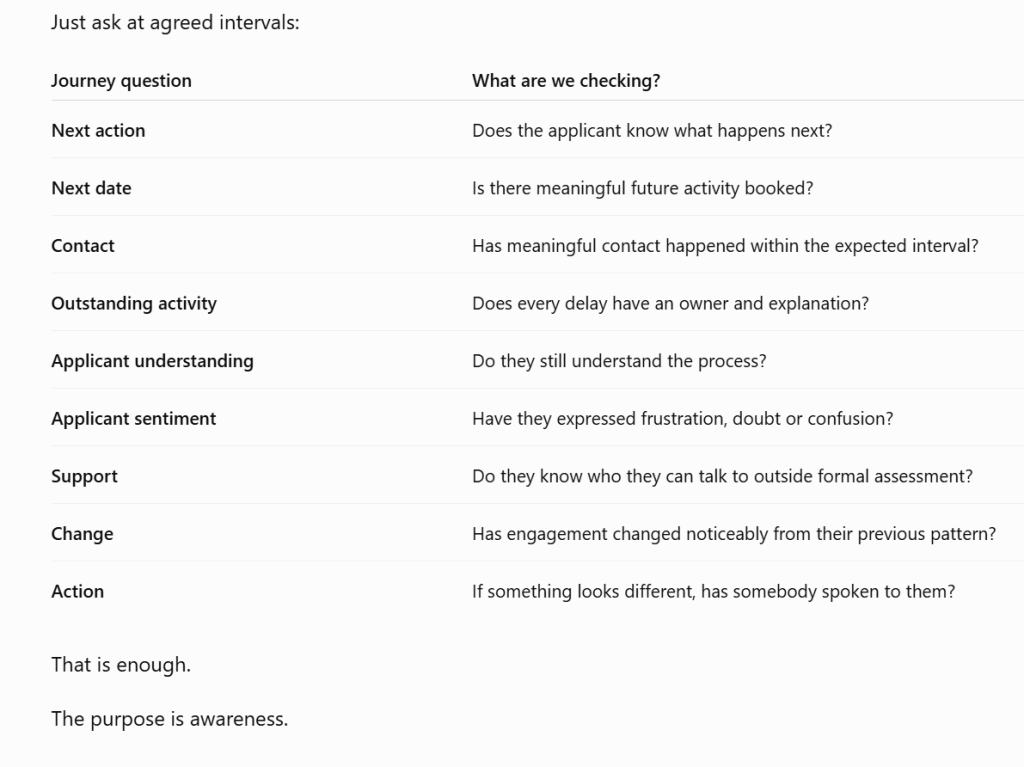
A useful management approach could be a small Applicant Journey Check.
No numerical score.
No suitability rating.
No complicated dashboard.
GREEN, AMBER AND RED — BUT NOT FOR THE APPLICANT
If a service already uses RAG reporting, it could apply that to the journey, rather than to the person's suitability.
GREEN
Journey progressing as expected.
Meaningful next actions agreed.
AMBER
Potential process drift or engagement change.
Conversation required.
RED
Applicant has indicated they may withdraw, major process breakdown exists or there has been prolonged unexplained inactivity.
Immediate management contact required.
Notice what is being rated.
Not:
“Is this a good applicant?”
But:
“Is this recruitment journey functioning?”
That distinction is fundamental.
DON'T WAIT FOR A MONTHLY MANAGEMENT MEETING
If an applicant says on Tuesday:
“I'm seriously thinking of withdrawing because nobody has told me what's happening,”
the answer cannot be:
“We'll discuss the pipeline at next month's meeting.”
There should be an immediate route.
The service needs a clear expectation around who responds when a potential avoidable withdrawal becomes visible.
Not to persuade them to stay.
To understand what has happened quickly enough that, if it is fixable, it can be fixed.
GOVERNMENT POLICY IS MOVING TOWARDS PIPELINE VISIBILITY
This aligns closely with the Government's current direction.
Renewing Fostering says many existing regional hubs already hold regular pipeline-data meetings with partner local authorities to track applicant progression and identify delays.
The proposed expanded model includes enhanced regional data and a journey guide from enquiry to approval, specifically designed to provide responsive, dedicated support across the pathway.
That is significant.
The emerging model isn't simply interested in how many applicants reach each destination.
It is increasingly interested in whether somebody is actively following their movement through the pipeline.
Point 68 takes that principle one stage further:
DON'T ONLY TRACK WHERE THEY ARE.
NOTICE WHEN THEY STOP MOVING.
DATA WITHOUT CONVERSATION WON'T SOLVE THIS
Technology can flag:
no contact in 21 days;
appointment cancelled twice;
training incomplete;
check outstanding;
documents overdue.
Useful.
But technology cannot reliably tell you:
why.
The applicant may be:
losing confidence;
on holiday;
dealing with bereavement;
worried about money;
concerned about an assessment question;
confused;
thinking of another provider;
or completely fine.
That requires conversation.
This is why the DfE's finding about qualitative data is so important.
Numbers tell you:
what happened.
Conversation helps tell you:
why.
DON'T COLLECT MORE DATA THAN YOU WILL USE
There is another warning from the same DfE research.
Participants described the challenge of collecting substantial volumes of data without sufficient resource or engagement to analyse it, including limited engagement from strategic leadership.
So Point 68 is not recommending 35 new tracking fields.
If nobody uses them, they add administrative burden and achieve nothing.
Choose a small number of indicators that trigger action.
Then act.
WITHDRAWAL SHOULD TRIGGER A QUICK LEARNING CONVERSATION WHERE POSSIBLE
Sometimes early intervention will not change the outcome.
The applicant still withdraws.
At that point, the organisation has another opportunity.
Ask:
“Would you be willing to tell us what led to your decision?”
The purpose is not to challenge it.
It is to learn.
And where possible, don't rely entirely on the ASW to conduct that conversation.
If the applicant's experience of assessment contributed to their decision, they may be more candid with someone who was not assessing them.
The DfE research specifically identified a desire among fostering services for more qualitative information about withdrawals following application because quantitative data alone does not explain the story behind the numbers.
THE LANGUAGE OF WITHDRAWAL MATTERS
Instead of a single:
Applicant withdrew
services might want to understand whether the outcome was broadly:
Informed decision that fostering isn't right
Household circumstances changed
Temporary barrier / potential Not Now
Professional concern influenced progression
Applicant experience/process concern
Relationship/communication issue
Delay
Chose another provider
Financial viability
Unknown
This is not intended as a replacement for statutory or Ofsted reporting categories.
It is local management intelligence.
One applicant may have several interacting reasons.
The point is to understand, not simplify.
NOT NOW STILL MATTERS AFTER APPLICATION
Earlier stages of this Review established that not everybody who cannot progress today should be lost permanently.
That remains true here.
An applicant's circumstances might change during assessment.
Employment.
Housing.
Illness within the family.
Relationship circumstances.
Caring responsibilities.
Financial pressures.
Sometimes withdrawing may be appropriate.
But the journey outcome might actually be:
NOT NOW.
If so, do they disappear?
Or is there an agreed, consented future contact point?
The investment and relationship developed during assessment need not automatically be thrown away.
ASWs NEED TO KNOW WHY THIS MATTERS — WITHOUT BEING MADE RESPONSIBLE FOR CONVERSION
This connects back to our Stage Seven workforce theme.
If Assessing Social Workers are never shown:
local withdrawal rates;
common applicant feedback;
where applicants disengage;
or the recruitment challenge facing the service,
there is no reason to assume they will naturally view early disengagement through that wider organisational lens.
That isn't a training deficiency in the individual.
It is an induction and management question.
The principle remains:
RECRUITMENT AWARENESS WITHOUT RECRUITMENT PRESSURE.
The ASW should understand why applicant experience matters.
They should never be pressured to preserve applications or approval rates.
AN EXPRESSED DOUBT SHOULD BE SAFE
This is critical.
If applicants believe saying:
“I'm finding this difficult”
will be interpreted as:
“I am not resilient enough to Foster”
they may simply say nothing.
That would make early intervention impossible.
Services therefore need to distinguish between an applicant expressing normal uncertainty or frustration about the process and evidence relevant to professional assessment.
Of course, information may sometimes overlap with matters legitimately requiring professional exploration.
The ASW must retain their professional judgement.
But organisations should avoid creating a culture where applicants feel they must appear relentlessly positive throughout assessment.
DOUBT IS NOT AUTOMATICALLY DISENGAGEMENT.
FRUSTRATION IS NOT AUTOMATICALLY UNSUITABILITY.
HERE IS THE TEST…
Take your last 20 applicant withdrawals.
Not just the final record.
Reconstruct the previous eight weeks.
1. WHEN DID ENGAGEMENT FIRST CHANGE?
Can you identify a point?
2. WHAT HAPPENED IMMEDIATELY BEFORE IT?
Cancellation?
Delay?
Difficult assessment session?
Check problem?
Training?
Nothing obvious?
3. WHEN WAS THE LAST MEANINGFUL CONTACT?
How long before formal withdrawal?
4. WAS THERE A FUTURE DATE IN THE DIARY?
Or had the roadmap disappeared?
5. DID THE APPLICANT EXPRESS CONCERN BEFORE WITHDRAWING?
Who heard it?
Where was it recorded?
6. DID ANYBODY ASK HOW THE JOURNEY WAS FEELING?
Before they left?
7. WHO OWNED THAT CONVERSATION?
Was it clear?
8. DID THE BUDDY KNOW THEY WERE STRUGGLING?
If so, did the applicant want help accessing the organisation?
9. WAS THERE AN ORGANISATIONAL PROBLEM THAT COULD HAVE BEEN FIXED?
If yes, was it?
10. WAS WITHDRAWAL ENTIRELY APPROPRIATE?
Record that too.
The purpose isn't to label every withdrawal a failure.
11. COULD THIS HAVE BEEN A NOT NOW?
If circumstances changed, was future contact appropriate and agreed?
12. WHAT REASON DID WE RECORD?
Was it actually meaningful?
Or simply:
“Applicant withdrew.”
13. WHAT DID WE LEARN?
Did anything change as a result?
If the same reason appears repeatedly and nothing changes, the organisation isn't learning from attrition.
CREATE A VERY SIMPLE ESCALATION ROUTE
A practical model might be:
SIGNAL
Something about the journey or engagement changes.
↓
CHECK
Named journey contact speaks to the applicant.
↓
UNDERSTAND
Is this:
normal variation;
a personal circumstance;
a professional assessment matter;
or an organisational process problem?
↓
ACT
Fix what can legitimately be fixed.
Clarify what cannot.
Respect the applicant's decision.
↓
LEARN
If they withdraw, understand why and feed useful learning back into management.
No complicated bureaucracy.
Just a response before the applicant disappears.
THE GOAL ISN'T ZERO WITHDRAWALS
That would be the wrong metric.
Some withdrawals demonstrate that the process is working.
People learn.
Circumstances change.
Assessment reveals complexity.
Applicants make informed choices.
The goal is:
ZERO UNEXAMINED WITHDRAWALS.
Not because every withdrawal requires an investigation.
But because a service facing substantial recruitment pressure should at least understand the major reasons appropriate applicants are leaving.
THE MOST DANGEROUS APPLICANT MAY BE THE QUIET ONE
Not dangerous in a safeguarding sense.
Dangerous to your recruitment data.
The person complaining loudly about a delay is still talking to you.
You have an opportunity to respond.
The person who simply becomes quieter can disappear without anyone noticing.
Three unanswered calls later:
Unable to contact.
Eventually:
Withdrawn.
And nobody ever really learns what happened.
That is why Point 68 is not fundamentally about a dashboard.
It is about attention.
DON'T WAIT UNTIL THEY HAVE LEFT TO NOTICE THEY WERE LEAVING
The final principle is simple.
We already have systems that record the outcome.
We need people and processes that recognise the journey towards it.
Not to hold applicants in assessment.
Not to influence professional judgement.
Not to create surveillance.
But to ensure that an appropriate prospective Foster Carer doesn't quietly disappear because nobody noticed that the relationship was deteriorating.
AN ENGAGEMENT SIGNAL SHOULD TRIGGER A CONVERSATION — NOT A JUDGEMENT.
“WITHDRAWN” IS AN OUTCOME CODE — NOT AN EXPLANATION.
And:
DON'T WAIT UNTIL THEY HAVE LEFT TO NOTICE THEY WERE LEAVING.
Point 69 follows directly.
Because sometimes the applicant does identify a problem.
They tell somebody the journey isn't working.
The next question is: