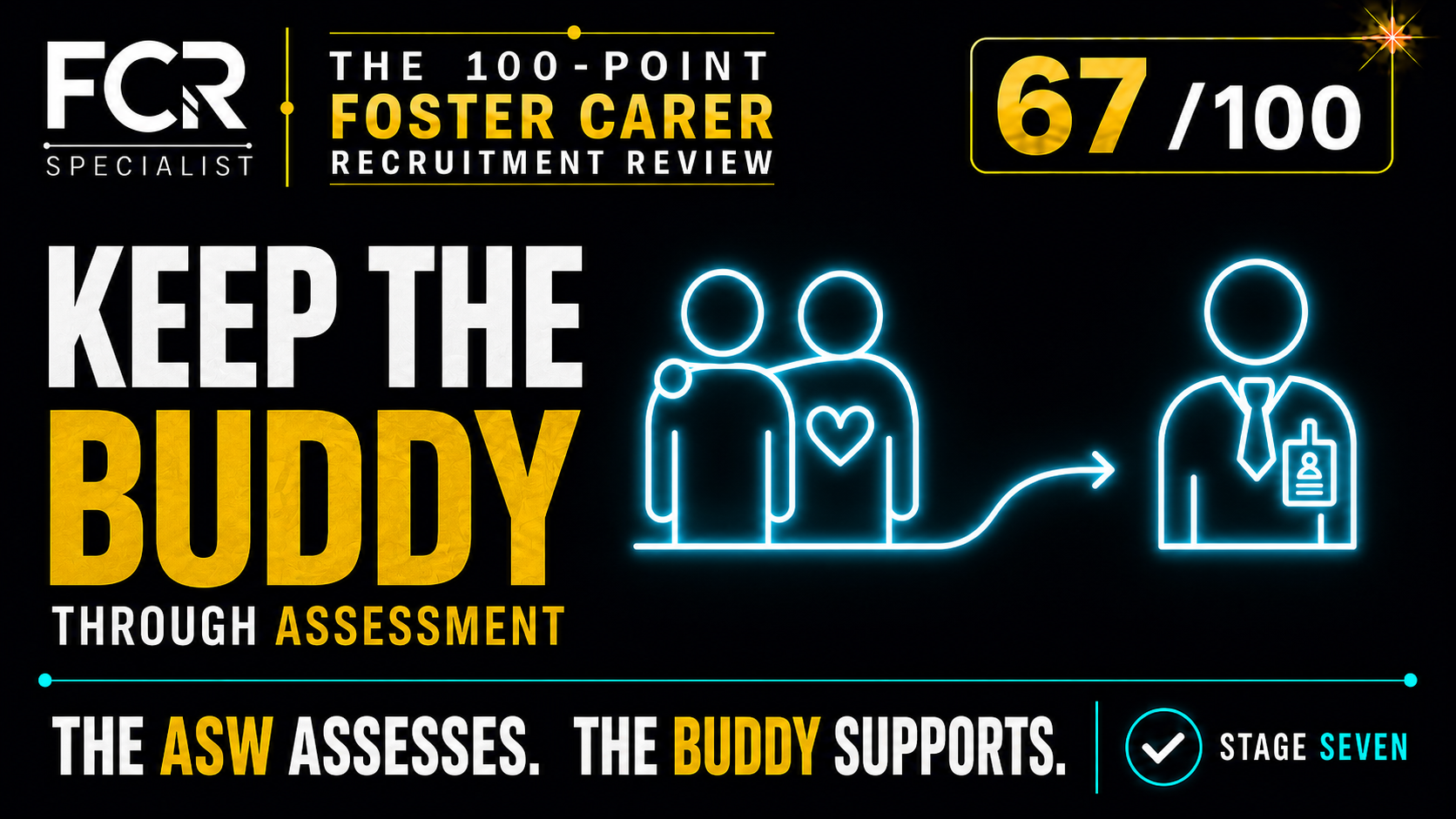
POINT 67/100 — DOES THE FOSTER CARER BUDDY STAY WITH THEM THROUGH ASSESSMENT?
POINT 67/100 — DOES THE FOSTER CARER BUDDY STAY WITH THEM THROUGH ASSESSMENT?
There is something slightly strange about the way Foster Carer support can sometimes operate.
We recognise that somebody exploring fostering benefits from speaking to an experienced Foster Carer.
We introduce them.
They ask questions.
They hear what fostering is really like.
They start developing a relationship with somebody who has lived experience.
Then the prospective Foster Carer applies.
Formal assessment starts.
And the buddy disappears.
Why?
Because arguably this is precisely the point at which that relationship could become more valuable, not less.
The applicant is moving from exploring fostering into one of the most intensive parts of the journey.
And that gives Point 67 its central question:
IF PEER SUPPORT HELPED THEM GET THIS FAR, WHY WOULD WE REMOVE IT WHEN THE JOURNEY BECOMES MORE DIFFICULT?
THE EVIDENCE SUPPORTS LIVED EXPERIENCE
This isn't simply an attractive idea.
The Department for Education's 2023 qualitative research into Foster Carer Recruitment and conversion rates found that prospective Foster Carers tended to see people with lived experience as more compelling and more trusted sources of information.
Participants also said prospective Foster Carers found it easier to ask them questions.
Some participating services had mentoring schemes involving existing or former Foster Carers, with mentors offered to prospective carers for around six months. Mentors could provide emotional support, explain what to expect and in some cases accompany applicants through to panel.
The wider study identified opportunities to hear directly from Foster Carers and people with lived experience as one of the enablers to recruitment, alongside relational approaches, streamlined processes, applicant support and reduced anxiety.
As throughout this Stage, this was small-scale qualitative research involving ten fostering services.
It does not prove that a buddy scheme will increase approval rates by a particular percentage.
But it provides credible evidence that services are already using this approach and that lived-experience relationships can add something distinct to the applicant journey.
THE ASW AND THE BUDDY DO DIFFERENT THINGS
This distinction must be completely clear.
The Assessing Social Worker has a formal professional responsibility.
They assess.
They gather evidence.
They explore.
They challenge where necessary.
They make professional judgements.
They ultimately contribute to a recommendation about suitability.
The Foster Carer buddy does none of those things.
Their role is:
SUPPORT — NOT ASSESSMENT.
That distinction protects everyone.
It protects the applicant.
It protects the buddy.
And importantly, it protects the integrity of the ASW relationship.
WHY MIGHT THE BUDDY MATTER MORE DURING ASSESSMENT?
Foster Carer assessment necessarily becomes personal.
Applicants may be asked to think about:
their childhood;
family relationships;
significant experiences;
parenting;
loss;
previous relationships;
health;
life events;
and other aspects of their personal history.
This Review is not questioning why relevant areas need to be explored.
That is assessment.
But imagine being the applicant.
You come out of a demanding assessment session and think:
“That was much harder than I expected.”
Who do you talk to?
You could talk to your ASW.
And there will be times when that is exactly what should happen.
But there is another question only somebody with lived experience can really answer:
“WHAT DID IT FEEL LIKE WHEN YOU WENT THROUGH THIS?”
That is where the buddy relationship becomes different.
“THAT FELT DIFFICULT FOR ME TOO”
The buddy can normalise the experience without minimising it.
For example:
“I remember finding that part difficult too.”
“I wondered why they needed to ask me that.”
“My assessment made me think about things I hadn't thought about for years.”
“There were times when I wondered whether I wanted to continue.”
“It helped me to ask my ASW why something needed exploring.”
Those are not assessment judgements.
They are lived experience.
And sometimes that may be exactly what an applicant needs to hear.
THE BUDDY SHOULD NEVER EXPLAIN AWAY A PROFESSIONAL CONCERN
This boundary is equally important.
Suppose an applicant says:
“My ASW keeps asking questions about this issue and I think they're making too much of it.”
The buddy should not say:
“Don't worry about that. You'll be fine.”
They do not know that.
Nor should they say:
“My assessor didn't ask me that, so yours shouldn't either.”
Assessments are individual.
The better response might be:
“It sounds as though you need to understand why your ASW feels that needs further exploration. Have you asked them to explain it?”
That maintains the professional boundary while supporting the applicant.
DO NOT TURN THE BUDDY INTO A SHADOW ASSESSOR
This is probably the most important warning in Point 67.
The buddy should not be quietly asked:
“What do you think of them?”
“Do you think they'll make good Foster Carers?”
“Did anything concern you?”
If that happens, the relationship changes immediately.
The applicant no longer has a peer supporter.
They have another person observing and assessing them.
That undermines the very reason the relationship exists.
So:
THE BUDDY SHOULD NOT REPORT SUBJECTIVE IMPRESSIONS ABOUT SUITABILITY TO THE ASW.
They should not be an unofficial information-gathering channel.
They should not be asked to investigate.
They should not be given access to confidential Form F material simply because they are supporting the applicant.
They should not become an additional assessment meeting disguised as friendship.
THE BUDDY SHOULDN'T COACH THE APPLICANT EITHER
The opposite boundary matters too.
Peer support cannot become:
“Here's what you need to say to get through Form F.”
The buddy must never coach answers.
Their role isn't helping somebody “pass” assessment.
There isn't a correct script.
If the applicant asks:
“What should I say when they ask me about that?”
the buddy can say:
“Tell them what you genuinely think and how you understand it.”
Not:
“This is what they're looking for.”
That distinction is crucial.
THE BUDDY IS NOT THERE TO HELP AN UNSUITABLE APPLICANT GET APPROVED
This needs saying explicitly.
The objective of Foster Carer Recruitment is not maximum conversion regardless of suitability.
The objective is to avoid losing appropriate prospective Foster Carers through preventable process problems while preserving rigorous assessment.
If professional assessment identifies that an applicant should not proceed, the buddy cannot and should not change that.
Indeed, peer support may also help someone come to an informed conclusion that fostering isn't right for them.
That can be a good outcome.
AN INFORMED WITHDRAWAL IS DIFFERENT FROM AN AVOIDABLE LOSS.
WHO SUPPORTS THE APPLICANT AFTER A DIFFICULT MEETING?
This is where the model becomes very practical.
Imagine an assessment session finishes at 4pm.
The applicant has discussed something deeply personal.
The ASW leaves.
Professionally, the session may have been entirely appropriate.
But emotionally, the applicant may still be processing it at 7pm.
Could they message their Foster Carer buddy?
Not to discuss confidential assessment details inappropriately.
But simply:
“That was a difficult one today.”
And receive:
“I remember having days like that. Are you okay? If anything is unclear, make sure you talk it through with your ASW.”
That may sound small.
From the applicant's perspective, it may not be.
THE BUDDY PROVIDES A DIFFERENT TYPE OF CONTINUITY
Stage Seven has repeatedly argued that assessment should not feel as though another organisation has suddenly taken over.
The buddy can help maintain that continuity.
Recruitment relationship.
↓
Initial Visit.
↓
Decision to proceed.
↓
Application.
↓
Assessment.
↓
Preparation training.
↓
Panel.
The ASW may change.
Administrators may change.
Different professionals may appear.
But the Foster Carer buddy can potentially be one familiar person who remains alongside the applicant.
That creates another Stage Seven principle:
ROLES MAY CHANGE. SUPPORT DOESN'T HAVE TO DISAPPEAR.
THIS ALSO COMPLEMENTS THE “JOURNEY GUIDE” DIRECTION
The Government's Renewing Fostering plan emphasises reliable points of contact, trusted relationships and an end-to-end journey from enquiry through approval. It says applicants are more likely to progress where recruitment involves timely, responsive processes, consistent points of contact and clear information about timescales and commitments.
The Government's proposed model includes a journey guide providing support across that wider pathway.
A Foster Carer buddy is not the same thing as a formal journey guide.
But the principles are compatible.
One provides organisational continuity.
The other provides lived-experience continuity.
There may be value in having both.
THE BUDDY SHOULD NOT REPLACE THE JOURNEY CONTACT
This distinction is important too.
If the assessment stalls, the service cannot say:
“Well, they've got their buddy.”
The buddy isn't responsible for fixing organisational problems.
They don't allocate an ASW.
They don't chase statutory checks.
They don't arrange training.
They don't manage assessment workload.
They don't resolve complaints.
They are not a cheap substitute for professional support.
If the applicant says:
“Nobody has contacted me for three weeks.”
the buddy should know how to help them access the correct organisational route.
The buddy should not become that route themselves.
THERE NEEDS TO BE A CLEAR ESCALATION ROUTE
A buddy relationship needs boundaries because sometimes an applicant may disclose something more significant than normal frustration.
They may say:
“I don't understand what is happening with my assessment.”
“Nobody is responding.”
“I'm thinking of withdrawing because this has completely stalled.”
“I'm worried that if I complain it will affect the outcome.”
Or potentially something involving safeguarding or serious conduct concerns.
The buddy needs to know:
what they can support informally;
what should be directed back to the ASW;
what constitutes an organisational process concern;
who the applicant can contact;
and what must be escalated because of safeguarding or other serious concerns.
That shouldn't be left to improvisation.
GIVE THE BUDDY A ROLE DESCRIPTION
If services use Foster Carer buddies, I would suggest something very simple.
Not a twenty-page policy.
A clear one-page role description.
THE BUDDY CAN:
offer lived-experience support;
answer practical questions about fostering from personal experience;
talk about what assessment felt like for them;
provide reassurance;
encourage applicants to raise questions;
help applicants understand the broad journey;
maintain appropriate contact through assessment;
and explain where to seek help if the process is not working.
THE BUDDY DOES NOT:
assess suitability;
comment professionally on Form F;
advise the applicant how to answer assessment questions;
access confidential assessment material unnecessarily;
promise an applicant will be approved;
challenge professional decisions on the applicant's behalf;
report informal impressions about suitability;
or replace the ASW, recruitment team or formal complaints/escalation process.
That makes the relationship safer and more useful.
CONFIDENTIALITY NEEDS TO BE REALISTIC
The applicant also needs to understand what kind of relationship this is.
It should feel safe enough for genuine conversation.
But the service should not imply that the buddy can promise absolute confidentiality regardless of what they are told.
If a significant safeguarding issue arises, the buddy needs a clear organisational route.
This can be explained without making every conversation feel monitored.
For example:
“Your buddy is here to support you and isn't part of your assessment. They won't routinely report your conversations back to the ASW. However, like anyone working within the service, they need to know what to do if something serious involving safety or safeguarding is disclosed.”
The exact local wording and arrangements will need to reflect the service's policies.
The principle is transparency.
MATCH THE BUDDY WITH SOME THOUGHT
Not every Foster Carer will suit every applicant.
Sometimes there may be particular value in matching around relevant experience.
For example:
a single applicant might value speaking to a single Foster Carer;
somebody continuing to work may want a Foster Carer who has balanced employment with fostering;
an LGBTQ+ applicant may value relevant lived experience;
someone interested in caring for teenagers may want somebody who actually Fosters teenagers;
a couple with birth children may want to talk to a fostering household that has navigated that experience.
This does not need to become an elaborate matching assessment.
The point is simply:
RELEVANT LIVED EXPERIENCE CAN MAKE PEER SUPPORT MORE USEFUL.
And the applicant should always be able to say that a particular buddy match isn't working.
WHAT IF THE APPLICANT DOESN'T WANT A BUDDY?
Then don't give them one.
This should be an offer.
Not another compulsory component of becoming a Foster Carer.
Some applicants will find peer support extremely valuable.
Others will prefer to work directly with professionals.
Some may initially decline and then want support later.
The relationship works precisely because it is different from formal assessment.
Turning it into another mandatory appointment would undermine that.
THE ASW SHOULD KNOW WHAT THE BUDDY IS — AND WHAT THEY ARE NOT
This is another small but important part of the ASW induction issue we've been discussing.
If one ASW thinks:
“The buddy is part of recruitment and shouldn't have anything to do with assessment,”
while another regularly uses the buddy informally to gather impressions, the service has no coherent model.
Everybody should understand the boundary.
The ASW assesses.
The buddy supports.
The recruitment/journey function manages the wider applicant pathway.
Senior management ensures those roles fit together.
THE BUDDY MAY ALSO HEAR DISENGAGEMENT FIRST
This becomes particularly important ahead of Point 68.
Applicants don't always announce:
“I am now disengaging from assessment.”
They say things like:
“I'm getting fed up.”
“This wasn't what I expected.”
“I'm not sure I can be bothered with all this.”
“Nobody seems to know what's happening.”
“I keep being asked the same things.”
“Maybe this isn't for us.”
A trusted Foster Carer buddy may hear those comments before anyone else.
That creates an opportunity.
Not for the buddy to assess the applicant's commitment.
But perhaps to say:
“Before you decide anything, would you like somebody in the service to talk through what is going wrong?”
That could create early intervention before the applicant simply disappears.
THIS MATTERS BECAUSE WITHDRAWAL REMAINS SO HIGH
The national application figures remain central.
Ofsted recorded 5,370 fostering applications as completed during 2024–25.
Of those:
2,050 — 38% — were approved.
3,290 — 61% — were withdrawn.
30 — 1% — were rejected.
Of the withdrawals, 2,175 were applicant-led and 1,115 were service-led.
As throughout Stage Seven, these figures are reporting-year flows and should not be treated as one cohort followed directly from application to outcome.
And many withdrawals will be entirely appropriate.
But among applications started in-year and withdrawn by applicants by year-end, 20% recorded the fostering process not being what the applicant expected.
A buddy scheme cannot be claimed to solve that.
There is no evidence supporting that causal conclusion.
But if applicants sometimes leave because of their experience of the process, giving them someone with lived experience who can help them interpret that experience is a reasonable intervention for services to consider and evaluate.
DON'T ONLY ASK WHETHER THE BUDDY EXISTS
The management question should go further.
Some services may proudly say:
“Yes, we have a buddy scheme.”
But:
When is the buddy introduced?
How many applicants accept one?
Does the relationship continue through assessment?
How frequently is meaningful contact happening?
Do buddies understand their boundaries?
Are they trained in escalation and safeguarding?
Does the applicant know the buddy isn't assessing them?
Do ASWs understand the role?
What happens if the relationship doesn't work?
How many applicants who withdraw had active buddy support?
Do applicants say the support helped?
Those questions turn a nice idea into an operational model.
HERE IS THE TEST…
Take every current applicant in assessment.
1. PEER SUPPORT
Have they been offered access to an experienced Foster Carer?
If not, why not?
2. TIMING
Was peer support introduced early enough for a relationship to develop before assessment became difficult?
3. CONTINUITY
If they had a buddy before application, is that relationship still active during assessment?
Or did it quietly stop when recruitment handed over?
4. CHOICE
Is the buddy genuinely optional?
5. ROLE CLARITY
Can the applicant explain what the buddy does?
Can the ASW?
Can the buddy?
If the three answers differ, the role needs clarifying.
6. PROFESSIONAL BOUNDARY
Is the buddy ever asked for opinions about applicant suitability?
If yes, stop and examine why.
7. COACHING BOUNDARY
Do buddies understand that support must never become coaching applicants on what to say?
8. CONFIDENTIALITY
Does everybody understand the boundaries around ordinary supportive conversation and significant safeguarding concerns?
9. ESCALATION
If the applicant says the assessment journey has stalled, does the buddy know where to direct them?
10. RELEVANCE
Where practical, has the applicant been connected with somebody whose lived experience is useful to them?
11. DISENGAGEMENT
Are buddies helped to recognise comments suggesting an applicant may be becoming frustrated or considering withdrawal — without turning those comments into assessment judgements?
12. FEEDBACK
After assessment, ask:
“Was having access to an experienced Foster Carer helpful?”
And:
“When was it most useful?”
13. ATTRITION
For applicants who withdraw:
Did they have a buddy?
Had they spoken recently?
What did they say about the journey?
Again, this isn't to make the buddy responsible for withdrawal.
It's to learn.
MEASURE VALUE — NOT JUST ACTIVITY
A service could easily report:
27 applicants allocated a buddy.
That tells us almost nothing.
Better questions are:
Did they actually make contact?
Did applicants use the relationship?
What types of questions did they find useful?
Did the buddy help them understand the process?
Did applicants feel more supported?
Were concerns directed to the right professional route?
Did anybody misunderstand the buddy as part of the assessment?
Those are much more meaningful measures.
THE BUDDY RELATIONSHIP MAY CONTINUE BEYOND APPROVAL
There is another potential advantage.
If the applicant is approved, the person who supported them through recruitment and assessment may potentially remain part of their informal peer network as they become a Foster Carer.
That creates continuity into the next stage.
The relationship changes again.
But it doesn't necessarily need to end at panel.
This Review is still focused here on recruitment and assessment, so we don't need to move into post-approval support in detail.
But it reinforces something important:
WE ARE BUILDING RELATIONSHIPS — NOT JUST MOVING APPLICATIONS.
THE BUDDY DOES SOMETHING THE ORGANISATION CANNOT REPLICATE
A recruiter can explain fostering.
An ASW can assess suitability.
A manager can manage the process.
Training can develop understanding.
A website can provide information.
But only somebody who has actually been assessed and gone on to Foster can genuinely say:
“I've sat where you're sitting.”
That is the distinctive value.
So the principle for Point 67 is:
THE ASW ASSESSES. THE BUDDY SUPPORTS.
Alongside it:
SUPPORT — NOT ASSESSMENT.
And:
ROLES MAY CHANGE. SUPPORT DOESN'T HAVE TO DISAPPEAR.
Point 68 now follows naturally.
Because the buddy, recruiter, ASW, administrator and manager may all see different pieces of the applicant's behaviour.
The next question is: