POINT 66/100 — DOES RIGOROUS ASSESSMENT HAVE TO MEAN A SLOW ASSESSMENT?
POINT 66/100 — DOES RIGOROUS ASSESSMENT HAVE TO MEAN A SLOW ASSESSMENT?
There is a phrase that can close down a conversation about Foster Carer assessment remarkably quickly:
“It takes time because it has to be thorough.”
Of course it has to be thorough.
Nobody should be approved to Foster because a recruitment target needs hitting.
Nobody should be rushed through difficult areas of assessment because a manager wants better conversion figures.
No Assessing Social Worker should feel pressure to reduce professional scrutiny because the service needs more Foster Carers.
But none of those things answers the actual question.
DOES PROFESSIONAL RIGOUR EXPLAIN ALL OF THE TIME?
That is what Point 66 asks.
Because there is a fundamental difference between:
time required to undertake a safe, thoughtful and defensible assessment
and:
time created by the way an organisation manages that assessment.
We need to stop treating the two as though they are automatically the same.
THE SCALE OF THE ISSUE IS NOW VERY DIFFICULT TO IGNORE
The Government's February 2026 Renewing Fostering: homes for 10,000 more children paper is unusually direct.
It describes the recruitment process in many areas as “clunky” and states that, within local authorities, 59% of fostering assessments take more than six months and 29% take more than eight months. It also refers to carers dropping out during the journey.
Those figures do not tell us why those assessments took that long.
That is important.
They do not prove that Social Workers are working slowly.
They do not prove that bureaucracy is responsible.
They do not distinguish:
- highly complex assessments;
- applicant availability;
- safeguarding concerns;
- overseas information;
- medical delays;
- workforce capacity;
- training schedules;
- diary gaps;
- administrative delay;
- or poor process design.
And that is exactly the point.
ASSESSMENT LENGTH ALONE IS NOT ENOUGH INFORMATION.
If the service wants to improve, it has to understand where the time went.
RIGOUR IS ABOUT QUALITY — NOT ELAPSED DAYS
A six-month assessment is not necessarily more rigorous than a four-month assessment.
An eight-month assessment is not necessarily safer than a five-month assessment.
Equally, a faster assessment is not automatically better.
Time, by itself, tells us almost nothing about quality.
A rigorous assessment involves:
appropriate evidence;
professional exploration;
required checks;
critical analysis;
understanding the household;
testing areas that need testing;
and ultimately reaching a defensible recommendation.
Some households will require more assessment activity than others.
Some information will genuinely take longer.
Some issues should slow an assessment down.
But that is completely different from assuming:
LONG = THOROUGH.
It does not.
THE REGULATIONS THEMSELVES ALLOW CONCURRENCY
This is important because sometimes fostering processes are treated as though everything must happen sequentially.
It doesn't.
The current assessment framework allows Stage 1 and Stage 2 activity to take place concurrently.
Indeed, when the 2013 reforms were introduced, the Government explicitly allowed the stages to run in parallel following concerns that a purely sequential model would create delay.
Ofsted's 2024 recruitment analysis found that 76% of mainstream households approved during 2022–23 had experienced Stage 1 and Stage 2 concurrently. The figure was 85% for IFA approvals and 65% for local-authority approvals.
The DfE's qualitative research also found participating services generally describing concurrency as a way to make the process quicker and more efficient.
But the research makes an equally important qualification.
There are times when sequential working is appropriate.
If something significant emerges during Stage 1 and needs properly investigating before a service invests further in the assessment, slowing or sequencing the work can be the correct professional decision.
So the principle is not:
everything must run concurrently.
It is:
CONCURRENCY WHERE APPROPRIATE.
SEQUENCING WHERE NECESSARY.
And crucially:
know why you are doing one rather than the other.
NECESSARY PROFESSIONAL TIME ≠ ORGANISATIONAL WAITING
This is perhaps the most useful distinction for managers.
Imagine two applicants whose assessments each take seven months.
APPLICANT A
A significant issue emerges.
The ASW needs further information.
Several additional discussions take place.
Professional advice is required.
The applicant needs time to reflect.
The ASW properly explores the issue before reaching a conclusion.
That time has purpose.
APPLICANT B
ASW allocation takes three weeks.
The first appointment is another three weeks later.
Subsequent appointments are booked one at a time.
A medical request goes out late.
Preparation training is missed and the next course is six weeks away.
An ASW takes annual leave and nobody manages the gap.
The assessment report waits for internal quality assurance.
That time is very different.
Yet the dashboard may record both as:
Assessment duration: seven months.
That is not sufficiently sophisticated management information.
WE NEED TO START ANALYSING THE TIME
Instead of asking only:
“How long are assessments taking?”
ask:
WHAT IS THE ASSESSMENT TIME MADE OF?
A useful breakdown could include:
Professional assessment activity
Time genuinely required to undertake visits, explore information and complete professional analysis.
Applicant-led time
Planned pauses, availability, personal circumstances or time the applicant appropriately needs.
External dependency
DBS, medical, references, overseas checks or another body.
Workforce capacity
Waiting for allocation, unavailable practitioner capacity, sickness or competing demands.
Diary delay
Avoidable gaps between planned professional contacts.
Training dependency
Waiting for preparation training or another service-controlled activity.
Administrative delay
Requests not issued, information not processed, forms not transferred, actions not chased.
Quality assurance / panel administration
Time after substantive assessment activity has finished.
Necessary professional pause
A material concern needs resolving before further progress.
Unknown
Nobody can tell why the application stopped moving.
That last category should be the one managers find most uncomfortable.
THE DfE RESEARCH IDENTIFIED WORKFORCE DESIGN AS PART OF THE ISSUE
The 2023 DfE/Ipsos research contains a particularly important finding.
Participants described progressing an assessment quickly after application as important.
They also reported that having a team dedicated specifically to assessment could help assessments progress and complete more quickly.
Where workers undertaking assessments also carried responsibilities for existing Foster Carers, urgent placement matters could understandably take priority and create substantial assessment delay.
That should stop us making this an individual practitioner criticism.
Imagine an ASW is due to write up an applicant assessment.
Then an existing fostering household experiences a placement crisis involving a child.
Which gets immediate attention?
Of course the child does.
The answer cannot simply be:
“The ASW needs to manage their time better.”
That's not serious workforce planning.
The management question is:
HAVE WE GIVEN ASSESSMENT ENOUGH PROTECTED CAPACITY?
DON'T ASK ASWs TO SOLVE A SYSTEM PROBLEM WITH PERSONAL EFFICIENCY
This is an important distinction.
If the organisation wants assessments to progress more consistently, it may need to examine:
allocation;
caseload;
administrative support;
dedicated assessment capacity;
cover arrangements;
supervision;
quality assurance;
training;
diary protection;
and management oversight.
That is very different from telling practitioners:
“You need to finish Form Fs faster.”
Point 66 is not calling for faster Social Work.
It is calling for better system design around Social Work.
NEW TO FOSTERING DOES NOT MEAN NEW TO SOCIAL WORK
There is another sensitive management issue we need to acknowledge.
Assessing Social Workers can enter fostering practice with very different professional backgrounds.
One practitioner may have completed Foster Carer assessments for many years.
Another may have considerable Social Work assessment experience but be comparatively new to Form F work.
Another may be earlier in their professional career.
It would be wrong to infer competence simply from any of those labels.
A Social Worker new to fostering has to learn fostering-specific practice somewhere.
The important question is what the service provides.
They may receive:
formal training;
statutory guidance;
Form F materials;
supervision;
shadowing;
practice guidance;
quality assurance;
and support from more experienced colleagues.
All of that may be appropriate.
But there is another question for senior managers:
ARE THEY ALSO TAUGHT TO UNDERSTAND THE APPLICANT JOURNEY AROUND THE ASSESSMENT?
THE RECRUITMENT DIMENSION MAY NOT BE OBVIOUS
An ASW's professional education and fostering-specific training quite properly focus heavily on assessment.
What must be explored?
What evidence is required?
What does good analysis look like?
What safeguarding responsibilities exist?
Those are fundamental.
But an ASW may not automatically know:
how difficult the applicant was to recruit;
what journey they have already experienced;
how many applicants the service loses during assessment;
what applicants say when they withdraw;
where organisational delays usually arise;
or how seemingly small communication gaps can affect applicant confidence.
Why would they know unless the organisation tells them?
This is why Stage Seven keeps returning to:
RECRUITMENT AWARENESS WITHOUT RECRUITMENT PRESSURE.
The ASW should not become a salesperson.
They should not be expected to “keep an applicant in” where professional evidence points elsewhere.
They should not compromise their recommendation.
But understanding the wider journey can help them recognise that professional rigour and applicant experience are not opposing objectives.
PROFESSIONAL RIGOUR AND APPLICANT AWARENESS ARE NOT COMPETING VALUES
An ASW can:
ask a difficult question;
challenge an inconsistency;
explore childhood experiences;
raise a concern;
require further evidence;
and ultimately recommend that somebody should not be approved.
While still:
keeping appointments;
explaining why something needs revisiting;
communicating delay;
avoiding unnecessary repetition;
planning the next contact;
and treating the applicant as someone who remains voluntarily engaged in a recruitment journey.
Those things are not “sales”.
They are good professional and organisational practice.
INVESTMENT MATTERS MORE THAN ASSUMPTION
This is why the wording around less fostering-experienced ASWs must remain careful.
The question should never be:
“Why don't they know this?”
It should be:
WHAT DID WE INVEST IN THEM KNOWING?
When somebody begins undertaking Foster Carer assessments, does induction include:
the end-to-end Foster Carer Recruitment journey?
the Initial Visit process?
the information recruitment has already gathered?
the service's application and withdrawal figures?
the most common recorded withdrawal reasons?
applicant feedback?
how preparation training fits the journey?
expected communication standards?
how to escalate organisational barriers?
what the Foster Carer buddy does?
who manages checks?
what happens when an assessment begins to drift?
If not, recruitment awareness has effectively been left to chance.
AND BE CAREFUL OF “THIS IS HOW WE DO IT HERE”
Peer learning is essential.
An ASW will naturally speak to experienced colleagues.
They will observe practice.
They will use templates.
They will learn how the local service operates.
That is normal.
But where fostering-specific practice is learned largely by reproducing local practice, there is a risk that some historical habits reproduce themselves too.
That does not mean colleagues are doing poor work.
It means every professional system requires periodic challenge.
Is this required by regulation?
Is it professional assessment practice?
Is it organisational policy?
Or:
is it simply something we've always done?
Without management oversight, professional communities can unintentionally become closed loops.
GOOD PRACTICE SHOULD SPREAD.
HISTORIC DELAY SHOULD NOT.
THE GOVERNMENT IS NOW EXPLICITLY CHALLENGING BUREAUCRACY
The 2026 Renewing Fostering paper goes beyond assessment timescales.
It says inconsistencies in practice have grown and that services have become overly bureaucratic.
The same policy proposes a regional assessment function using embedded Social Workers to support quicker progress and decisions, together with end-to-end pipeline data designed to identify delays.
That doesn't mean every existing process is unnecessary bureaucracy.
Nor should policy rhetoric be used to dismiss professional requirements.
But it makes this an especially appropriate time for services to separate:
WHAT PROTECTS THE ASSESSMENT?
from:
WHAT HAS SIMPLY ACCUMULATED AROUND IT?
THE ATTRITION QUESTION REMAINS CENTRAL
The latest Ofsted figures make this particularly important.
Of the 5,370 applications recorded as completed during 2024–25:
2,050 — 38% — were approved.
3,290 — 61% — were withdrawn.
30 — 1% — were rejected.
Of those withdrawals, 2,175 were applicant-led and 1,115 service-led.
As throughout Stage Seven, these are reporting-year flows.
They are not a single cohort beginning and ending assessment together.
And withdrawal is not automatically failure.
But Ofsted also reports that among applications started in-year and withdrawn by applicants by year-end, 20% recorded the fostering process not being what the applicant expected.
The DfE's qualitative research separately identified lengthy assessment processes that can feel invasive among factors associated with dropout, and reported that lengthy waits can compromise prospective Foster Carers' motivation and morale.
None of that proves that a particular delayed assessment would otherwise have resulted in approval.
It does mean management cannot treat delay as neutral.
HOW MANY WITHDRAWALS HAPPEN AFTER A PERIOD OF DRIFT?
That is a local question every service should be able to investigate.
When somebody withdraws, look back.
What happened in the preceding eight weeks?
Was there regular purposeful contact?
Was the assessment actively progressing?
Had something significant emerged professionally?
Or was there:
a cancelled visit;
no replacement date;
another gap;
an outstanding check;
missed training;
ASW absence;
confusion;
or silence?
The withdrawal may still have had nothing to do with those factors.
But unless the service asks, it cannot know.
And once again:
“WITHDRAWN” IS AN OUTCOME CODE — NOT AN EXPLANATION.
FAST IS NOT THE OBJECTIVE
This Point could easily be misunderstood.
So let's make this explicit.
The aim is not:
the fastest Form F;
the shortest assessment in the region;
a league table of ASWs;
a target that pressures professional judgement;
or applicants being rushed to panel.
The objective is:
PURPOSEFUL TIME.
If six months are genuinely needed, use six months.
If eight months are genuinely needed, use eight months.
If something serious needs slowing down, slow it down.
But if an assessment contains six weeks in which nothing meaningful happened because of organisational process:
that should be visible;
that should be understood;
and where possible, that should be removed.
TIME SHOULD HAVE A REASON
This might be the simplest management standard for Point 66.
For every significant period in an assessment, somebody should be able to answer:
What was happening?
If the answer is:
“The ASW was undertaking necessary assessment work.”
fine.
“The applicant requested a pause.”
fine.
“A safeguarding matter required resolution.”
fine.
“We were awaiting an overseas check and everything appropriate that could continue was continuing.”
fine.
But:
“Nothing really happened for a month.”
requires another question:
Why?
HERE IS THE TEST…
Take every assessment completed in the last 12 months.
Do not simply rank them by total duration.
Break the time down.
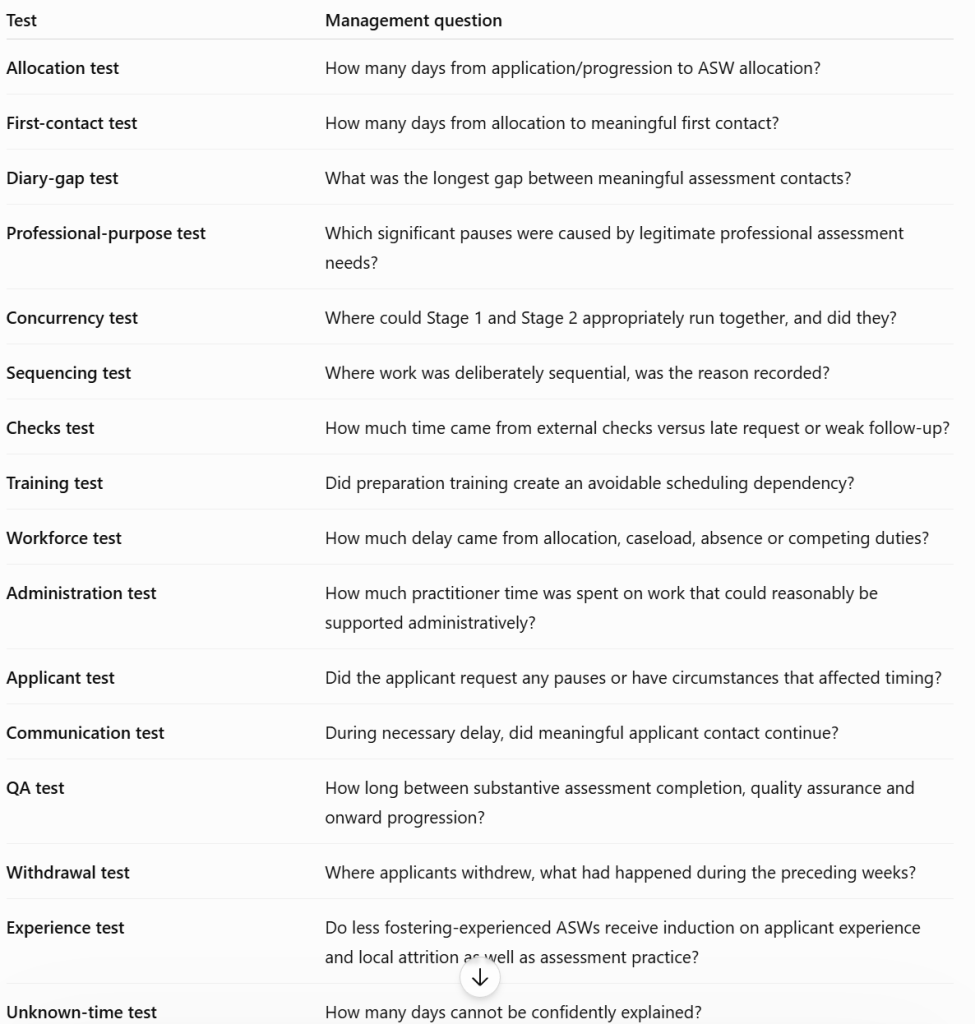
Then calculate something more useful than average assessment duration.
For each assessment identify:
Necessary professional time
External waiting time
Applicant-led time
Organisational waiting time
Unknown time
That starts to tell management what can actually be changed.
DON'T BENCHMARK INDIVIDUAL ASWs WITHOUT CONTEXT
There is another important warning.
Suppose ASW A averages five months.
ASW B averages seven.
It would be dangerous to conclude immediately that ASW A is more efficient.
ASW B may:
receive more complex cases;
work with applicants requiring greater support;
inherit delayed assessments;
carry additional duties;
have had significant external-check problems;
or appropriately undertake additional professional work.
So worker-level variation is something to understand, not something to turn automatically into performance judgement.
The management sequence should be:
FIND THE VARIATION.
UNDERSTAND THE CONTEXT.
THEN DECIDE WHETHER THERE IS A PROCESS ISSUE.
That protects both professional integrity and organisational learning.
THE BEST QUESTION ISN'T “HOW DO WE SPEED THIS UP?”
It is:
WHAT PART OF THIS TIME ADDED VALUE TO THE ASSESSMENT?
That reframes the entire discussion.
A difficult two-hour assessment conversation may add enormous value.
A three-week diary gap may add none.
A necessary reference investigation may add enormous value.
A report sitting unread in an inbox may add none.
A pause because an applicant needs time may be entirely appropriate.
A pause because nobody owns the next action may not be.
The elapsed calendar contains them all.
Management needs to distinguish them.
RIGOUR ≠ DELAY
Professional assessment must be protected.
That should be non-negotiable.
But unnecessary time should not be protected simply because it sits beside professional assessment.
The two are not the same.
So the core principles for Point 66 are:
RIGOUR ≠ DELAY.
CONCURRENCY WHERE APPROPRIATE. SEQUENCING WHERE NECESSARY.
DON'T TELL ASWs TO ASSESS FASTER. GIVE THEM A SYSTEM THAT WASTES LESS TIME.
And perhaps the management question that matters most:
WHAT PART OF THE TIME WAS NECESSARY — AND WHAT PART DID WE CREATE?
Point 67 now moves to the person who can provide something completely different while all of this professional assessment is taking place: