POINT 65/100 — ARE REQUIRED CHECKS BEING MANAGED — OR JUST WAITED FOR?
POINT 65/100 — ARE REQUIRED CHECKS BEING MANAGED — OR JUST WAITED FOR?
There is a sentence prospective Foster Carers can hear surprisingly often during assessment:
“We're just waiting for your checks.”
It sounds reasonable.
And sometimes it is.
Foster Carer assessment requires significant information to be obtained before somebody can be approved.
Some of that information comes from outside the fostering service.
It cannot necessarily be produced instantly.
Nobody should suggest otherwise.
But there is a substantial difference between:
A CHECK TAKING TIME
and:
A CHECK SITTING UNMANAGED.
That is the distinction behind Point 65 of The 100-Point Foster Carer Recruitment Review.
FIRST: THE CHECKS ARE THERE FOR A REASON
This Point must not drift into suggesting that safeguarding requirements should be removed simply because they sometimes create delay.
Current statutory guidance requires Stage 1 information including the applicant's identity and address, health supported by a medical report, household and family information, accommodation, previous fostering or adoption history, personal referees and enhanced DBS information for the applicant and relevant adult household members.
There are also requirements around personal references, consultation with the local authority where appropriate and previous fostering-service information in relevant circumstances.
These are substantive elements of a safe assessment.
They are not bureaucratic inconveniences that Foster Carer Recruitment should try to bypass.
The recruitment question is:
HOW WELL DOES THE ORGANISATION MANAGE THEM?
“WAITING FOR CHECKS” IS A STATUS — NOT A MANAGEMENT PLAN
Suppose an applicant asks:
“What's happening with my assessment?”
The answer is:
“We're waiting for your medical.”
That still leaves a lot of unanswered questions.
When was it requested?
Was the request complete?
Has the GP practice acknowledged it?
Is payment or another administrative requirement outstanding?
Does the applicant need to do anything?
Has anyone followed it up?
When was it last chased?
Who owns the chase?
Is this one outstanding item preventing all other activity, or can the assessment continue appropriately?
The same questions can apply to:
DBS activity;
references;
local authority information;
previous-service information;
or another required enquiry.
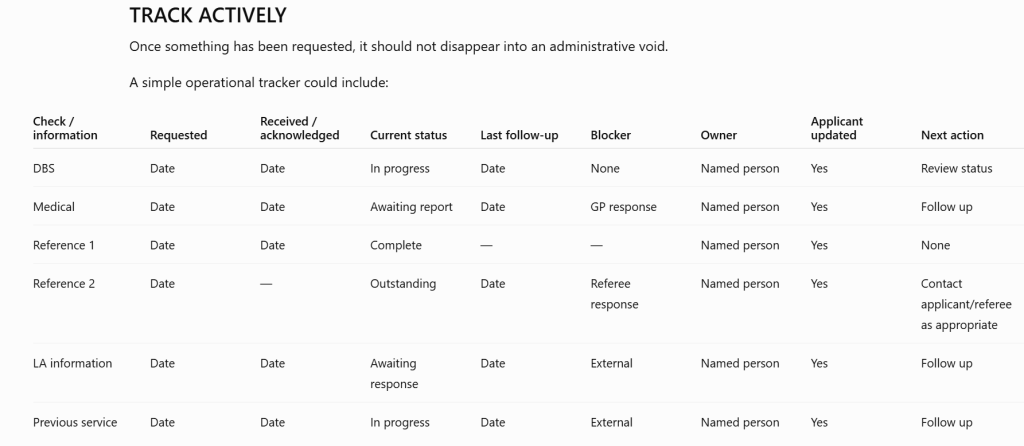
This is why every outstanding check should have more than a status.
It needs an owner and a next action.
THE STATUTORY CLOCK DOES NOT TELL YOU THE WHOLE STORY
There is an especially important management point within the current Stage 1 framework.
The statutory guidance says Stage 1 information should be sought as soon as possible, and that once all the required Stage 1 information has been received, the decision about whether the applicant has successfully completed Stage 1 must be made within 10 working days.
Read that carefully.
The ten-working-day requirement applies after the required information has been received.
So an organisation could technically meet that decision timescale while an applicant has already spent weeks or months waiting for information to arrive.
That gives managers another clock to watch:
APPLICATION / PROGRESSION → CHECK REQUESTED → CHECK RECEIVED.
That time matters too.
A service should not simply know how quickly it made the decision after everything arrived.
It should know how long it took to get everything in.
THE CLOCK YOU NEED TO MANAGE STARTS BEFORE THE STATUTORY CLOCK DOES
That is probably the most important management lesson in this Point.
For each check, separate:
Time before request
from:
external response time
from:
time sitting unprocessed after receipt.
Those are three very different things.
Imagine a medical report taking six weeks.
That headline tells management very little.
Possibility one:
The request was issued the day the applicant progressed, the GP practice was chased appropriately and the report genuinely took six weeks.
Possibility two:
Nobody sent the request for three weeks, and the GP then took three weeks.
The applicant experiences:
six weeks waiting
in both scenarios.
But only one contains three weeks of organisational delay.
Unless the service measures the components, the difference remains invisible.
GOVERNMENT RESEARCH HAS ALREADY IDENTIFIED CHECKS AS A SOURCE OF DELAY
The Department for Education's 2023 qualitative research found participating fostering services saying that medical and criminal-record checks and references should ideally commence right at the beginning because they can take considerable time, particularly where more complex or overseas information is required.
The research also identified medical checks as a particular operational issue, with participants reporting difficulties associated with GP capacity and prioritisation.
This was small-scale qualitative research involving ten fostering services, so it should not be interpreted as measuring how long every check takes nationally.
But it does support a very practical principle:
IF SOMETHING MAY TAKE A LONG TIME, DON'T START IT LATE.
SEND EARLY
There are some delays an organisation cannot control.
There are others it creates itself.
One of the simplest tests is:
How long after the decision to proceed are the necessary requests actually initiated?
Not:
When did somebody start thinking about them?
When were they sent?
If the organisation already has the necessary information, permissions and legal basis to begin an action, unnecessary delay before initiating it adds nothing to assessment quality.
The check will still be rigorous.
It has simply started earlier.
Hence:
THE CHECK CAN TAKE TIME.
THE REQUEST SHOULDN'T.
“WE'VE CHASED IT” ISN'T ENOUGH EITHER
Services also need a proportionate escalation process.
Repeatedly sending the same email may technically be chasing.
It may not be effective management.
Managers should ask:
When does an outstanding check move from routine follow-up to escalation?
Who can escalate it?
Is there an alternative contact route?
Does the applicant need to know?
Has a problem been identified with the original request?
Is something missing?
The objective isn't to harass external organisations.
It is to prevent delay becoming invisible.
THE APPLICANT SHOULD KNOW WHAT IS HAPPENING
One of the worst experiences for an applicant is unexplained waiting.
Consider these two messages.
VERSION ONE
“We're still waiting for your checks.”
VERSION TWO
“Your DBS is in progress. Your two personal references have been received. Your medical report was requested on 7 August and we're waiting for the GP response; we followed that up again on 21 August. There's nothing else you need to do at the moment, and your next assessment meeting remains booked for 5 September.”
The underlying delay might be identical.
The applicant experience is completely different.
One creates uncertainty.
The other demonstrates that somebody is managing their journey.
DON'T MAKE THE APPLICANT CHASE WHAT THEY CANNOT SEE
Applicants can sometimes help.
A referee may have overlooked an email.
The GP surgery may need the applicant to arrange something.
A document may be missing.
Where there is a genuine action for the applicant, tell them clearly.
But do not turn them into the project's administrator.
They should not have to telephone the fostering service every week asking:
“Has anything come back yet?”
The organisation should know.
And the organisation should communicate.
DON'T MAKE THEM CHASE YOUR PROCESS.
MANAGE THE JOURNEY.
WAITING FOR ONE THING DOES NOT AUTOMATICALLY MEAN EVERYTHING STOPS
This becomes particularly important because Stage 1 and Stage 2 can be undertaken concurrently under the current framework.
The DfE's 2023 research found participating services commonly reporting that they ran the stages concurrently to improve speed and efficiency, while recognising that sequential working could be appropriate where significant concerns genuinely needed resolving first.
So a service should be very careful with phrases like:
“We can't do anything until all the checks are back.”
Sometimes that may be professionally or procedurally correct for the specific circumstances.
Sometimes it may not.
The right question is:
DOES THIS PARTICULAR OUTSTANDING INFORMATION NEED TO STOP THIS PARTICULAR ACTIVITY?
That is a professional and organisational judgement.
It should not simply be historic habit.
Hence the Stage Seven principle:
CONCURRENCY WHERE APPROPRIATE.
SEQUENCING WHERE NECESSARY.
A CHECK CAN ALSO REVEAL SOMETHING THAT REQUIRES THE PROCESS TO PAUSE
The opposite needs to be stated just as clearly.
If information arising from a check raises a material issue, the service may need to investigate it before progressing further.
That is not avoidable delay.
That is assessment doing what assessment is supposed to do.
The distinction is between:
waiting because a professional issue must be resolved
and:
waiting because nobody has managed the administration.
Those should never be recorded as though they are the same thing.
THE APPLICANT ROADMAP FROM POINT 64 SHOULD SHOW THE CHECKS
This is where Point 64 and Point 65 connect.
The roadmap should not simply show assessment appointments.
It should show major dependencies.
For example:
DBS — in progress
Medical — requested
References — 2 of 2 received
Local authority information — outstanding
Preparation training — booked
Next ASW meeting — confirmed
Now the applicant can see that several parts of the journey are moving simultaneously.
They do not experience the whole assessment as:
waiting.
SENIOR MANAGERS NEED TO DISTINGUISH INTERNAL FROM EXTERNAL DELAY
This is one of the most useful pieces of management information Point 65 can create.
When an assessment takes longer than expected, classify the delay.
For example:
External-response delay
The request was properly issued and managed, but another organisation took time to respond.
Applicant-action delay
The applicant needed to complete an action and this took longer than anticipated.
Professional assessment delay
An emerging matter properly required further exploration.
Workforce/capacity delay
The assessment could not progress because professional capacity was unavailable.
Administrative delay
A request was not issued, followed up, processed or transferred promptly.
Unknown
The service cannot establish why the time was lost.
That final category should worry management.
Because if you cannot explain the gap, you cannot improve it.
“WAITING” SHOULD ALWAYS HAVE AN OWNER
One of the most useful fields in any assessment tracker is simply:
OWNER
Not:
DBS.
Not:
GP.
Not:
referee.
Those are the source of information.
Who inside the service owns the next action?
Even where the next action is:
check status again on 10 September
someone should own it.
Otherwise everybody can reasonably assume somebody else is watching.
THIS IS NOT AN ASW ADMINISTRATION PROBLEM
Another important boundary.
We should not automatically load all check management onto the Assessing Social Worker.
If the ASW spends professional assessment time repeatedly checking whether documents have arrived, that may not be the most effective use of scarce Social Work capacity.
Different fostering services organise administration differently.
But senior management should ask:
Who is best placed to manage the operational check process?
Could administration initiate and track activity?
Could the ASW see the status without manually chasing it?
Could recruitment maintain visibility?
Could one shared system show everybody what is outstanding?
This is a process-design question.
Not a criticism of individual ASWs.
GOOD SYSTEMS SHOULD PROMPT ACTION BEFORE SOMEBODY REMEMBERS
This is where technology can make a useful difference.
A functioning case-management system should ideally allow the service to see:
what has been requested;
what is outstanding;
how long it has been outstanding;
who owns it;
and what should happen next.
The exact functionality will depend on the system in use.
The important principle is not the software brand.
It is:
DON'T MANAGE REQUIRED CHECKS FROM MEMORY.
If an organisation needs somebody to remember to open a case every few weeks and see whether anything has arrived, the process is unnecessarily vulnerable.
CHECK MANAGEMENT ALSO NEEDS APPLICANT EXPECTATION MANAGEMENT
At the beginning of assessment, applicants should understand that some checks depend upon external bodies and can therefore take variable amounts of time.
That is part of realistic recruitment.
Don't promise:
“Everything will be back in two weeks.”
unless you genuinely control that timescale.
Instead explain:
“We will initiate these as early as we can. Some are outside our direct control. We will track them, tell you if anything needs your action and keep the rest of the journey moving where appropriate.”
That is much more defensible.
And much more reassuring.
WHY THIS MATTERS WHEN SO MANY APPLICATIONS WITHDRAW
The national attrition context remains central.
Ofsted recorded 5,370 fostering applications as completed during 2024–25.
Of those:
2,050 — 38% — were approved.
3,290 — 61% — were withdrawn.
30 — 1% — were rejected.
Of the withdrawn applications, 2,175 were applicant-led and 1,115 service-led.
As throughout Stage Seven, these are reporting-year flows rather than one cohort followed neatly from application to outcome.
Many withdrawals will also be appropriate.
But among applications started during the year and withdrawn by applicants by year-end, 20% recorded the fostering process not being what the applicant expected.
We cannot claim that delays in checks caused those withdrawals.
The data does not tell us that.
But the scale of applicant attrition means an organisation cannot afford to dismiss unexplained waiting as administratively unimportant.
Every local service should know:
How many applicants withdrew while significant checks were outstanding?
And:
What was actually happening immediately before they disengaged?
THE NATIONAL DIRECTION IS ALREADY CHALLENGING DELAY
The Government's 2026 Renewing Fostering plan describes the recruitment process in many places as clunky and reports that within local authorities, 59% of fostering assessments take more than six months and 29% more than eight months. The document also explicitly refers to prospective carers dropping out along the way.
Those figures do not tell us how much of that time is caused by checks.
That distinction is crucial.
But they strengthen the case for services breaking total assessment duration into its component parts.
Because:
“THE ASSESSMENT TOOK SEVEN MONTHS”
is not enough information.
Management needs to know why.
HERE IS THE TEST…
Take every applicant currently in assessment.
Now look only at their outstanding checks and required information.
For each applicant, answer the following.
THE REQUEST TEST
When was every required request actually sent?
How many days passed between progression and initiation?
THE ACKNOWLEDGEMENT TEST
Do you know whether the receiving organisation actually has the request?
THE OWNER TEST
Does every outstanding item have a named internal owner?
THE CHASE TEST
When was it last followed up?
What happens if there is still no response?
THE BLOCKER TEST
Is the delay genuinely external, or is something missing from your side?
THE APPLICANT TEST
Does the applicant know what is outstanding and whether they need to do anything?
THE CONCURRENCY TEST
While one item is outstanding, what other activity can appropriately continue?
THE STOP TEST
If activity has paused, can you explain the professional or procedural reason?
THE RECEIPT TEST
Once information arrives, how quickly is it identified, recorded and acted upon?
THE ATTRITION TEST
Do applicants withdrawing while checks are outstanding receive a proper follow-up conversation about why they are leaving?
THE DATA TEST
Can senior management distinguish:
external waiting
from:
internal delay?
And finally:
HOW MANY DAYS OF YOUR “ASSESSMENT TIME” ARE ACTUALLY CHECK-WAITING TIME — AND HOW MUCH OF THAT WAS AVOIDABLE?
That is a management question worth answering.
A SIMPLE CHECK-MANAGEMENT STANDARD
Every significant outstanding item should ideally tell management five things:
WHAT are we waiting for?
WHEN was it requested?
WHO owns the next action?
WHY is it still outstanding?
WHAT can continue while we wait?
If the service cannot answer those questions quickly, the check is probably being waited for rather than managed.
CHECKS SHOULD PROTECT CHILDREN — NOT HIDE PROCESS DELAY
The safeguards must remain.
The medical report still needs to be obtained.
DBS requirements still need to be met.
References still need to be appropriately considered.
Required local authority and previous-service information still needs to be managed.
Nothing in this Point weakens that.
But rigorous checking and competent operational management are not competing objectives.
In fact, good management can make statutory work more visible, more auditable and more reliable.
So the principle for Point 65 is:
THE CHECK CAN TAKE TIME. THE REQUEST SHOULDN'T.
And:
WAITING FOR INFORMATION DOES NOT ALWAYS MEAN NOTHING ELSE CAN HAPPEN.
Perhaps most importantly:
“WAITING” SHOULD ALWAYS HAVE AN OWNER.
Point 66 takes this question further.
Because once we separate professional assessment time, external dependencies and organisational delay, we can ask: