POINT 64/100 — CAN YOU GIVE THE APPLICANT A CLEAR ASSESSMENT ROADMAP FROM DAY ONE?
POINT 64/100 — CAN YOU GIVE THE APPLICANT A CLEAR ASSESSMENT ROADMAP FROM DAY ONE?
There is a major difference between an assessment taking time and an applicant not knowing what is happening.
Those two things can easily become confused.
A prospective Foster Carer may completely understand that assessment is rigorous.
They may accept that checks take time.
They may understand that their Assessing Social Worker needs several meetings with them.
They may know that references, medical information, training and panel all form part of the journey.
What becomes much harder is:
“I'll get back to you about the next appointment.”
Then waiting.
Having the next meeting.
Then:
“We'll arrange another date.”
Then waiting again.
A four- or five-month assessment containing purposeful activity is very different from a four- or five-month assessment containing unexplained gaps.
That is why Point 64 asks:
CAN THE APPLICANT SEE THE ROAD AHEAD?
A ROADMAP IS NOT A PROMISE THAT NOTHING WILL CHANGE
This distinction needs to be made immediately.
Formal Foster Carer assessment cannot be reduced to a fixed series of appointments where nothing unexpected ever happens.
An Assessing Social Worker may identify something requiring further exploration.
New information may emerge.
A reference may raise an issue.
An applicant's circumstances may change.
A meeting may need rearranging.
Another professional may need to become involved.
The assessment must retain the flexibility necessary for proper professional judgement.
So the proposal is not:
“Every assessment must follow an identical rigid timetable.”
It is:
PLAN WHAT CAN BE PLANNED.
And when something changes:
CHANGE THE PLAN.
That is very different from having no visible plan at all.
THE REGULATORY FRAMEWORK ALREADY CONTAINS MILESTONES
There is already structure around Foster Carer assessment.
Current statutory guidance provides for Stage 1 and Stage 2. Stage 1 information should be sought as soon as possible, and the decision about whether an applicant has successfully completed Stage 1 must be made within 10 working days once all the required Stage 1 information has been received. Stage 1 and Stage 2 can also be undertaken concurrently.
The National Minimum Standards also state that the fostering panel should make its recommendation on a prospective Foster Carer's suitability within eight months of receipt of the application to be assessed.
That eight-month point is an outer national standard.
It is not an argument for deliberately taking eight months.
Nor does the 10-working-day Stage 1 decision mean every Stage 1 check will somehow return within ten working days. The clock relates to the decision once the required information has been obtained.
But these requirements demonstrate something important:
the assessment is already a journey containing identifiable stages and milestones.
The question is whether the applicant can see them.
GOVERNMENT RESEARCH ACTUALLY RECOMMENDS THIS
The Department for Education's 2023 Foster Carer Recruitment and Conversion Rates research is particularly useful here.
Participants described good practice as laying out the application and assessment process for prospective Foster Carers at the start and keeping them thoroughly informed throughout.
That included explaining:
what happens at each stage;
who the applicant will speak to;
and what they should expect.
The researchers linked this with applicants feeling more empowered and equipped during the journey.
That is very close to what I mean by an assessment roadmap.
Not another glossy leaflet.
Not a generic webpage saying:
“Assessment usually takes several months.”
A roadmap for this applicant.
SO WHAT SHOULD THE APPLICANT KNOW?
By the beginning of formal assessment, they should increasingly be able to answer some basic questions.
What stage am I at?
Who is my Assessing Social Worker?
What checks have started?
What information do you still need from me?
When is my preparation training?
Roughly how many assessment meetings are anticipated?
When is my next meeting?
What significant pieces of work will I need to complete?
What happens after assessment?
When might my report be quality assured?
What is the likely panel window?
Who do I contact if something stalls?
And crucially:
WHAT AM I WAITING FOR RIGHT NOW?
If neither the applicant nor the organisation can answer that final question, the process is vulnerable to drift.
BOOK THE JOURNEY EARLY
This is one of the most practical recommendations in Stage Seven.
At the first formal assessment meeting, where practicable, why not provisionally diary as many of the anticipated assessment sessions as reasonably possible?
In some assessments that might be most of them.
In others, the nature or complexity of the assessment may make that unrealistic.
That professional judgement remains with the ASW and service.
But imagine the difference for an applicant.
Instead of:
Assessment meeting one — then wait for another date.
They leave knowing:
Assessment meeting two — 14 September.
Assessment meeting three — 28 September.
Assessment meeting four — 12 October.
Further session provisionally held — 26 October.
Training — already booked.
Expected review of progress — early November.
Indicative panel window — December, subject to assessment completion and the necessary processes.
Those dates can change.
But something now has to happen to create delay.
Without them, delay can occur simply because nobody opens their diary until later.
That gives us an important Stage Seven distinction:
CHANGING A PLANNED APPOINTMENT IS NOT THE SAME AS HAVING NO NEXT APPOINTMENT.
THIS IS NOT ABOUT MANAGING THE ASW'S PROFESSIONAL CONTENT
There is another boundary we need to maintain.
Senior managers should not tell Assessing Social Workers:
“You must cover subject A in meeting one, subject B in meeting two and subject C in meeting three regardless of what emerges.”
That would move this Review into territory it does not belong in.
The ASW decides how the professional assessment needs to develop.
The recruitment and management question is different:
Can the organisation create sufficient diary capacity and forward planning so that the professional work can actually happen without unnecessary gaps?
In other words:
BOOK THE CAPACITY.
DON'T PREDETERMINE THE ASSESSMENT.
PREPARATION TRAINING SHOULD NOT SUDDENLY APPEAR LATE IN THE JOURNEY
The same principle applies to preparation training.
The DfE's 2023 study found that training commonly takes place alongside assessment, with services using preparation programmes and sometimes supplementing them with mentoring, therapeutic or trauma-informed learning and lived-experience input.
There is no national rule saying every service must use one particular commercial training package or that preparation training must take place on one prescribed date.
But from a recruitment-process perspective, the organisation should know when its courses run.
If the service and prospective Foster Carer have agreed at or shortly after the Initial Visit that progression is appropriate, why wait several weeks before discussing the next available training course?
Where local arrangements allow, consider booking it there and then.
That changes:
“We'll send you the dates later.”
into:
“Your preparation training is already reserved for these dates.”
Again:
DECISION TO PROCEED SHOULD TRIGGER THE NEXT ACTION.
DON'T LET TRAINING BECOME THE LAST THING EVERYONE REMEMBERS
Imagine an assessment reaching its later stages and somebody realising:
“They still need to do preparation training.”
The next course is six weeks away.
That is not additional professional assessment time.
That is a scheduling problem.
A roadmap exposes that risk at the beginning.
If training needs completing before the service intends to take the application to panel, it should appear on the roadmap from day one.
CHECKS NEED TO APPEAR ON THE ROADMAP TOO
Point 65 will look much more closely at checks.
But they belong on the applicant roadmap.
The DfE research found participating services commonly described medical and criminal checks and references commencing at the beginning because some can take considerable time, particularly where overseas information is involved. The study also found Stage 1 and Stage 2 were often undertaken concurrently where appropriate.
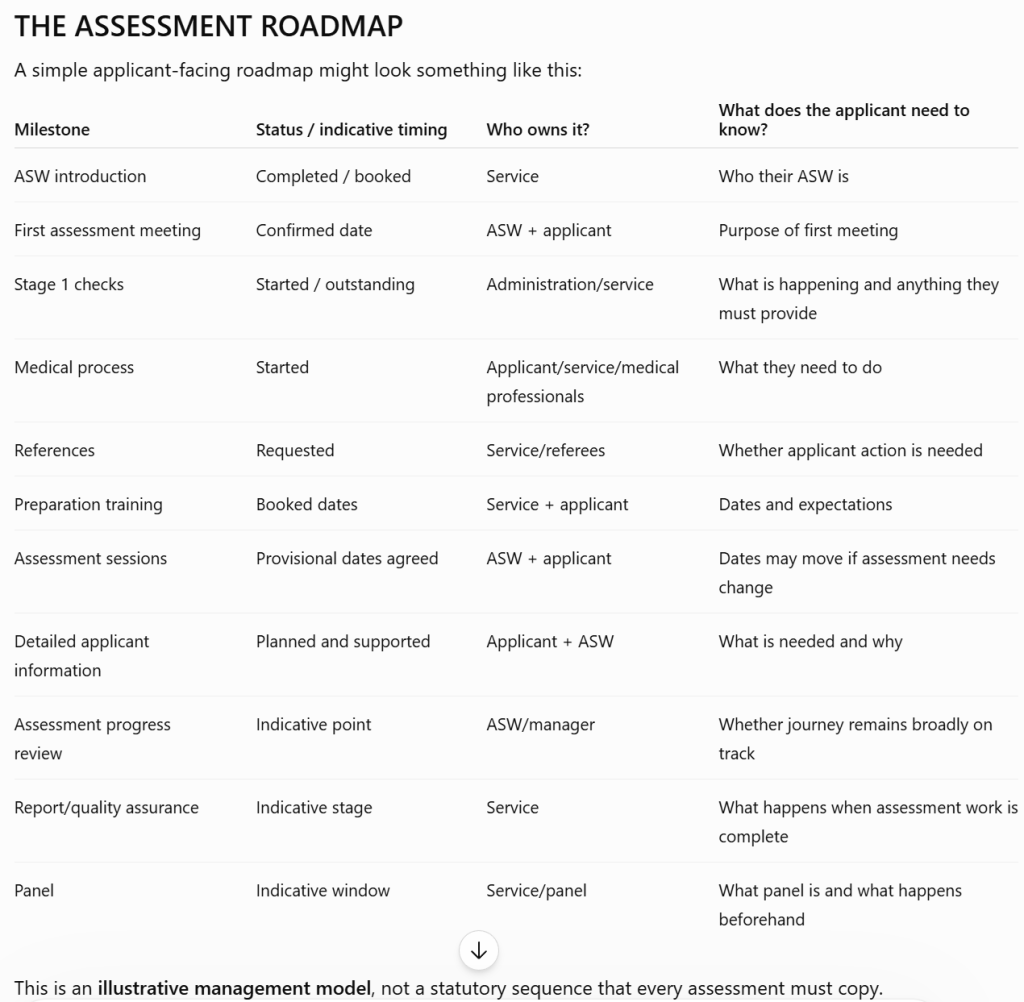
So the applicant should know:
DBS requested — date.
Medical information — action required.
References requested — date.
Local authority checks — underway.
Outstanding item — waiting for X.
The applicant does not need every internal administrative detail.
They do need enough information to understand progress.
Otherwise:
“We're waiting for checks.”
can describe one week or six weeks with almost no difference in language.
WHAT CAN CONTINUE WHILE SOMETHING ELSE IS OUTSTANDING?
This is one of the reasons a roadmap is valuable.
When activity is viewed as a series of individual steps, there is a temptation to complete one before thinking about the next.
But the regulatory structure expressly allows Stage 1 and Stage 2 to run concurrently. Whether that is appropriate in a particular case remains a professional and organisational decision.
The DfE research found the participating services generally reported using concurrency to make the process quicker and more efficient, while recognising that sequential work could be appropriate where a material concern required investigation first.
That gives us another principle:
CONCURRENCY WHERE APPROPRIATE.
SEQUENCING WHERE NECESSARY.
The roadmap makes the distinction visible.
One delayed external check does not automatically have to mean:
everything stops.
But equally, if an important issue genuinely needs resolution before further assessment activity is sensible, the roadmap can show that too.
SOME OF THE WORK IS DIFFICULT FOR APPLICANTS
There is another aspect of planning that is easy to miss.
Foster Carer assessment asks people to organise and reflect upon a substantial amount of their lives.
Some services may ask applicants to develop a chronology or provide detailed information about previous addresses, employment, relationships, family history or other significant events.
This Review is not prescribing how an ASW should conduct that professional work.
But it can ask a recruitment question:
ARE WE SUPPORTING PEOPLE THROUGH THE DEMANDING PARTS OF THE JOURNEY — OR JUST GIVING THEM HOMEWORK?
If detailed historical information is required, the applicant roadmap should show:
what is needed;
why it is needed;
when it needs to be available;
and where the applicant can obtain help if they struggle.
Where the service chooses to develop a chronology early, there is value in considering whether significant elements can be supported through conversation rather than simply handing over a blank document and asking the applicant to reconstruct their life alone.
The principle isn't:
make the work easier by reducing what needs to be explored.
It is:
MAKE THE PROCESS EASIER TO NAVIGATE.
THE ROADMAP SHOULD ALSO SHOW WHAT THE ORGANISATION HAS TO DO
There is a danger that assessment plans become lists of tasks for the applicant.
Complete this.
Send that.
Attend training.
Arrange your medical.
Provide references.
Prepare this information.
But the organisation has actions too.
The ASW needs to contact them.
Administration needs to initiate checks.
References need requesting.
Training needs booking.
Management needs to quality-assure work.
Panel administration needs managing.
The roadmap should therefore answer:
WHO OWNS THE NEXT ACTION?
That is important because an applicant cannot chase something they do not know exists.
DON'T MAKE THE APPLICANT PROJECT-MANAGE THEIR OWN ASSESSMENT
This connects directly with the earlier Stage Seven principles.
The applicant should not have to think:
Nobody has contacted me for two weeks. Should I chase them?
Has my reference arrived?
Am I supposed to book the training?
Has my medical been received?
When will I see my ASW again?
When is panel?
They are the prospective Foster Carer.
They should not become the project manager holding the organisation together.
DON'T MAKE THEM CHASE YOUR PROCESS.
MANAGE THE JOURNEY.
ASSESSING SOCIAL WORKERS NEED THE CONDITIONS TO MAKE THIS POSSIBLE
This is also where the management issue we have been discussing becomes important.
It would be unfair to say:
“ASWs should simply organise themselves better.”
An Assessing Social Worker may have competing responsibilities, caseload pressures, leave, training, supervision and unexpected professional demands.
The 2023 DfE study specifically reported that assessments could be delayed where staff completing them also had responsibilities for existing Foster Carers and urgent placement matters understandably took priority. Dedicated assessment resources were described by participants as helping assessments progress more quickly.
So if senior management wants early diary planning, management must create the conditions that allow it.
That means asking:
Does the ASW actually have visible capacity for the assessment?
Are they allocated too many households simultaneously?
Can future appointments realistically be protected?
What administrative tasks can someone else manage?
Who monitors cancelled or repeatedly moved sessions?
What happens when an ASW is absent?
A roadmap is useless if the organisation continually wipes it clean.
THE APPLICANT JOURNEY SHOULD BE PART OF ASW INDUCTION
This also connects with the additional Stage Seven issue we identified earlier.
An Assessing Social Worker may enter fostering with extensive Social Work assessment experience but comparatively little experience of Foster Carer assessment.
Others may be much earlier in their professional careers.
That should never be presented as a criticism.
The management issue is:
WHAT DOES THE ORGANISATION INVEST IN?
Alongside fostering-specific assessment training, supervision and professional guidance, does the ASW understand:
the recruitment journey before assessment;
the applicant's expectations;
how much contact has already taken place;
the organisation's withdrawal rates;
where delays commonly occur;
and why continuity and momentum matter?
This is:
RECRUITMENT AWARENESS WITHOUT RECRUITMENT PRESSURE.
The ASW is not being asked to sell fostering.
They are being given the organisational context surrounding their professional assessment.
THE ATTRITION FIGURES MAKE UNCERTAINTY A MANAGEMENT ISSUE
The scale of application withdrawal remains difficult to ignore.
Of the 5,370 fostering applications recorded by Ofsted as completed during 2024–25:
2,050 — 38% — were approved.
3,290 — 61% — were withdrawn.
30 — 1% — were rejected.
Of those withdrawn applications, 2,175 were recorded as withdrawn by applicants and 1,115 by services.
As throughout Stage Seven, these figures are reporting-year flows, not a single cohort followed from application to outcome.
Many withdrawals will also be entirely appropriate.
But Ofsted separately reports that among applications started in-year and withdrawn by applicants by year-end, 20% recorded the fostering process not being what the applicant expected.
A roadmap cannot guarantee that applicants will remain.
Nor is there national evidence demonstrating that putting assessment dates in diaries will produce a particular percentage improvement in conversion.
We should not make that claim.
But where applicants are telling the sector that the process itself sometimes differs from expectations, clarity about that process is an entirely reasonable management response.
THE 2026 GOVERNMENT DIRECTION MAKES THIS PARTICULARLY TIMELY
The Government's Renewing Fostering plan proposes an end-to-end regional model in which prospective Foster Carers are supported from enquiry through assessment and approval.
One of its seven principles is specifically a:
“journey guide” from enquiry to approval
providing responsive, dedicated support from first enquiry to decision.
It also says many existing hubs already hold regular pipeline meetings to track progression and identify delays, and the expanded model is intended to maintain full oversight of applications from enquiry through approval.
That reinforces something important.
A roadmap shouldn't only exist for the applicant.
Management should be able to see it too.
HERE IS THE TEST…
Take ten applicants currently in assessment.
For each one, ask:
1. CAN THEY TELL YOU WHAT HAPPENS NEXT?
Not what happened last.
What happens next?
2. IS THERE A DATE IN THE DIARY?
If there isn't, why not?
3. HOW MANY ANTICIPATED ASSESSMENT SESSIONS HAVE BEEN FORWARD-PLANNED?
Is the service booking the journey or scheduling one meeting at a time?
4. IS PREPARATION TRAINING ALREADY BOOKED?
If not, could it become a future bottleneck?
5. HAVE THE REQUIRED CHECKS BEEN STARTED AS EARLY AS APPROPRIATE?
What is still outstanding?
6. DOES EVERY OUTSTANDING ITEM HAVE AN OWNER?
“Waiting” is not an owner.
7. IS THE APPLICANT WAITING FOR THE ORGANISATION — OR IS THE ORGANISATION WAITING FOR THE APPLICANT?
Do you distinguish between the two?
8. WHEN WAS THE LAST MEANINGFUL CONTACT?
Not an automated email.
Meaningful contact.
9. DOES THE APPLICANT KNOW THE BROAD PANEL WINDOW?
It does not have to be guaranteed.
But do they understand where the journey is heading?
10. IF SOMETHING HAS MOVED, WAS ANOTHER DATE IMMEDIATELY AGREED?
Or has the applicant gone back into an unplanned gap?
11. ARE DIFFICULT APPLICANT TASKS BEING SUPPORTED?
Or have we handed them a complex piece of work and assumed they will manage?
12. CAN SENIOR MANAGEMENT SEE THE SAME ROADMAP?
If not, how will management distinguish:
necessary assessment time
from
organisational drift?
MEASURE THE GAP BETWEEN MEETINGS
There is one particularly useful metric here.
Most fostering services will know roughly how long an assessment takes.
Far fewer may routinely analyse:
THE NUMBER OF DAYS BETWEEN MEANINGFUL ASSESSMENT CONTACTS.
That could reveal something very different.
Two assessments might each take five months.
In one:
the applicant has frequent planned contact and purposeful activity throughout.
In the other:
there are repeated three- or four-week gaps because the next appointment keeps being organised late.
The headline duration is identical.
The applicant experience is not.
So don't only ask:
How long did assessment take?
Ask:
Where was the time spent?
That distinction will become even more important in Points 65 and 66.
MOMENTUM DOES NOT MEAN RUSHING THE PERSON
One final caution.
The purpose of a roadmap is not to create pressure on an applicant to move faster than is appropriate.
A person may need time to think.
A household member may need further discussion.
Something difficult may emerge and require space.
The applicant may appropriately ask to slow down.
That should be respected.
The principle from earlier in this Review still applies:
THE SERVICE SHOULD BE FAST.
THE PERSON SHOULD NOT FEEL RUSHED.
Planning gives people certainty.
It should not remove their agency.
A PLANNED JOURNEY IS EASIER TO COMPLETE
The strongest applicant journey may therefore start assessment with a conversation something like:
Here is the broad assessment process.
Here is what we have already completed.
Here are the checks underway.
Here are your training dates.
Here are the assessment sessions we can provisionally put in the diary now.
Here is what we need from you.
Here is what we will do.
Here is the broad panel window we're working towards.
Things may change as the assessment develops. If they do, we'll explain why and re-plan with you.
That is not selling fostering.
It is not reducing assessment rigour.
It is good organisational management.
And its principle is straightforward:
A PLANNED JOURNEY IS EASIER TO COMPLETE THAN A SERIES OF UNKNOWN NEXT STEPS.
And perhaps the most important sentence of all:
ASSESSMENT MAY TAKE TIME. SILENCE SHOULD NOT.
Point 65 asks what happens when one of the biggest potential sources of delay enters that roadmap: