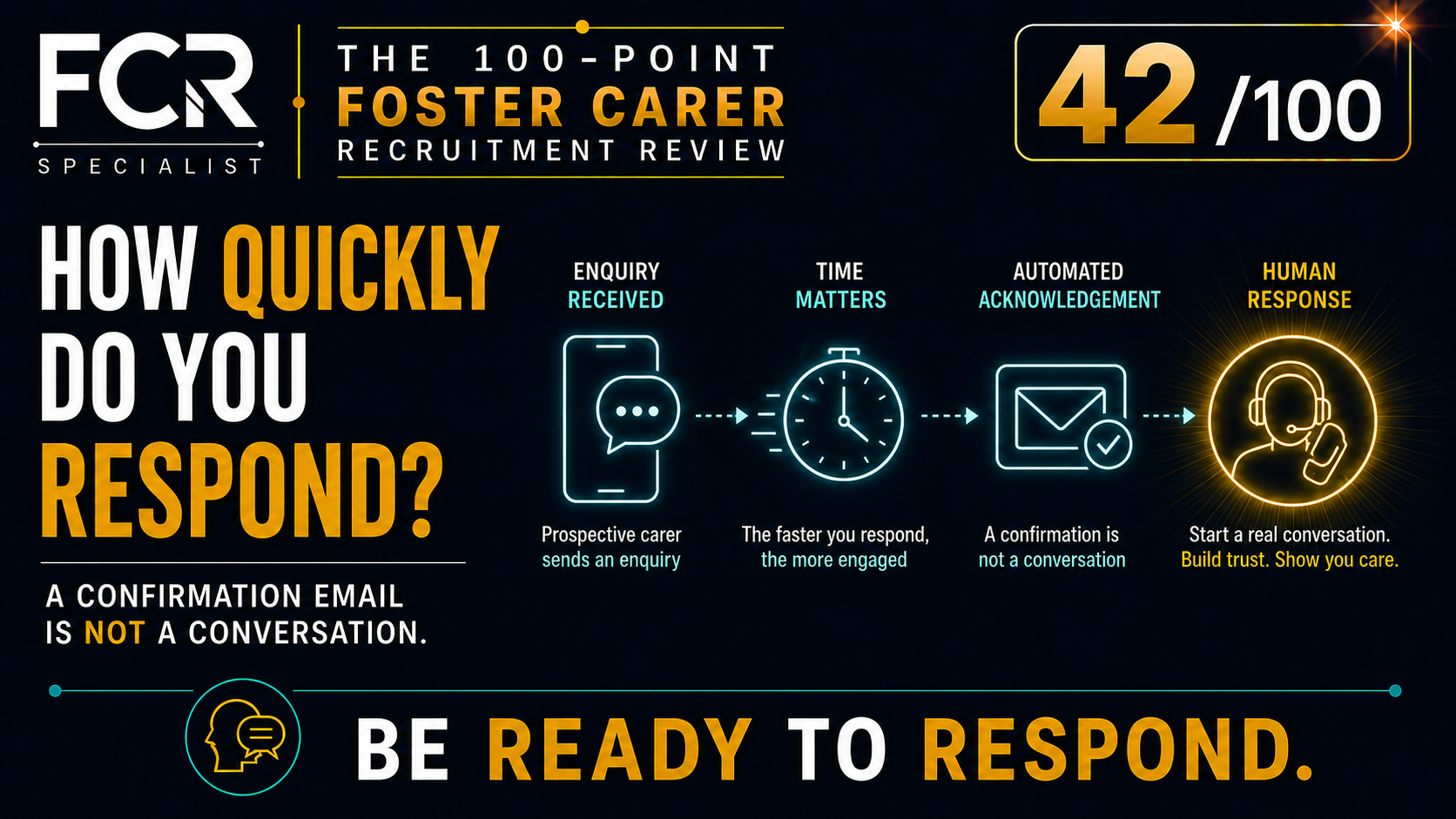
Point 42/100 — How Quickly Do You Respond When Someone Raises Their Hand?
Point 42/100 — How Quickly Do You Respond When Someone Raises Their Hand?
Someone has just done exactly what your Foster Carer Recruitment strategy wanted them to do.
They have responded.
Perhaps Meta introduced them to fostering.
Google captured their search.
A Foster Carer referred them.
A community event created the conversation.
Your website made it easy to enquire.
They have now given you their details and effectively said:
“I'm interested. Talk to me.”
What happens next?
Because generating the enquiry is only half the job.
HOW QUICKLY DO YOU RESPOND WHEN SOMEONE RAISES THEIR HAND?
The advertising may be working while your office is closed
Imagine an enquiry arrives at:
7.45pm on Friday.
What does the prospective Foster Carer experience?
Perhaps an immediate acknowledgement:
Thanks for getting in touch. We've received your enquiry and a member of our fostering team will contact you.
Good.
That provides reassurance.
But what happens after that?
Saturday?
Monday morning?
Monday afternoon?
Tuesday?
And, more importantly:
Does anyone in the organisation know what should happen?
This is where response time stops being a matter of individual recruiter enthusiasm and becomes a recruitment-system question.
What does the evidence actually say?
The Department for Education's 2023 qualitative research into Foster Carer Recruitment found that participating services generally reported responding to enquiries quickly, commonly within one to two working days.
Some also said they deliberately contacted prospective carers during evenings or weekends because those times could make prospective Foster Carers easier to reach.
Responsibility varied. Initial responses could sit with recruitment teams, marketing teams, Social Workers or designated staff.
That is useful evidence.
But it is important not to turn it into something it isn't.
ONE TO TWO WORKING DAYS IS NOT A NATIONAL FOSTER CARER RECRUITMENT STANDARD.
This was a small-scale qualitative study describing participating services' practice.
I would therefore not announce:
“Every fostering provider must respond within X hours.”
The sector does not need another invented benchmark.
Instead, every organisation should establish its own clear, deliberate and measurable response expectation.
The current published National Minimum Standards provide the broader principle. They state that people interested in fostering should be dealt with openly and respectfully, that enquiries should be handled courteously and efficiently by staff with appropriate knowledge and skills, and that prospective Foster Carers should receive timely and relevant information following their enquiry.
That is the standard of thinking I would apply.
Acknowledgement is not response
Modern systems make it very easy to send an automatic email.
That is useful.
It reassures somebody that:
- the form worked
- their details have arrived
- the organisation exists
- something should happen next
But there is a distinction.
AUTOMATED ACKNOWLEDGEMENT
is not the same as:
MEANINGFUL HUMAN RESPONSE.
If someone enquires at 8pm, an automated acknowledgement may be exactly right.
But if the only thing they receive over the next few days is:
“Thank you for your interest in fostering”
we should not tell ourselves that the enquiry has been dealt with.
It hasn't.
The organisation has merely confirmed receipt.
For management purposes, I would distinguish:
Time to acknowledgement
from
Time to first genuine human contact attempt
and eventually:
Time to meaningful contact.
Point 43 will examine exactly where that information should be captured and tracked.
For Point 42, the important issue is that the organisation agrees what good response actually means.
Don't advertise 24/7 and think only 9–5
Digital advertising doesn't stop because the recruitment office closes.
A prospective Foster Carer may research fostering:
- after putting children to bed
- after finishing work
- on a Sunday afternoon
- during their lunch break
- while commuting
- on a bank holiday
- late at night
That doesn't mean every fostering provider needs a fully staffed 24-hour recruitment operation.
That would be unrealistic for many organisations and completely disproportionate for smaller providers.
But it does mean the response system should have been designed around how enquiries actually arrive, rather than simply around traditional office hours.
Ask:
When do our enquiries arrive?
When are prospective Foster Carers easiest to reach?
What proportion arrive outside normal working hours?
What happens to Friday-evening enquiries?
What happens to weekend enquiries?
What happens during Christmas or bank-holiday periods?
Do we need occasional evening contact?
Could recruiters work some flexible hours?
Could an agreed rota help?
Should someone be available for limited weekend callbacks during major campaigns?
The answer will differ by provider.
But the question should be asked deliberately.
Response speed is partly about capacity planning
This connects directly back to Stage Four.
Suppose your organisation normally receives:
10 enquiries a week.
Then you launch a major recruitment campaign.
Suddenly:
60 arrive.
Marketing celebrates.
Recruitment is overwhelmed.
Calls are delayed.
Voicemails build up.
People receive generic emails.
Recruiters spend days trying to catch up.
Then somebody says:
“The leads weren't very good.”
Maybe.
But before making that judgement, ask:
DID WE HAVE THE OPERATIONAL CAPACITY TO HANDLE THE CAMPAIGN WE CREATED?
Point 39 told us to test campaigns properly.
Point 40 told us every activity needs an owner, a budget and an operating plan.
That planning has to include what happens if the campaign succeeds.
Before increasing advertising intensity, ask:
- How many additional enquiries might this create?
- Who will respond?
- What else are they already doing?
- Is cover available?
- What happens if volume exceeds expectations?
- Can other trained staff assist temporarily?
- Should campaign spend be reduced if the team cannot responsibly process more response?
Because:
THERE IS LITTLE VALUE IN BUYING MORE ENQUIRIES THAN YOU CAN PROPERLY HANDLE.
That is not a marketing problem.
It is an operational recruitment problem.
The missed-call test
Telephone enquiries need particular attention.
Someone finally builds up the confidence to telephone.
Nobody answers.
What happens?
Can they:
- leave a voicemail?
- request a callback?
- send a text?
- use another enquiry route?
- clearly understand when somebody will return their call?
And then:
Does somebody actually return it?
A missed telephone call is not automatically a lost enquiry.
But it can become one if there is no deliberate callback system.
Similarly, if a recruiter rings a prospective carer and they don't answer, what happens?
Do they receive a useful voicemail?
Something like:
Hello, it's Sarah from the fostering team. I'm calling because you contacted us about fostering. There's nothing urgent — I just wanted to introduce myself and answer any questions. I'll try again tomorrow, or you're welcome to call me back.
The exact wording will vary.
The principle is reassurance.
Point 44 will examine the quality and tone of those conversations properly.
Here, the issue is simply ensuring contact is attempted intelligently and promptly.
What happens when the recruiter isn't there?
This is where systems often reveal that the process depends too heavily on one person.
What happens when the designated recruiter is:
- on annual leave?
- sick?
- at an event?
- in training?
- already on another call?
- visiting another office?
- working part-time?
Does the enquiry wait?
Does somebody else see it?
Can another suitably trained person make the first response?
Or does the entire Foster Carer Recruitment system effectively close because:
“Jane deals with the enquiries and Jane isn't in today.”
For a small provider, it may genuinely be one person's job.
That is not necessarily a problem.
But there still needs to be a contingency.
For example:
Primary responder → backup responder → agreed callback expectation.
Simple is fine.
Unplanned is not.
Regional and centralised systems need the same discipline
The issue becomes particularly relevant when enquiries pass through larger arrangements.
A prospective Foster Carer might contact:
regional hub
↓
central recruitment team
↓
Local Authority / regional team
↓
named recruiter
Every handoff has potential advantages.
It can create specialist expertise and consistent initial handling.
But every additional handoff also creates another opportunity for delay.
So where recruitment is centralised or regionalised, the question isn't simply:
“How quickly did the hub respond?”
It is:
HOW QUICKLY DID THE PROSPECTIVE FOSTER CARER GET TO THE PERSON WHO COULD ACTUALLY MOVE THEIR ENQUIRY FORWARD?
Point 43 will explore that journey much more deeply when we ask where enquiries arrive, where they are recorded and who owns them.
Here, the management principle is straightforward:
handoffs need response expectations too.
Marketing response and recruitment response are not necessarily the same
A Meta lead form might instantly deliver data.
A chatbot may immediately answer a basic question.
A website may generate an automatic email.
A call centre may answer within seconds.
But none necessarily means the prospective carer has yet spoken to somebody capable of having a meaningful Foster Carer Recruitment conversation.
This matters when reporting performance.
Imagine the dashboard says:
Average response time: 43 seconds.
Excellent.
But what happened?
An automated system sent an email.
The first recruiter called three days later.
The 43-second statistic may be technically correct.
It is also potentially meaningless as a measure of the actual recruitment experience.
So define the terms properly.
Don't promise what you cannot deliver
Some fostering websites make very specific promises:
We'll call you within 24 hours.
That can be powerful.
But only make promises the organisation can consistently keep.
If the service says:
“We'll contact you the next working day”
and routinely takes three days, the organisation has created disappointment before the relationship has even started.
A slightly less dramatic but consistently achieved promise may be better.
The internal question is:
WHAT RESPONSE STANDARD CAN WE COMMIT TO — AND DELIVER CONSISTENTLY?
Then test whether it is good enough.
Not against a mythical universal benchmark.
Against:
- candidate experience
- actual enquiry behaviour
- staffing capability
- campaign volumes
- progression data
- comparative performance over time
Speed isn't everything
I want to be careful here.
The fastest response isn't automatically the best response.
A recruiter ringing somebody three minutes after a Meta form arrives and immediately interrogating them about bedrooms, employment and household circumstances could potentially create a worse experience than a thoughtful call later that evening.
That is precisely why Point 44 exists.
Point 42 asks:
Were we available and responsive?
Point 44 will ask:
What did the person experience when we finally spoke?
Both matter.
Speed cannot compensate for poor interpersonal skill.
But excellent interpersonal skill is of little use if the prospective Foster Carer waits so long that the conversation never happens.
Two clocks
I think every fostering provider should therefore understand two simple clocks.
CLOCK ONE — RECEIPT
How quickly does someone know:
“Your enquiry has reached us.”
Technology can often make this immediate.
CLOCK TWO — HUMAN RESPONSE
How quickly does somebody capable of progressing the initial enquiry attempt meaningful contact?
That is the recruitment clock.
Then, in Point 43, we will ask whether the organisation actually records any of this.
HERE IS THE TEST…
Submit a genuine test enquiry to your own Foster Carer Recruitment system.
Do it at:
10am on Tuesday.
Then perhaps another authorised test at:
7pm on Friday.
Record what happens.
Ask:
- Did I immediately know my enquiry had arrived?
- Was I told what would happen next?
- Was I given a realistic response expectation?
- When did the first human contact attempt occur?
- Was it within the organisation's own agreed standard?
- What happened because the enquiry arrived outside normal office hours?
- Could I easily return the call?
- If I missed the call, was a useful message left?
- Was there an alternative way to respond?
- Who covered if the normal recruiter was unavailable?
- Was the enquiry delayed by an internal handoff?
- Would campaign volume change any of these answers?
- Do we have enough capacity if advertising performs exceptionally well?
- Are we measuring acknowledgement time or genuine response time?
- Are we making promises publicly that we can actually deliver?
Then ask the most important question:
ARE WE AS GOOD AT RESPONDING TO INTEREST AS WE ARE AT PAYING TO GENERATE IT?
Because Foster Carer Recruitment does not stop when the lead form is submitted.
That is where the recruitment relationship starts.
A CONFIRMATION EMAIL IS NOT A CONVERSATION.
GENERATING THE ENQUIRY IS ONLY HALF THE JOB.
BE READY TO RESPOND.
And that takes us directly to Point 43.
Because once enquiries start arriving through multiple channels, another management question becomes unavoidable: