Point 73: Does the Form F Contain Any Surprises?
Point 73: Does the Form F Contain Any Surprises?
There is a strange experience towards the end of Foster Carer assessment.
After months of talking about your life, somebody sends you a professional report about it.
And you read it.
For an Assessing Social Worker, the written assessment report is the culmination of months of professional enquiry, evidence gathering, analysis and judgement.
For the prospective Foster Carer, it can feel quite different.
They are reading somebody else's professional interpretation of:
their childhood;
their relationships;
their family;
their experiences;
their strengths;
their vulnerabilities;
their parenting;
their motivation;
and potentially some of the most personal events in their life.
Even a positive report can therefore feel exposing.
But there is one reaction that should make a fostering service particularly curious:
“WHERE ON EARTH DID THAT COME FROM?”
A note about “Form F”
Throughout this Point I use Form F because it remains familiar shorthand across much of the fostering sector.
Technically, the statutory requirement is for a written assessment report. Current statutory guidance says the relevant assessment information must be included in the report to panel, together with recommendations about suitability and terms of approval, but there are no specific statutory requirements about exactly how that information must be collected or presented to panel.
Different services may therefore use different assessment formats.
The principle in this Point applies regardless of the document's name.
THE APPLICANT IS ENTITLED TO SEE THE REPORT
This is not an optional courtesy.
Under the current assessment and approval framework in England, once Stage 2 is completed, the fostering service must prepare a written report including its assessment of the applicant's suitability and proposals concerning any terms of approval.
The applicant must then be:
given a copy;
notified that the case is being referred to fostering panel;
and invited to submit written observations within 10 working days.
The report, the applicant's observations and any other relevant information are then sent to panel.
That 10-working-day period exists for a reason.
The applicant is not merely a passive subject of a document about their life.
They have an opportunity to comment upon it.
But we need to be very clear what that does — and does not — mean.
NO SURPRISES DOES NOT MEAN NO PROFESSIONAL CHALLENGE
An assessment report is not something the applicant and Assessing Social Worker negotiate until everybody agrees.
The ASW has professional responsibilities.
They must make their own assessment.
They may identify concerns.
They may analyse something differently from the applicant.
They may reach a conclusion the applicant dislikes.
They may recommend terms of approval different from those the applicant hoped for.
And, in some circumstances, the professional conclusion may ultimately be that the applicant should not be approved.
None of that is incompatible with a good applicant experience.
The important distinction is between:
disagreement
and:
surprise.
These are not the same thing
Consider two applicants reading a difficult section of their assessment.
Applicant A
“I disagree with that conclusion. But we've discussed this several times and I understand why my Social Worker has reached it.”
Applicant B
“This is apparently a major concern about whether I can Foster. Nobody has ever told me that before.”
Both applicants disagree.
Only one has been surprised.
That distinction matters.
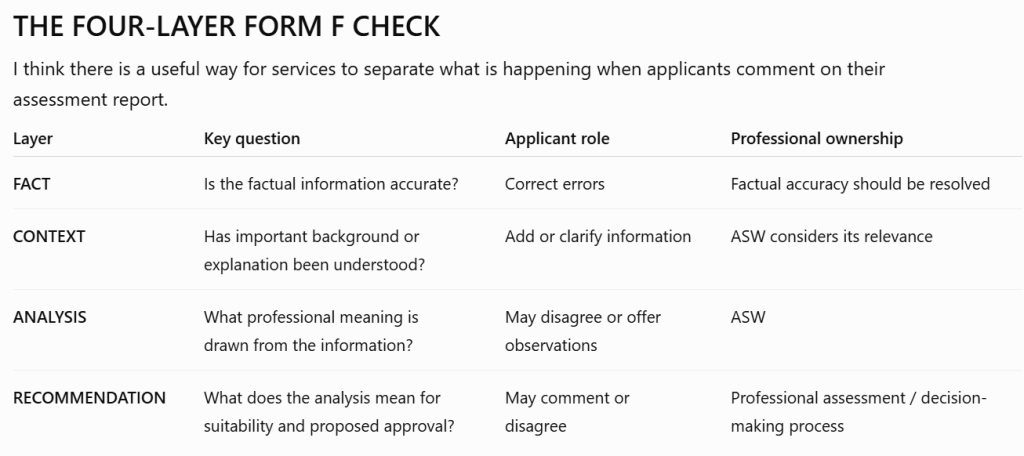
That boundary is extremely important.
An applicant should absolutely be able to say:
“That date is wrong.”
They should be able to say:
“I don't think that paragraph properly reflects what happened.”
They should be able to say:
“I disagree with your interpretation.”
But:
“I disagree”
does not automatically mean:
“Change the assessment.”
FACTUAL CORRECTION IS NOT PROFESSIONAL INTERFERENCE
Some issues should be straightforward.
The report says the applicant worked somewhere until 2015.
It was 2017.
The report describes somebody as their sister.
It is their cousin.
A chronology date is incorrect.
A previous address is wrong.
These are factual matters.
A long and detailed assessment report can contain errors.
The applicant-reading stage provides an important opportunity to identify them before panel.
A service should not turn a straightforward factual correction into a professional dispute.
CONTEXT CAN BE MORE COMPLICATED
Sometimes the applicant may accept the factual statement but believe important context is missing.
For example:
“Yes, I left that job suddenly, but the report doesn't explain that I had just become my mother's full-time carer.”
Or:
“Yes, that relationship broke down badly, but I don't think the report reflects what happened afterwards.”
The applicant's additional information does not automatically invalidate the existing analysis.
But it may be relevant.
The ASW should consider it professionally.
THEN WE REACH ANALYSIS
This is where the boundary becomes particularly important.
The applicant might say:
“You describe me as becoming defensive when challenged. I don't believe I do.”
That is not necessarily a factual correction.
It may be a disagreement with professional analysis.
The applicant is entitled to make that disagreement known.
The ASW is entitled to maintain their professional analysis.
Indeed, the statutory process specifically anticipates that applicants may submit observations on the report for panel to consider alongside it.
Disagreement is therefore not some unexpected failure of assessment.
It can be part of the process.
AND FINALLY, RECOMMENDATION
The report must include recommendations concerning the applicant's suitability to Foster and any proposed terms of approval.
That may create further disagreement.
An applicant may have imagined fostering:
two children;
siblings;
a broad age range;
or particular types of placement.
The assessment may lead to a different recommendation.
Again:
no surprises does not mean the applicant gets the recommendation they want.
But ideally they should understand how the assessment journey reached it.
THE “WHERE DID THAT COME FROM?” TEST
This is where I think fostering services should become curious.
If an applicant encounters a significant concern in the report and says:
“I knew we disagreed about that.”
there may be no problem at all.
But if they say:
“Nobody has ever told me this was considered a significant concern.”
ask another question:
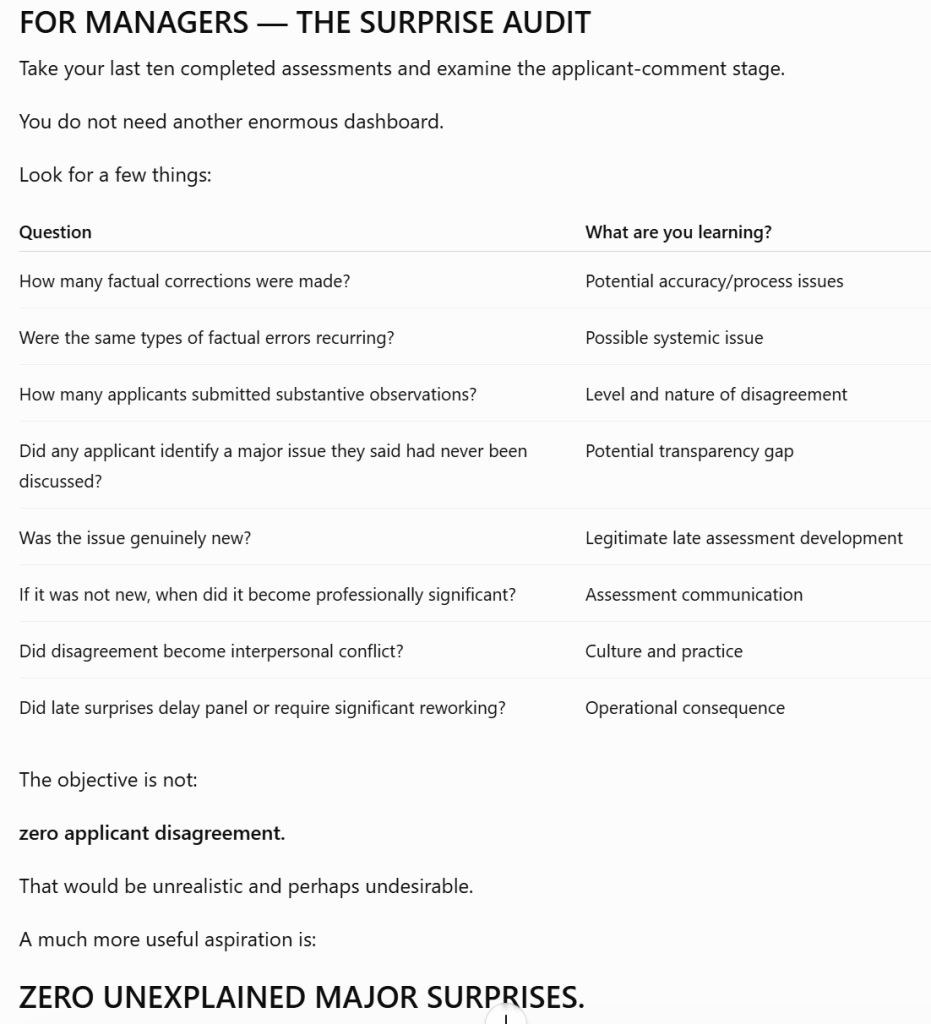
Is this genuinely new information?
Sometimes it will be.
Significant information may emerge late.
A reference may raise something new.
A disclosure may change.
An event may happen during assessment.
Further professional analysis may legitimately alter the position.
In those circumstances, a late change is not evidence of bad practice.
But if the concern is based on information known for several months:
Why is the applicant only now discovering its significance?
That is a legitimate management question.
DIFFICULT ISSUES SHOULD BE DISCUSSED WHEN THEY BECOME SIGNIFICANT
This does not mean an ASW has to announce a professional conclusion before they have reached one.
Assessment is iterative.
Practitioners explore information.
Evidence can accumulate.
Thinking changes.
Supervision and analysis matter.
Sometimes something only becomes significant when several pieces are brought together.
But once an issue becomes an important element of the assessment, the applicant should ordinarily understand that it is being explored and why.
A useful distinction is:
PROFESSIONAL THINKING CAN DEVELOP. PROFESSIONAL CONCERN SHOULD NOT BE DELIBERATELY STORED UP AS A FINAL REVEAL.
The Form F should not operate like the final episode of a television drama.
READING YOUR OWN LIFE IN A PROFESSIONAL REPORT
There is also a human aspect to this Point that shouldn't be lost.
Imagine reading thirty or forty pages describing you and your family.
The language may be professional.
It may be analytical.
It may discuss incidents you remember emotionally.
It may refer to relationships differently from how you would describe them.
It may identify strengths you rarely acknowledge.
It may also describe vulnerabilities you would prefer not to see written down.
The applicant may therefore react emotionally even where the report is completely fair.
That should not automatically be interpreted as:
resistance;
lack of insight;
or:
inability to accept challenge.
The nature, content and behaviour surrounding the response may legitimately matter professionally.
But the simple fact that somebody finds reading a professional analysis of their life uncomfortable is hardly surprising.
DISAGREEMENT SHOULD NOT AUTOMATICALLY BECOME CONFLICT
The current process explicitly gives applicants the opportunity to submit observations before panel.
Services therefore need a culture capable of accommodating respectful disagreement.
The applicant might say:
“I understand why you've written that. I still don't agree with it and I'd like my view included.”
That is not necessarily a failed assessment relationship.
It may actually demonstrate a transparent one.
The professional view remains visible.
The applicant's view remains visible.
Panel receives both.
WATCH OUT: THE APPLICANT'S OBSERVATIONS ARE NOT AN EDITING SERVICE
There is an opposite risk.
The applicant-review period should not turn into:
“Tell us which paragraphs you would like removed.”
The purpose is not to produce a jointly agreed marketing document.
The report exists to support an objective professional approval decision.
Current National Minimum Standards require the report to provide the information panel and the decision-maker need in order to make an objective decision.
Professional analysis should therefore not be watered down because it is uncomfortable.
ASK YOUR TEAM — WHAT HAPPENS WHEN THE APPLICANT DISAGREES?
Services should think carefully about their response.
Is disagreement:
welcomed as legitimate feedback?
heard calmly?
distinguished between fact, context and analysis?
considered professionally?
recorded appropriately?
Or does the atmosphere immediately become:
“They're challenging the Social Worker”?
That cultural distinction matters.
RECRUITMENT MUST NOT INTERFERE WITH THIS STAGE
There is an especially important boundary here.
Suppose recruitment staff have built an excellent relationship with the applicant.
The applicant receives the Form F and phones their recruitment contact saying:
“I can't believe they've written this about me.”
Recruitment can:
listen;
help the applicant understand the process;
remind them that they have an opportunity to submit observations;
encourage appropriate communication with the assessing team.
Recruitment should not:
tell the ASW to change their report;
argue for a more favourable recommendation;
coach the applicant's response;
minimise professional concerns;
or intervene because they want to protect recruitment conversion.
The Stage Seven principle applies perfectly:
THE ASW ASSESSES. THE ORGANISATION STILL RECRUITS.
And:
RECRUITMENT AWARENESS WITHOUT RECRUITMENT PRESSURE.
THERE SHOULD BE NO SURPRISE ABOUT THE PROCESS EITHER
Point 73 is principally about the content of the assessment.
But one other issue matters.
The applicant should already know:
that they will see the report;
that they can comment;
that their observations can accompany it;
that disagreement does not automatically require the ASW to alter their professional view;
and what happens next.
Under the current framework, they have 10 working days from notification to submit written observations.
Do not introduce that process for the first time when you email the document.
POINT 73 TEST
When the applicant reads their report, could they reasonably say:
FACT
“This is factually accurate.”
CONTEXT
“My story has been heard, even if the Social Worker interprets parts of it differently.”
ANALYSIS
“I understand the professional concerns being expressed, even where I disagree.”
RECOMMENDATION
“I understand how the recommendation has been reached.”
If the answer is yes, the assessment can still be rigorous, challenging and uncomfortable.
But it has also been transparent.
NO SURPRISES IS NOT THE SAME AS NO DISAGREEMENT
That is the distinction I would want every service to remember.
A good assessment does not necessarily finish with the applicant saying:
“I agree with every word.”
It may finish with:
“I don't agree with everything, but I understand why it's there, I've had the opportunity to give my view and panel will see it.”
That is very different.
The assessment belongs professionally to the ASW.
The applicant's life still belongs to the applicant.
Both voices can exist in the process.
So before another Form F reaches panel, ask:
DOES THIS REPORT CONTAIN A PROFESSIONAL CHALLENGE — OR AN UNEXPLAINED SURPRISE?
The first may be entirely necessary.
The second deserves investigation.
NO SURPRISES DOES NOT MEAN NO PROFESSIONAL CHALLENGE.
And: